Розроблення моделі розвитку соціального підприємництва на основі інновацій та трансферу технологій
DOI:
https://doi.org/10.15587/1729-4061.2025.344260Ключові слова:
social entrepreneurship, innovation, technology transfer model, institutional support, social impactАнотація
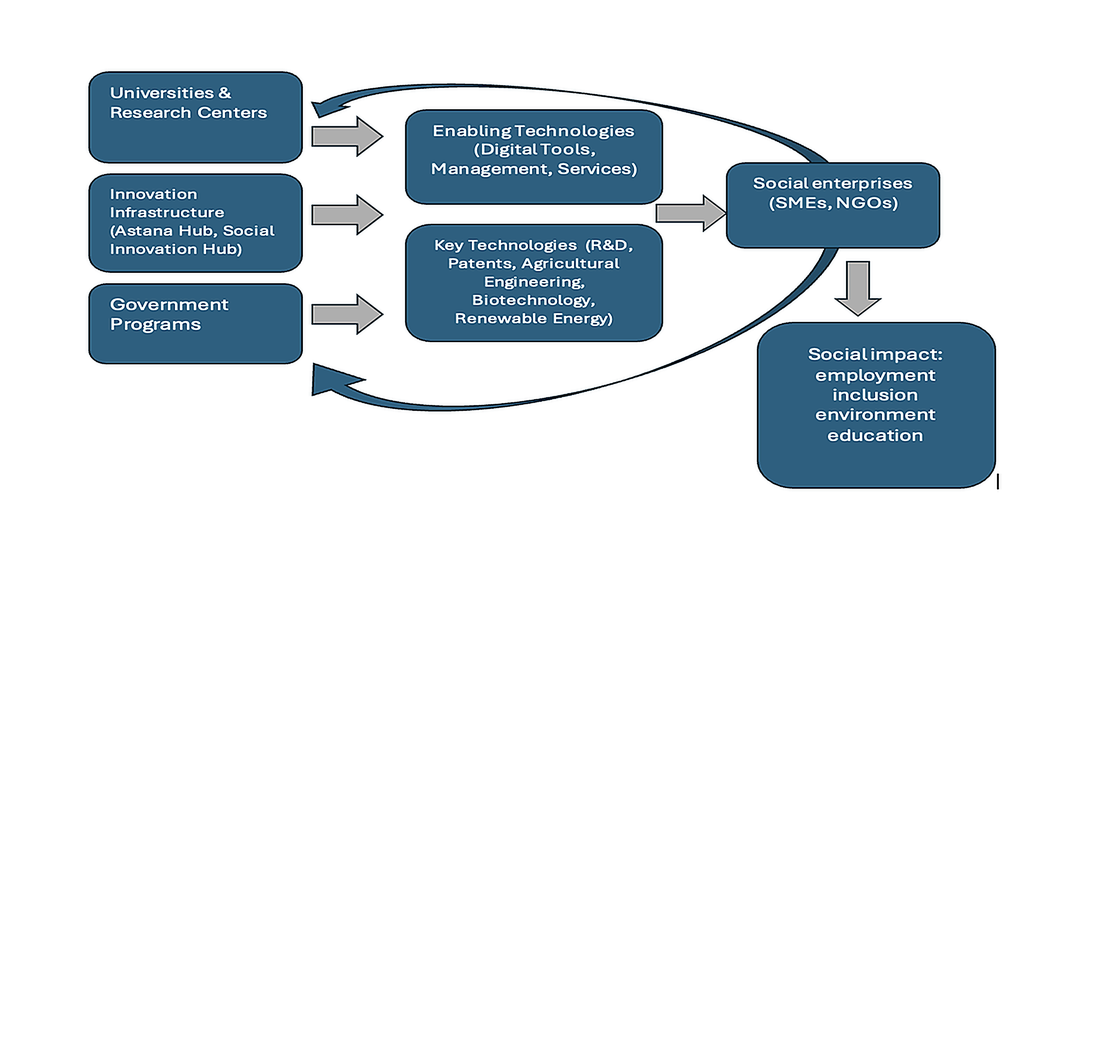
Об’єктом дослідження є соціальне підприємництво в Республіці Казахстан у контексті національної інноваційної екосистеми. Соціальне підприємництво розглядається як інструмент розв’язання соціально-економічних завдань. У даному дослідженні вирішено проблему вдосконалення шляхів підвищення стійкості соціального підприємництва через ефективне використання його інституційного та технологічного потенціалу, а також упровадження механізмів трансферу технологій.
Результати дослідження показали, що соціальне підприємництво характеризується регіональною та галузевою нерівномірністю, однак динаміка його загального розвитку має стійку тенденцію до зростання. Кореляційно-регресійний аналіз засвідчив слабку залежність між розвитком соціального підприємництва та інноваційними й інституційними чинниками, що підтверджує складність і неоднорідність факторів впливу на соціальний бізнес. Крім того, дворівнева модель запропонувала механізми інтеграції соціального підприємництва в національну інноваційну екосистему та охарактеризувала можливі напрями підвищення ефективності й економічної результативності соціальних проєктів.
Практична значущість результатів дослідження полягає в запропонуванні адаптивних механізмів інтеграції соціального підприємництва з системами технологічної та інституційної підтримки. Це, своєю чергою, сприяє формуванню технологічних інновацій, розвитку соціального підприємництва, створенню інноваційних рішень соціальних проблем, підвищенню ефективності, масштабованості та фінансової стійкості соціальних проєктів. Отримані результати свідчать, що впровадження моделі трансферу технологій у розвиток соціального підприємництва може сприяти створенню інноваційних платформ, які одночасно генерують економічну та соціальну цінність.
Посилання
- Global Innovation Index 2024. WIPO. Available at: https://www.wipo.int/en/web/global-innovation-index/2024/index
- Parmanova, R., Baimoldayeva, M., Azretbergenova, G., Beisekova, P. (2025). Relationship between Energy Consumption, Economic Growth and Population in Kazakhstan. International Journal of Energy Economics and Policy, 15 (3), 608–613. https://doi.org/10.32479/ijeep.19104
- Stephan, U., Uhlaner, L. M., Stride, C. (2014). Institutions and social entrepreneurship: The role of institutional voids, institutional support, and institutional configurations. Journal of International Business Studies, 46 (3), 308–331. https://doi.org/10.1057/jibs.2014.38
- Zahra, S. A., Wright, M. (2015). Understanding the Social Role of Entrepreneurship. Journal of Management Studies, 53 (4), 610–629. https://doi.org/10.1111/joms.12149
- Savaget, P., Ozcan, P., Pitsis, T. (2024). Social Entrepreneurs as Ecosystem Catalysts: The Dynamics of Forming and Withdrawing from a Self‐Sustaining Ecosystem. Journal of Management Studies, 62 (1), 246–278. https://doi.org/10.1111/joms.13055
- Battilana, J., Sengul, M., Pache, A.-C., Model, J. (2015). Harnessing Productive Tensions in Hybrid Organizations: The Case of Work Integration Social Enterprises. Academy of Management Journal, 58 (6), 1658–1685. https://doi.org/10.5465/amj.2013.0903
- Pache, A.-C., Battilana, J., Spencer, C. (2024). An Integrative Model of Hybrid Governance: The Role of Boards in Helping Sustain Organizational Hybridity. Academy of Management Journal, 67 (2), 437–467. https://doi.org/10.5465/amj.2021.0966
- Smith, W. K., Besharov, M. L. (2017). Bowing before Dual Gods: How Structured Flexibility Sustains Organizational Hybridity. Administrative Science Quarterly, 64 (1), 1–44. https://doi.org/10.1177/0001839217750826
- Gerli, F., Chiodo, V., Bengo, I. (2020). Technology Transfer for Social Entrepreneurship: Designing Problem-Oriented Innovation Ecosystems. Sustainability, 13 (1), 20. https://doi.org/10.3390/su13010020
- Oelberger, C. R., Shachter, S. Y. (2021). National Sovereignty and Transnational Philanthropy: The Impact of Countries’ Foreign Aid Restrictions on US Foundation Funding. VOLUNTAS: International Journal of Voluntary and Nonprofit Organizations, 32 (2), 204–219. https://doi.org/10.1007/s11266-020-00265-y
- Battilana, J., Dorado, S. (2010). Building Sustainable Hybrid Organizations: The Case of Commercial Microfinance Organizations. Academy of Management Journal, 53 (6), 1419–1440. https://doi.org/10.5465/amj.2010.57318391
- Girum, T., Wattanakomol, S., Silpcharu, T. (2022). Guidelines to Drive Social Enterprises to Grow Sustainability in the Digital Economy Era. Humanities and Social Sciences Letters, 10 (3), 356–368. https://doi.org/10.18488/73.v10i3.3075
- Nyussupova, G. N., Aidarkhanova, G. B., Tokbergenova, A. A. (2022). Geography of Human Capital in Republic of Kazakhstan: a Comparison Between Regions. Economics: The Strategy and Practice, 16 (4), 160–173. https://doi.org/10.51176/1997-9967-2021-4-160-173
- Kraemer-Mbula, E. (2024). Harnessing innovation: The transformative potential of social enterprises in Africa. Global Innovation Index 2024. Available at: https://www.wipo.int/documents/d/global-innovation-index/docs-en-2024-gii-2024-contributors-erika-kraemer.pdf
- Kraemer-Mbula, E., Wunsch-Vincent, S. (Eds.) (2016). The Informal Economy in Developing Nations: Hidden Engine of Innovation? Cambridge University Press. https://doi.org/10.1017/CBO9781316662076
- Audretsch, D. B., Belitski, M., Eichler, G. M., Schwarz, E. (2023). Entrepreneurial ecosystems, institutional quality, and the unexpected role of the sustainability orientation of entrepreneurs. Small Business Economics, 62 (2), 503–522. https://doi.org/10.1007/s11187-023-00763-5
- Polishchuk, Y., Kornyliuk, A., Lavreniuk, V., Horbov, V., Ivashchenko, A., Tepliuk, M. (2024). Running a business during wartime: Voice of Ukrainian displaced business. Problems and Perspectives in Management, 22 (3), 287–302. https://doi.org/10.21511/ppm.22(3).2024.23
- Del Giudice, M., Khan, Z., De Silva, M., Scuotto, V., Caputo, F., Carayannis, E. (2017). The microlevel actions undertaken by owner‐managers in improving the sustainability practices of cultural and creative small and medium enterprises: A United Kingdom–Italy comparison. Journal of Organizational Behavior, 38 (9), 1396–1414. https://doi.org/10.1002/job.2237
- Reestr subektov socialnogo predprinimatelstva. Ministerstvo nacionalnoy ekonomiki Respubliki Kazahstan. Available at: https://rsp.gov.kz/ru/rssp
- Structural statistics. Bureau of National statistics of Agency for Strategic planning and reforms of the Republic of Kazakhstan. Available at: https://stat.gov.kz/en/industries/business-statistics/stat-struct/
##submission.downloads##
Опубліковано
Як цитувати
Номер
Розділ
Ліцензія
Авторське право (c) 2025 Madina Mukanova, Aigul Mukhamejanova, Nazym Nurpeisova, Zaure Zambinova, Kuralay Yeltayeva, Daryika Tugolbaeva

Ця робота ліцензується відповідно до Creative Commons Attribution 4.0 International License.
Закріплення та умови передачі авторських прав (ідентифікація авторства) здійснюється у Ліцензійному договорі. Зокрема, автори залишають за собою право на авторство свого рукопису та передають журналу право першої публікації цієї роботи на умовах ліцензії Creative Commons CC BY. При цьому вони мають право укладати самостійно додаткові угоди, що стосуються неексклюзивного поширення роботи у тому вигляді, в якому вона була опублікована цим журналом, але за умови збереження посилання на першу публікацію статті в цьому журналі.
Ліцензійний договір – це документ, в якому автор гарантує, що володіє усіма авторськими правами на твір (рукопис, статтю, тощо).
Автори, підписуючи Ліцензійний договір з ПП «ТЕХНОЛОГІЧНИЙ ЦЕНТР», мають усі права на подальше використання свого твору за умови посилання на наше видання, в якому твір опублікований. Відповідно до умов Ліцензійного договору, Видавець ПП «ТЕХНОЛОГІЧНИЙ ЦЕНТР» не забирає ваші авторські права та отримує від авторів дозвіл на використання та розповсюдження публікації через світові наукові ресурси (власні електронні ресурси, наукометричні бази даних, репозитарії, бібліотеки тощо).
За відсутності підписаного Ліцензійного договору або за відсутністю вказаних в цьому договорі ідентифікаторів, що дають змогу ідентифікувати особу автора, редакція не має права працювати з рукописом.
Важливо пам’ятати, що існує і інший тип угоди між авторами та видавцями – коли авторські права передаються від авторів до видавця. В такому разі автори втрачають права власності на свій твір та не можуть його використовувати в будь-який спосіб.