Experimental study on the fatigue cracking resistance of asphalt concrete pavement reinforced with synthetic meshes
DOI:
https://doi.org/10.15587/1729-4061.2025.344899Keywords:
asphalt concrete, fatigue cracking, Adfors GlasGrid geogrids, highways, cyclic loadsAbstract
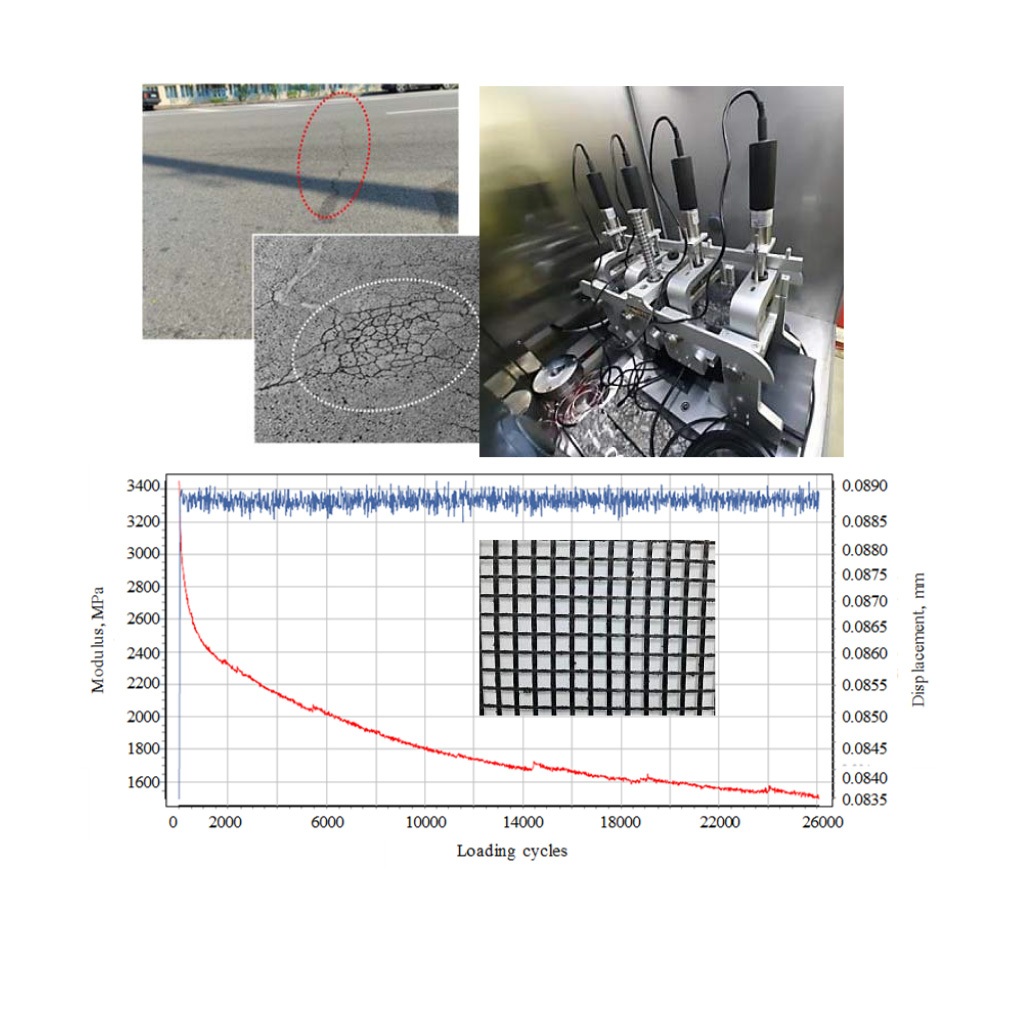
This study investigates fatigue cracking resistance of asphalt concrete pavement beam specimens operating under cyclic loading conditions and undergoing fatigue cracking. The task is to establish the regularities of fatigue cracking resistance of asphalt concrete beam specimens reinforced with Adfors GlasGrid GG50, Adfors GlasGrid GG100, and Adfors GlasGrid CG50L geogrids.
Fatigue cracking resistance of asphalt concrete beam specimens reinforced with Adfors GlasGrid geogrids under the action of sinusoidal loading with a frequency of 10 Hz was examined experimentally.
The four-point bending method was accepted as the criterion for assessing fatigue durability when testing reinforced asphalt concrete beam specimens. Under the action of cyclic loading, the number of load application cycles was adopted, during which the initial complex modulus of rigidity that is observed after the first 100 load cycles would decrease by 50%.
It was found that when reinforcing asphalt concrete beam specimens with Adfors GlasGrid GG50 geogrid, the average number of cycles to lose 50% of the complex modulus of rigidity reached 68,460 load cycles during the application of loads. When reinforcing with Adfors GlasGrid GG100 geogrid, 76,900 load cycles, and when reinforcing asphalt concrete beam specimens with Adfors GlasGrid CG50L geogrid, 153,127 load cycles were applied. In the absence of asphalt concrete reinforcement with geogrids, the average number of load cycles was 25,975 cycles.
When losing 50% of the complex modulus of rigidity, it was found that the increase in the number of cycles in relation to beam specimens without geogrid reinforcement was 2.6 times when reinforcing beam specimens with Adfors GlasGrid GG50 geogrids. When reinforced with Adfors GlasGrid GG100 geogrids, this indicator was 3.0, and when reinforced with Adfors GlasGrid CG50L geogrids, it was 5.9.
References
- Mozghovyi, V. V., Onyshchenko, A. M., Harkusha, M. V., Aksonov, S. Yu. (2012). Suchasni aspekty pidvyshchennia koliestiykosti nezhorstkoho dorozhnoho odiahu. Avtoshliakhovyk Ukrainy, 5, 25–30. Available at: http://nbuv.gov.ua/UJRN/au_2012_5_8
- Gaidaichuk, V., Gustieliev, O., Radkevich, A., Shevchuk, L., Shlyun, N. (2019). Thermal elastic deformation of the layered covering on the concave part of a road. Strength of Materials and Theory of Structures, 102, 180–190. https://doi.org/10.32347/2410-2547.2019.102.180-190
- Vasileva, H., Koshevyi, O., Mishchenko, O., Cherednichenko, P. (2020). Thermoelastic state of multilayered road pavement. Urban Development and Spatial Planning, 73, 29–40. https://doi.org/10.32347/2076-815x.2020.73.29-40
- SOU 45.2-00018112-080:2011. Avtomobilni dorohy. Otsinka ta reiestratsiya stanu dorozhnikh pokryttiv ta tekhnichnykh zasobiv avtomobilnykh dorih avtomatyzovanymy systemamy videodiahnostyky. Available at: https://online.budstandart.com/ua/catalog/doc-page.html?id_doc=27907
- Kovalchuk, V., Sobolevska, Y., Onyshchenko, A., Fedorenko, O., Tokin, O., Pavliv, A. et al. (2021). Procedure for determining the thermoelastic state of a reinforced concrete bridge beam strengthened with methyl methacrylate. Eastern-European Journal of Enterprise Technologies, 4 (7 (112)), 26–33. https://doi.org/10.15587/1729-4061.2021.238440
- Onyshchenko, A., Kovalchuk, V., Zagorodniy, O., Moroz, V. (2023). Determining the residual service life of polymer-modified asphalt concrete pavement on road bridges. Eastern-European Journal of Enterprise Technologies, 3 (1 (123)), 41–51. https://doi.org/10.15587/1729-4061.2023.279006
- Onyshchenko, A., Kovalchuk, V., Husev, D., Anishchenko, D., Tymoshyn, M., Tsekhansky, O. et al. (2025). Determining the effect of reinforcing asphalt-concrete coating with synthetic nets on its performance indicators. Eastern-European Journal of Enterprise Technologies, 1 (1 (133)), 73–81. https://doi.org/10.15587/1729-4061.2025.320426
- Onyshchenko, A. M. (2016). Method of Calculating Strength Grip Coating of Asphalt Roadway Bridge at Shift from Emergency Braking of Vehicle. Visnyk Vinnytskoho politekhnichnoho instytutu, 4, 12–19. Available at: https://ir.lib.vntu.edu.ua/handle/123456789/21577?show=full
- Al-Hadidy, A. I. (2023). Experimental Investigation on Performance of Asphalt Mixtures with Waste Materials. International Journal of Pavement Research and Technology, 17 (4), 1079–1091. https://doi.org/10.1007/s42947-023-00288-w
- Zhou, F., Li, H., Chen, P., Scullion, T. (2014). Report No. FHWA/TX-14/0-6674-1. Laboratory Evaluation of Asphalt Binder Rutting, Fracture, and Adhesion tests. Texas Department of Transportation. Research and Technology Implementation Office. Available at: https://rosap.ntl.bts.gov/view/dot/27289
- Kushnir, O. V., Gamelyak, I. P., Raikovsky, V. F., Klimov, U. M. (2020). Designing of a design of road clothes for transportation of large and especially heavy loads by roads of Ukraine. Science and Education a New Dimension, VIII (30 (2024)), 53–62. https://doi.org/10.31174/send-nt2020-244viii30-13
- Dorozhko, Y., Batrakova, A., Tymoshevskyi, V., Zakharova, E. (2021). Ensuring adhesion between the asphalt-concrete road surface and rigid base at the roadbed design stage. Eastern-European Journal of Enterprise Technologies, 3 (7 (111)), 84–92. https://doi.org/10.15587/1729-4061.2021.235394
- Mozghovyi, V., Kutsman, O., Baran, S., Borovyk, I. (2016). Flexible pavement design with features using reinforced asphalt layers of highways. The National Transport University Bulletin, 1 (34), 294–302. Available at: https://www.researchgate.net/publication/375336166_FLEXIBLE_PAVEMENT_DESIGN_WITH_FEATURES_USING_REINFORCED_ASPHALT_LAYERS_OF_HIGHWAYS
- Shu, L., Ni, F., Du, H., Han, Y. (2023). An Evaluation of Asphalt Mixture Crack Resistance and Identification of Influential Factors. Coatings, 13 (8), 1382. https://doi.org/10.3390/coatings13081382
- Yu, J., Feng, Z., Chen, Y., Yu, H., Korolev, E., Obukhova, S. et al. (2024). Investigation of cracking resistance of cold asphalt mixture designed for ultra-thin asphalt layer. Construction and Building Materials, 414, 134941. https://doi.org/10.1016/j.conbuildmat.2024.134941
- Nguyen, M. L., Chupin, O., Blanc, J., Piau, J.-M., Hornych, P., Lefeuvre, Y. (2019). Investigation of Crack Propagation in Asphalt Pavement Based on APT Result and LEFM Analysis. Journal of Testing and Evaluation, 48 (1), 161–177. https://doi.org/10.1520/jte20180933
- Kou, C., Fan, R., Zhang, M., Zhu, Z., Kang, A., Baaj, H. (2025). Investigation into the crack propagation behaviors of asphalt mixture containing recycled concrete aggregates using digital image correlation. Construction and Building Materials, 470, 140636. https://doi.org/10.1016/j.conbuildmat.2025.140636
- Xu, D., Ni, F., Du, H., Zhao, Z., Wang, J., Chen, S. (2023). Investigation of Factors Affecting the Intermediate-Temperature Cracking Resistance of In-Situ Asphalt Mixtures Based on Semi-Circular Bending Test. Coatings, 13 (2), 384. https://doi.org/10.3390/coatings13020384
- Huang, B., Shu, X., Vukosavljevic, D. (2011). Laboratory Investigation of Cracking Resistance of Hot-Mix Asphalt Field Mixtures Containing Screened Reclaimed Asphalt Pavement. Journal of Materials in Civil Engineering, 23 (11), 1535–1543. https://doi.org/10.1061/(asce)mt.1943-5533.0000223
- Armuiuchi heogratky dlia asfaltobetonu GlasGrid®. Adfors. Available at: https://www.viaduk.net/clients/caponier.nsf/0/2b53f3260fafa98bc22586f8002cd3aa/$FILE/minicatalogue_UKR_2020.10_v6.pdf
- Nguyen, Q. T., Tran, T. C. H. (2021). Experimental Investigation of Fatigue Behavior for Polymer Modified Asphalt and Epoxy Asphalt Mixtures. Proceedings of the 3rd International Conference on Sustainability in Civil Engineering, 161–166. https://doi.org/10.1007/978-981-16-0053-1_20
- Di Benedetto, H., Nguyen, Q. T., Sauzéat, C. (2011). Nonlinearity, Heating, Fatigue and Thixotropy during Cyclic Loading of Asphalt Mixtures. Road Materials and Pavement Design, 12 (1), 129–158. https://doi.org/10.1080/14680629.2011.9690356
- Lundström, R., Isacsson, U. (2004). Linear Viscoelastic and Fatigue Characteristics of Styrene–Butadiene–Styrene Modified Asphalt Mixtures. Journal of Materials in Civil Engineering, 16 (6), 629–638. https://doi.org/10.1061/(asce)0899-1561(2004)16:6(629)
- Wen, H., Kutay, M. E., Shen, S. (2011). Evaluation of the Effects of Asphalt Binder on the Properties of Hot Mix Asphalt at Intermediate Temperatures. Journal of Testing and Evaluation, 39 (3), 321–326. https://doi.org/10.1520/jte102878
- Abojaradeh, M., Jrew, B., Ghragheer, F., Kaloush, K., Abojaradeh, D. (2010). Cracking characteristic of asphalt rubber mixtures. Jordan Journal of Civil Engineering, 4 (3), 205–210. Available at: https://www.researchgate.net/publication/320419437_Cracking_characteristic_of_asphalt_rubber_mixtures
- Orešković, M., Trifunović, S., Mladenović, G., Bohuš, Š. (2019). Fatigue resistance of a grid-reinforced asphalt concrete using four-point bending beam test. Bituminous Mixtures and Pavements VII, 589–594. https://doi.org/10.1201/9781351063265-79
- GLASGRID® GG. Available at: https://asphaltgroup.co.uk/glasgrid-gg
- Asphalt Reinforcement. Available at: https://eu.adfors.com/asphalt-reinforcement
Downloads
Published
How to Cite
Issue
Section
License
Copyright (c) 2025 Artur Onyshchenko, Vitalii Kovalchuk, Oleksii Rykovtsev, Oleg Tsekhansky, Dmytro Husev, Dmitry Anishchenko, Ivan Kravets, Roman Lisnevskyi, Olexiy Zagorodniy

This work is licensed under a Creative Commons Attribution 4.0 International License.
The consolidation and conditions for the transfer of copyright (identification of authorship) is carried out in the License Agreement. In particular, the authors reserve the right to the authorship of their manuscript and transfer the first publication of this work to the journal under the terms of the Creative Commons CC BY license. At the same time, they have the right to conclude on their own additional agreements concerning the non-exclusive distribution of the work in the form in which it was published by this journal, but provided that the link to the first publication of the article in this journal is preserved.
A license agreement is a document in which the author warrants that he/she owns all copyright for the work (manuscript, article, etc.).
The authors, signing the License Agreement with TECHNOLOGY CENTER PC, have all rights to the further use of their work, provided that they link to our edition in which the work was published.
According to the terms of the License Agreement, the Publisher TECHNOLOGY CENTER PC does not take away your copyrights and receives permission from the authors to use and dissemination of the publication through the world's scientific resources (own electronic resources, scientometric databases, repositories, libraries, etc.).
In the absence of a signed License Agreement or in the absence of this agreement of identifiers allowing to identify the identity of the author, the editors have no right to work with the manuscript.
It is important to remember that there is another type of agreement between authors and publishers – when copyright is transferred from the authors to the publisher. In this case, the authors lose ownership of their work and may not use it in any way.








