Development of an integrated model for emission reduction through energy efficiency and renewable energy
DOI:
https://doi.org/10.15587/1729-4061.2025.345067Keywords:
decarbonization, sustainable energy, emission reduction strategies, environmental policy, regression analysisAbstract
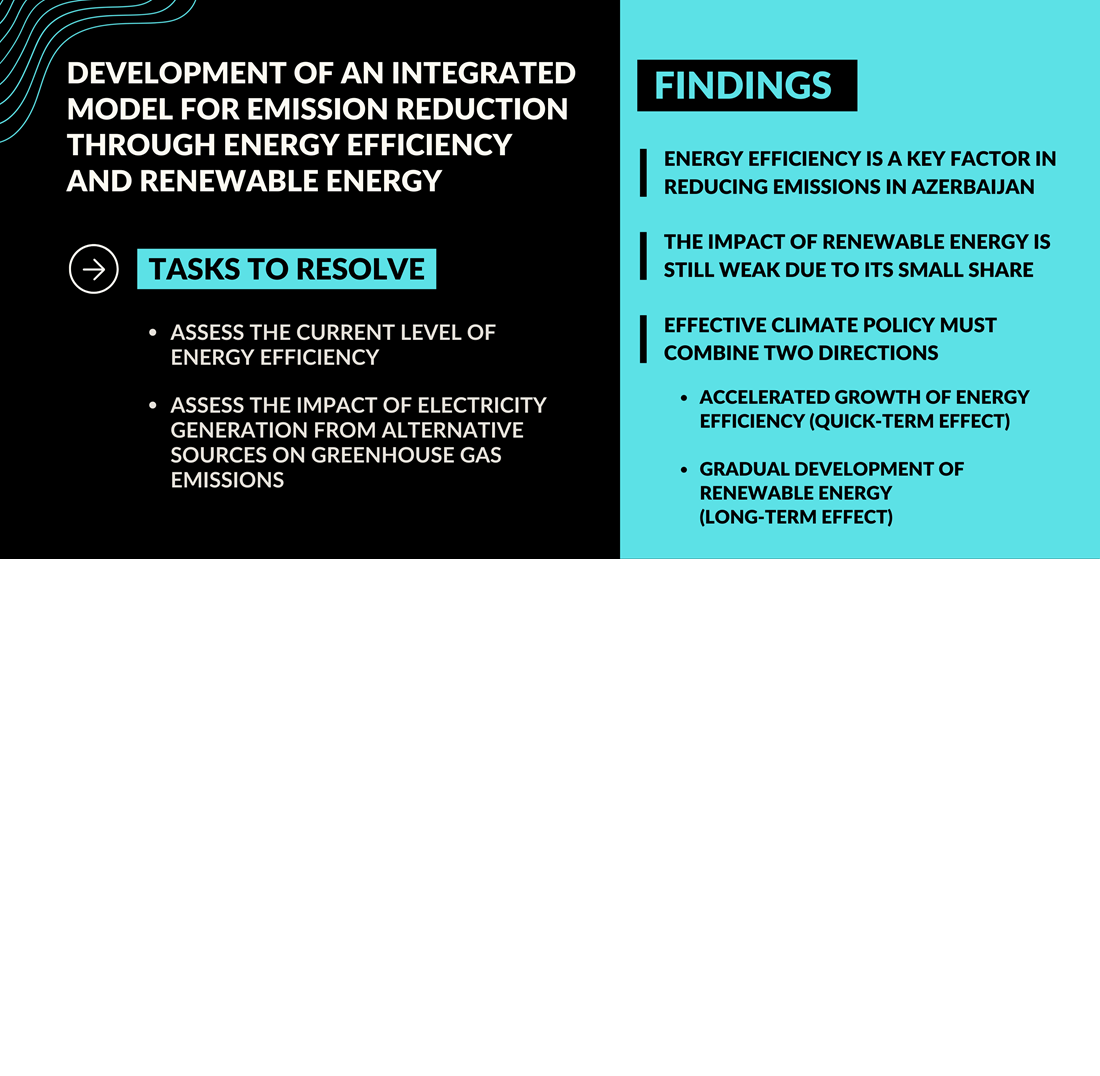
The study’s focus is the country’s energy sector, including renewable energy production. The problem to be solved is modeling the impact of energy efficiency and renewable energy production on greenhouse gas emissions in the country. This study investigates the impact of energy efficiency and the transition to renewable energy sources on greenhouse gas emissions in Azerbaijan, where the energy mix remains dominated by fossil fuels. Using a regression–based analytical framework, the research quantifies the contribution of these factors to changes in emission levels over time. The empirical results demonstrate that improvements in energy efficiency, measured as gross domestic product (GDP) generated per unit of total energy consumption, exert the greatest influence on emission reductions. This finding suggests that economic growth driven by efficient energy use can serve as a key mechanism for decarbonization. In contrast, the expected mitigating effect of the share of renewable energy sources in the national energy balance was not statistically significant. This outcome is likely explained by the relatively small share of renewables in Azerbaijan’s total energy supply and the early stage of the country’s renewable sector. The study concludes that effective climate policy should combine measures to accelerate improvements in energy efficiency with initiatives to expand the use of renewable energy. The proposed model highlights the dual importance of optimizing existing energy consumption while investing in cleaner technologies. Based on the results, 80% of the annual change in a country’s greenhouse gas emissions can be explained by changes in factors such as renewable electricity generation, the share of renewable electricity in total electricity generation, and GDP per unit of energy consumption. The findings can be applied to the design of sustainable energy strategies and long-term decarbonization policies.
References
- Shang, Y., Sang, S., Tiwari, A. K., Khan, S., Zhao, X. (2024). Impacts of renewable energy on climate risk: A global perspective for energy transition in a climate adaptation framework. Applied Energy, 362, 122994. https://doi.org/10.1016/j.apenergy.2024.122994
- Nunes, L. J. R. (2023). The Rising Threat of Atmospheric CO2: A Review on the Causes, Impacts, and Mitigation Strategies. Environments, 10 (4), 66. https://doi.org/10.3390/environments10040066
- Smith, H. B., Vaughan, N. E., Forster, J. (2024). Residual emissions in long-term national climate strategies show limited climate ambition. One Earth, 7 (5), 867–884. https://doi.org/10.1016/j.oneear.2024.04.009
- Wang, W., Melnyk, L., Kubatko, O., Kovalov, B., Hens, L. (2023). Economic and Technological Efficiency of Renewable Energy Technologies Implementation. Sustainability, 15 (11), 8802. https://doi.org/10.3390/su15118802
- Alam, M. S., Manigandan, P., Kisswani, K. M., Baig, I. A. (2025). Achieving goals of the 2030 sustainable development agenda through renewable energy utilization: Comparing the environmental sustainability effects of economic growth and financial development. Sustainable Futures, 9, 100534. https://doi.org/10.1016/j.sftr.2025.100534
- Diaconescu, M., Marinas, L. E., Marinoiu, A. M., Popescu, M.-F., Diaconescu, M. (2024). Towards Renewable Energy Transition: Insights from Bibliometric Analysis on Scholar Discourse to Policy Actions. Energies, 17 (18), 4719. https://doi.org/10.3390/en17184719
- Yu, H., Wen, B., Zahidi, I., Chow, M. F., Liang, D., Madsen, D. Ø. (2024). The critical role of energy transition in addressing climate change at COP28. Results in Engineering, 22, 102324. https://doi.org/10.1016/j.rineng.2024.102324
- Rzayeva, U., Guliyeva, A., Jafarova, N. (2021). Analysis of some indicators by means of fuzzy logic on the example of Azerbaijani energy enterprises. E3S Web of Conferences, 250, 02001. https://doi.org/10.1051/e3sconf/202125002001
- Candra, O., Chammam, A., Alvarez, J. R. N., Muda, I., Aybar, H. Ş. (2023). The Impact of Renewable Energy Sources on the Sustainable Development of the Economy and Greenhouse Gas Emissions. Sustainability, 15 (3), 2104. https://doi.org/10.3390/su15032104
- Szeberényi, A., Rokicki, T., Papp-Váry, Á. (2022). Examining the Relationship between Renewable Energy and Environmental Awareness. Energies, 15 (19), 7082. https://doi.org/10.3390/en15197082
- Atstāja, D. (2025). Renewable Energy for Sustainable Development: Opportunities and Current Landscape. Energies, 18 (1), 196. https://doi.org/10.3390/en18010196
- Suleman, S., Sowah, J. N. (2024). Investigating the implications of energy transition on electricity tariffs in Ghana. Social Sciences & Humanities Open, 10, 101185. https://doi.org/10.1016/j.ssaho.2024.101185
- Guliyeva, A., Rzayeva, U., Azimzadeh, A. (2023). Navigating Investment Risks in the Renewable Energy Market of Developing Countries. Analyzing Energy Crises and the Impact of Country Policies on the World, 54–81. https://doi.org/10.4018/979-8-3693-0440-2.ch004
- Lorente-de-Las-Casas, A., Marrero, G. A. (2025). Impact of renewable energies on CO2 emissions in the OECD. Energy Sources, Part B: Economics, Planning, and Policy, 20 (1). https://doi.org/10.1080/15567249.2025.2517325
- Ibishova, B., Misund, B., Tveterås, R. (2024). Driving green: Financial benefits of carbon emission reduction in companies. International Review of Financial Analysis, 96, 103757. https://doi.org/10.1016/j.irfa.2024.103757
- Hasanov, F. J., Mukhtarov, S., Suleymanov, E. (2023). The role of renewable energy and total factor productivity in reducing CO2 emissions in Azerbaijan. Fresh insights from a new theoretical framework coupled with Autometrics. Energy Strategy Reviews, 47, 101079. https://doi.org/10.1016/j.esr.2023.101079
- Mustafayev, F., Kulawczuk, P., Orobello, C. (2022). Renewable Energy Status in Azerbaijan: Solar and Wind Potentials for Future Development. Energies, 15 (2), 401. https://doi.org/10.3390/en15020401
- Qamruzzaman, M., Karim, S. (2023). Does public-private investment augment renewable energy consumption in BIMSTEC nations? Evidence from symmetric and asymmetric assessment. Energy Strategy Reviews, 49, 101169. https://doi.org/10.1016/j.esr.2023.101169
- Tvinnereim, E., Mehling, M. (2018). Carbon pricing and deep decarbonisation. Energy Policy, 121, 185–189. https://doi.org/10.1016/j.enpol.2018.06.020
- Liu, W., Zhang, X., Feng, S. (2019). Does renewable energy policy work? Evidence from a panel data analysis. Renewable Energy, 135, 635–642. https://doi.org/10.1016/j.renene.2018.12.037
- Sribna, Y., Stupnytskyi, V., Stupnytska, N. (2023). Problems and trends of ukraine’s transition to the EU environmental and energy system. Bulletin National University of Water and Environmental Engineering, 1 (101), 204–215. https://doi.org/10.31713/ve1202318
- Us, Y., Pimonenko, T., Lyulyov, O. (2021). The impact of energy efficiency policy on Ukraine’s green brand: a bibliometrics analysis. Polityka Energetyczna – Energy Policy Journal, 24 (4), 5–18. https://doi.org/10.33223/epj/142462
- Tachega, M. A., Yao, X., Liu, Y., Ahmed, D., Li, H., Mintah, C. (2021). Energy efficiency evaluation of oil producing economies in Africa: DEA, malmquist and multiple regression approaches. Cleaner Environmental Systems, 2, 100025. https://doi.org/10.1016/j.cesys.2021.100025
- Energy supply from renewable sources. The State Statistical Committee of the Republic of Azerbaija. Available at: https://www.stat.gov.az/search/?q=b%C9%99rpa+olunan+enerji&lang=en
- Energy. The State Statistical Committee of the Republic of Azerbaija. Energy supply from renewable sources. Available at: https://www.stat.gov.az/source/balance_fuel/?lang=en
- Azerbaijan Renewable Energy. Available at: https://www.macrotrends.net/global-metrics/countries/aze/azerbaijan/renewable-energy-statistics#:~:text=Azerbaijan%20renewable%20energy%20for%202021,a%200.01%25%20increase%20from%202017
- Azerbaijan AZ:(GDP) Gross Domestic Productper Unit of Energy Use: PPP per Kg of Oil Equivalent. Available at: https://www.ceicdata.com/en/azerbaijan/environmental-energy-production-and-consumption/az-gdp-per-unit-of-energy-use-ppp-per-kg-of-oil-equivalent
- Global Historical Emissions. Available at: https://www.climatewatchdata.org/ghg-emissions?breakBy=sector&chartType=area®ions=AZE&source=Climate%20Watch
- Wang, A., Lin, Q., Liu, C., Yang, L., Sun, S. (2024). Sustainable Energy Development: Reviewing Carbon Emission Reduction in Photovoltaic Power Systems. Sustainability, 16 (23), 10428. https://doi.org/10.3390/su162310428
- Gajdzik, B., Wolniak, R., Nagaj, R., Žuromskaitė-Nagaj, B., Grebski, W. W. (2024). The Influence of the Global Energy Crisis on Energy Efficiency: A Comprehensive Analysis. Energies, 17 (4), 947. https://doi.org/10.3390/en17040947
- Berardi, U. (2017). A cross-country comparison of the building energy consumptions and their trends. Resources, Conservation and Recycling, 123, 230–241. https://doi.org/10.1016/j.resconrec.2016.03.014
- Oliveira, H., Moutinho, V. (2021). Renewable Energy, Economic Growth and Economic Development Nexus: A Bibliometric Analysis. Energies, 14 (15), 4578. https://doi.org/10.3390/en14154578
Downloads
Published
How to Cite
Issue
Section
License
Copyright (c) 2025 Ulviyya Rzayeva, Rasul Balayev, Emin Ahmadzade, Konul Mirzammadova

This work is licensed under a Creative Commons Attribution 4.0 International License.
The consolidation and conditions for the transfer of copyright (identification of authorship) is carried out in the License Agreement. In particular, the authors reserve the right to the authorship of their manuscript and transfer the first publication of this work to the journal under the terms of the Creative Commons CC BY license. At the same time, they have the right to conclude on their own additional agreements concerning the non-exclusive distribution of the work in the form in which it was published by this journal, but provided that the link to the first publication of the article in this journal is preserved.
A license agreement is a document in which the author warrants that he/she owns all copyright for the work (manuscript, article, etc.).
The authors, signing the License Agreement with TECHNOLOGY CENTER PC, have all rights to the further use of their work, provided that they link to our edition in which the work was published.
According to the terms of the License Agreement, the Publisher TECHNOLOGY CENTER PC does not take away your copyrights and receives permission from the authors to use and dissemination of the publication through the world's scientific resources (own electronic resources, scientometric databases, repositories, libraries, etc.).
In the absence of a signed License Agreement or in the absence of this agreement of identifiers allowing to identify the identity of the author, the editors have no right to work with the manuscript.
It is important to remember that there is another type of agreement between authors and publishers – when copyright is transferred from the authors to the publisher. In this case, the authors lose ownership of their work and may not use it in any way.








