Design of a methodological toolkit for financial provision of enterprise sustainability in the context of digital transformation
DOI:
https://doi.org/10.15587/1729-4061.2025.345355Keywords:
digital transformations, enterprise, financial provision, stability, capital structure, management, optimizationAbstract
This paper reports the design of a methodological toolkit for financial provision of enterprise sustainability, taking into account the target needs of the enterprise's capital management, available opportunities, and digital changes in the business environment.
This study considers the processes and mechanisms of financial provision sustainability of enterprises in the context of digital transformations of the economy.
The task addressed relates to the lack of effective methodological tools for flexible adaptation to changes under financial conditions and strategic needs for ensuring financial sustainability of enterprises, taking into account the requirements of balanced economic development. Such tools are based on the mechanism of capital structure optimization and make it possible to build the financial architecture of the enterprise and effectively respond to digital challenges.
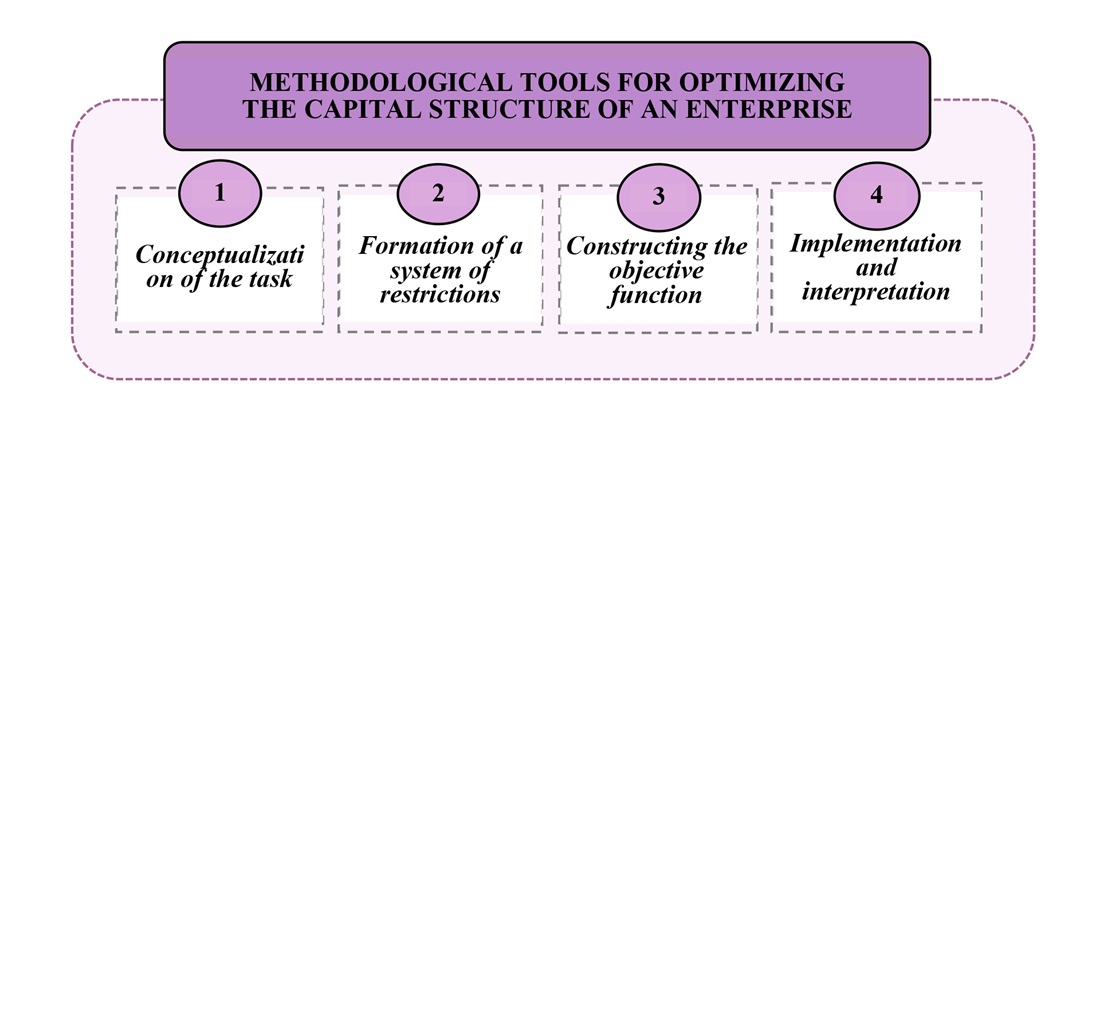
Using the linear programming method, an economic and mathematical model for optimizing the capital structure of the enterprise has been constructed. It includes an objective function that is focused on maximizing profit and minimizing the weighted average cost of capital and makes it possible to determine the rational ratio of the enterprise's equity and debt capital. The system of constraints of the objective function takes into account the policy of financing the assets of the enterprise under the conditions of digital transformations, and covers the criteria of financial stability, solvency, and efficiency of capital use of the enterprise. This makes it possible to ensure the consistency of financial decisions with the strategic goals of the enterprise's development, to increase its resistance to the latest challenges of the digital economy.
The practical significance of the designed methodological toolkit is in the possibility of its application for substantiating management decisions, developing financial and economic policy.
References
- Karpenko, L. M., Koev, S. R., Kashchena, N. B., Grushko, V., Khorosheniuk, А. (2019). Formation of the stakeholders account model in conditions of sustainable development. Academy of Accounting and Financial Studies Journal, 23 (2). Available at: https://www.abacademies.org/articles/Formation-of-the-Stakeholders-Account-Model-in-Conditions-of-1528-2635-23-SI-2-413.pdf
- Bartolacci, F., Caputo, A., Soverchia, M. (2019). Sustainability and financial performance of small and medium sized enterprises: A bibliometric and systematic literature review. Business Strategy and the Environment, 29 (3), 1297–1309. https://doi.org/10.1002/bse.2434
- Kashchena, N., Chmil, H., Nesterenko, I., Lutsenko, O., Kovalevska, N. (2024). Diagnostics as a Tool for Managing Behavior and Economic Activity of Retailers in the Conditions of Digital Business Transformation. Data-Centric Business and Applications, 149–173. https://doi.org/10.1007/978-3-031-53984-8_7
- Qian, J., Zhu, J. L. (2018). Return to Invested Capital and the Performance of Mergers and Acquisitions. Management Science, 64 (10), 4818–4834. https://doi.org/10.1287/mnsc.2017.2766
- Nesterenko, I., Kashchena, N., Chmil, H., Chumak, O., Shtyk, Y., Nesterenko, O., Kovalevska, N. (2024). Devising a methodological approach to identifying the economic potential of production costs for eco-innovative products. Eastern-European Journal of Enterprise Technologies, 3 (13 (129)), 6–15. https://doi.org/10.15587/1729-4061.2024.304805
- Wang, W. (2025). Financial decentralization, financial expansion and sustainable development of real enterprises from the perspective of return on invested capital. Finance Research Letters, 74, 106766. https://doi.org/10.1016/j.frl.2025.106766
- Apasrawirote, D., Yawised, K. (2023). The emerging of business resilience plans (BRPs) in dealing with business turbulence. Management Research Review, 47 (1), 141–161. https://doi.org/10.1108/mrr-04-2022-0273
- Su, Y., Wu, J. (2024). Digital transformation and enterprise sustainable development. Finance Research Letters, 60, 104902. https://doi.org/10.1016/j.frl.2023.104902
- Wang, C., Nazar, R., Ali, S., Meo, M. S. (2025). Eco-friendly algorithms: Artificial intelligence and green finance in European intelligent nations. Technology in Society, 83, 102960. https://doi.org/10.1016/j.techsoc.2025.102960
- Santos, A. de M., Sant’Anna, Â. M. O. (2024). Industry 4.0 technologies for sustainability within small and medium enterprises: A systematic literature review and future directions. Journal of Cleaner Production, 467, 143023. https://doi.org/10.1016/j.jclepro.2024.143023
- Álvarez Jaramillo, J., Zartha Sossa, J. W., Orozco Mendoza, G. L. (2018). Barriers to sustainability for small and medium enterprises in the framework of sustainable development – Literature review. Business Strategy and the Environment, 28 (4), 512–524. https://doi.org/10.1002/bse.2261
- Avelar, S., Borges-Tiago, T., Almeida, A., Tiago, F. (2024). Confluence of sustainable entrepreneurship, innovation, and digitalization in SMEs. Journal of Business Research, 170, 114346. https://doi.org/10.1016/j.jbusres.2023.114346
- Radicic, D., Petković, S. (2023). Impact of digitalization on technological innovations in small and medium-sized enterprises (SMEs). Technological Forecasting and Social Change, 191, 122474. https://doi.org/10.1016/j.techfore.2023.122474
- Kashchena, N., Chmil, H., Chumak, O., Nesterenko, I., Mykytas, A., Chmil, Y. (2025). Assessing the effectiveness of innovative transformations of socio-economic systems and enterprise development within Industry 5.0. Eastern-European Journal of Enterprise Technologies, 3 (13 (135)), 35–46. https://doi.org/10.15587/1729-4061.2025.333006
- Damiano, R., Valenza, G. (2024). Enacting Resilience in Small and Medium Enterprises Following the Sustainability Path: A Systematic Literature Review. Strategic Change, 34 (2), 237–252. https://doi.org/10.1002/jsc.2608
- Perramon, J., Bagur-Femenías, L., Alonso-Almeida, M. del M., Llach, J. (2024). Does the transition to a circular economy contribute to business resilience and transformation? Evidence from SMEs. Journal of Cleaner Production, 453, 142279. https://doi.org/10.1016/j.jclepro.2024.142279
- Howard, M., Böhm, S., Eatherley, D. (2022). Systems resilience and SME multilevel challenges: A place-based conceptualization of the circular economy. Journal of Business Research, 145, 757–768. https://doi.org/10.1016/j.jbusres.2022.03.014
- Lysak, H., Morozova, H., Gorokh, O., Maliy, O., Nesterenko, I. (2022). The System of Financial Control in the Management of a Small Business Enterprise: Methods and Tools of Implementation. Review of Economics and Finance, 20, 1034–1041. https://doi.org/10.55365/1923.x2022.20.115
- Danso, A., Adomako, S., Amankwah‐Amoah, J., Owusu‐Agyei, S., Konadu, R. (2019). Environmental sustainability orientation, competitive strategy and financial performance. Business Strategy and the Environment, 28 (5), 885–895. https://doi.org/10.1002/bse.2291
- Ardito, L., Raby, S., Albino, V., Bertoldi, B. (2021). The duality of digital and environmental orientations in the context of SMEs: Implications for innovation performance. Journal of Business Research, 123, 44–56. https://doi.org/10.1016/j.jbusres.2020.09.022
- Kashchena, N., Nesterenko, I., Chmil, H., Kovalevska, N., Velieva, V., Lytsenko, O. (2023). Digitalization of Biocluster Management on Basis of Balanced Scorecard. Journal of Information Technology Management, 15 (4), 80–96. https://doi.org/10.22059/jitm.2023.94711
- Awad, J., Martín‐Rojas, R. (2023). Enhancing social responsibility and resilience through entrepreneurship and digital environment. Corporate Social Responsibility and Environmental Management, 31 (3), 1688–1704. https://doi.org/10.1002/csr.2655
- Isensee, C., Teuteberg, F., Griese, K. M. (2023). Success factors of organizational resilience: a qualitative investigation of four types of sustainable digital entrepreneurs. Management Decision, 61 (5), 1244–1273. https://doi.org/10.1108/md-03-2022-0326
- Ross, S., Westerfield, R., Jaffe, J., Jordan, B., Shue, K. (2022). Corporate Finance. McGraw-Hill Education. Available at: https://studylib.net/doc/27627577/corporate-finance-13th-edition---ross--westerfield--jaffe
- Hansen, A. K., Christiansen, L., Lassen, A. H. (2024). Technology isn’t enough for Industry 4.0: on SMEs and hindrances to digital transformation. International Journal of Production Research, 63 (18), 6585–6605. https://doi.org/10.1080/00207543.2024.2305800
Downloads
Published
How to Cite
Issue
Section
License
Copyright (c) 2025 Dmytro Tyshchenko, Olha Hlushchenko, Nataliia Kashchena, Nataliia Savytska, Hanna Chmil, Oksana Chumak, Iryna Nesterenko, Andrii Konstantinov, Olga Diachek, Vadym Koniukhov

This work is licensed under a Creative Commons Attribution 4.0 International License.
The consolidation and conditions for the transfer of copyright (identification of authorship) is carried out in the License Agreement. In particular, the authors reserve the right to the authorship of their manuscript and transfer the first publication of this work to the journal under the terms of the Creative Commons CC BY license. At the same time, they have the right to conclude on their own additional agreements concerning the non-exclusive distribution of the work in the form in which it was published by this journal, but provided that the link to the first publication of the article in this journal is preserved.
A license agreement is a document in which the author warrants that he/she owns all copyright for the work (manuscript, article, etc.).
The authors, signing the License Agreement with TECHNOLOGY CENTER PC, have all rights to the further use of their work, provided that they link to our edition in which the work was published.
According to the terms of the License Agreement, the Publisher TECHNOLOGY CENTER PC does not take away your copyrights and receives permission from the authors to use and dissemination of the publication through the world's scientific resources (own electronic resources, scientometric databases, repositories, libraries, etc.).
In the absence of a signed License Agreement or in the absence of this agreement of identifiers allowing to identify the identity of the author, the editors have no right to work with the manuscript.
It is important to remember that there is another type of agreement between authors and publishers – when copyright is transferred from the authors to the publisher. In this case, the authors lose ownership of their work and may not use it in any way.








