Devising an approach to assessing the quality of gluten-free bread of new recipes
DOI:
https://doi.org/10.15587/1729-4061.2025.345357Keywords:
gluten-free flour, quinoa, psyllium, optimization of bread recipes, organoleptic evaluation criteriaAbstract
This study investigates the quality of gluten-free bread. In Ukraine, the range of gluten-free products remains limited. This paper determines the possibility of improving the laboratory assessment of gluten-free bread to further define the rational use of gluten-free flour in bread baking with guaranteed stability of the product structure.
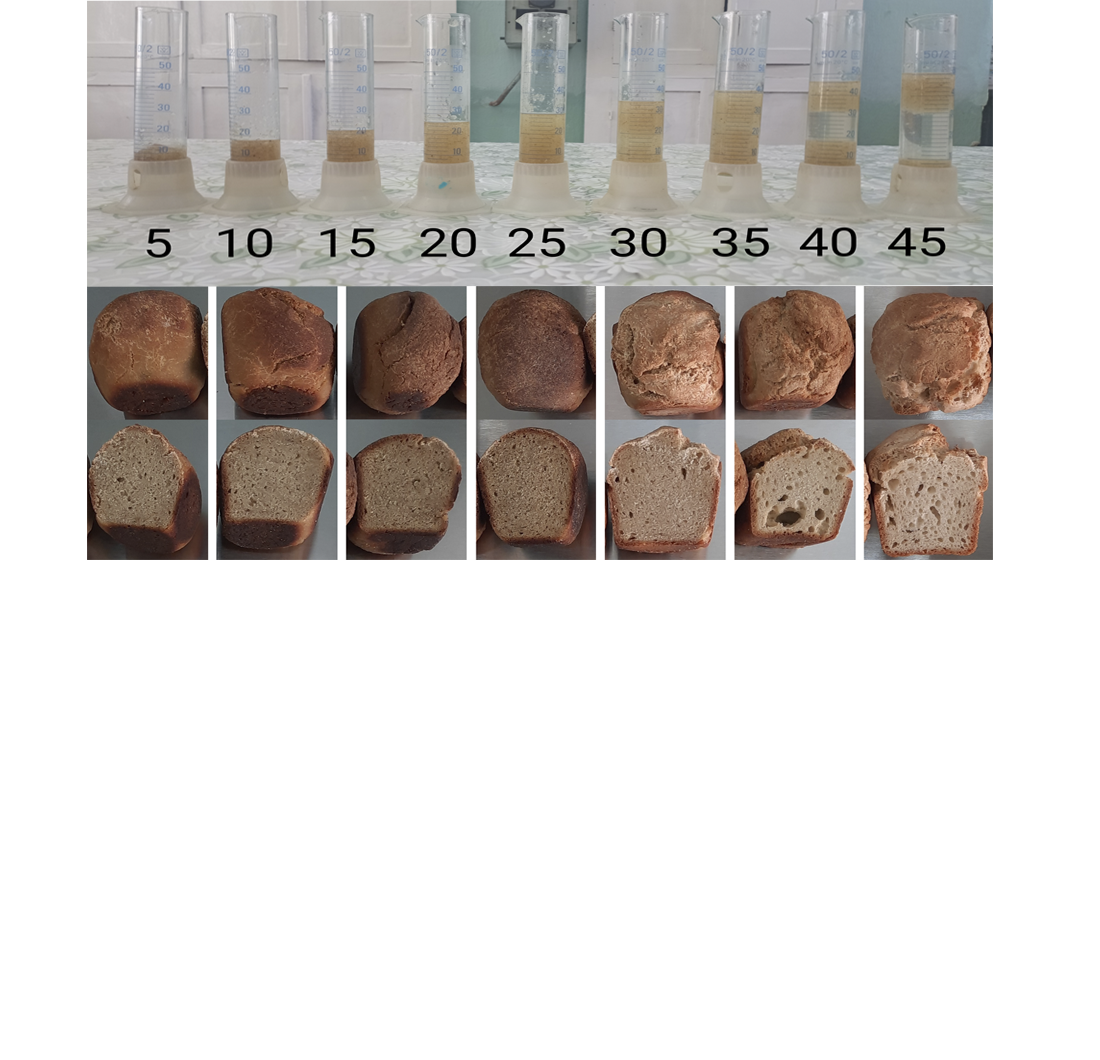
The recommended approach to assessing the quality of gluten-free bread involves a 5-point assessment scale containing the following indicators: physical appearance (shape, surface, color of the crust); crumb condition (consistency, structure, color); taste; and smell. The devised weighting factors take into account the smaller volume and porosity of products made from gluten-free raw materials compared to wheat bread.
The combination of non-traditional raw materials (quinoa, buckwheat, corn flour) with an improved quality assessment system made it possible not only to develop a competitive recipe for gluten-free bread but also form a unified approach to controlling its quality. Thus, the positive results are attributed to the high nutritional properties of quinoa and buckwheat, as well as the functional characteristics of psyllium and starch, which compensate for the absence of gluten proteins. Structure-forming agents – xanthan gum, starch, and psyllium – and their amounts are recommended to ensure dimensional stability and improve the texture of the product. The proposed recipe ratios (quinoa flour as the main raw material in combination with buckwheat and corn flour and the addition of 1.0% psyllium powder or 1:3 of the amount of starch) and an improved approach to evaluation could be used in laboratory practice, during industrial and small-scale production of gluten-free bakery products, as well as in the development of other types of functional grain flour products
References
- Hrishchenko, А. (2025). Research of trends in the development of the bakery industry in Ukraine. Agrosvit, 1, 77–89. https://doi.org/10.32702/2306-6792.2025.1.77
- Catassi, C., Bai, J., Bonaz, B., Bouma, G., Calabrò, A., Carroccio, A. et al. (2013). Non-Celiac Gluten Sensitivity: The New Frontier of Gluten Related Disorders. Nutrients, 5 (10), 3839–3853. https://doi.org/10.3390/nu5103839
- Capriles, V. D., Valéria de Aguiar, E., Garcia dos Santos, F., Fernández, M. E. A., de Melo, B. G., Tagliapietra, B. L. et al. (2023). Current status and future prospects of sensory and consumer research approaches to gluten-free bakery and pasta products. Food Research International, 173, 113389. https://doi.org/10.1016/j.foodres.2023.113389
- Chen, Y., Fu, Q., Jin, W., Shen, W., Li, J. (2025). Improving the quality of steamed rice bread using micro-cellulose as fillers: Effect of particle size. Carbohydrate Polymers, 362, 123663. https://doi.org/10.1016/j.carbpol.2025.123663
- Semenova, A. B., Biela, N. I., Prykhodko, Yu. S., Pysarets, O. P. (2016). Pat. No. 114989 UA. Khlib bezghliutenovyi. No. a201606264; declareted: 09.06.2016; published: 28.08.2017. Available at: https://sis.nipo.gov.ua/uk/search/detail/707100/
- Nakov, G., Jukić, M., Soler, F., Syleimanova, S., Lukinac, J., Estivi, L. et al. (2025). Enhancing the Antioxidant and Nutritional Profile of Gluten-Free Sourdough Bread Using Hemp Press Cake Meal. Foods, 14 (20), 3571. https://doi.org/10.3390/foods14203571
- Grassi de Alcântara, R., Aparecida de Carvalho, R., Maria Vanin, F. (2020). Evaluation of wheat flour substitution type (corn, green banana and rice flour) and concentration on local dough properties during bread baking. Food Chemistry, 326, 126972. https://doi.org/10.1016/j.foodchem.2020.126972
- Zhang, J., Zhu, Q., Cheng, L., Kang, J., Liu, H., Zhang, L. et al. (2025). Enhancing gluten-free dough and bread properties using xanthan gum and its trifluoroacetic acid hydrolytes. Food Hydrocolloids, 164, 111204. https://doi.org/10.1016/j.foodhyd.2025.111204
- Vicente, A., Villanueva, M., Caballero, P. A., Lazaridou, A., Biliaderis, C. G., Ronda, F. (2024). Flours from microwave-treated buckwheat grains improve the physical properties and nutritional quality of gluten-free bread. Food Hydrocolloids, 149, 109644. https://doi.org/10.1016/j.foodhyd.2023.109644
- Abdelshafy, A. M., Rashwan, A. K., Osman, A. I. (2024). Potential food applications and biological activities of fermented quinoa: A review. Trends in Food Science & Technology, 144, 104339. https://doi.org/10.1016/j.tifs.2024.104339
- Navruz-Varli, S., Sanlier, N. (2016). Nutritional and health benefits of quinoa (Chenopodium quinoa Willd.). Journal of Cereal Science, 69, 371–376. https://doi.org/10.1016/j.jcs.2016.05.004
- Elgeti, D., Nordlohne, S. D., Föste, M., Besl, M., Linden, M. H., Heinz, V. et al. (2014). Volume and texture improvement of gluten-free bread using quinoa white flour. Journal of Cereal Science, 59 (1), 41–47. https://doi.org/10.1016/j.jcs.2013.10.010
- Belorio, M., Gómez, M. (2020). Psyllium: a useful functional ingredient in food systems. Critical Reviews in Food Science and Nutrition, 62 (2), 527–538. https://doi.org/10.1080/10408398.2020.1822276
- Fratelli, C., Santos, F. G., Muniz, D. G., Habu, S., Braga, A. R. C., Capriles, V. D. (2021). Psyllium Improves the Quality and Shelf Life of Gluten-Free Bread. Foods, 10 (5), 954. https://doi.org/10.3390/foods10050954
- Elkatry, H. O., El-Beltagi, H. S., Ahmed, A. R., Mohamed, H. I., Al-Otaibi, H. H., Ramadan, K. M. A., Mahmoud, M. A. A. (2023). The potential use of Indian rice flour or husk in fortification of pan bread: assessing bread’s quality using sensory, physicochemical, and chemometric methods. Frontiers in Nutrition, 10. https://doi.org/10.3389/fnut.2023.1240527
- Drobot, V. I. (2006). Laboratornyi praktykum z tekhnolohiyi khlibopekarskoho ta makaronnoho vyrobnytstv. Tekhnolohiya khlibopekarskoho vyrobnytstva. Kyiv: Tsentr navch. l-ry, 341.
- Kyienko, Z. B., Prysiazhniuk, L. M., Shovhun, O. O. et al. (2015). Metodyka derzhavnoi naukovo-tekhnichnoi ekspertyzy sortiv roslyn. Vinnytsia: TOV "Nilan-LTD", 160.
- Leonov, O. Yu., Panchenko, I. A., Skliarevskyi, K. M. et al. (2011). Metodychni rekomendatsiyi z otsinky yakosti zerna selektsiynoho materialu. Kharkiv: Instytut roslynnytstva im. V.Ya. Yurieva, 70.
- Hospodarenko, H. M., Liubych, V. V., Polianetska, I. O., Voziyan, V. V. (2015). Pat. No. 110269 UA. Sposib otsinky yakosti khliba zi spelty. No. u201512030; declareted: 04.12.2015; published: 10.10.2016. Available at: https://sis.nipo.gov.ua/uk/search/detail/827769/
- Osokina, N., Kostetska, K., Gerasymchuk, H., Voziian, V., Telezhenko, L., Priss, O. et al. (2017). Substantiation of the use of spice plants for enrichment of wheat bread. Eastern-European Journal of Enterprise Technologies, 4 (11 (88)), 16–22. https://doi.org/10.15587/1729-4061.2017.108900
- Kiiko, В., Melnyk, О., Gavrylenko, О. (2023). The bakery industry of Ukraine in wartime conditions. Commodity science. Technologies. Engineering, 45 (1), 27–40. https://doi.org/10.31617/2.2023(45)03
- Shanina, O. M., Haliasnyi, I. V., Lobacheva, N. L. (2015). Justification of the flour raw materials composition in the technology of non-yeast glutenfree bread. Wschodnioeuropejskie Czasopismo Naukowe, 4, 56‒60. Available at: http://repo.snau.edu.ua/bitstream/123456789/4919/1/Польща.pdf
- Gibb, R. D., Sloan, K. J., McRorie, J. W. (2023). Psyllium is a natural nonfermented gel-forming fiber that is effective for weight loss: A comprehensive review and meta-analysis. Journal of the American Association of Nurse Practitioners, 35 (8), 468–476. https://doi.org/10.1097/jxx.0000000000000882
Downloads
Published
How to Cite
Issue
Section
License
Copyright (c) 2025 Nina Osokina, Kateryna Kostetska, Аndrii Kysil, Olesia Pris

This work is licensed under a Creative Commons Attribution 4.0 International License.
The consolidation and conditions for the transfer of copyright (identification of authorship) is carried out in the License Agreement. In particular, the authors reserve the right to the authorship of their manuscript and transfer the first publication of this work to the journal under the terms of the Creative Commons CC BY license. At the same time, they have the right to conclude on their own additional agreements concerning the non-exclusive distribution of the work in the form in which it was published by this journal, but provided that the link to the first publication of the article in this journal is preserved.
A license agreement is a document in which the author warrants that he/she owns all copyright for the work (manuscript, article, etc.).
The authors, signing the License Agreement with TECHNOLOGY CENTER PC, have all rights to the further use of their work, provided that they link to our edition in which the work was published.
According to the terms of the License Agreement, the Publisher TECHNOLOGY CENTER PC does not take away your copyrights and receives permission from the authors to use and dissemination of the publication through the world's scientific resources (own electronic resources, scientometric databases, repositories, libraries, etc.).
In the absence of a signed License Agreement or in the absence of this agreement of identifiers allowing to identify the identity of the author, the editors have no right to work with the manuscript.
It is important to remember that there is another type of agreement between authors and publishers – when copyright is transferred from the authors to the publisher. In this case, the authors lose ownership of their work and may not use it in any way.








