Construction of a strategic change management model to enable the evolution of a high-tech enterprise
DOI:
https://doi.org/10.15587/1729-4061.2025.347459Keywords:
high-tech business, organizational changes, situational analysis, economic-mathematical modeling, management efficiencyAbstract
This study focuses on the process of strategic change management at a high-tech enterprise. The task addressed relates to the lack of a unified pedagogical method for managing the strategy of changes, which would combine situation analysis, diagnostics of the structure of enterprise functions, and economic-mathematical prediction of the effectiveness of transformation decisions.
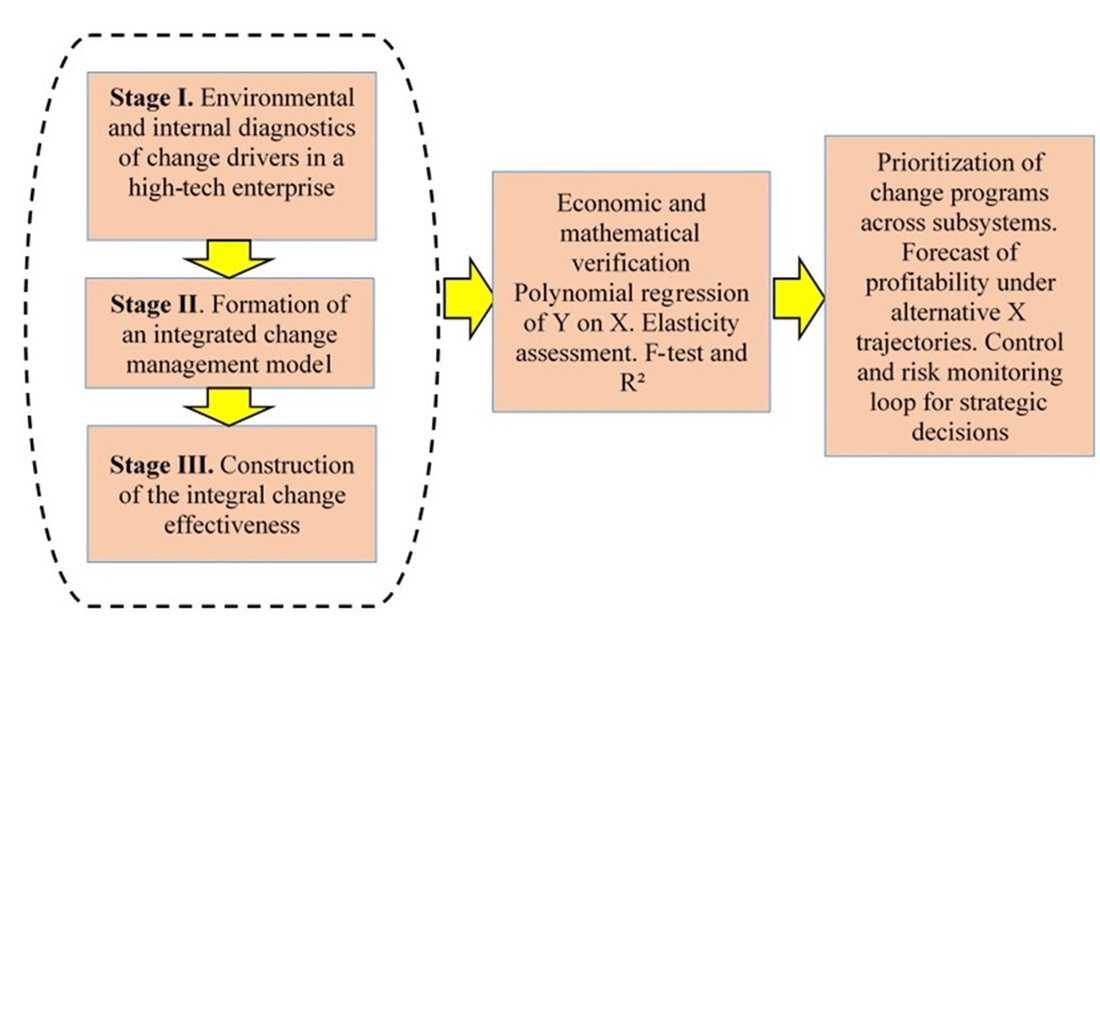
The main results are as follows. It has been proven that the success of transformations does not depend on individual management decisions but on a set of organizational resilience factors that help the enterprise adapt innovative processes to changes in the external environment. In the process of studying, a conceptual model of change management was built, which allows for the coordination of environment monitoring, situational diagnostics of structural inconsistencies, and the design of organizational shifts in a single management circuit.
The economic-mathematical assessment was performed on the basis of data on the activities of TOV "Flight Control" in 2015–2024 using regression-correlation analysis. A statistically significant impact of internal functional subsystems on the integrated performance indicator, the overall profitability of the enterprise, which increased from 9.3% in 2015 to 13.6% in 2024, was revealed.
The modeling results showed that the greatest positive impact on profitability is exerted by controlling and risk management (β = 39.55), innovation and R&D (β = 26.53), marketing and foreign contracts (β = 25.99), while financing of innovation projects without proper administrative support is characterized by a negative impact (β = –28.74). Correlation analysis (r = 0.86–0.98) confirmed the systemic relationship of management factors, which justifies the appropriateness of a comprehensive, rather than a separate, approach to strategic changes.
The results could be used by enterprises in the high-tech sector to carry out structural and organizational changes, devise reorganization programs, optimize production and business processes, as well as to increase the level of innovative development
References
- Asher, S., Nafees, M., Syeda, T. (2024). Exploring the change management framework: An in-depth investigation. MethodsX, 13, 102978. https://doi.org/10.1016/j.mex.2024.102978
- Christou, E., Piller, F. (2024). Organizational Transformation: A Management Research Perspective. Transformation Towards Sustainability, 303–330. https://doi.org/10.1007/978-3-031-54700-3_11
- Dorogaia, I. (2022). Change management in the digital age: the perspectives of development. Eastern European Journal of Regional Studies, 8 (1). https://doi.org/10.53486/2537-6179.8-1.04
- Krajcsák, Z., Bakacsi, G. (2024). The three levels of organizational change to build future potential organizations. International Journal of Innovation Science, 17 (3), 630–649. https://doi.org/10.1108/ijis-08-2023-0173
- Minghui, B., Chelliah, S. (2024). The effect of strategic management on enterprise performance in manufacturing of China: The mediating role of digital management. Global Business and Management Research: An International Journal, 16 (4s), 1331–1344. Available at: https://gbmrjournal.com/pdf/v16n4s/V16N4s-84.pdf
- Jiang, F. (2025). The Role of Entrepreneurial Capabilities and Organizational Resilience in Strategic Change: Evidence from High-Tech Enterprises in the GBA. International Journal of Science and Business, 45 (1), 72–85. https://doi.org/10.58970/ijsb.2576
- Yukhman, Ya. V., Berezhnytskyi, O. I. (2024). Change management as a tool for developing the adaptive capacity of an enterprise. Economic Bulletin of Dnipro University of Technology, 87, 161–168. https://doi.org/10.33271/ebdut/87.161
- Monferdini, L., Bottani, E. (2024). How do businesses utilize change management for process optimization? A cross-analysis among industrial sectors. Business Process Management Journal, 30 (8), 371–414. https://doi.org/10.1108/bpmj-03-2024-0158
- Wei, L.-Q., Ling, Y., Kellermanns, F. W., Zhang, Y. (2025). Strategic consensus at founding and product innovation performance in high-tech ventures. Journal of Business Research, 188, 115082. https://doi.org/10.1016/j.jbusres.2024.115082
- Lu, Y. (2024). Impact of Digital Technologies on Organizational Change Strategies: A Review. Research Journal in Business and Economics, 2 (1), 01–11. https://doi.org/10.61424/rjbe.v2i1.128
- Mahamoud Hasan, M., Aparisi-Torrijo, S., González-Ladrón-de-Guevara, F. (2025). Change management and organizational performance: current key trends. Cogent Business & Management, 12 (1). https://doi.org/10.1080/23311975.2025.2478447
- Sony, M., Antony, J., Mc Dermott, O. (2022). How do the technological capability and strategic flexibility of an organization impact its successful implementation of Industry 4.0? A qualitative viewpoint. Benchmarking: An International Journal, 30 (3), 924–949. https://doi.org/10.1108/bij-09-2021-0541
- Murthy, M. N., Katyal, Dr. M. (2024). The Role of Change Management in Large-Scale Technology Adoption. International Journal of Research Publication and Reviews, 5 (12), 5934–5942. https://doi.org/10.55248/gengpi.5.1224.0251
- Alokshe, M. M. F., Adedokun, M. W., Iyiola, K. (2025). Advanced manufacturing technologies, strategic agility, business network and sustained competitive performance: an empirical evidence from an emerging economy. Humanities and Social Sciences Communications, 12 (1). https://doi.org/10.1057/s41599-025-04671-9
- Peddisetty, N. (2024). Change management strategies for successful digital transformation. Journal of Advances in Developmental Research (IJAIDR), 15 (1), 1–5. https://doi.org/10.5281/zenodo.14615670
- Zhang, X., Saadé, R. G. (2025). Towards a Deeper Understanding of Strategic Management Factors in International Non-Governmental Organizations. Administrative Sciences, 15 (2), 34. https://doi.org/10.3390/admsci15020034
- Kiarie, M. M., Kinyua, G. M. (2025). Strategic fit as an antecedent of firm performance: Evidence from review of literature. International Journal of Education and Research, 13 (2), 221–252. Available at: https://ijern.com/journal/2025/February-2025/13.pdf
- Koripalli, M. (2025). Enterprise architecture in modern businesses: Overcoming challenges and ensuring success. World Journal of Advanced Research and Reviews, 26 (2), 011–017. https://doi.org/10.30574/wjarr.2025.26.2.1493
- German Israel, S. A., Erendira Yareth, V. L., Noé, L. A. (2025). Strategic Management as an Essential Part of Business Development and Growth. International Journal of Research and Innovation in Social Science, IX (VI), 3990–3997. https://doi.org/10.47772/ijriss.2025.906000301
- Makedon, V., Budko, O., Salyga, K., Myachin, V., Fisunenko, N. (2024). Improving Strategic Planning and Ensuring the Development of Enterprises Based on Relational Strategies. Theoretical and Practical Research in Economic Fields, 15 (4), 798. https://doi.org/10.14505/tpref.v15.4(32).02
- Moslehi, H. (2024). Strategic Management Process: The Role of Emerging Technologies and Decision-Making Performance. Digital Transformation and Administration Innovation, 2 (2), 32–39. https://doi.org/10.61838/dtai.2.2.4
- Koilakonda, R. R., Franklin, M. (2025). Global trends in change management: Insights and key takeaways for 2025. International Journal of Trend in Scientific Research and Development, 9 (2). https://doi.org/10.13140/RG.2.2.33437.01762
- Wang, X. (2025). Research on the change of enterprise strategy management mode empowered by artificial intelligence. In Proceedings of the 5th International Conference on Social Science, Education and Management (ICSSEM 2025). Available at: https://webofproceedings.org/proceedings_series/ESSP/ICSSEM%202025/S31.pdf
- Makedon, V., Myachin, V., Sokol, P., Hordiichuk, S. (2025). Synchronization of marketing strategies with company restructuring. Eastern-European Journal of Enterprise Technologies, 2 (13 (134)), 71–81. https://doi.org/10.15587/1729-4061.2025.326377
- Grove, H., Clouse, M., Xu, T. (2023). Strategic foresight for companies. Corporate Board Role Duties and Composition, 19 (2), 8–14. https://doi.org/10.22495/cbv19i2art1
- Lesiv, I., Datsun, S., Kremena, R., Shakhovets, A., Onysiuk, S. (2025). Adaptive management systems for enhancing production enterprise efficiency. African Journal of Applied Research, 11 (1), 484–497. https://doi.org/10.26437/ajar.v11i1.865
- Acciarini, C., Boccardelli, P., Peruffo, E. (2024). Strategic change: A systematic review, synthesis, and a future research agenda. European Management Review, 21 (4), 782–802. https://doi.org/10.1111/emre.12668
- Makedon, V., Zaikina, H., Slusareva, L., Shumkova, O., Zhmaylova, O. (2020). Use of rebranding in marketing sphere of international entrepreneurship. International Journal of Entrepreneurship, 24 (1S). Available at: https://www.abacademies.org/articles/use-of-rebranding-in-marketing-sphere-of-international-entrepreneurship-9325.html
- Crase, L., Cooper, B., Burton, M., Baumgartner, L. J., Ning, N. (2024). Adaptive management: are important environmental concepts understood and valued by the public? Australasian Journal of Environmental Management, 31 (3), 362–377. https://doi.org/10.1080/14486563.2024.2377774
- Song, W., Zhu, Y. (2025). Strategic configurations of digital technologies and servitization business model components. Journal of Information Technology. https://doi.org/10.1177/02683962251340700
Downloads
Published
How to Cite
Issue
Section
License
Copyright (c) 2025 Viacheslav Makedon, Dmytro Pavlov, Olena Plakhotnik, Dmytro Nechaev, Oleg Kovnir

This work is licensed under a Creative Commons Attribution 4.0 International License.
The consolidation and conditions for the transfer of copyright (identification of authorship) is carried out in the License Agreement. In particular, the authors reserve the right to the authorship of their manuscript and transfer the first publication of this work to the journal under the terms of the Creative Commons CC BY license. At the same time, they have the right to conclude on their own additional agreements concerning the non-exclusive distribution of the work in the form in which it was published by this journal, but provided that the link to the first publication of the article in this journal is preserved.
A license agreement is a document in which the author warrants that he/she owns all copyright for the work (manuscript, article, etc.).
The authors, signing the License Agreement with TECHNOLOGY CENTER PC, have all rights to the further use of their work, provided that they link to our edition in which the work was published.
According to the terms of the License Agreement, the Publisher TECHNOLOGY CENTER PC does not take away your copyrights and receives permission from the authors to use and dissemination of the publication through the world's scientific resources (own electronic resources, scientometric databases, repositories, libraries, etc.).
In the absence of a signed License Agreement or in the absence of this agreement of identifiers allowing to identify the identity of the author, the editors have no right to work with the manuscript.
It is important to remember that there is another type of agreement between authors and publishers – when copyright is transferred from the authors to the publisher. In this case, the authors lose ownership of their work and may not use it in any way.








