Building a model of artillery firing efficiency under conditions of limited ammunition resources and barrel wear
DOI:
https://doi.org/10.15587/1729-4061.2025.347656Keywords:
artillery battery, limited resources, barrel bore wear, firing efficiency coefficient, firing threshold conditions, counter-battery damageAbstract
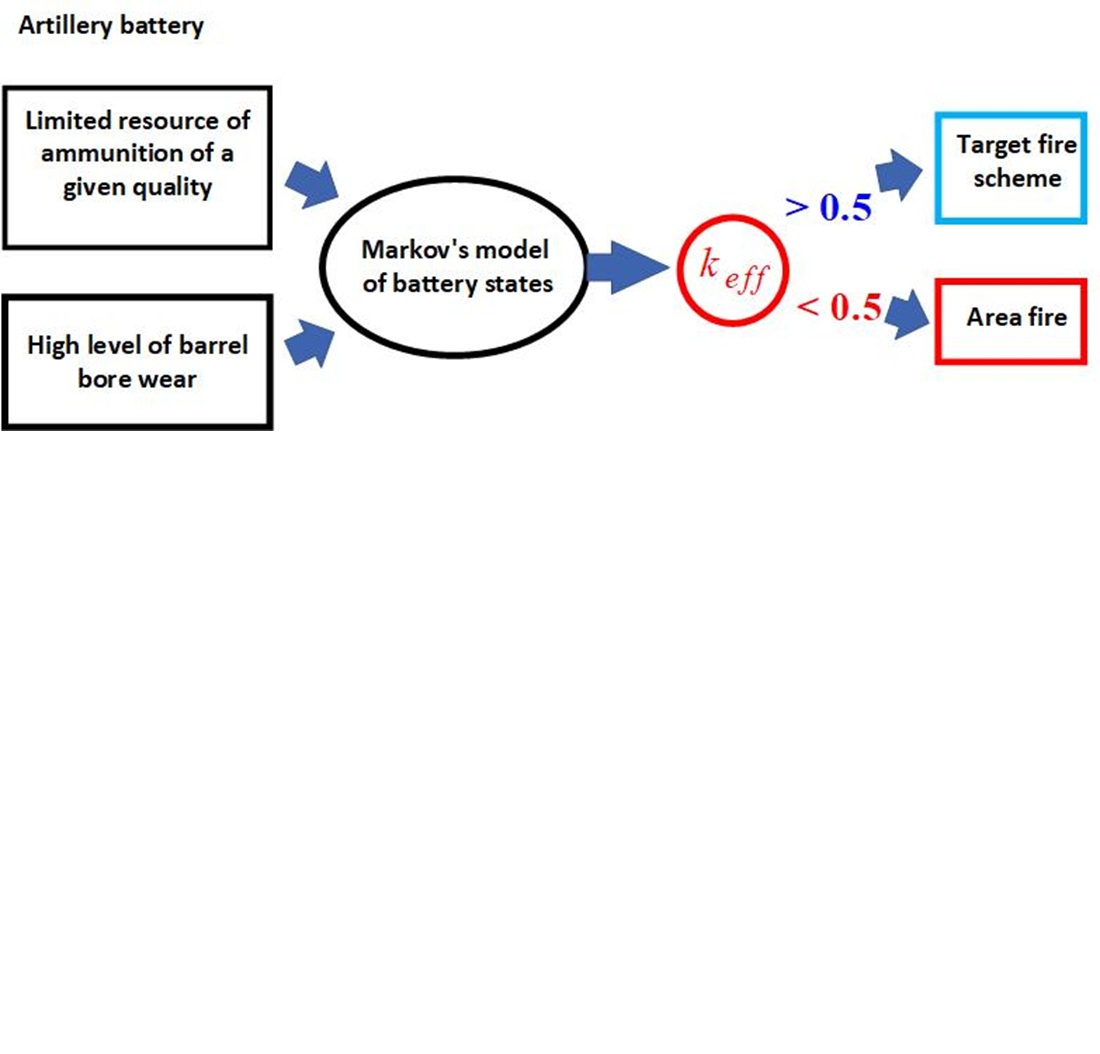
This study examines the process of destroying individual and group targets by an artillery battery under conditions of limited ammunition of a given quality and varying degrees of barrel bore wear.
The task addressed relates to the revealed lack of a quantitative model that would make it possible to assess the effectiveness of aimed or planar fire in the presence of resource limitations on shots and barrel bore wear, which could facilitate determining the threshold conditions for the feasibility of continuing fire.
A discrete stochastic model of the effectiveness of firing an artillery unit has been proposed. The model is designed to assess the effectiveness of aimed fire under conditions of limited resource of high-quality ammunition. The model also takes into account the presence of guns in the unit, the barrels of which have different levels of wear. It is proposed to divide shots from each gun in the artillery unit into four different classes, which takes into account the quality of the shot elements: the projectile and the propellant charge, as well as the condition of the barrel.
It is proposed to consider the successive states of the artillery unit's guns as elements of the Markov chain. It was established that it is possible to achieve a firing efficiency coefficient that lies within the range of 0.63−0.83. The limiting estimate of the firing efficiency coefficient of the artillery unit on a separate target was obtained, which is equal to 0.5.
The results showed that when the limiting value of the firing efficiency coefficient is obtained, aimed fire degenerates into planar target destruction with enlarged scattering ellipses. This state leads to an almost twofold increase in the cost of shots and the time of firing, which sharply increases the risk of counter-battery damage to the battery.
Such results are attributed to the combination of the accepted classification of shots by quality, taking into account the increased wear of the barrel bores due to a decrease in the probability of hitting, and the analysis of a set of realistic gun firing strategies.
The model could be offered for performing tactical calculations when choosing a fire mode, the structure of using available ammunition, and assessing the feasibility of switching from aimed to plane fire
References
- Markov, D. (2025). A change in the way artillery is used, based on the Russia-Ukraine conflict. Environment. Technology. Resources. Proceedings of the International Scientific and Practical Conference, 5, 179–183. https://doi.org/10.17770/etr2025vol5.8464
- Świętochowski, N. (2024). Field Artillery in the defensive war of Ukraine 2022-2023. Part II. Methods of task implementation. Scientific Journal of the Military University of Land Forces, 211 (1), 57–76. https://doi.org/10.5604/01.3001.0054.4136
- Taranets, S., Fylypenko, A. (2025). The artillery application by the defense forces of ukraine during the russian-ukrainian war. Military Strategy and Technology, 1 (1), 99–110. https://doi.org/10.63978/3083-6476.2025.1.1.11
- Sampir, O., Vozniak, R., Horbachova, Y., Novikova, I. (2024). Analysis of the combat experience of the artillery weapon systems operation during the russian-ukrainian war. Social Development and Security, 14 (1), 113–126. https://doi.org/10.33445/sds.2024.14.1.10
- Calcagno, E., Marrone, A. (2024). Artillery in Present and Future High-Intensity Operations. Istituto Affari Internazionali (IAI). Available at: http://www.jstor.org/stable/resrep63163
- Naumenko, I., Kuznetsov, V. (2023). Kontrbatareina borotba za dosvidom rosiisko-ukrainskoi viyny. Scientific Collection «InterConf», 181, 456–459. Available at: https://archive.interconf.center/index.php/conference-proceeding/article/view/4931
- Kryvosheiev, A. M. (2009). Napriamky vykorystannia balistychnoi informatsiyi providnymy vyrobnykamy artyleriyskykh system. Systemy ozbroiennia i viiskova tekhnika, 1, 49–63. Available at: http://nbuv.gov.ua/UJRN/soivt_2009_1_13
- Gouveia, H., Freitas, R. (2024). Innovations and trends in field artillery weapon systems. Cogent Social Sciences, 10 (1). https://doi.org/10.1080/23311886.2024.2411867
- Markov, D. (2024). Use of artillery fire support assets in the attrition approach in the Russia-Ukraine conflict. Environment. Technologies. Resources. Proceedings of the International Scientific and Practical Conference, 4, 178–182. https://doi.org/10.17770/etr2024vol4.8208
- Jehličková, E., Konečný, P., Schmidt, M. (2025). Artillery Modular Charges Review. 2025 International Conference on Military Technologies (ICMT), 1–6. https://doi.org/10.1109/icmt65201.2025.11061321
- Ma, J. (2018). The law of barrel wear and its application. Defence Technology, 14 (6), 674–676. https://doi.org/10.1016/j.dt.2018.06.012
- Banerjee, A., Nayak, N., Giri, D., Bandha, K. (2019). Effect of Gun Barrel Wear on Muzzle Velocity of a typical Artillery Shell. 2019 International Conference on Range Technology (ICORT), 1–3. https://doi.org/10.1109/icort46471.2019.9069641
- Tsybulyak, B. Z. (2016). Parameters degradation barrel artillery equipment during exploitation. Military Technical Collection, 14, 121–126. https://doi.org/10.33577/2312-4458.14.2016.121-126
- Anipko, O., Baulin, D., Horielyshev, S., Boikov, I., Medvid, M., Babkov, Y. et al. (2024). Development of a method for predicting barrel wear resistance when using ammunition with a long storage life. EUREKA: Physics and Engineering, 2, 119–130. https://doi.org/10.21303/2461-4262.2024.003298
- Shabatura, Y., Popovchenko, O. (2023). Modern methods and means of technical diagnostics of artillery weapons and prospects for their development. Military Technical Collection, 29, 90–101. https://doi.org/10.33577/2312-4458.29.2023.90-101
- Qi, W., Liu, J., Gou, Y., Han, Z., Li, B., Wang, K. (2024). Enhancing Artillery Barrel Wear Detection via CRNN-Based Acoustic Analysis and Domain Adaptation. Journal of Physics: Conference Series, 2891 (11), 112018. https://doi.org/10.1088/1742-6596/2891/11/112018
- Świętochowski, N. (2023). Field Artillery in the defensive war of Ukraine 2022-2023Part I. Combat potential, tasks and tactics. Scientific Journal of the Military University of Land Forces, 210 (4), 341–358. https://doi.org/10.5604/01.3001.0054.1631
- Sampir, O., Dachkovskiy, V. (2023). Analysis of the 155 mm howitzer М777 operation during its combat use by units of the Armed Force of Ukraine in the Russian-Ukraine war in 2022. Social Development and Security, 13 (2), 31–40. https://doi.org/10.33445/sds.2023.13.2.4
- Nugroho, A., Ruyat, Y., Marsono, M. (2024). Comparison of Ballistic Performance Between Conventional and Modern Artillery Weapons: A Review on the M777 Howitzer Cannon. International Journal of Progressive Sciences and Technologies, 45 (2), 357–365.
- Aries, H., Giegerich, B., Lawrenson, T. (2023). The Guns of Europe: Defence-industrial Challenges in a Time of War. Survival, 65 (3), 7–24. https://doi.org/10.1080/00396338.2023.2218716
- Toshev, O., Kirkopulo, K., Klymchuk, O., Maksymov, M. (2025). Optimization of ammunition preparation strategies for modern artillery operations in computer simulation. Technology Audit and Production Reserves, 2 (2 (82)), 50–57. https://doi.org/10.15587/2706-5448.2025.326225
- Guzik, D. M. (1988). A Markov model for measuring artillery fire support effectiveness. California: Postgraduate School.
- Finlon, M. A. (1991). Analysis of the field artillery battalion organization using a Markov chain. Calhoun: The NPS Institutional Archive. Available at: https://core.ac.uk/download/pdf/36720787.pdf
- Boltenkov, V., Brunetkin, O., Dobrynin, Y., Maksymova, O., Kuzmenko, V., Gultsov, P. et al. (2021). Devising a method for improving the efficiency of artillery shooting based on the Markov model. Eastern-European Journal of Enterprise Technologies, 6 (3 (114)), 6–17. https://doi.org/10.15587/1729-4061.2021.245854
- Shim, Y., Atkinson, M. P. (2018). Analysis of artillery shoot‐and‐scoot tactics. Naval Research Logistics (NRL), 65 (3), 242–274. https://doi.org/10.1002/nav.21803
- Maksymova, O., Boltyonkov, V., Gultsov, P., Maksymov, O. (2023). Improvement of the model and method of artillery installation target damage control with minimal combat capability loss. Odes’kyi Politechnichnyi Universytet Pratsi, 2 (68), 98–115. https://doi.org/10.15276/opu.2.68.2023.11
- Aldoegre, M. (2019). Comparison between trajectory models for firing table application. North-West University, 94. Available at: https://5dok.net/document/7q08x49y-comparison-between-trajectory-models-for-firing-table-application.html
- arma3. Available at: https://arma3.com/
- Maksymova, O. B., Boltenkov, V. O., Maksymov, M. V., Gultsov, P. S., Maksymov, O. M. (2023). Development and optimization of simulation models and methods for controlling virtual artillery units in game scenarios. Herald of Advanced Information Technology, 6 (4), 320–337. https://doi.org/10.15276/hait.06.2023.21
Downloads
Published
How to Cite
Issue
Section
License
Copyright (c) 2025 Maksym Maksymov, Viktor Boltenkov, Yevhenii Dobrynin, Oleksandr Sidelnykov

This work is licensed under a Creative Commons Attribution 4.0 International License.
The consolidation and conditions for the transfer of copyright (identification of authorship) is carried out in the License Agreement. In particular, the authors reserve the right to the authorship of their manuscript and transfer the first publication of this work to the journal under the terms of the Creative Commons CC BY license. At the same time, they have the right to conclude on their own additional agreements concerning the non-exclusive distribution of the work in the form in which it was published by this journal, but provided that the link to the first publication of the article in this journal is preserved.
A license agreement is a document in which the author warrants that he/she owns all copyright for the work (manuscript, article, etc.).
The authors, signing the License Agreement with TECHNOLOGY CENTER PC, have all rights to the further use of their work, provided that they link to our edition in which the work was published.
According to the terms of the License Agreement, the Publisher TECHNOLOGY CENTER PC does not take away your copyrights and receives permission from the authors to use and dissemination of the publication through the world's scientific resources (own electronic resources, scientometric databases, repositories, libraries, etc.).
In the absence of a signed License Agreement or in the absence of this agreement of identifiers allowing to identify the identity of the author, the editors have no right to work with the manuscript.
It is important to remember that there is another type of agreement between authors and publishers – when copyright is transferred from the authors to the publisher. In this case, the authors lose ownership of their work and may not use it in any way.








