Development of technology for cooking boiled sausage with the addition of soy isolate and chickpea flour
DOI:
https://doi.org/10.15587/1729-4061.2025.347797Keywords:
soy isolate, chickpea flour, boiled sausage, beef meat, chicken breastAbstract
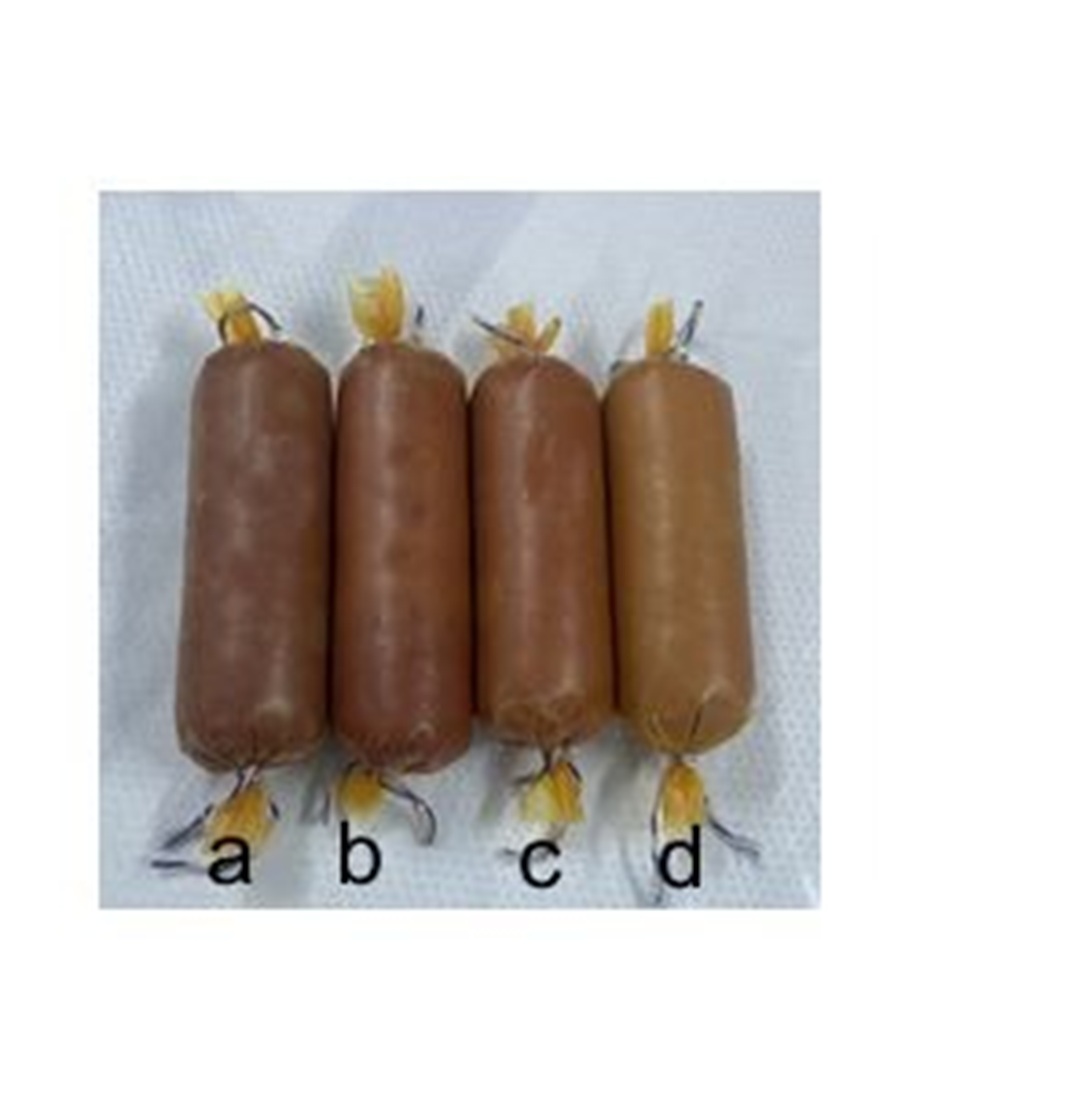
The object of the study is the production of cooked sausages from beef and chicken breast with the addition of soy isolate and chickpea flour. The problem to be solved is to development of combined meats. An improved recipe for boiled sausage with the addition of soy isolate and chickpea flour is proposed. Its process is fully described. The technology is distinguished by its simplicity of preparation. According to the developed technology, several samples of boiled sausage were experimentally produced, combined according to the ratio 100:0, 70:30, 80:20, 60:40 based on a balanced ratio of the main food components, providing increased digestibility and digestibility. Production tests of the product development were carried out. The quality assessment of the organoleptic and physico-chemical parameters of the finished product was carried out according to generally accepted methods.
The effect of soy isolate on the quality characteristics of combined cooked sausages containing chickpea flour and 10% beef fat was studied. Recipes containing premium beef and chicken breast in a 60:40 ratio were examined for their physical and organoleptic properties. The inclusion of soy isolate and chickpea flour significantly increased the moisture content, moisture and fat resistance, and finished product yield, and reduced cooking losses compared to the control sample. Furthermore, the sausages were less red with the addition of at least 5% soy isolate and chickpea flour. The results of the organoleptic evaluation showed that some quality characteristics of light sausages, such as juiciness and density, can be improved by the addition of soy isolate. Both sausages with 3% soy isolate and the control light sausages were darker and denser.
References
- Turisbekova, G., Aitmukhanbetova, D. (2020). Development of the meat processing industry of the Republic of Kazakhstan. Problems of the agricultural market, 1, 127–134.
- Kenenbai, Sh. Y., Uzakov, Yа. M., Tortay, A. N., Omirkhan, A. A. (2025). Study of the effect of plant-based components on the quality indicators of meat products. The Journal of Almaty Technological University, 148 (2), 99–107. https://doi.org/10.48184/2304-568x-2025-2-99-107
- Vasilev, D., Glišić, M., Janković, V., Dimitrijević, M., Karabasil, N., Suvajdžić, B., Teodorović, V. (2017). Perspectives in production of functional meat products. IOP Conference Series: Earth and Environmental Science, 85, 012033. https://doi.org/10.1088/1755-1315/85/1/012033
- Clemente, A. (2000). Enzymatic protein hydrolysates in human nutrition. Trends in Food Science & Technology, 11 (7), 254–262. https://doi.org/10.1016/s0924-2244(01)00007-3
- Idowu, A. T., Benjakul, S., Sinthusamran, S., Sookchoo, P., Kishimura, H. (2018). Protein hydrolysate from salmon frames: Production, characteristics and antioxidative activity. Journal of Food Biochemistry, 43 (2), e12734. https://doi.org/10.1111/jfbc.12734
- Colla, G., Rouphael, Y., Canaguier, R., Svecova, E., Cardarelli, M. (2014). Biostimulant action of a plant-derived protein hydrolysate produced through enzymatic hydrolysis. Frontiers in Plant Science, 5. https://doi.org/10.3389/fpls.2014.00448
- Grasso, S., Brunton, N. P., Lyng, J. G., Lalor, F., Monahan, F. J. (2014). Healthy processed meat products – Regulatory, reformulation and consumer challenges. Trends in Food Science & Technology, 39 (1), 4–17. https://doi.org/10.1016/j.tifs.2014.06.006
- Etemadian, Y., Ghaemi, V., Shaviklo, A. R., Pourashouri, P., Sadeghi Mahoonak, A. R., Rafipour, F. (2021). Development of animal/ plant-based protein hydrolysate and its application in food, feed and nutraceutical industries: State of the art. Journal of Cleaner Production, 278, 123219. https://doi.org/10.1016/j.jclepro.2020.123219
- Mohammadian, M., Madadlou, A. (2016). Characterization of fibrillated antioxidant whey protein hydrolysate and comparison with fibrillated protein solution. Food Hydrocolloids, 52, 221–230. https://doi.org/10.1016/j.foodhyd.2015.06.022
- Kozhakhiyeva, M., Kaldarbekova, M., Yessengaziyeva, A., Uzakov, Y., Medeubayeva, Z., Kuzembayeva, G., Aitbayeva, A. (2025). Devising a technology and optimizing processing parameters for making functional boiled sausage fortified with protein hydrolysates. Eastern-European Journal of Enterprise Technologies, 3 (11 (135)), 52–60. https://doi.org/10.15587/1729-4061.2025.330002
- Sha, L., Liu, S., Liu, D. (2020). Effects of soybean protein isolate on protein structure, batter rheology, and water migration in emulsified sausage. Journal of Food Processing and Preservation, 44 (9). https://doi.org/10.1111/jfpp.14711
- Mohamed, H. M., Emara, M. M., Nouman, T. M. (2015). Effect of cooking temperatures on characteristics and microstructure of camel meat emulsion sausages. Journal of the Science of Food and Agriculture, 96 (9), 2990–2997. https://doi.org/10.1002/jsfa.7468
Downloads
Published
How to Cite
Issue
Section
License
Copyright (c) 2025 Elmira Kanseitova, Aibala Taspoltayeva, Zhazira Zheleuova, Marat Abishev, Birol Kilic

This work is licensed under a Creative Commons Attribution 4.0 International License.
The consolidation and conditions for the transfer of copyright (identification of authorship) is carried out in the License Agreement. In particular, the authors reserve the right to the authorship of their manuscript and transfer the first publication of this work to the journal under the terms of the Creative Commons CC BY license. At the same time, they have the right to conclude on their own additional agreements concerning the non-exclusive distribution of the work in the form in which it was published by this journal, but provided that the link to the first publication of the article in this journal is preserved.
A license agreement is a document in which the author warrants that he/she owns all copyright for the work (manuscript, article, etc.).
The authors, signing the License Agreement with TECHNOLOGY CENTER PC, have all rights to the further use of their work, provided that they link to our edition in which the work was published.
According to the terms of the License Agreement, the Publisher TECHNOLOGY CENTER PC does not take away your copyrights and receives permission from the authors to use and dissemination of the publication through the world's scientific resources (own electronic resources, scientometric databases, repositories, libraries, etc.).
In the absence of a signed License Agreement or in the absence of this agreement of identifiers allowing to identify the identity of the author, the editors have no right to work with the manuscript.
It is important to remember that there is another type of agreement between authors and publishers – when copyright is transferred from the authors to the publisher. In this case, the authors lose ownership of their work and may not use it in any way.








