Establishing the dependence of fatty acids content and lipid quality on maturity term of the alpine and yogurt hard goat cheeses
DOI:
https://doi.org/10.15587/1729-4061.2026.350220Keywords:
fatty acids, fat quality indices, unpasteurized milkAbstract
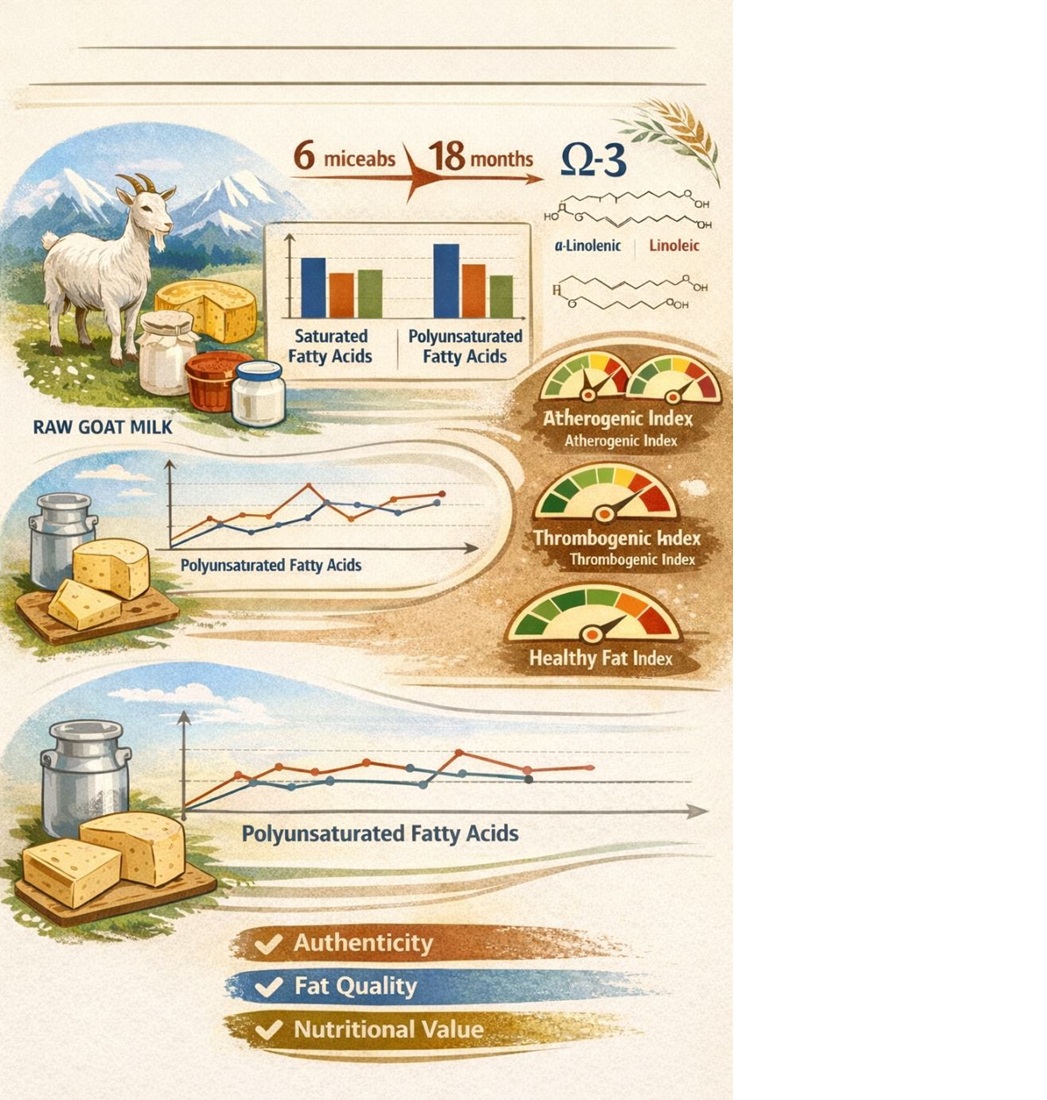
The Alpine and Yogurt craft hard cheeses made from unpasteurized goat milk are studied in this paper. The task under consideration is to define the authenticity criteria for the Alpine and Yogurt craft goat cheeses made from unpasteurized milk during maturity process.
Consumers' orientation towards healthy eating leads to an increase in the supply of craft cheeses made from unpasteurized goat milk on the market, which involves assessing their quality, safety, and establishing authenticity criteria. Such indicators include the fatty acid composition and quality of milk fat lipids.
The fatty acid composition of the cheeses has been analyzed using gas chromatography. The lipid structure of both cheeses contained 15 fatty acids (11 saturated and 4 unsaturated). The share of saturated fatty acids increased by 4.04–4.44% at the 18th month of maturity of the Yogurt cheese and at the 6th month of maturity of the Alpine cheese.
During the maturity process, the proportion of polyunsaturated fatty acids in the Alpine cheese increased by 1.60–2.07%; in the Yogurt cheese by 1.24–2.35%. In both cheeses, the basis of ω-3 and ω-6 polyunsaturated fatty acids was linolenic and linoleic; their ratio ranged from 1:4.26 to 1:2.31.
The ripened Alpine and Yogurt cheeses were characterized by the highest indices of thrombogenicity and atherogenicity, in contrast to old-ripened cheeses, in which these indices decreased against the background of an increase in the indices of hypocholesterolemic/hypercholesterolemic acids and healthy fat. The delta nine desaturase index (C14) during maturity period of the Alpine cheese decreased by 0.010–0.011; in the Yogurt cheese, on the contrary, it increased by 0.054–0.026 units.
The fatty acid composition of goat craft hard cheeses could be a justification for devising criteria for their authenticity and nutritional value
References
- Inácio, R. S., Rodríguez-Alcalá, L. M., Pimentel, L. L., Saraiva, J. A., Gomes, A. M. P. (2023). Evolution of Qualitative and Quantitative Lipid Profiles of High-Pressure-Processed Serra da Estrela Cheese throughout Storage. Applied Sciences, 13 (10), 5927. https://doi.org/10.3390/app13105927
- Bal-Prylypko, L., Berezina, L., Stepasyuk, L., Cherednichenko, O., Lialyk, A. (2023). Developing dairy farming and improving product quality. Scientific Horizons, 27 (1), 140–151. https://doi.org/10.48077/scihor1.2024.140
- Kasapidou, E., Karatzia, M.-A., Mitlianga, P., Basdagianni, Z. (2022). Effects of Production Systems and Seasons on Retail-Goat-Milk Fatty-Acid Composition and Nutritional Indices in Greece. Animals, 12 (17), 2204. https://doi.org/10.3390/ani12172204
- Bal-Prylypko, L., Nikolaenko, M., Volkhova, T., Holembovska, N., Tyshchenko, L., Ivaniuta, A. et al. (2023). The study of functional and technological properties of vegetarian ice cream. Potravinarstvo Slovak Journal of Food Sciences, 17, 110–121. https://doi.org/10.5219/1798
- Vlasenko, I., Bandura, V., Semko, T., Fialkovska, L., Ivanishcheva, O., Palamarchuk, V. (2021). Innovative approaches to the development of a new sour milk product. Potravinarstvo Slovak Journal of Food Sciences, 15, 970–981. https://doi.org/10.5219/1688
- Savchenko, O., Grek, O., Skuibida, V., Onopriichuk, O., Pshenychnа, T. (2025). Optimisation of parameters for obtaining milk-plant concentrates. Animal Science and Food Technology, 16 (1), 126–140. https://doi.org/10.31548/animal.1.2025.126
- Davydovych, V., Shevchenko, L., Shulyak, S., Nedashkivskyi, V., Semenko, O., Tyshchenko, L. et al. (2025). Influence of aging time on the physicochemical characteristics of craft soft cheeses made from unpasteurized goat’s milk. Acta Universitatis Agriculturae et Silviculturae Mendelianae Brunensis, 73 (4-5), 243–252. https://doi.org/10.11118/actaun.2025.017
- Ali, A. H., Khalifa, S. A., Gan, R.-Y., Shah, N., Ayyash, M. (2023). Fatty acids, lipid quality parameters, and amino acid profiles of unripened and ripened cheeses produced from different milk sources. Journal of Food Composition and Analysis, 123, 105588. https://doi.org/10.1016/j.jfca.2023.105588
- Anedda, R., Pardu, A., Korb, J.-P., Curti, E. (2021). Effect of the manufacturing process on Fiore Sardo PDO cheese microstructure by multi-frequency NMR relaxometry. Food Research International, 140, 110079. https://doi.org/10.1016/j.foodres.2020.110079
- Iakubchak, O., Martynenko, O., Taran, T., Pylypchuk, O., Naumenko, T., Tverezovska, N. et al. (2024). Analysis of the hard rennet cheese microbiota at different stages of the technological process. Potravinarstvo Slovak Journal of Food Sciences, 18, 899–918. https://doi.org/10.5219/2011
- Wang, F., Wang, M., Xu, L., Qian, J., Xu, B., Gao, X. et al. (2025). Application and Possible Mechanism of Microbial Fermentation and Enzyme Catalysis in Regulation of Food Flavour. Foods, 14 (11), 1909. https://doi.org/10.3390/foods14111909
- Westheim, A. J. F., Stoffels, L. M., Dubois, L. J., van Bergenhenegouwen, J., van Helvoort, A., Langen, R. C. J. et al. (2022). Fatty Acids as a Tool to Boost Cancer Immunotherapy Efficacy. Frontiers in Nutrition, 9. https://doi.org/10.3389/fnut.2022.868436
- Kapoor, B., Kapoor, D., Gautam, S., Singh, R., Bhardwaj, S. (2021). Dietary Polyunsaturated Fatty Acids (PUFAs): Uses and Potential Health Benefits. Current Nutrition Reports, 10 (3), 232–242. https://doi.org/10.1007/s13668-021-00363-3
- Barać, M. (2025). Fatty acid profiles and health fatty acid indices of traditional cheeses of southeastern European countries. Mljekarstvo, 75 (2), 63–77. https://doi.org/10.15567/mljekarstvo.2025.0201
- Bittante, G., Amalfitano, N., Tagliapietra, F., Schiavon, S., Cipolat-Gotet, C., Stocco, G. (2024). Characterization of the Detailed Fatty Acid Profiles of a Large Number of Types of Cheese from the Mountains and Plains. Foods, 13 (24), 4040. https://doi.org/10.3390/foods13244040
- Davydovych, V., Shevchenko, L., Brovenko, T., Nesterenko, N., Altanova, A., Umanets, R. et al. (2025). Microbiological changes in craft hard cheeses from raw goat milk during ripening with the use of mites Acarus siro. Scifood, 19, 176–191. https://doi.org/10.5219/scifood.26
- Folch, J., Lees, M., Stanley, G. H. S. (1957). A simple method for the isolation and purification of total lipides from animal tissues. Journal of Biological Chemistry, 226 (1), 497–509. https://doi.org/10.1016/s0021-9258(18)64849-5
- Christie, W. W. (1982). Lipid analysis: isolation, separation, identification, and structural analysis of lipids. Pergamon Press.
- Burgos, L. S., Pece, N., Maldonado, S. (2020). Fatty acid composition and microstructure of ripened goat cheese. Latin American Applied Research - An International Journal, 51 (1), 43–48. https://doi.org/10.52292/j.laar.2021.166
- Medeiros, E., Queiroga, R., Oliveira, M., Medeiros, A., Sabedot, M., Bomfim, M., Madruga, M. (2014). Fatty Acid Profile of Cheese from Dairy Goats Fed a Diet Enriched with Castor, Sesame and Faveleira Vegetable Oils. Molecules, 19 (1), 992–1003. https://doi.org/10.3390/molecules19010992
- Ivanova, A., Hadzhinikolova, L. (2015). Evaluation of nutritional quality of common carp (Cyprinus carpio L.) lipids through fatty acid ratios and lipid indices. Bulgarian Journal of Agricultural Science, 21 (1). 180–185. Available at: https://www.agrojournal.org/21/01s-27.pdf
- Ulbricht, T. L. V., Southgate, D. A. T. (1991). Coronary heart disease: seven dietary factors. The Lancet, 338 (8773), 985–992. https://doi.org/10.1016/0140-6736(91)91846-m
- Dal Bosco, A., Cavallo, M., Menchetti, L., Angelucci, E., Cartoni Mancinelli, A., Vaudo, G. et al. (2024). The Healthy Fatty Index Allows for Deeper Insights into the Lipid Composition of Foods of Animal Origin When Compared with the Atherogenic and Thrombogenicity Indexes. Foods, 13 (10), 1568. https://doi.org/10.3390/foods13101568
- Sadvari, V. Y., Shevchenko, L. V., Midyk, S. V., Korniyenko, V. I., Slobodyanyuk, N. M., Pylypchuk, О. S. et al. (2025). Fatty acid profile of artisanal hard cheeses made from raw goat milk during the ripening process. Regulatory Mechanisms in Biosystems, 33 (1), e25002. https://doi.org/10.15421/0225002
- Ioannidou, M. D., Maggira, M., Samouris, G. (2022). Physicochemical Characteristics, Fatty Acids Profile and Lipid Oxidation during Ripening of Graviera Cheese Produced with Raw and Pasteurized Milk. Foods, 11 (14), 2138. https://doi.org/10.3390/foods11142138
- Singh, T. P., Arora, S., Borad, S. G., Bam, J., Paul, V., Thomas, R., Sarkar, M. (2023). Fatty acid and amino acid profiling, antioxidant activity and other quality characteristics of vacuum packed cheddar style-yak milk cheese during ripening. Food Bioscience, 51, 102213. https://doi.org/10.1016/j.fbio.2022.102213
- Mylostyvyi, R., Midyk, S., Izhboldina, O., Cherniy, N., Kornienko, V. (2023). Changes in the Qualitative Composition of the milk of Holstein Cows During Summer Chronic Heat Stress. Jurnal Ilmu Ternak Dan Veteriner, 28 (2), 112–121. https://doi.org/10.14334/jitv.v28i2.3151
- Sadvari, V. Y., Shevchenko, L. V., Slobodyanyuk, N. M., Tupitska, O. M., Gruntkovskyi, M. S., Furman, S. V. (2024). Microbiome of craft hard cheeses from raw goat milk during ripening. Regulatory Mechanisms in Biosystems, 15 (3), 483–489. https://doi.org/10.15421/022468
- Davydovych, V., Shevchenko, L., Mykhalska, V., Pylypchuk, O., Naumenko, T. (2025). Microbiome of Kraft soft cheeses made from raw goat milk during ripening. Animal Science and Food Technology, 16 (3), 105–120. https://doi.org/10.31548/animal.3.2025.105
- Davydovych, V., Shevchenko, L., Shulyak, S., Slobodyanyuk, N., Nedashkivskyi, V., Tomchuk, V. et al. (2025). The influence of ripening time on the physicochemical characteristics of craft hard goat cheeses. Online Journal of Animal and Feed Research, 15 (5), 264–273. https://doi.org/10.51227/ojafr.2025.30
- Purkiewicz, A., Pietrzak-Fiećko, R. (2024). Determination of the Fatty Acid Profile and Lipid Quality Indices in Selected Infant Formulas. Molecules, 29 (9), 2044. https://doi.org/10.3390/molecules29092044
Downloads
Published
How to Cite
Issue
Section
License
Copyright (c) 2026 Viktor Davydovych, Larysa Shevchenko, Natalia Slobodyanyuk, Svitlana Furman, Valentyna Bandura, Tetiana Lebedenko, Olena Sydorenko, Nataliia Kovalenko, Natalia Nesterenko

This work is licensed under a Creative Commons Attribution 4.0 International License.
The consolidation and conditions for the transfer of copyright (identification of authorship) is carried out in the License Agreement. In particular, the authors reserve the right to the authorship of their manuscript and transfer the first publication of this work to the journal under the terms of the Creative Commons CC BY license. At the same time, they have the right to conclude on their own additional agreements concerning the non-exclusive distribution of the work in the form in which it was published by this journal, but provided that the link to the first publication of the article in this journal is preserved.
A license agreement is a document in which the author warrants that he/she owns all copyright for the work (manuscript, article, etc.).
The authors, signing the License Agreement with TECHNOLOGY CENTER PC, have all rights to the further use of their work, provided that they link to our edition in which the work was published.
According to the terms of the License Agreement, the Publisher TECHNOLOGY CENTER PC does not take away your copyrights and receives permission from the authors to use and dissemination of the publication through the world's scientific resources (own electronic resources, scientometric databases, repositories, libraries, etc.).
In the absence of a signed License Agreement or in the absence of this agreement of identifiers allowing to identify the identity of the author, the editors have no right to work with the manuscript.
It is important to remember that there is another type of agreement between authors and publishers – when copyright is transferred from the authors to the publisher. In this case, the authors lose ownership of their work and may not use it in any way.








