Construction of a generalized mathematical model for particle sliding on the surface of a rotating vertical straight helicoid
DOI:
https://doi.org/10.15587/1729-4061.2026.352152Keywords:
vertical helicoid, generalized model, sliding trajectory, complex motion, particle motionAbstract
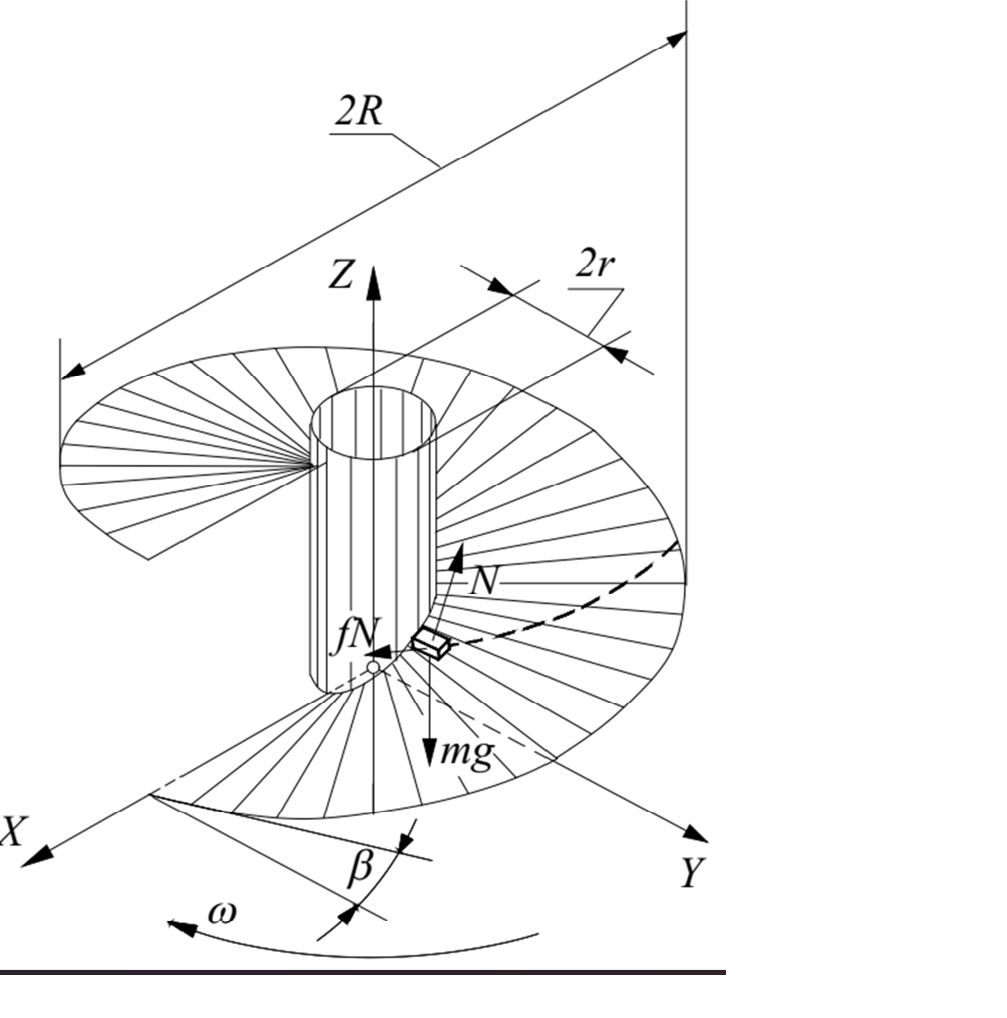
The object of this study is the complex motion of a particle on the surface of a vertical straight helicoid rotating around its own axis. In screw conveyors, closed helicoids are used as well-known technical helical surfaces. An issue is not the disadvantages of using classical closed helicoids but the limitations of existing mathematical models of particle motion, which essentially reduce engineering research only to this type of surfaces. The lack of a generalized model for other helical surfaces makes their analysis and practical application impossible. The proposed approach expands the class of helicoids under consideration and creates the prerequisites for finding new design solutions.
The derived second-order differential equations describe the trajectory of particle sliding on the surface. Depending on the structural parameters, such a surface can be an open or closed helicoid, as well as a special case of rotation of a horizontal flat disk. That has made it possible to define the parameters of particle motion on different surfaces and compare the results. In particular, the particle sliding trajectories along closed and open helicoids rotating with angular velocity ω = 10 s–1 and ω = 20 s–1 were constructed. In this case, the friction coefficient f = 0.3 and the lift angle β = 15° of the outer edge of the surface were assumed at a radius of R = 0.1 m of the limiting cylinder. The particle sliding trajectories were constructed within the surface compartment, as well as under the condition that it is not limited by the cylinder.
The practical significance of the results is the possibility of using the model built for designing energy-efficient screw conveyors without an external casing. This makes it possible to reduce the metal content of structures by 15–20% and prevent jamming during the transportation of fractional materials. The resulting analytical dependences make it possible to calculate the optimal screw pitch and shaft radius to ensure a given material movement trajectory.
References
- Diachun, A., Gevko, I., Lyashuk, O., Stanko, A., Pik, A., Omelyanskyi, Y. (2024). Study of fiber deformation of elastic brush-like screws during grain material transportation. INMATEH Agricultural Engineering, 72 (1), 579–588. https://doi.org/10.35633/inmateh-72-51
- Nоvitskiy, A., Banniy, O., Novitskyi, Y., Antal, M. (2023). A study of mixer-feeder equipment operational reliability. Machinery & Energetics, 14 (4), 101–110. https://doi.org/10.31548/machinery/4.2023.101
- Minglani, D., Sharma, A., Pandey, H., Dayal, R., Joshi, J. B., Subramaniam, S. (2020). A review of granular flow in screw feeders and conveyors. Powder Technology, 366, 369–381. https://doi.org/10.1016/j.powtec.2020.02.066
- Wulantuya, Wang, H., Wang, C., Qinglin. (2020). Theoretical analysis and experimental study on the process of conveying agricultural fiber materials by screw conveyors. Engenharia Agrícola, 40 (5), 589–594. https://doi.org/10.1590/1809-4430-eng.agric.v40n5p589-594/2020
- Mei, X., Xue, Y., Zhang, L. (2022). Determination of the optimal working performance matching through theoretical analysis and experimental study for a screw conveyor. PLOS ONE, 17 (6), e0266948. https://doi.org/10.1371/journal.pone.0266948
- Moelder, K., Lillerand, T. (2025). Design and feasbility analysis of vertical static flight screw conveyor usage in granulated fertilizer transportation. 24th International Scientific Conference Engineering for Rural Development Proceedings, 24. https://doi.org/10.22616/erdev.2025.24.tf090
- Karwat, B., Rubacha, P., Stańczyk, E. (2020). Simulational and experimental determination of the exploitation parameters of a screw conveyor. Eksploatacja i Niezawodność – Maintenance and Reliability, 22 (4), 741–747. https://doi.org/10.17531/ein.2020.4.18
- Wenwu, Y., Longyu, F., Xiwen, L., Hui, L., Yangqing, Y., Zhanhao, L. (2020). Experimental study of the effects of discharge port parameters on the fertilizing performance for fertilizer distribution apparatus with screw. Transactions of the Chinese Society of Agricultural Engineering, 36 (17). https://doi.org/10.11975/j.issn.1002-6819.2020.17.001
- Pylypaka, S., Volina, T., Hryshchenko, I., Dieniezhnikov, S., Rybenko, I. (2022). Mathematical Model of Lifting Particles of Technological Material by Vertical Auger. Advances in Design, Simulation and Manufacturing V, 112–122. https://doi.org/10.1007/978-3-031-06044-1_11
- Pylypaka, S., Babka, V., Hryshchenko, I., Kresan, Т. (2018). Mathematical model of moving particle by vertical screw in stationary mode. Machinery & Energetics, 9 (4), 31–36. Available at: https://technicalscience.com.ua/uk/journals/t-9-4-2018/matyematichna-modyel-pyeryemishchyennya-chastinki-vyertikalnim-shnyekom-pri-statsionarnomu-ryezhimi
- Kresan, T. A. (2020). Calculation of gravitation descent formed by surface of skew closed helicoid. Machinery & Energetics, 11 (2), 49–57. https://doi.org/10.31548/machenergy2020.02.049
- Klendii, M., Logusch, I., Dragan, A., Tsvartazkii, I., Grabar, A. (2022). Justification and calculation of design and strength parameters of screw loaders. Machinery & Energetics, 13 (4), 48–59. https://doi.org/10.31548/machenergy.13(4).2022.48-59
- Bidas, M., Galecki, G. (2021). The concept of a screw conveyor for the vertical transport of bulk materials. Mining Machines, 39 (3), 28–33. https://doi.org/10.32056/KOMAG2021.3.3
- Tarelnyk, V. B., Konoplianchenko, Ie. V., Gaponova, O. P., Tarelnyk, N. V., Martsynkovskyy, V. S., Sarzhanov, B. O. et al. (2020). Effect of Laser Processing on the Qualitative Parameters of Protective Abrasion-Resistant Coatings. Powder Metallurgy and Metal Ceramics, 58 (11-12), 703–713. https://doi.org/10.1007/s11106-020-00127-8
- Lytvynenko, A., Yukhymenko, M., Pavlenko, I., Pitel, J., Mizakova, J., Lytvynenko, O. et al. (2019). Ensuring the Reliability of Pneumatic Classification Process for Granular Material in a Rhomb-Shaped Apparatus. Applied Sciences, 9 (8), 1604. https://doi.org/10.3390/app9081604
- Yuan, J., Li, M., Ye, F., Zhou, Z. (2020). Dynamic characteristic analysis of vertical screw conveyor in variable screw section condition. Science Progress, 103 (3). https://doi.org/10.1177/0036850420951056
- Rademacher, F. J. C. (1974). Some aspects of the characteristics of vertical screw conveyors for granular material. Powder Technology, 9 (2-3), 71–89. https://doi.org/10.1016/0032-5910(74)85011-4
- Diachun, A. Y., Dmytriv, O. R., Нevko, B. R., Koval, S. O., Tsapyk, R. P. (2024). Experimental automated equipment of the screw conveyor with the rotating casing for bulk materials mixing. Perspective technologies and devices, 1 (24), 38–44. https://doi.org/10.36910/10.36910/6775-2313-5352-2024-24-06
- Zareiforoush, H., Komarizadeh, M. H., Alizadeh, M. R., Masoomi, M. (2010). Screw Conveyors Power and Throughput Analysis during Horizontal Handling of Paddy Grains. Journal of Agricultural Science, 2 (2). https://doi.org/10.5539/jas.v2n2p147
- Bulgakov, V., Trokhaniak, O., Holovach, I., Adamchuk, V., Klendii, M., Ivanovs, S. (2022). Investigation of the performance of a screw conveyor with a working body, made in the form of a shaft with inclined flat blades. INMATEH Agricultural Engineering, 67 (2), 406–411. https://doi.org/10.35633/inmateh-67-41
Downloads
Published
How to Cite
Issue
Section
License
Copyright (c) 2026 Tetiana Volina, Serhii Pylypaka, Ivan Rogovskii, Mykhailo Kalenyk, Vitalii Ploskyi, Natalia Ausheva, Olga Shoman, Vitaliy Babka, Oleksandr Tatsenko, Larysa Korzh-Usenko

This work is licensed under a Creative Commons Attribution 4.0 International License.
The consolidation and conditions for the transfer of copyright (identification of authorship) is carried out in the License Agreement. In particular, the authors reserve the right to the authorship of their manuscript and transfer the first publication of this work to the journal under the terms of the Creative Commons CC BY license. At the same time, they have the right to conclude on their own additional agreements concerning the non-exclusive distribution of the work in the form in which it was published by this journal, but provided that the link to the first publication of the article in this journal is preserved.
A license agreement is a document in which the author warrants that he/she owns all copyright for the work (manuscript, article, etc.).
The authors, signing the License Agreement with TECHNOLOGY CENTER PC, have all rights to the further use of their work, provided that they link to our edition in which the work was published.
According to the terms of the License Agreement, the Publisher TECHNOLOGY CENTER PC does not take away your copyrights and receives permission from the authors to use and dissemination of the publication through the world's scientific resources (own electronic resources, scientometric databases, repositories, libraries, etc.).
In the absence of a signed License Agreement or in the absence of this agreement of identifiers allowing to identify the identity of the author, the editors have no right to work with the manuscript.
It is important to remember that there is another type of agreement between authors and publishers – when copyright is transferred from the authors to the publisher. In this case, the authors lose ownership of their work and may not use it in any way.








