Ergonomic optimization of a manual wheeled furrowing implement (IMRS) using user-centered design methodologies: a case study in Peruvian smallholder agriculture
DOI:
https://doi.org/10.15587/1729-4061.2026.352159Keywords:
furrowing implement, rapid upper limb assessment, quality function deployment, digital human modeling, smallholder agriculture, artisanal manufacturingAbstract
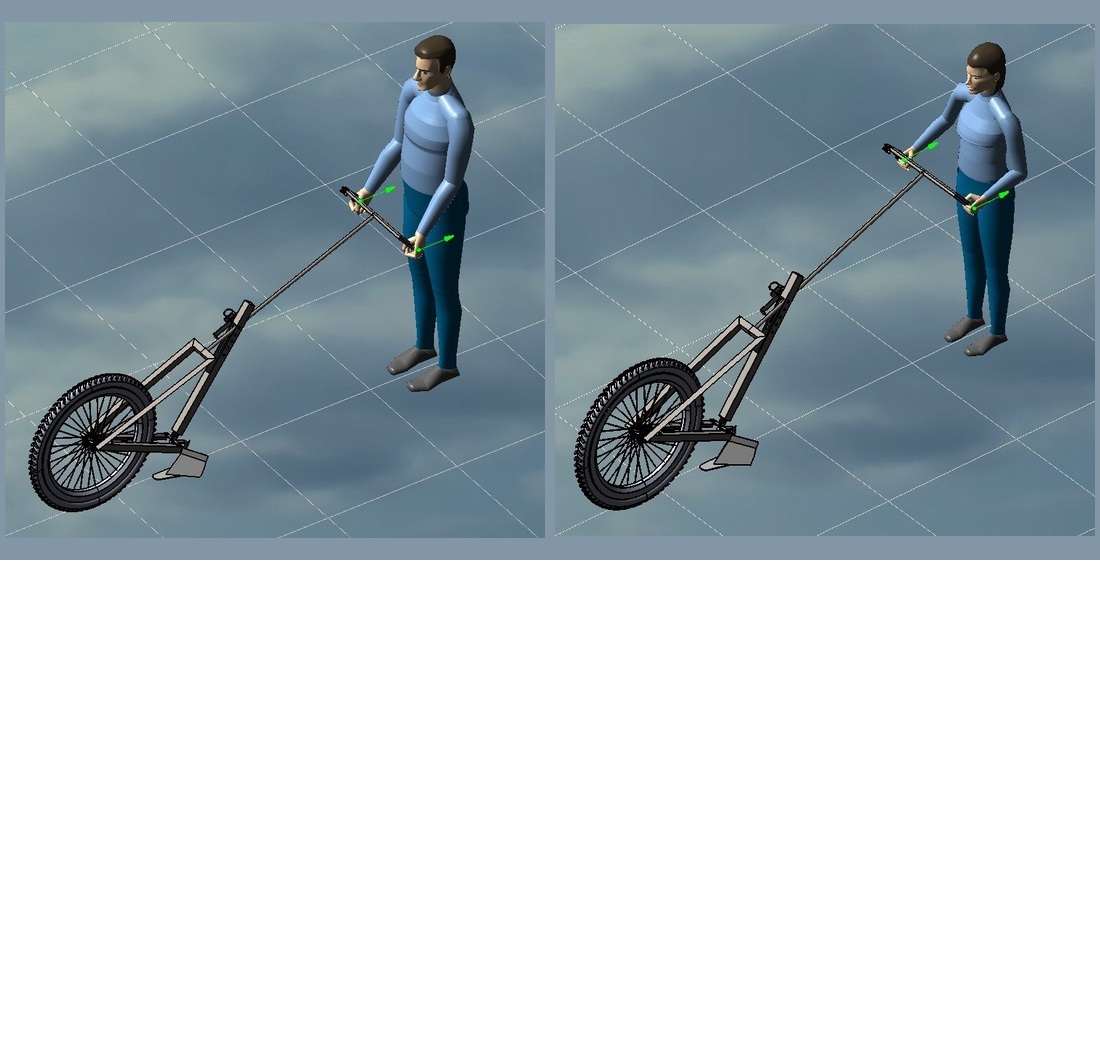
The object of the study is the manual wheeled furrowing implement (IMRS), a human-powered tool used by smallholder farmers in the Tiabaya district (Arequipa, Peru) to form furrows and hill crops of onion and garlic requiring 45 cm spacing, operated for up to 227 furrows per plot in 10–12 hour shifts. The unvarying height of the handle compels taller individuals to maintain prolonged trunk bending and wrist extension, while shorter users manage the excess force with their arms, structurally excluding women who lack a fitting handle height. Four approaches were employed: design thinking and quality function deployment (QFD) to translate farmer needs into key engineering goals; VDI 2221/2225 to evaluate design alternatives; the McKyes & Ali equation for modeling soil resistance in sandy loam found in Tiabaya; and Digital Human Models within CATIA V5 for biomechanical validation at female P5 and male P95 percentiles before physical prototyping. The refined design incorporates a Ø2" SCH10 tube frame with a quick-release height adjustment limited to between 900 and 1,200 mm based on QFD priorities, a Ø600 mm spoked wheel, an AISI 1045 heat-treated furrower, and handles made from AISI 304 steel, minimizing push force by 8%. This reduction occurs because the larger wheel distributes soil reaction over a broader area, lowering rolling resistance per the McKyes & Ali model. The adjustable height eliminates the postures causing a score of 5 on the rapid upper limb assessment (RULA), reducing it to 4 for users at both measurement extremes. While unit cost is higher (≈ S/680 vs. S/300–400), a lifespan exceeding 12 years yields break-even within 3–4 years, aligning with sustainable development goals (SDGs) 2, 5, and 8
References
- The Future of Food and Agriculture: Alternative Pathways to 2050 (2018). Food and Agriculture Organization of the United Nations. Available at: https://www.fao.org/3/i8429en/i8429en.pdf
- Ricciardi, V., Ramankutty, N., Mehrabi, Z., Jarvis, L., Chookolingo, B. (2018). How much of the world’s food do smallholders produce? Global Food Security, 17, 64–72. https://doi.org/10.1016/j.gfs.2018.05.002
- Lowder, S. K., Skoet, J., Raney, T. (2016). The Number, Size, and Distribution of Farms, Smallholder Farms, and Family Farms Worldwide. World Development, 87, 16–29. https://doi.org/10.1016/j.worlddev.2015.10.041
- de Janvry, A., Sadoulet, E. (2009). Agricultural Growth and Poverty Reduction: Additional Evidence. The World Bank Research Observer, 25 (1), 1–20. https://doi.org/10.1093/wbro/lkp015
- Fathallah, F. A. (2010). Musculoskeletal disorders in labor-intensive agriculture. Applied Ergonomics, 41 (6), 738–743. https://doi.org/10.1016/j.apergo.2010.03.003
- Zhang, M., Kim, R. (2025). Occupational health in agriculture: a re-emerging frontier in worker protection. Global Health Journal, 9 (2), 65–71. https://doi.org/10.1016/j.glohj.2025.06.001
- Goals 8: Promote sustained, inclusive and sustainable economic growth, full and productive employment and decent work for all. United Nations. Available at: https://sdgs.un.org/goals/goal8
- Harianto, S., Listyani, R. H. (2025). Empowering marginalised women in rural Indonesia: a multifaceted approach. International Journal of Sociology and Social Policy, 45 (9-10), 959–980. https://doi.org/10.1108/ijssp-02-2025-0111
- Majumder, J., Shah, P. (2017). Mapping the Role of Women in Indian Agriculture. Annals of Anthropological Practice, 41 (2), 46–54. https://doi.org/10.1111/napa.12112
- Yoder, A. M., Adams, A. M., Brensinger, E. A., Freivalds, A. (2010). Designing Tools and Agricultural Equipment for Women. 2010 Pittsburgh, Pennsylvania, June 20 - June 23, 2010. https://doi.org/10.13031/2013.29983
- Caputo, F., Greco, A., Fera, M., Caiazzo, G., Spada, S. (2018). Simulation Techniques for Ergonomic Performance Evaluation of Manual Workplaces During Preliminary Design Phase. Proceedings of the 20th Congress of the International Ergonomics Association (IEA 2018), 170–180. https://doi.org/10.1007/978-3-319-96077-7_18
- Devaux, A., Horton, D., Velasco, C., Thiele, G., López, G., Bernet, T. Et al. (2009). Collective action for market chain innovation in the Andes. Food Policy, 34 (1), 31–38. https://doi.org/10.1016/j.foodpol.2008.10.007
- Escobal, J., Torero, M. (2003). Adverse Geography and Differences in Welfare in Peru. United Nations University. Available at: https://www.wider.unu.edu/sites/default/files/dp2003-073.pdf
- Escobal, J., Ponce, C. (2008). Enhancing Income Opportunities for the Rural Poor: The Benefits of Rural Roads. Economic Reform in Developing Countries. https://doi.org/10.4337/9781781007655.00019
- Food security and nutrition and sustainable agriculture. United Nations. Available at: https://sdgs.un.org/topics/food-security-and-nutrition-and-sustainable-agriculture
- Colombini, D. (2018). Application Study: Biomechanical Overload in Agriculture. Proceedings of the 20th Congress of the International Ergonomics Association (IEA 2018), 72–83. https://doi.org/10.1007/978-3-319-96083-8_10
- Yu, H., Nam, K., Shin, S., Choi, M., Son, Y., Chang, J. (2021). Repetitive patterns in the locations of touch errors for two-thumb text entry on a smartphone. Applied Ergonomics, 97, 103541. https://doi.org/10.1016/j.apergo.2021.103541
- Markova, V., Petrova, Z., Valcheva-Georgieva, I. (2025). Assessing Musculoskeletal Health Risks in Standing Occupations. EEPES 2025, 74. https://doi.org/10.3390/engproc2025104074
- Meinel, C., Leifer, L., Plattner, H. (Eds.) (2011). Design Thinking. Springer Berlin Heidelberg. https://doi.org/10.1007/978-3-642-13757-0
- Akao, Y. (1990). Quality Function Deployment: Integrating Customer Requirements into Product Design. Productivity Press.
- Apfata Limachi, B. A., Cari Mora, F. A., Sivincha Quispe, Y. S., Valdeiglesias Flores, E., Silva Vidal, Y. L., Sulla Espinoza, E., Pari, L. (2024). Application of QFD and FMEA methodologies for the development and improvement of an explosive ordnance disposal robot design. Eastern-European Journal of Enterprise Technologies, 5 (1 (131)), 30–42. https://doi.org/10.15587/1729-4061.2024.306986
- Rega, S. J., Rohman, T., Ishlah, N. W., Subekti, S. (2024). Application of the VDI 2221 method in the design of an air-to-water converter device. JTTM: Jurnal Terapan Teknik Mesin, 5 (2), 277–288. https://doi.org/10.37373/jttm.v5i2.1126
- Leutenecker-Twelsiek, B., Klahn, C., Meboldt, M. (2016). Considering Part Orientation in Design for Additive Manufacturing. Procedia CIRP, 50, 408–413. https://doi.org/10.1016/j.procir.2016.05.016
- Schröppel, T., Miehling, J., Wartzack, S. (2020). How to identify relevant product properties in the context of user-product interaction? Procedia CIRP, 91, 615–620. https://doi.org/10.1016/j.procir.2020.02.219
- Llave, T. G. V., Huaman, L. A. L., Torres, B. P. R., Rodríguez, J. C., Vidal, Y. L. S. (2024). Conceptual Design of a Trash Collecting Machine for Highways in Arequipa, Peru. International Journal of Mechanical Engineering and Robotics Research, 13 (4), 477–488. https://doi.org/10.18178/ijmerr.13.4.477-488
- Gembarski, P. C., Bibani, M., Lachmayer, R. (2016). Design catalogues: Knowledge repositories for knowledge-based-engineering applications. International Design Conference - DESIGN 2016. Available at: https://www.researchgate.net/publication/309610854_Design_Catalogues_Knowledge_Repositories_for_Knowledge-Based-Engineering_Applications
- Jiang, S., Sarica, S., Song, B., Hu, J., Luo, J. (2022). Patent Data for Engineering Design: A Critical Review and Future Directions. Journal of Computing and Information Science in Engineering, 22 (6). https://doi.org/10.1115/1.4054802
- López-Perez, V. P., Ramirez-Montesdeoca, W. A., Alarcón-Moyano, G. A. (2020). Estudio de materiales utilizados en la construcción de aperos para la mecanización agricola en la zona Andina del Ecuador. Dominio de las Ciencias, 6 (3), 1194–1204. Available at: https://dialnet.unirioja.es/servlet/articulo?codigo=7539763
- Bringas-Fernandez, B., Carrion-Reyes, M., Altamirano-Flores, E., Viacava-Campos, G. (2022). Model to Increase the Production Efficiency of Low-Pressure Regulators through the Combined Use of Lean Tools at a Metalworking SME. 2022 8th International Conference on Information Management (ICIM), 141–145. https://doi.org/10.1109/icim56520.2022.00032
- Leceta, F., Binder, C., Mader, C., Mächtle, B., Marsh, E., Dietrich, L. et al. (2024). The impact of agriculture on tropical mountain soils in the western Peruvian Andes: a pedo-geoarchaeological study of terrace agricultural systems in the Laramate region (14.5° S). SOIL, 10 (2), 727–761. https://doi.org/10.5194/soil-10-727-2024
- Hruban, V., Panfilova, A., Galeeva, A., Khramov, M. (2024). Optimisation of structural parameters of rotary tillage units to increase the stability of operation under the influence of variable loads. Naukovij Žurnal «Tehnìka Ta Energetika», 16 (1), 65–80. https://doi.org/10.31548/machinery/1.2025.65
- Stafford, J. V. (1979). The performance of a rigid tine in relation to soil properties and speed. Journal of Agricultural Engineering Research, 24 (1), 41–56. https://doi.org/10.1016/0021-8634(79)90059-3
- Fielke, J. M., Riley, T. W. (1991). The universal earthmoving equation applied to chisel plough wings. Journal of Terramechanics, 28 (1), 11–19. https://doi.org/10.1016/0022-4898(91)90003-o
- Hasankhani-Ghavam, F., Abbaspour-Gilandeh, Y., Shahgoli, G., Rahmanzadeh-Bahram, H. (2015). Design, manufacture and evaluation of the new instrument to measure the friction coefficient of soil. CIGR Journal, 17 (1), 101–109. Available at: https://cigrjournal.org/index.php/Ejounral/article/view/2710
- Ucgul, M., Saunders, C., Fielke, J. M. (2017). Discrete element modelling of tillage forces and soil movement of a one-third scale mouldboard plough. Biosystems Engineering, 155, 44–54. https://doi.org/10.1016/j.biosystemseng.2016.12.002
- Antunez, A. et al. (2017). Propiedades fisico-hidricas del suelo en el cultivo del maiz grano. INIA, 31–50. Available at: https://biblioteca.inia.cl/server/api/core/bitstreams/19314dbc-3274-4165-b176-b4370c91fe20/content
- Mouazen, A. M., Neményi, M. (1999). Tillage Tool Design by the Finite Element Method: Part 1. Finite Element Modelling of Soil Plastic Behaviour. Journal of Agricultural Engineering Research, 72 (1), 37–51. https://doi.org/10.1006/jaer.1998.0343
- GEO5 Software. Online Help. Available at: https://www.finesoftware.eu/help/geo5/en/material-10/
Downloads
Published
How to Cite
Issue
Section
License
Copyright (c) 2026 Cesar Augusto Castillo Roque, Wendy Carolina Yupanqui Leon, Trunks Giorgio Vasquez Llave, Jose Carlos Canazas Rodriguez, Yuri Lester Silva Vidal, Jose Fernando Garate Delgado

This work is licensed under a Creative Commons Attribution 4.0 International License.
The consolidation and conditions for the transfer of copyright (identification of authorship) is carried out in the License Agreement. In particular, the authors reserve the right to the authorship of their manuscript and transfer the first publication of this work to the journal under the terms of the Creative Commons CC BY license. At the same time, they have the right to conclude on their own additional agreements concerning the non-exclusive distribution of the work in the form in which it was published by this journal, but provided that the link to the first publication of the article in this journal is preserved.
A license agreement is a document in which the author warrants that he/she owns all copyright for the work (manuscript, article, etc.).
The authors, signing the License Agreement with TECHNOLOGY CENTER PC, have all rights to the further use of their work, provided that they link to our edition in which the work was published.
According to the terms of the License Agreement, the Publisher TECHNOLOGY CENTER PC does not take away your copyrights and receives permission from the authors to use and dissemination of the publication through the world's scientific resources (own electronic resources, scientometric databases, repositories, libraries, etc.).
In the absence of a signed License Agreement or in the absence of this agreement of identifiers allowing to identify the identity of the author, the editors have no right to work with the manuscript.
It is important to remember that there is another type of agreement between authors and publishers – when copyright is transferred from the authors to the publisher. In this case, the authors lose ownership of their work and may not use it in any way.








