Ергономічна оптимізація ручного колісного знаряддя для борознування (IMRS) із застосуванням методологій проєктування, орієнтованих на користувача: дослідження на прикладі сімейного фермерства в Перу
DOI:
https://doi.org/10.15587/1729-4061.2026.352159Ключові слова:
борознювальний інструмент, швидка оцінка верхніх кінцівок, розгортання функцій якості, цифрове моделювання людини, дрібне сільське господарство, кустарне виробництвоАнотація
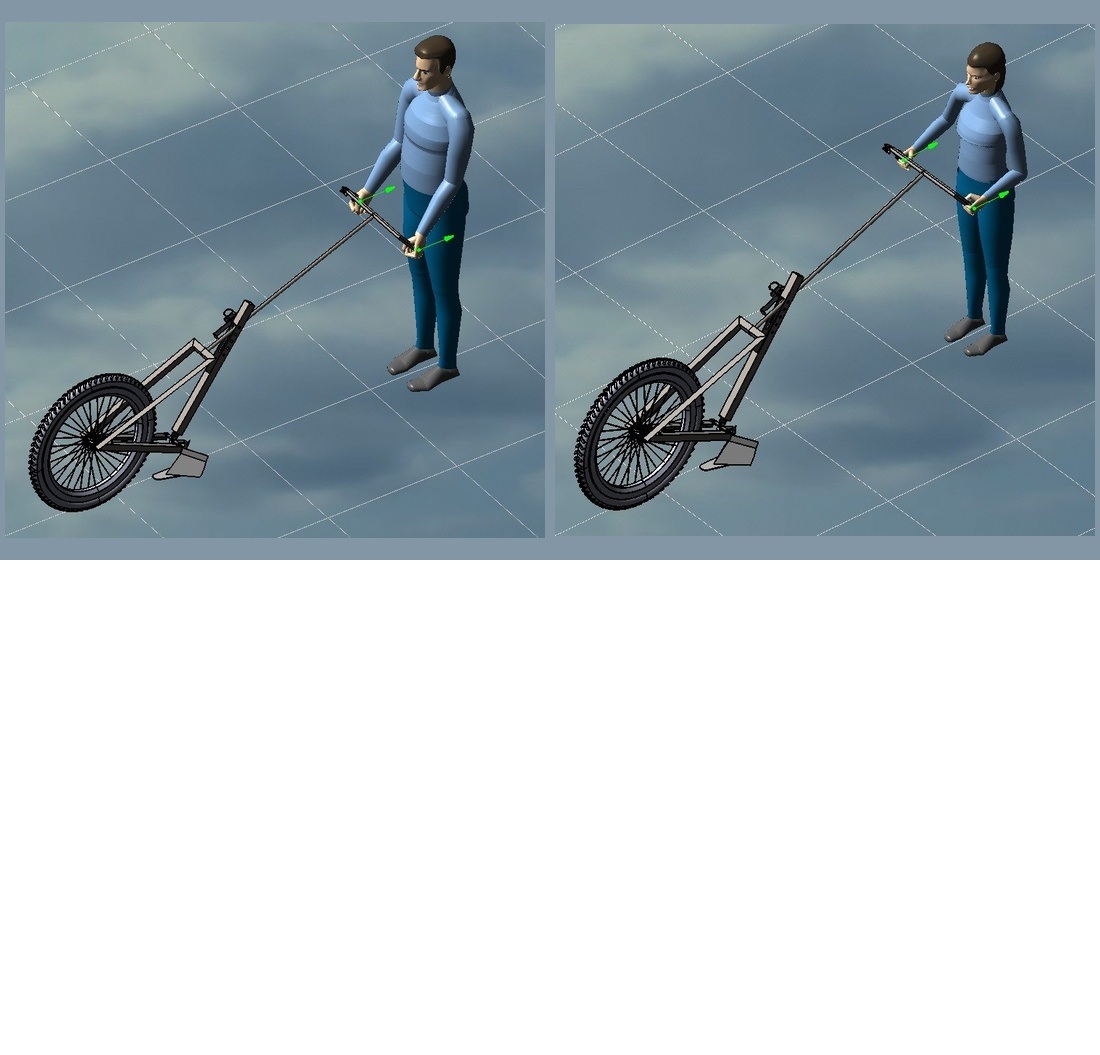
Об’єкт дослідження є ручний колісний борозник (IMRS) – інструмент, що приводиться в дію мускульною силою, який використовують дрібні фермери в районі Тіабая (Арекіпа, Перу) для формування борозен та підгортання цибулі та часнику з інтервалом 45 см; за 10–12-годинну зміну обробляється до 227 борозен на ділянці. Незмінна висота ручки змушує високих людей тривалий час згинати тулуб і розгинати зап’ястя, тоді як нижчі користувачі компенсують надмірне навантаження на руки, що структурно виключає жінок, для яких висота ручки є невідповідною. Було застосовано чотири підходи: «Дизайн-мислення» та «Розгортання функцій якості» (QFD) для перетворення потреб фермерів у ключові інженерні цілі; VDI 2221/2225 для оцінки альтернатив; рівняння Маккіса та Алі для моделювання опору ґрунту в супісках, що зустрічаються в Тіабаї; та цифрові моделі людини в CATIA V5 для біомеханічної валідації на 5-му процентилі для жінок та 95-му для чоловіків перед створенням фізичного прототипу. Удосконалена конструкція включає раму з труб Ø2" SCH10 із швидким регулюванням висоти від 900 до 1200 мм за пріоритетами QFD, колесо зі спицями Ø600 мм, борознювач із термообробленої сталі AISI 1045 та ручки зі сталі AISI 304, знижуючи зусилля на 8%. Більше колесо розподіляє силу від ґрунту на більшій площі контакту, що зменшує опір при русі, як зазначають McKyes та Ali. Налаштування висоти усуває позиції тіла, які отримують оцінку 5 за Rapid Upper Limb Assessment (RULA), знижуючи її до 4 для користувачів з крайніми параметрами. Незважаючи на те що вартість технічного засобу вища (приблизно 680 солей у порівнянні з 300–400), строк служби більше 12 років забезпечує повернення інвестицій за 3–4 роки, відповідно до Цілей сталого розвитку (ЦСР) 2, 5 та 8
Посилання
- The Future of Food and Agriculture: Alternative Pathways to 2050 (2018). Food and Agriculture Organization of the United Nations. Available at: https://www.fao.org/3/i8429en/i8429en.pdf
- Ricciardi, V., Ramankutty, N., Mehrabi, Z., Jarvis, L., Chookolingo, B. (2018). How much of the world’s food do smallholders produce? Global Food Security, 17, 64–72. https://doi.org/10.1016/j.gfs.2018.05.002
- Lowder, S. K., Skoet, J., Raney, T. (2016). The Number, Size, and Distribution of Farms, Smallholder Farms, and Family Farms Worldwide. World Development, 87, 16–29. https://doi.org/10.1016/j.worlddev.2015.10.041
- de Janvry, A., Sadoulet, E. (2009). Agricultural Growth and Poverty Reduction: Additional Evidence. The World Bank Research Observer, 25 (1), 1–20. https://doi.org/10.1093/wbro/lkp015
- Fathallah, F. A. (2010). Musculoskeletal disorders in labor-intensive agriculture. Applied Ergonomics, 41 (6), 738–743. https://doi.org/10.1016/j.apergo.2010.03.003
- Zhang, M., Kim, R. (2025). Occupational health in agriculture: a re-emerging frontier in worker protection. Global Health Journal, 9 (2), 65–71. https://doi.org/10.1016/j.glohj.2025.06.001
- Goals 8: Promote sustained, inclusive and sustainable economic growth, full and productive employment and decent work for all. United Nations. Available at: https://sdgs.un.org/goals/goal8
- Harianto, S., Listyani, R. H. (2025). Empowering marginalised women in rural Indonesia: a multifaceted approach. International Journal of Sociology and Social Policy, 45 (9-10), 959–980. https://doi.org/10.1108/ijssp-02-2025-0111
- Majumder, J., Shah, P. (2017). Mapping the Role of Women in Indian Agriculture. Annals of Anthropological Practice, 41 (2), 46–54. https://doi.org/10.1111/napa.12112
- Yoder, A. M., Adams, A. M., Brensinger, E. A., Freivalds, A. (2010). Designing Tools and Agricultural Equipment for Women. 2010 Pittsburgh, Pennsylvania, June 20 - June 23, 2010. https://doi.org/10.13031/2013.29983
- Caputo, F., Greco, A., Fera, M., Caiazzo, G., Spada, S. (2018). Simulation Techniques for Ergonomic Performance Evaluation of Manual Workplaces During Preliminary Design Phase. Proceedings of the 20th Congress of the International Ergonomics Association (IEA 2018), 170–180. https://doi.org/10.1007/978-3-319-96077-7_18
- Devaux, A., Horton, D., Velasco, C., Thiele, G., López, G., Bernet, T. Et al. (2009). Collective action for market chain innovation in the Andes. Food Policy, 34 (1), 31–38. https://doi.org/10.1016/j.foodpol.2008.10.007
- Escobal, J., Torero, M. (2003). Adverse Geography and Differences in Welfare in Peru. United Nations University. Available at: https://www.wider.unu.edu/sites/default/files/dp2003-073.pdf
- Escobal, J., Ponce, C. (2008). Enhancing Income Opportunities for the Rural Poor: The Benefits of Rural Roads. Economic Reform in Developing Countries. https://doi.org/10.4337/9781781007655.00019
- Food security and nutrition and sustainable agriculture. United Nations. Available at: https://sdgs.un.org/topics/food-security-and-nutrition-and-sustainable-agriculture
- Colombini, D. (2018). Application Study: Biomechanical Overload in Agriculture. Proceedings of the 20th Congress of the International Ergonomics Association (IEA 2018), 72–83. https://doi.org/10.1007/978-3-319-96083-8_10
- Yu, H., Nam, K., Shin, S., Choi, M., Son, Y., Chang, J. (2021). Repetitive patterns in the locations of touch errors for two-thumb text entry on a smartphone. Applied Ergonomics, 97, 103541. https://doi.org/10.1016/j.apergo.2021.103541
- Markova, V., Petrova, Z., Valcheva-Georgieva, I. (2025). Assessing Musculoskeletal Health Risks in Standing Occupations. EEPES 2025, 74. https://doi.org/10.3390/engproc2025104074
- Meinel, C., Leifer, L., Plattner, H. (Eds.) (2011). Design Thinking. Springer Berlin Heidelberg. https://doi.org/10.1007/978-3-642-13757-0
- Akao, Y. (1990). Quality Function Deployment: Integrating Customer Requirements into Product Design. Productivity Press.
- Apfata Limachi, B. A., Cari Mora, F. A., Sivincha Quispe, Y. S., Valdeiglesias Flores, E., Silva Vidal, Y. L., Sulla Espinoza, E., Pari, L. (2024). Application of QFD and FMEA methodologies for the development and improvement of an explosive ordnance disposal robot design. Eastern-European Journal of Enterprise Technologies, 5 (1 (131)), 30–42. https://doi.org/10.15587/1729-4061.2024.306986
- Rega, S. J., Rohman, T., Ishlah, N. W., Subekti, S. (2024). Application of the VDI 2221 method in the design of an air-to-water converter device. JTTM: Jurnal Terapan Teknik Mesin, 5 (2), 277–288. https://doi.org/10.37373/jttm.v5i2.1126
- Leutenecker-Twelsiek, B., Klahn, C., Meboldt, M. (2016). Considering Part Orientation in Design for Additive Manufacturing. Procedia CIRP, 50, 408–413. https://doi.org/10.1016/j.procir.2016.05.016
- Schröppel, T., Miehling, J., Wartzack, S. (2020). How to identify relevant product properties in the context of user-product interaction? Procedia CIRP, 91, 615–620. https://doi.org/10.1016/j.procir.2020.02.219
- Llave, T. G. V., Huaman, L. A. L., Torres, B. P. R., Rodríguez, J. C., Vidal, Y. L. S. (2024). Conceptual Design of a Trash Collecting Machine for Highways in Arequipa, Peru. International Journal of Mechanical Engineering and Robotics Research, 13 (4), 477–488. https://doi.org/10.18178/ijmerr.13.4.477-488
- Gembarski, P. C., Bibani, M., Lachmayer, R. (2016). Design catalogues: Knowledge repositories for knowledge-based-engineering applications. International Design Conference - DESIGN 2016. Available at: https://www.researchgate.net/publication/309610854_Design_Catalogues_Knowledge_Repositories_for_Knowledge-Based-Engineering_Applications
- Jiang, S., Sarica, S., Song, B., Hu, J., Luo, J. (2022). Patent Data for Engineering Design: A Critical Review and Future Directions. Journal of Computing and Information Science in Engineering, 22 (6). https://doi.org/10.1115/1.4054802
- López-Perez, V. P., Ramirez-Montesdeoca, W. A., Alarcón-Moyano, G. A. (2020). Estudio de materiales utilizados en la construcción de aperos para la mecanización agricola en la zona Andina del Ecuador. Dominio de las Ciencias, 6 (3), 1194–1204. Available at: https://dialnet.unirioja.es/servlet/articulo?codigo=7539763
- Bringas-Fernandez, B., Carrion-Reyes, M., Altamirano-Flores, E., Viacava-Campos, G. (2022). Model to Increase the Production Efficiency of Low-Pressure Regulators through the Combined Use of Lean Tools at a Metalworking SME. 2022 8th International Conference on Information Management (ICIM), 141–145. https://doi.org/10.1109/icim56520.2022.00032
- Leceta, F., Binder, C., Mader, C., Mächtle, B., Marsh, E., Dietrich, L. et al. (2024). The impact of agriculture on tropical mountain soils in the western Peruvian Andes: a pedo-geoarchaeological study of terrace agricultural systems in the Laramate region (14.5° S). SOIL, 10 (2), 727–761. https://doi.org/10.5194/soil-10-727-2024
- Hruban, V., Panfilova, A., Galeeva, A., Khramov, M. (2024). Optimisation of structural parameters of rotary tillage units to increase the stability of operation under the influence of variable loads. Naukovij Žurnal «Tehnìka Ta Energetika», 16 (1), 65–80. https://doi.org/10.31548/machinery/1.2025.65
- Stafford, J. V. (1979). The performance of a rigid tine in relation to soil properties and speed. Journal of Agricultural Engineering Research, 24 (1), 41–56. https://doi.org/10.1016/0021-8634(79)90059-3
- Fielke, J. M., Riley, T. W. (1991). The universal earthmoving equation applied to chisel plough wings. Journal of Terramechanics, 28 (1), 11–19. https://doi.org/10.1016/0022-4898(91)90003-o
- Hasankhani-Ghavam, F., Abbaspour-Gilandeh, Y., Shahgoli, G., Rahmanzadeh-Bahram, H. (2015). Design, manufacture and evaluation of the new instrument to measure the friction coefficient of soil. CIGR Journal, 17 (1), 101–109. Available at: https://cigrjournal.org/index.php/Ejounral/article/view/2710
- Ucgul, M., Saunders, C., Fielke, J. M. (2017). Discrete element modelling of tillage forces and soil movement of a one-third scale mouldboard plough. Biosystems Engineering, 155, 44–54. https://doi.org/10.1016/j.biosystemseng.2016.12.002
- Antunez, A. et al. (2017). Propiedades fisico-hidricas del suelo en el cultivo del maiz grano. INIA, 31–50. Available at: https://biblioteca.inia.cl/server/api/core/bitstreams/19314dbc-3274-4165-b176-b4370c91fe20/content
- Mouazen, A. M., Neményi, M. (1999). Tillage Tool Design by the Finite Element Method: Part 1. Finite Element Modelling of Soil Plastic Behaviour. Journal of Agricultural Engineering Research, 72 (1), 37–51. https://doi.org/10.1006/jaer.1998.0343
- GEO5 Software. Online Help. Available at: https://www.finesoftware.eu/help/geo5/en/material-10/
##submission.downloads##
Опубліковано
Як цитувати
Номер
Розділ
Ліцензія
Авторське право (c) 2026 Cesar Augusto Castillo Roque, Wendy Carolina Yupanqui Leon, Trunks Giorgio Vasquez Llave, Jose Carlos Canazas Rodriguez, Yuri Lester Silva Vidal, Jose Fernando Garate Delgado

Ця робота ліцензується відповідно до Creative Commons Attribution 4.0 International License.
Закріплення та умови передачі авторських прав (ідентифікація авторства) здійснюється у Ліцензійному договорі. Зокрема, автори залишають за собою право на авторство свого рукопису та передають журналу право першої публікації цієї роботи на умовах ліцензії Creative Commons CC BY. При цьому вони мають право укладати самостійно додаткові угоди, що стосуються неексклюзивного поширення роботи у тому вигляді, в якому вона була опублікована цим журналом, але за умови збереження посилання на першу публікацію статті в цьому журналі.
Ліцензійний договір – це документ, в якому автор гарантує, що володіє усіма авторськими правами на твір (рукопис, статтю, тощо).
Автори, підписуючи Ліцензійний договір з ПП «ТЕХНОЛОГІЧНИЙ ЦЕНТР», мають усі права на подальше використання свого твору за умови посилання на наше видання, в якому твір опублікований. Відповідно до умов Ліцензійного договору, Видавець ПП «ТЕХНОЛОГІЧНИЙ ЦЕНТР» не забирає ваші авторські права та отримує від авторів дозвіл на використання та розповсюдження публікації через світові наукові ресурси (власні електронні ресурси, наукометричні бази даних, репозитарії, бібліотеки тощо).
За відсутності підписаного Ліцензійного договору або за відсутністю вказаних в цьому договорі ідентифікаторів, що дають змогу ідентифікувати особу автора, редакція не має права працювати з рукописом.
Важливо пам’ятати, що існує і інший тип угоди між авторами та видавцями – коли авторські права передаються від авторів до видавця. В такому разі автори втрачають права власності на свій твір та не можуть його використовувати в будь-який спосіб.