Determining the identification of parameters for the mathematical model of electrical conductivity in conductometric models
DOI:
https://doi.org/10.15587/1729-4061.2026.352348Keywords:
conductometry, Fisher matrix, parameter non-identification, weak electrolytes, association constant, electrical conductivityAbstract
Using an aqueous solution of acetic acid an example, this study has investigated a mathematical model of the electrical conductivity of weak electrolyte dilute solutions.
To resolve the issue of identification and reliability in determining the parameters for the mathematical model of the electrical conductivity of dilute solutions of weak electrolytes, the determinant of the Fisher information matrix was calculated.
The issues related to determining the association constants and the limiting molar electrical conductivity of weak electrolytes under different conditions of experimental experiments were identified and explained.
This paper reports results of mathematical processing of conductometric data for aqueous solutions of acetic acid.
It was established that for weak, associated electrolytes, when determining the association constants and the limiting molar coefficients, it is necessary to take into account the existence of a correlation between them.
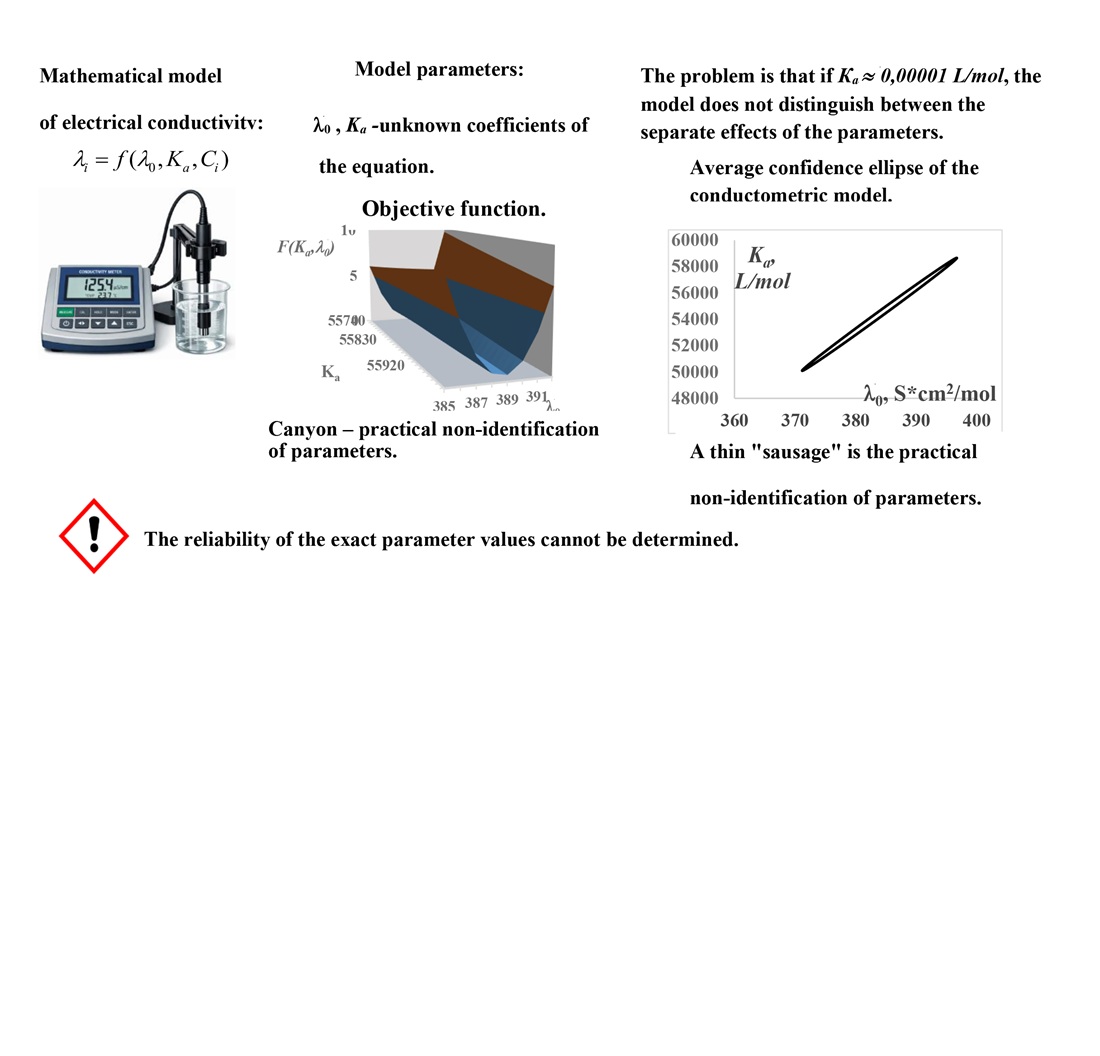
It is proven that at large values of the association constant (5.58 * 104 mol/L) the determinant of the Fisher information matrix is close to zero and there is a structural non-identification of parameters for the mathematical model of electrical conductivity of dilute solutions of weak electrolytes.
It is shown that the results of mathematical processing of conductometric data for aqueous solutions of acetic acid indicate the presence of structural non-identification. This is confirmed by the values of the determinant of the Fisher information matrix, which is equal to 5.5 * 10-8, and the normalized index of 0.988.
Analysis of the shape of the surface of the objective functions of the studied mathematical models and the form of the average error ellipse reveals the existence of a canyon with an almost flat bottom, which complicates the interpretation and reliability of parameters for the mathematical model of electrical conductivity.
The results confirm the possibility of structural non-identification of parameters for the mathematical model of the electrical conductivity of dilute solutions of weak electrolytes
References
- Belsley, D. A., Kuh, E., Welsch, R. E. (1980). Regression Diagnostics. Wiley Series in Probability and Statistics. John Wiley & Sons. https://doi.org/10.1002/0471725153
- Montgomery, C. D., Peck, A. E., Vining, G. G. (2012). Introduction to Linear Regression Analysis. Wiley, 672.
- Walter É., Pronzato L. (1997). Identification of parametric models from experimental data. Springer, 413.
- Fisher, R. A. (1922). On the mathematical foundations of theoretical statistics. Philosophical Transactions of the Royal Society of London. Series A, Containing Papers of a Mathematical or Physical Character, 222 (594-604), 309–368. https://doi.org/10.1098/rsta.1922.0009
- Jacquez, J. A., Greif, P. (1985). Numerical parameter identifiability and estimability: Integrating identifiability, estimability, and optimal sampling design. Mathematical Biosciences, 77 (1-2), 201–227. https://doi.org/10.1016/0025-5564(85)90098-7
- Schmidt, P. J., Emelko, M. B., Thompson, M. E. (2019). Recognizing Structural Nonidentifiability: When Experiments Do Not Provide Information About Important Parameters and Misleading Models Can Still Have Great Fit. Risk Analysis, 40 (2), 352–369. https://doi.org/10.1111/risa.13386
- Takam Soh, P., Kouassi, E., Bosson Brou, J. M., Nadarajah, S. (2025). Fisher Information Matrix for Two-way Random e Effects Model with Heteroscedasticity: Accepted - January 2024. REVSTAT-Statistical Journal, 23 (4), 543–567. https://doi.org/10.57805/revstat.v23i4.647
- Ahmad, R., Johansson, P., Schultzberg, M. (2024). Is Fisher inference inferior to Neyman inference for policy analysis? Statistical Papers, 65 (6), 3425–3445. https://doi.org/10.1007/s00362-024-01528-2
- Ho, L. B. (2023). A stochastic evaluation of quantum Fisher information matrix with generic Hamiltonians. EPJ Quantum Technology, 10 (1). https://doi.org/10.1140/epjqt/s40507-023-00195-w
- Geremia, M., Macchietto, S., Bezzo, F. (2026). A review on model-based design of experiments for parameter precision – Open challenges, trends and future perspectives. Chemical Engineering Science, 319, 122347. https://doi.org/10.1016/j.ces.2025.122347
- Raue, A., Kreutz, C., Maiwald, T., Bachmann, J., Schilling, M., Klingmüller, U., Timmer, J. (2009). Structural and practical identifiability analysis of partially observed dynamical models by exploiting the profile likelihood. Bioinformatics, 25 (15), 1923–1929. https://doi.org/10.1093/bioinformatics/btp358
- Safonova, L. P., Kolker, A. M. (1992). Conductometry of electrolyte solutions. Russian Chemical Reviews, 61 (9), 959–973. https://doi.org/10.1070/rc1992v061n09abeh001009
- Kontogeorgis, G. M., Maribo-Mogensen, B., Thomsen, K. (2018). The Debye-Hückel theory and its importance in modeling electrolyte solutions. Fluid Phase Equilibria, 462, 130–152. https://doi.org/10.1016/j.fluid.2018.01.004
- Zhang, W., Chen, X., Wang, Y., Wu, L., Hu, Y. (2020). Experimental and Modeling of Conductivity for Electrolyte Solution Systems. ACS Omega, 5 (35), 22465–22474. https://doi.org/10.1021/acsomega.0c03013
- Logan, E. R., Tonita, E. M., Gering, K. L., Dahn, J. R. (2018). A Critical Evaluation of the Advanced Electrolyte Model. Journal of The Electrochemical Society, 165 (14), A3350–A3359. https://doi.org/10.1149/2.0471814jes
- Hojo, M. (2008). Elucidation of specific ion association in nonaqueous solution environments. Pure and Applied Chemistry, 80 (7), 1539–1560. https://doi.org/10.1351/pac200880071539
- Gonçalves, M. L. N., Menezes, T. C. (2020). Gauss-Newton methods with approximate projections for solving constrained nonlinear least squares problems. Journal of Complexity, 58, 101459. https://doi.org/10.1016/j.jco.2020.101459
Downloads
Published
How to Cite
Issue
Section
License
Copyright (c) 2026 Vitaliy Chumak, Mariia Maksymiuk, Andrii Kоpаnytsia

This work is licensed under a Creative Commons Attribution 4.0 International License.
The consolidation and conditions for the transfer of copyright (identification of authorship) is carried out in the License Agreement. In particular, the authors reserve the right to the authorship of their manuscript and transfer the first publication of this work to the journal under the terms of the Creative Commons CC BY license. At the same time, they have the right to conclude on their own additional agreements concerning the non-exclusive distribution of the work in the form in which it was published by this journal, but provided that the link to the first publication of the article in this journal is preserved.
A license agreement is a document in which the author warrants that he/she owns all copyright for the work (manuscript, article, etc.).
The authors, signing the License Agreement with TECHNOLOGY CENTER PC, have all rights to the further use of their work, provided that they link to our edition in which the work was published.
According to the terms of the License Agreement, the Publisher TECHNOLOGY CENTER PC does not take away your copyrights and receives permission from the authors to use and dissemination of the publication through the world's scientific resources (own electronic resources, scientometric databases, repositories, libraries, etc.).
In the absence of a signed License Agreement or in the absence of this agreement of identifiers allowing to identify the identity of the author, the editors have no right to work with the manuscript.
It is important to remember that there is another type of agreement between authors and publishers – when copyright is transferred from the authors to the publisher. In this case, the authors lose ownership of their work and may not use it in any way.








