Construction of the discrete-continuous mathematical model of a hysteresis damper impact device
DOI:
https://doi.org/10.15587/1729-4061.2026.353245Keywords:
impact device, pulse process, rheological model, energy efficiency, Euler scheme with linearizationAbstract
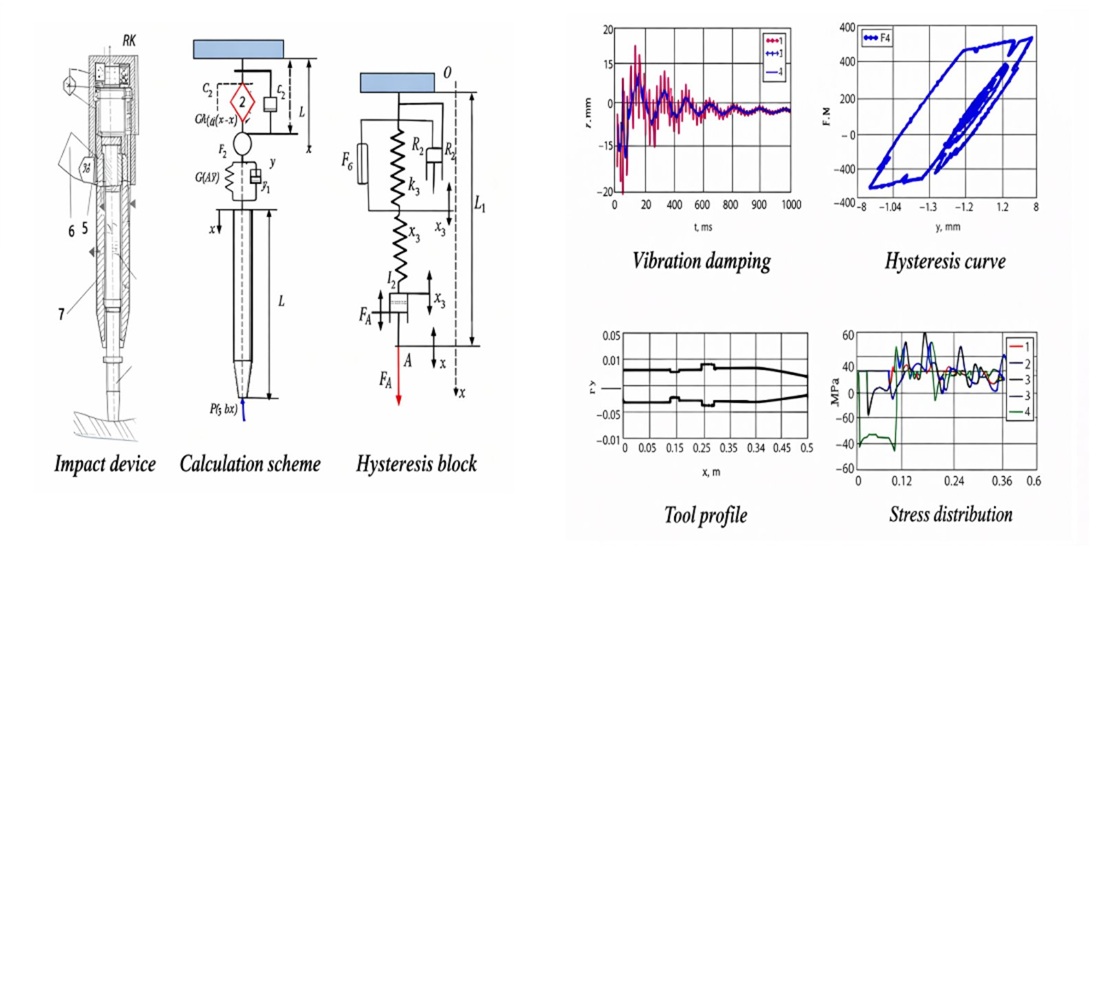
This study investigates the process of interaction between the impact device tool and its body elements during an impulse response from the processing medium in the presence of a hysteretic damper of mechanical vibrations. The task addressed is to build a mathematical model with hysteresis damping of oscillations of the impact device elements.
In the mathematical model, the tool is represented by a rod of variable cross-section, and the body parts of the hydraulic hammer are represented by a discrete element with a reduced mass. To damp mechanical oscillations, a rheological model of the hysteresis type is used. The impact interaction of the device elements is modeled by the presence of rigid and dissipative connections. The motion of the impact device elements is described by a system of nonlinear differential equations.
The combination of discrete and continuous types of models has made it possible to solve the task of synthesizing a mathematical model. A comparison for the discrete-continuous model and the discrete model of hysteresis curves justifies their correctness. The proposed model makes it possible to estimate the energy consumption for damping and the distribution of stresses along the length of the tool. When the recoil force changes in the range of 50–500 kN for 1 ms, the energy losses were up to 500 J, and the stress in the conical part of the tool was up to 560 MPa.
To solve the initial-boundary problem, a numerical method is used, which includes the finite difference method and the Euler scheme with linearization. The parameters of the numerical method were determined using a discrete two-mass model. The length step is 0.005–0.01 of the tool length, the time step is 0.001–0.05 ms.
The model could be used in the design of rock development devices and impact systems to increase hydrocarbon production in the oil industry
References
- Denysiuk, S. P., Han, A. L., Danilin, O. V. et al. (2022). Navchalno-naukovyi instytut enerhozberezhennia ta enerhomenedzhmentu. 25 rokiv stanovlennia ta rozvytku. Kyiv, 419. Available at: https://ela.kpi.ua/handle/123456789/63165
- Goldsmith, W. (1960). Impact. The theory and physical behaviour of colliding solids. London: Edvard Arnold LTD, 393. Available at: https://ia800802.us.archive.org/8/items/in.ernet.dli.2015.140646/2015.140646.Impact-The-Theory-And-Physical-Behaviour-Of-Colliding-Solids_text.pdf
- Batako, A. D., Babitsky, V. I., Halliwell, N. A. (2004). Modelling of vibro-impact penetration of self-exciting percussive-rotary drill bit. Journal of Sound and Vibration, 271 (1-2), 209–225. https://doi.org/10.1016/s0022-460x(03)00642-4
- Slidenko, V. M., Shevchuk, S. P., Zamaraieva, O. V., Listovshchyk, L. K. (2013). Adaptyvne funktsionuvannia impulsnykh vykonavchykh orhaniv hirnychykh mashyn. Kyiv: NTUU «KPI», 180.
- Slidenko, V., Slidenko, O., Marchuk, L., But, V. (2023). Development of a discreet-continuous mathematical model of a percussion device with parameters of influence on the characteristics of an impact pulse. Eastern-European Journal of Enterprise Technologies, 5 (7 (125)), 70–79. https://doi.org/10.15587/1729-4061.2023.290029
- Slidenko, A. M., Slidenko, V. M., Valyukhov, S. G. (2021). Discrete-continuous three-element model of impact device. Journal of Physics: Conference Series, 2131 (3), 032091. https://doi.org/10.1088/1742-6596/2131/3/032091
- Eroshenko, V. A., Grosu, Ya. G. (2013). Maxwell’s relations and thermal coefficients for repulsive clathrates. Technical Physics, 58 (8), 1087–1093. https://doi.org/10.1134/s1063784213080124
- Eroshenko, V. A. (2007). A new paradigm of mechanical energy dissipation. Part 1: Theoretical aspects and practical solutions. Proceedings of the Institution of Mechanical Engineers, Part D: Journal of Automobile Engineering, 221 (3), 285–300. https://doi.org/10.1243/09544070d01505
- Eroshenko, V., Slidenko, V. (2015). Heterogeneous lyophobic systems – the powerful dissipaters of energy oscillation in the hydro-mechanical systems. Enerhetyka, 2, 16–21. Available at: http://nbuv.gov.ua/UJRN/eete_2015_2_4
- Danilin, A. N., Shalashilin, V. I. (2010). A method to identify hysteresis by an example of an antigalloping device. International Applied Mechanics, 46 (5), 588–595. https://doi.org/10.1007/s10778-010-0345-x
- Semenov, M. E., Solovyov, A. M., Meleshenko, P. A., Reshetova, O. O. (2020). Efficiency of hysteretic damper in oscillating systems. Mathematical Modelling of Natural Phenomena, 15, 43. https://doi.org/10.1051/mmnp/2019053
- Semenov, M. E., Solovyov, A. M., Rukavitsyn, A. G., Gorlov, V. A., Meleshenko, P. A. (2016). Hysteretic damper based on the Ishlinsky-Prandtl model. MATEC Web of Conferences, 83, 01008. https://doi.org/10.1051/matecconf/20168301008
- Krasnosel'skii, M. A., Pokrovskii, A. V. (2011). Systems with Hysteresis. Springer, 428.
- Borman, V. D., Belogorlov, A. A., Byrkin, V. A., Lisichkin, G. V., Tronin, V. N., Troyan, V. I. (2011). The infiltration of nonwetting liquid into nanoporous media and the thermal effect. Journal of Physics: Conference Series, 291, 012044. https://doi.org/10.1088/1742-6596/291/1/012044
- Eroshenko, V. A., Lazarev, Yu. F. (2012). Rheology and dynamics of repulsive clathrates. Journal of Applied Mechanics and Technical Physics, 53 (1), 98–112. https://doi.org/10.1134/s0021894412010130
- Samarskii, A. A. (2001). The Theory of Difference Schemes. CRC Press. https://doi.org/10.1201/9780203908518
Downloads
Published
How to Cite
Issue
Section
License
Copyright (c) 2026 Viktor Slidenko, Oleksandr Slidenko, Oksana Zamarajeva, Vladyslav Tkachenko, Oleksandr Balaniuk

This work is licensed under a Creative Commons Attribution 4.0 International License.
The consolidation and conditions for the transfer of copyright (identification of authorship) is carried out in the License Agreement. In particular, the authors reserve the right to the authorship of their manuscript and transfer the first publication of this work to the journal under the terms of the Creative Commons CC BY license. At the same time, they have the right to conclude on their own additional agreements concerning the non-exclusive distribution of the work in the form in which it was published by this journal, but provided that the link to the first publication of the article in this journal is preserved.
A license agreement is a document in which the author warrants that he/she owns all copyright for the work (manuscript, article, etc.).
The authors, signing the License Agreement with TECHNOLOGY CENTER PC, have all rights to the further use of their work, provided that they link to our edition in which the work was published.
According to the terms of the License Agreement, the Publisher TECHNOLOGY CENTER PC does not take away your copyrights and receives permission from the authors to use and dissemination of the publication through the world's scientific resources (own electronic resources, scientometric databases, repositories, libraries, etc.).
In the absence of a signed License Agreement or in the absence of this agreement of identifiers allowing to identify the identity of the author, the editors have no right to work with the manuscript.
It is important to remember that there is another type of agreement between authors and publishers – when copyright is transferred from the authors to the publisher. In this case, the authors lose ownership of their work and may not use it in any way.








