The influence of magnetic shielding technique on the magnetic field topology in an accelerating channel of the Hall-effect thruster
DOI:
https://doi.org/10.15587/1729-4061.2026.354694Keywords:
Hall-effect thruster, magnetic shielding, magnetic field topology, acceleration channel, simulationAbstract
This study investigates magnetic system in the ST-40-type Hall-effect thruster and its modification with magnetic shielding of the accelerating channel. The task addressed relates to the lack of systematic quantitative data on the influence of magnetic shielding techniques on the topology of the magnetic field in the channel. The associated parameters that affect the erosion of the walls and the stability of the engine operating modes remain undefined.
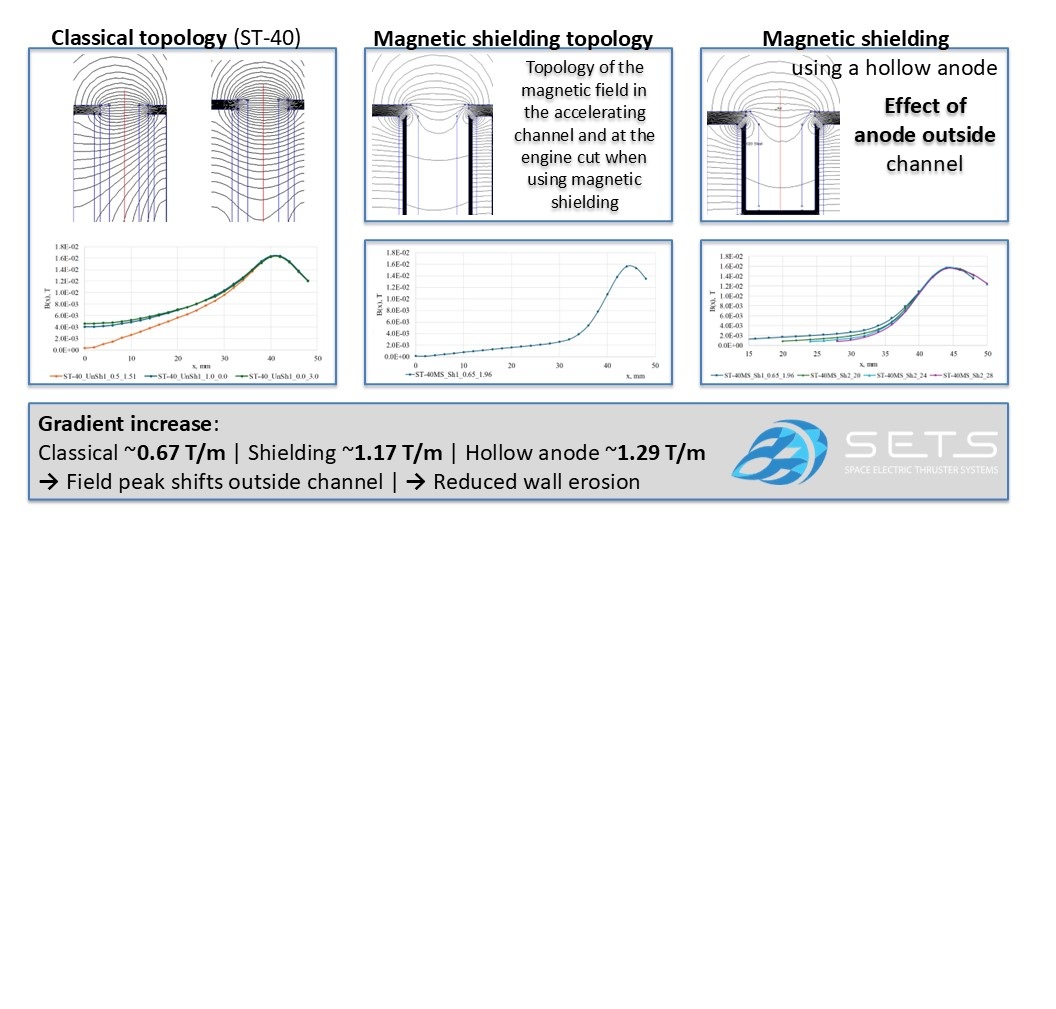
This work reports mathematical modeling of the magnetic field topology for the engine of the classical scheme and two variants of magnetic shielding: with an external magnetic shield and using a magnetically soft hollow anode. Spatial distributions of the radial component of the field induction were determined and induction gradients along the axis of the accelerating channel were derived. It is shown that for the classical scheme the maximum induction gradient is about 0.67 T/m. The external magnetic shield increases it to 1.17 T/m, and the hollow anode – to 1.29 T/m, that is, 1.7–1.9 times.
The results are explained by a change in magnetic resistance and redistribution of magnetic flux, which leads to deformation of the lines of force, their orientation along the dielectric walls of the channel, and removal of the maximum magnetic field induction beyond the engine section. A distinctive feature of this study is a direct quantitative comparison of the magnetic field topology for different design schemes on a single geometric and current basis, which made it possible to objectively assess the effectiveness of each variant of magnetic shielding.
The implementation of results is possible in the design and optimization of magnetic systems of Hall engines of medium power class under conditions close to laboratory and ground tests. Their application could contribute to reducing erosion, increasing discharge stability, and increasing the resource
References
- Kim, V. P. (2017). On the longitudinal distribution of electric field in the acceleration zones of plasma accelerators and thrusters with closed electron drift. Plasma Physics Reports, 43 (4), 486–498. https://doi.org/10.1134/s1063780x17040055
- Mikellides, I. G., Katz, I., Hofer, R. R., Goebel, D. M., de Grys, K., Mathers, A. (2011). Magnetic shielding of the channel walls in a Hall plasma accelerator. Physics of Plasmas, 18 (3). https://doi.org/10.1063/1.3551583
- Mikellides, I. G., Katz, I., Hofer, R. R., Goebel, D. M. (2014). Magnetic shielding of a laboratory Hall thruster. I. Theory and validation. Journal of Applied Physics, 115 (4). https://doi.org/10.1063/1.4862313
- de Grys, K., Mathers, A., Welander, B., Khayms, V. (2010). Demonstration of 10,400 Hours of Operation on 4.5 kW Qualification Model Hall Thruster. 46th AIAA/ASME/SAE/ASEE Joint Propulsion Conference & Exhibit. https://doi.org/10.2514/6.2010-6698
- Goebel, D. M., Katz, I., Mikellides, I. G. (2024). Fundamentals of Electric Propulsion. Wiley. Available at: https://search.catalog.loc.gov/instances/6347bd67-d681-5525-a0e3-7eb73345fdba?option=lccn&query=2023023149
- Garrigues, L., Hagelaar, G. J. M., Bareilles, J., Boniface, C., Boeuf, J. P. (2003). Model study of the influence of the magnetic field configuration on the performance and lifetime of a Hall thruster. Physics of Plasmas, 10 (12), 4886–4892. https://doi.org/10.1063/1.1622670
- Liu, Q., Li, Y., Hu, Y., Mao, W. (2023). Effects of Magnetic Field Gradient on the Performance of a Magnetically Shielded Hall Thruster. Aerospace, 10 (11), 942. https://doi.org/10.3390/aerospace10110942
- Yang, L., Zhang, T., Chen, J., Jia, Y. (2018). Numerical study of low-frequency discharge oscillations in a 5 kW Hall thruster. Plasma Science and Technology, 20 (7), 075503. https://doi.org/10.1088/2058-6272/aac012
- Hofer, R. R., Polk, J. E., Sekerak, M. J., Mikellides, I. G., Kamhawi, H., Sarver-Verhey, T. R. et al. (2016). The 12.5 kW Hall Effect Rocket with Magnetic Shielding (HERMeS) for the Asteroid Redirect Robotic Mission. 52nd AIAA/SAE/ASEE Joint Propulsion Conference. https://doi.org/10.2514/6.2016-4825
- Hofer, R., Lobbia, R., Chaplin, V., Ortega, A., Mikellides, I., Polk J. et al. (2019). Completing the Development of the 12.5 kW Hall Effect Rocket with Magnetic Shielding (HERMeS). The 36th International Electric Propulsion Conference. University of Vienna. Available at: https://electricrocket.org/2019/193.pdf
- Kamhawi, H., Huang, W., Mikellides, I. G. (2018). Optimization of the Magnetic Field Topology in the Hall Effect Rocket with Magnetic Shielding. 2018 Joint Propulsion Conference. https://doi.org/10.2514/6.2018-4720
- Mikellides, I. G., Hofer, R. R., Katz, I., Goebel, D. M. (2014). Magnetic shielding of Hall thrusters at high discharge voltages. Journal of Applied Physics, 116 (5). https://doi.org/10.1063/1.4892160
- Petrenko, O., Troyan, A., Pererva, V. (2023). Parameters of the ST-40M hall thruster with increased power discharge supply. Journal of Rocket-Space Technology, 31 (4), 50–58. https://doi.org/10.15421/452307
- Meeker, D. (2015). Finite Element Method Magnetics (Version 4.2). Available at: https://www.femm.info
Downloads
Published
How to Cite
Issue
Section
License
Copyright (c) 2026 Olexandr Petrenko, Viktor Pererva

This work is licensed under a Creative Commons Attribution 4.0 International License.
The consolidation and conditions for the transfer of copyright (identification of authorship) is carried out in the License Agreement. In particular, the authors reserve the right to the authorship of their manuscript and transfer the first publication of this work to the journal under the terms of the Creative Commons CC BY license. At the same time, they have the right to conclude on their own additional agreements concerning the non-exclusive distribution of the work in the form in which it was published by this journal, but provided that the link to the first publication of the article in this journal is preserved.
A license agreement is a document in which the author warrants that he/she owns all copyright for the work (manuscript, article, etc.).
The authors, signing the License Agreement with TECHNOLOGY CENTER PC, have all rights to the further use of their work, provided that they link to our edition in which the work was published.
According to the terms of the License Agreement, the Publisher TECHNOLOGY CENTER PC does not take away your copyrights and receives permission from the authors to use and dissemination of the publication through the world's scientific resources (own electronic resources, scientometric databases, repositories, libraries, etc.).
In the absence of a signed License Agreement or in the absence of this agreement of identifiers allowing to identify the identity of the author, the editors have no right to work with the manuscript.
It is important to remember that there is another type of agreement between authors and publishers – when copyright is transferred from the authors to the publisher. In this case, the authors lose ownership of their work and may not use it in any way.








