Adsorption purification of sunflower oil using acid-activated montmorilonite and quality assessment
DOI:
https://doi.org/10.15587/1729-4061.2026.354824Keywords:
sunflower oil, adsorption purification, bleaching, peroxide value, color value, gas chromatography-mass spectrometryAbstract
This study investigates the process of sunflower oil adsorption purification using acid-activated montmorillonite from the Cherkasy deposit. The paper considers the change in sunflower oil quality indicators resulting from adsorption treatment with natural dispersed minerals.
This work reports a comprehensive solution to the problem of substantiating and devising efficient technology for vegetable oil purification that simultaneously removes impurities, oxidation products, as well as heavy metal cations. Process efficiency was evaluated using physicochemical methods, including determination of acid, color, peroxide values, mass fraction of phosphorus-containing substances, moisture, volatile matter, as well as chromatographic-mass spectrometric analysis of oil composition.
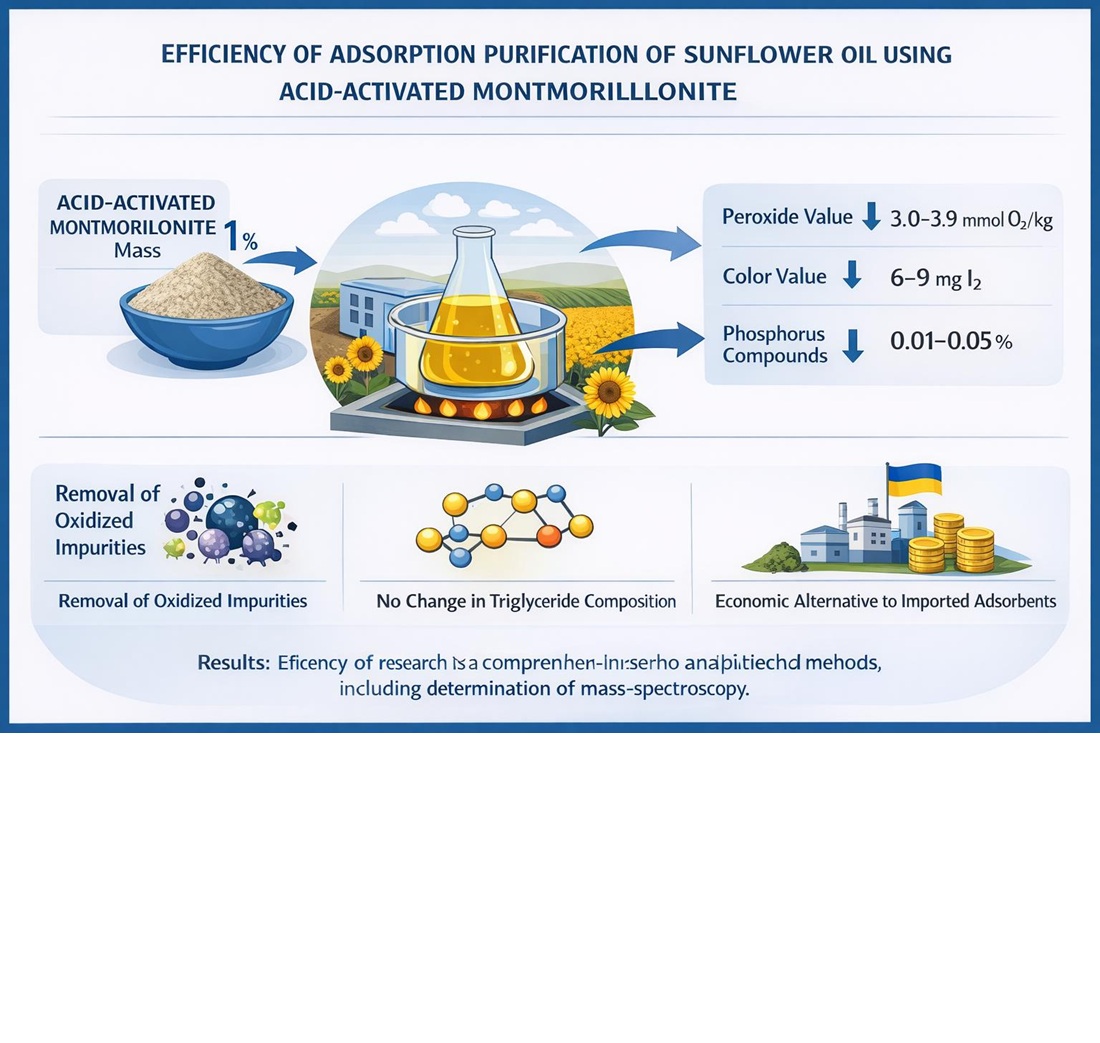
The results of experimental and pilot-scale studies demonstrate that the use of acid-activated montmorillonite at a dosage of 1% by oil mass, a temperature of 90–110°C, and a contact time of 20–30 min, ensures a reduction in the peroxide value to 3.0–3.9 mmol O2/kg, the color value to 6–9 mg I2, and the mass fraction of phosphorus-containing substances to 0.01–0.05%.
It has been shown that adsorption purification does not affect the basic triacylglycerol composition of the oil but promotes the removal of oxidized compounds that deteriorate its consumer properties and oxidative stability. The proposed technology could be implemented in industrial settings without significant modifications to existing production schemes; it represents a cost-effective alternative to imported bleaching clays
References
- Lee, Y.-Ying, Tang, T.-K., Phuah, E.-T., Lai, O.-M. (Eds.) (2022). Recent Advances in Edible Fats and Oils Technology. Springer Singapore. https://doi.org/10.1007/978-981-16-5113-7
- Gharby, S. (2022). Refining Vegetable Oils: Chemical and Physical Refining. The Scientific World Journal, 2022, 1–10. https://doi.org/10.1155/2022/6627013
- Susik, J., Ptasznik, S. (2023). Effect of bleaching with different clay on the final composition of post-fermentation corn oil with high content of β-sitosterol. LWT, 184, 114958. https://doi.org/10.1016/j.lwt.2023.114958
- O’Brien, R. D. (2008). Fats and Oils. CRC Press. https://doi.org/10.1201/9781420061673
- Hoffmann, G. (1989). Refining. The Chemistry and Technology of Edible Oils and Fats and Their High Fat Products, 139–200. https://doi.org/10.1016/b978-0-12-352055-5.50011-5
- Bandura, V., Fialkovska, L., Osadchuk, P., Levtrynskaia, Y., Palvashova, A. (2022). Investigation of properties of sunflower and rapeseed oils obtained by the soxhlet and microwave extraction methods. Agraarteadus, 33 (1), 48–58. https://doi.org/10.15159/jas.22.17
- Burdo, O., Bandura, V., Kolianovska, L., Dukulis, I. (2017). Experimental research of oil extraction from canola by using microwave technology. Engineering for Rural Development. https://doi.org/10.22616/erdev2017.16.n056
- Osadchuk, P., Enakiev, Y., Domuschi, D., Mortev, I., Bandura, V. (2024). Increasing of the Vegetable Oils Purification Efficiency in an Electromagnetic Field. 2024 32nd National Conference with International Participation (TELECOM), 1–4. https://doi.org/10.1109/telecom63374.2024.10812287
- Osadchuk, P. I., Bandura, V. N., Enakiev, Y. I., Elenov, B. P., Domuschi, D. P. (2024). Engineering Methods for Calculating the Process of Filtration of Vegetable Oils under Ultrasonic Cavitation Conditions. 2024 9th International Conference on Energy Efficiency and Agricultural Engineering (EE&AE), 1–6. https://doi.org/10.1109/eeae60309.2024.10600604
- Rhazi, L., Depeint, F., Ayerdi Gotor, A. (2022). Loss in the Intrinsic Quality and the Antioxidant Activity of Sunflower (Helianthus annuus L.) Oil during an Industrial Refining Process. Molecules, 27 (3), 916. https://doi.org/10.3390/molecules27030916
- Łaska-Zieja, B., Marcinkowski, D., Golimowski, W., Niedbała, G., Wojciechowska, E. (2020). Low-Cost Investment with High Quality Performance. Bleaching Earths for Phosphorus Reduction in the Low-Temperature Bleaching Process of Rapeseed Oil. Foods, 9 (5), 603. https://doi.org/10.3390/foods9050603
- Sedaghat Boroujeni, L., Ghavami, M., Piravi Vanak, Z., Ghasemi Pirbalouti, A. (2020). Optimization of sunflower oil bleaching parameters: using Response Surface Methodology (RSM). Food Science and Technology, 40 (suppl 1), 322–330. https://doi.org/10.1590/fst.10919
- Fialkovska, L. (2021). Effective ways of cleaning sunflower oil from impurities. Scientific Bulletin of the Tavria State Agrotechnological University, 11 (2), 26. https://doi.org/10.31388/2220-8674-2021-2-26
- Vuorte, M., Vierros, S., Kuitunen, S., Sammalkorpi, M. (2020). Adsorption of impurities in vegetable oil: A molecular modelling study. Journal of Colloid and Interface Science, 571, 55–65. https://doi.org/10.1016/j.jcis.2020.03.012
- Vasiljević, N., Yusup, S., Mićić, V., Tadić, G., Lazić, D., Kostić, D. (2025). Optimization of The Bleaching Process of Sunflower Oil. Acta Chimica Slovenica, 72 (3), 478–490. https://doi.org/10.17344/acsi.2024.8816
- Guseinova, E. A. (2022). Adsorption Purification of Used Industrial Oil Using Natural Aluminosilicates. Bulletin of the Karaganda University. “Chemistry” Series, 108 (4), 162–170. https://doi.org/10.31489/2022ch4/4-22-1
- Bhattacharyya, K. G., Gupta, S. S. (2008). Influence of acid activation on adsorption of Ni(II) and Cu(II) on kaolinite and montmorillonite: Kinetic and thermodynamic study. Chemical Engineering Journal, 136 (1), 1–13. https://doi.org/10.1016/j.cej.2007.03.005
- Yilmaz, E., Yücetepe, E. (2023). Bazi Natural Ve Asit-Aktive Natural Killerin, Sentetik Adsorbanlarin Ve Metal-Organik Çerçevelerin Alkali-Nötralize Ayçiçeği Yaği Ağartma Yeteneklerinin İncelenmesi. Gıda, 48 (3), 653–669. https://doi.org/10.15237/gida.gd23046
- Kooli, F., Khimyak, Y. Z., Alshahateet, S. F., Chen, F. (2005). Effect of the Acid Activation Levels of Montmorillonite Clay on the Cetyltrimethylammonium Cations Adsorption. Langmuir, 21 (19), 8717–8723. https://doi.org/10.1021/la050774z
- Petrović, Z., Mihajlović, J., Botić, T., Lazić, D., Fazlić, A., Ćebić, A. (2023). Possibility of bleaching sunflower oil with synthetic zeolite. Technologica Acta, 15 (2), 25–31. https://doi.org/10.51558/2232-7568.2022.15.2.25
- Maulana, M. R., Parlindungan, J. Y. (2025). Characterization of clay from Merauke Regency and its utilization as an adsorbent of free fatty acids in the purification of waste cooking oil. Fullerene Journal of Chemistry, 10 (2), 128–135. Available at: https://indochembull.com/index.php/fulerene/article/view/747
- ISO 5508:1990. Animal and vegetable fats and oils – Analysis by gas chromatography of methyl esters of fatty acids. ISO. Available at: https://www.fao.org/fao-who-codexalimentarius/codex-texts/list-standards/en/
- Andreeva, O., Shunko, V., Grechanovska, O. (2016). Comparative analysis of the mineral composition of bentonite from Cherkassy bentonitic area. Visnyk of Taras Shevchenko National University of Kyiv. Geology, 2 (73), 13–19. https://doi.org/10.17721/1728-2713.73.02
- CXS 210-1999. Standard for named vegetable oils. Codex Alimentarius. Available at: https://www.fao.org/fao-who-codexalimentarius/sh-proxy/tr/?lnk=1&url=https%253A%252F%252Fworkspace.fao.org%252Fsites%252Fcodex%252FStandards%252FCXS%2B210-1999%252FCXS_210e.pdf
- Shattar, S. F. A., Zakaria, N. A., Foo, K. Y. (2020). One step acid activation of bentonite derived adsorbent for the effective remediation of the new generation of industrial pesticides. Scientific Reports, 10 (1). https://doi.org/10.1038/s41598-020-76723-w
- Abedi, E., Akhavan, H., Hashemi, S. M. B., Oliyaei, N., Sourghali, M., Karimzadeh, A., Rownaghi, M. (2025). Comparison Between Emerging and Conventional Methods for Edible Oils Bleaching. Food Science & Nutrition, 13 (11). https://doi.org/10.1002/fsn3.71121
- Huda, M. S., Wilson, P., Sarker, N. C., Monono, E. (2024). Optimizing Bleaching Process Parameters of Distillers Corn Oil for edible applications using a response surface methodology. LWT, 212, 116991. https://doi.org/10.1016/j.lwt.2024.116991
Downloads
Published
How to Cite
Issue
Section
License
Copyright (c) 2026 Larisa Fialkovska, Valentyna Bandura, Marina Serdyuk, Maksym Hudzenko, Artem Antonenko, Vitalii Mihailik, Olga Vasylyshyna

This work is licensed under a Creative Commons Attribution 4.0 International License.
The consolidation and conditions for the transfer of copyright (identification of authorship) is carried out in the License Agreement. In particular, the authors reserve the right to the authorship of their manuscript and transfer the first publication of this work to the journal under the terms of the Creative Commons CC BY license. At the same time, they have the right to conclude on their own additional agreements concerning the non-exclusive distribution of the work in the form in which it was published by this journal, but provided that the link to the first publication of the article in this journal is preserved.
A license agreement is a document in which the author warrants that he/she owns all copyright for the work (manuscript, article, etc.).
The authors, signing the License Agreement with TECHNOLOGY CENTER PC, have all rights to the further use of their work, provided that they link to our edition in which the work was published.
According to the terms of the License Agreement, the Publisher TECHNOLOGY CENTER PC does not take away your copyrights and receives permission from the authors to use and dissemination of the publication through the world's scientific resources (own electronic resources, scientometric databases, repositories, libraries, etc.).
In the absence of a signed License Agreement or in the absence of this agreement of identifiers allowing to identify the identity of the author, the editors have no right to work with the manuscript.
It is important to remember that there is another type of agreement between authors and publishers – when copyright is transferred from the authors to the publisher. In this case, the authors lose ownership of their work and may not use it in any way.








