Improving the performance assessment of innovation processes in the context of see management based on information support
DOI:
https://doi.org/10.15587/1729-4061.2026.356117Keywords:
innovation process, performance assessment, information support, SEE-management, comprehensive analysis, sustainable developmentAbstract
The innovation process effectiveness in the context of management based on information support has been investigated in this study. The task addressed relates to the lack of a coordinated scientific and methodological approach to measuring and assessing the effectiveness of an innovative process, taking into account the role of information support to making effective management decisions.
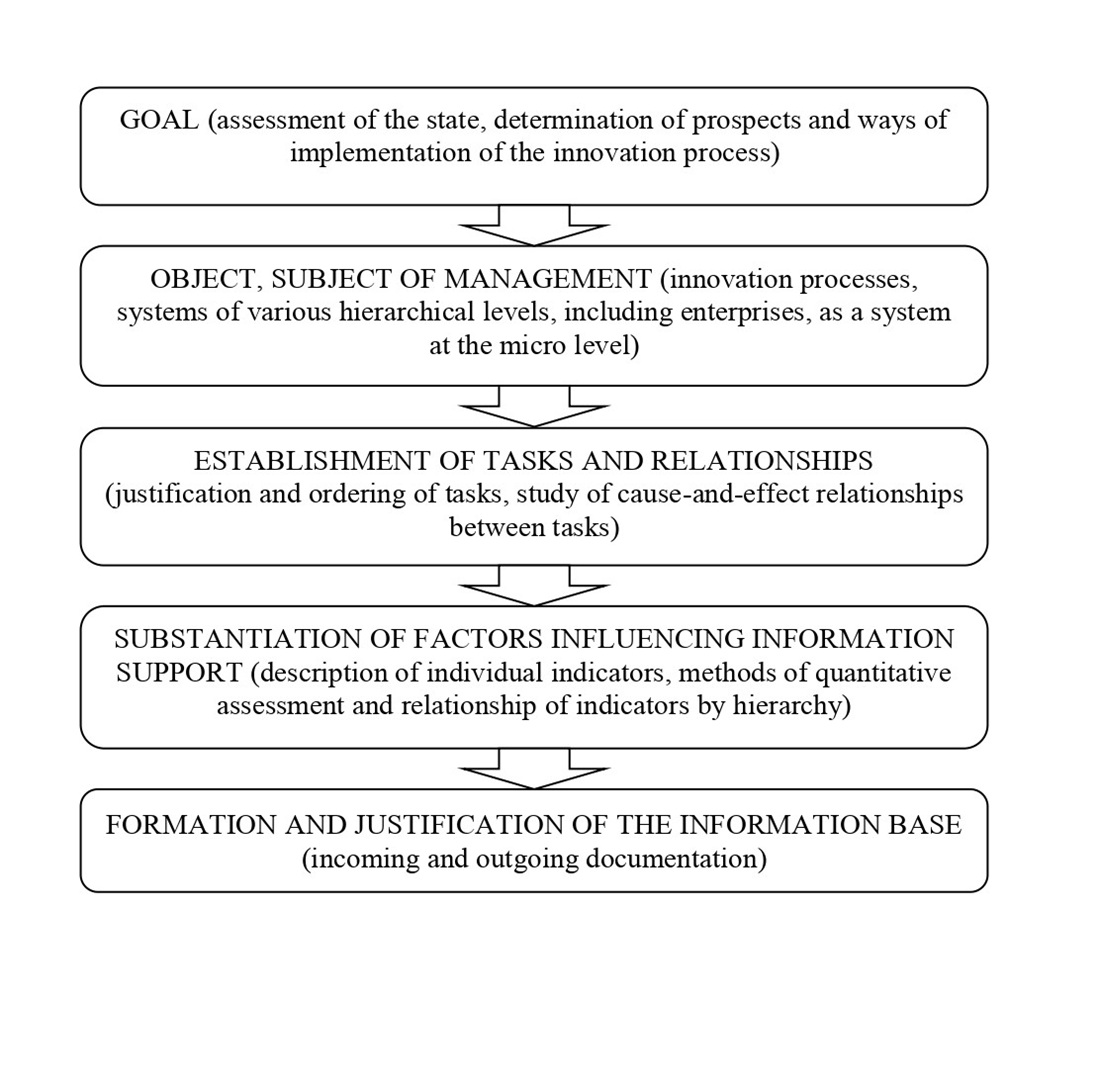
The study's results include the approach improved to assess the effectiveness of the innovation process by applying SEE management and a structural and logical model constructed to form an appropriate information support, which reflects the relationship between the components of effectiveness.
A feature of this study is the construction of a structural-logical model to form information support for assessing the effectiveness of the innovation process and to build a performance matrix that reflects the relationships between indicators of the enterprise's innovative activity.
The proposed matrix is integrated into the management information system (MIS) and provides increased validity of management decisions. The practical significance of research results is the possibility of using the proposed approach in the management systems of innovative activities at enterprises to increase the efficiency of planning and assessing the effectiveness of innovative processes.
The implementation of the proposed approach contributes to the coordination of strategic and operational goals of the enterprise's development, increasing the adaptability of innovative activities and forming an information basis for making management decisions under the conditions of digitalization of the economy and orientation on the principles of sustainable development
References
- Brunner, M., Gundolf, K., Guieu, G. (2025). From a conventional to a sustainable business model – a review on transformation actions and indicators. Cleaner Logistics and Supply Chain, 16, 100258. https://doi.org/10.1016/j.clscn.2025.100258
- Pangarso, A., Yunani, A., Umbara, T., Hendriyanto, R., Sisilia, K., Panutur, S. S. (2025). Uncovering the secrets of sustainable performance: Empirical studies on ethical behaviour, fortitude culture, ambidextrous governance and digital innovation using combined importance-performance map analysis. Sustainable Futures, 10, 101181. https://doi.org/10.1016/j.sftr.2025.101181
- Manikandan, S., Vickram, S., Deena, S. R., Subbaiya, R., Karmegam, N. (2024). Critical review on fostering sustainable progress: An in-depth evaluation of cleaner production methodologies and pioneering innovations in industrial processes. Journal of Cleaner Production, 452, 142207. https://doi.org/10.1016/j.jclepro.2024.142207
- Huy, P. Q., Phuc, V. K. (2025). Unveiling how business process management capabilities foster dynamic decision-making for effectiveness of sustainable digital transformation. Business Process Management Journal, 31 (8), 67–103. https://doi.org/10.1108/bpmj-06-2024-0467
- Li, P., Li, X., Wu, Q. (2025). Digitalization drives Sustainability: How digital trade enhances corporate ESG performance through innovation, internationalization and transparency. International Review of Economics & Finance, 101, 104248. https://doi.org/10.1016/j.iref.2025.104248
- Khan, I., Khan, I., Sharif, A., Ahmed, A., Rehman, M. Z. (2025). Advancing renewable energy strategies: Integrating technological innovation and economic complexity for sustainable resource management. Energy Strategy Reviews, 62, 101958. https://doi.org/10.1016/j.esr.2025.101958
- Ho, H. X., Nguyen, P. D., Nguyen-Phuong, K.-T. (2025). Fostering sustainable supply chain performance: a mixed-method approach of the moderated mediation model involving learning orientation, innovation, agility, and environmental complexity. Supply Chain Management: An International Journal, 31 (1), 122–142. https://doi.org/10.1108/scm-05-2025-0404
- Fernández-Hernández, M., Mora, P., Ortega, M. F., Cabello, J. P. (2025). Development of a comprehensive sustainability index for extractive and mining companies: Integrating the Sustainable Development Goals. Heliyon, 11 (2), e41975. https://doi.org/10.1016/j.heliyon.2025.e41975
- Mujie, S., Liu, S. (2025). Fostering energy innovation: Integrating working capital management strategies for sustainability in hydrogen entrepreneurship industries ecosystem. International Journal of Hydrogen Energy, 160, 150393. https://doi.org/10.1016/j.ijhydene.2025.150393
- Kristoffersen, E., Mikalef, P., Blomsma, F., Li, J. (2021). The effects of business analytics capability on circular economy implementation, resource orchestration capability, and firm performance. International Journal of Production Economics, 239, 108205. https://doi.org/10.1016/j.ijpe.2021.108205
- Latino, M. E., De Lorenzi, M. C., Corallo, A., Petruzzelli, A. M. (2024). The impact of metaverse for business model innovation: A review, novel insights and research directions. Technological Forecasting and Social Change, 206, 123571. https://doi.org/10.1016/j.techfore.2024.123571
- Lüdeke‐Freund, F. (2019). Sustainable entrepreneurship, innovation, and business models: Integrative framework and propositions for future research. Business Strategy and the Environment, 29 (2), 665–681. https://doi.org/10.1002/bse.2396
- Maresova, P., Javanmardi, E., Maskuriy, R., Selamat, A., Kuca, K. (2022). Dynamic sustainable business modelling: exploring the dynamics of business model components considering the product development framework. Applied Economics, 54 (51), 5904–5931. https://doi.org/10.1080/00036846.2022.2055740
- Mondal, S., Singh, S., Gupta, H. (2024). Achieving Technological Transformation and Social Sustainability: An Industry 4.0 Perspective. IEEE Transactions on Engineering Management, 71, 6623–6635. https://doi.org/10.1109/tem.2023.3246637
- Stadnyk, V., Holovchuk, O. (2017). Scientific and methodical approaches to innovative activity and informational provision management of an enterprise. Visnyk Khmelnytskoho natsionalnoho universytetu, 5, 177–181. Available at: https://elar.khmnu.edu.ua/server/api/core/bitstreams/0955a0bc-fefb-4aeb-b0ae-565b3b4a1066/content
- Turylo, A. A. (2013). Menedzhment innovatsiynoho rozvytku pidpryiemstva. Visnyk Kryvorizkoho natsionalnoho universytetu, 35, 278–280. Available at: http://ds.knu.edu.ua/jspui/bitstream/123456789/3302/1/%D0%A2%D1%83%D1%80%D0%B8%D0%BB%D0%BE%20%D0%90.%20%D0%90.%20%D0%9C%D0%B5%D0%BD%D0%B5%D0%B4%D0%B6%D0%BC%D0%B5%D0%BD%D1%82%20%D1%96%D0%BD%D0%BD%D0%BE%D0%B2%D0%B0%D1%86%D1%96%D0%B9%D0%BD%D0%BE%D0%B3%D0%BE%20%D1%80%D0%BE%D0%B7%D0%B2%D0%B8%D1%82%D0%BA%D1%83%20%D0%BF%D1%96%D0%B4%D0%BF%D1%80%D0%B8%D1%94%D0%BC%D1%81%D1%82%D0%B2%D0%B0.pdf
- Zakharchenko, V., Shvahirev, M. (2024). Information Support and its Role in Enterprise Management. Economics: Time Realities, 1 (71), 80–86. https://doi.org/10.15276/etr.01.2024.10
- Vala, L., Pereira, R., Caetano, I. (2017). Innovation Management Processes and Routines for Business Success and Value Creation. Management Studies, 5 (5), 471–481. https://doi.org/10.17265/2328-2185/2017.05.011
- Cantamessa, M., Montagna, F. (2023). Management of Innovation and Product Development. Springer London. https://doi.org/10.1007/978-1-4471-7531-5
- Stadnyk, V. V., Holovchuk, Yu. O. (2020). Upravlinnia innovatsiyamy na osnovi rozvytku partnerskykh vidnosyn pidpryiemstva. Kamianets-Podilskyi: TOV «Drukarnia «Ruta», 232. Available at: https://elar.khmnu.edu.ua/server/api/core/bitstreams/e70878b7-6d25-454e-a600-dbc7ba491f0d/content
- Chernoivanova, H. S. (2018). Information support in the management system of the innovative component of the enterprise. Naukovyi visnyk Mizhnarodnoho humanitarnoho universytetu, 31, 58–61. Available at: http://nbuv.gov.ua/UJRN/Nvmgu_eim_2018_31_14
- Burennikova, N. V., Yarmolenko, V. О., Burennikov, Y. Y. (2021). Effectiveness of the Functioning and Development of Systems: The Updated Approaches to Definitions of SEE-Governance. Business Inform, 3 (518), 94–100. https://doi.org/10.32983/2222-4459-2021-3-94-100
- Burennikova, N. V., Yarmolenko, V. О. (2016). SEE-Controlling on the Basis of Components of Efficiency as a Way to Improve the Force of Complex Systems Functioning: Essence, Methodology. Business Inform, 1, 145–152. Available at: https://www.business-inform.net/export_pdf/business-inform-2016-1_0-pages-8_14.pdf
- Khorunzhak, N. M., Portovaras, T. R., Lukanovska, I. R. (2023). Synergism of information from analysis, control and audit for quality management of economic entity activities. Economics and Law, 3, 80–90. https://doi.org/10.15407/econlaw.2023.03.080
- Dzhedzhula, V., Yepifanova, I., Kravchyk, Y. (2022). Use of the Theory of Fuzzy Sets in Determining the Level of Enterprise Security. 2022 12th International Conference on Advanced Computer Information Technologies (ACIT), 311–315. https://doi.org/10.1109/acit54803.2022.9913150
- Burennikova, N. V., Kozlov, L. G., Burennikov, Y. A., Zavgorodniy, I. V. (2022). Theoretical Foundations of the Effectiveness of Technology Transfer: Essence, Evaluation, Management. Business Inform, 7 (534), 162–170. https://doi.org/10.32983/2222-4459-2022-7-162-170
- Pro innovatsiynu diyalnist: zakon Ukrainy vid 04.07.2002 r. No. 40-IV. Available at: https://zakon.rada.gov.ua/laws/show/40-15#Text
- Marchenko, O., Pustiva, V. (2022). Development of innovative business processes at the enterprise. Market Infrastructure, 69. https://doi.org/10.32782/infrastruct69-17
- Smoliar, L. H., Lobodzynska, O. Yu. (2014). Upravlinnia portfelem innovatsiynykh proektiv pidpryiemstva. Naukovyi visnyk Khersonskoho derzhavnoho universytetu. Seriya: Ekonomichni nauky, 7, 185–187.
- Korolyshyn, T. V., Myronov, Yu. B. (2015). Provaidynh informatsiynoho zabezpechennia v innovatsiyniy diyalnosti orhanizatsiyi. Elektronnyi naukovyi visnyk «Kerivnyk.INFO». Available at: https://kerivnyk.info/2015/02/korolyshyn.html
- Yarmolenko, V. О., Burennikova, N. V. (2019). Measuring the Efficiency of the Processes of Functioning of a Component System Based on the Models of the Efficiency Constituents: The Energy Aspect. Business Inform, 12 (503), 102–110. https://doi.org/10.32983/2222-4459-2019-12-102-110
- Burennikova, N. V. (2021). Theory and Philosophy of the Effectiveness of Enterprises as Systems: An Updated Look at Ways to Implement Functions and Management. Business Inform, 6 (521), 190–196. https://doi.org/10.32983/2222-4459-2021-6-190-196
- Vărzaru, A. A., Bocean, C. G. (2024). Digital Transformation and Innovation: The Influence of Digital Technologies on Turnover from Innovation Activities and Types of Innovation. Systems, 12 (9), 359. https://doi.org/10.3390/systems12090359
- Plekhanov, D., Franke, H., Netland, T. H. (2023). Digital transformation: A review and research agenda. European Management Journal, 41 (6), 821–844. https://doi.org/10.1016/j.emj.2022.09.007
Downloads
Published
How to Cite
Issue
Section
License
Copyright (c) 2026 Inna Vishtak, Nataliia Burennikova, Leonid Maidanevych

This work is licensed under a Creative Commons Attribution 4.0 International License.
The consolidation and conditions for the transfer of copyright (identification of authorship) is carried out in the License Agreement. In particular, the authors reserve the right to the authorship of their manuscript and transfer the first publication of this work to the journal under the terms of the Creative Commons CC BY license. At the same time, they have the right to conclude on their own additional agreements concerning the non-exclusive distribution of the work in the form in which it was published by this journal, but provided that the link to the first publication of the article in this journal is preserved.
A license agreement is a document in which the author warrants that he/she owns all copyright for the work (manuscript, article, etc.).
The authors, signing the License Agreement with TECHNOLOGY CENTER PC, have all rights to the further use of their work, provided that they link to our edition in which the work was published.
According to the terms of the License Agreement, the Publisher TECHNOLOGY CENTER PC does not take away your copyrights and receives permission from the authors to use and dissemination of the publication through the world's scientific resources (own electronic resources, scientometric databases, repositories, libraries, etc.).
In the absence of a signed License Agreement or in the absence of this agreement of identifiers allowing to identify the identity of the author, the editors have no right to work with the manuscript.
It is important to remember that there is another type of agreement between authors and publishers – when copyright is transferred from the authors to the publisher. In this case, the authors lose ownership of their work and may not use it in any way.








