Development of a validated computational fluid dynamics model for film cooling efficiency calculation
DOI:
https://doi.org/10.15587/1729-4061.2026.356502Keywords:
film cooling, cooling efficiency, flat plate, numerical modeling, turbulence modelAbstract
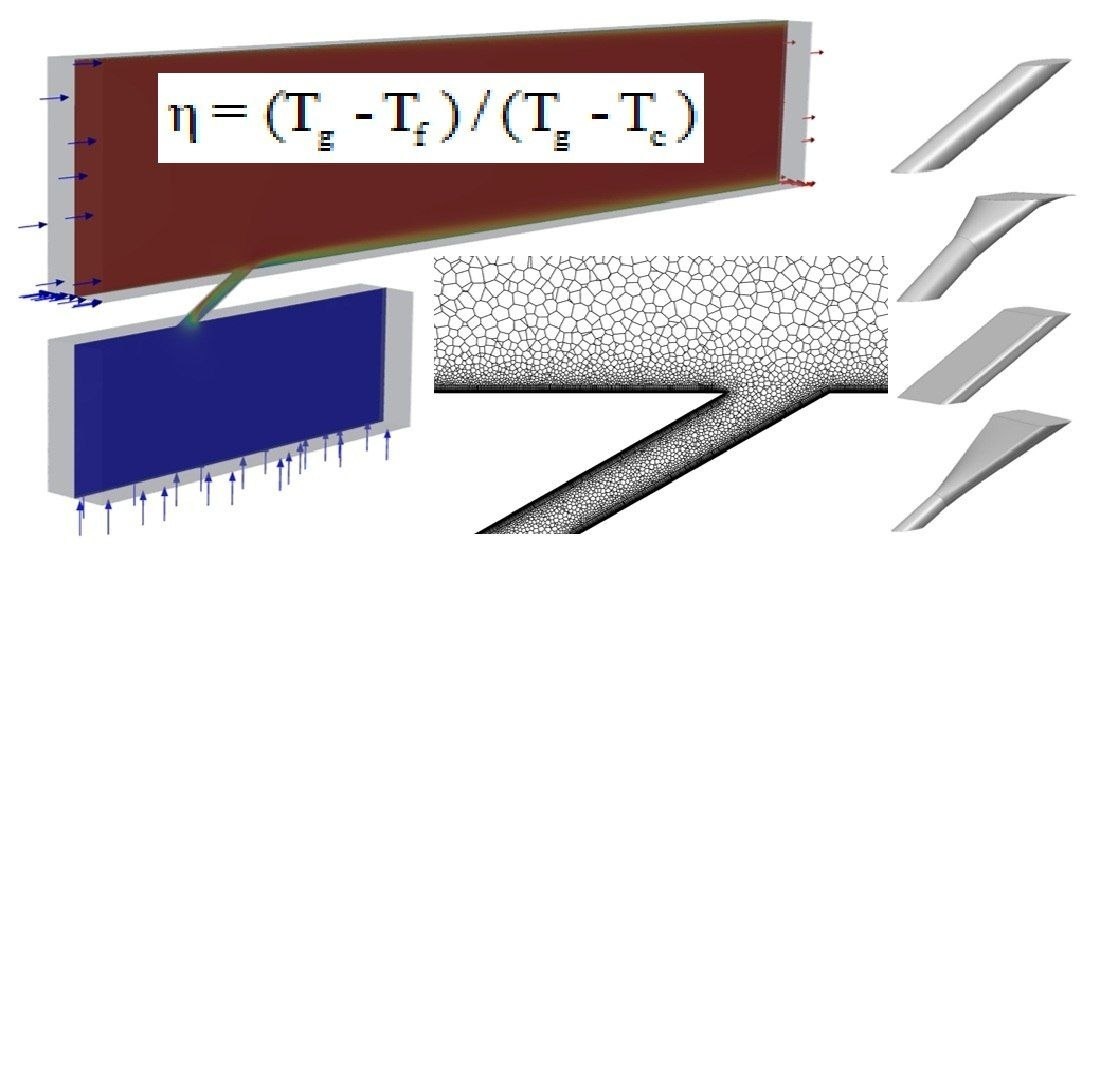
This study investigates the film cooling process on a flat plate. The task addressed relates to the identification of the most universal CFD model for different film cooling hole shapes.
The task has been solved by selecting an optimal computational mesh and determining the most suitable turbulence models for predicting film cooling effectiveness over a wide range of parameters. To investigate mesh‑independence effects, four levels of polyhedral computational grids were generated. It was shown that the mesh with 5.8 million elements, selected based on the mesh‑convergence analysis, performs nearly as well as a block‑structured mesh with identical settings.
A validated CFD model based on a polyhedral mesh was built. A distinctive feature of the results is that the CFD model covers 4 hole geometries spaced 5D apart and inclined at 30° to the mainstream flow (classical cylindrical, fan‑shaped, oval, and a diffused slot).
The results include a comparison of seven RANS turbulence models with experimental data. It was found that for the considered flow and geometric conditions, the most robust and generally applicable model is the k‑ε Realizable turbulence model. Its advantages may be explained by its improved stability and better sensitivity to regions of complex flow kinematics, which enables more accurate prediction of expanding (fan‑shaped and diffuser‑type) holes.
Additionally, the model feasibility was verified for the 7-7-7 hole configuration. For this type of hole, a preliminary analysis of the influence of thermal barrier coating configurations on film cooling effectiveness is presented. The proposed computational model could be used for optimizing hole geometry and blowing conditions in gas turbine blade cooling applications
References
- Jauregui, R., Silv, F. (2011). Numerical Validation Methods. Numerical Analysis - Theory and Application. https://doi.org/10.5772/23304
- Shevchuk, O., Tarasov, O. (2025). Review of the Current State of Problem of Film Cooling for Gas Turbine Blades. NTU “KhPI” Bulletin: Power and Heat Engineering Processes and Equipment, 1, 29–44. https://doi.org/10.20998/2078-774x.2025.01.03
- Bunker, R. S. (2010). Film Cooling: Breaking the Limits of Diffusion Shaped Holes. Heat Transfer Research, 41 (6), 627–650. https://doi.org/10.1615/heattransres.v41.i6.40
- Shevchuk, O. V. (2025). Analysis of Modern Numerical Approaches to Film Cooling Simulation on a Flat Surface: Trends, Errors and Correlation Dependencies. Journal of Mechanical Engineering, 28 (4), 11–25. https://doi.org/10.15407/pmach2025.04.011
- Chen, X., Li, J., Long, Y., Wang, Y., Weng, S., Yavuzkurt, S. (2020). A Conjugate Heat Transfer and Thermal Stress Analysis of Film-Cooled Superalloy With Thermal Barrier Coating. Volume 7B: Heat Transfer. https://doi.org/10.1115/gt2020-16241
- Zamiri, A., You, S. J., Chung, J. T. (2020). Numerical Evaluation of Surface Roughness Effects on Film-Cooling Performance in a Laidback Fan-Shaped Hole. Volume 7B: Heat Transfer. https://doi.org/10.1115/gt2020-14525
- Barigozzi, G., Zamiri, A., Brumana, G., Franchina, N., Chung, J. T. (2025). On the impact of Reynolds number on the performance of a trenched shaped hole. 16th European Conference on Turbomachinery Fluid Dynamics and Thermodynamics. https://doi.org/10.29008/etc2025-107
- Petelchic, V. Yu., Halatov, A. A., Pismenniy, D. N., Dashevskiy, Yu. Ya. (2013). Adaptation of SST turbulence model for a flat plate film cooling simulation. Eastern-European Journal of Enterprise Technologies, 3 (12 (63)), 25–29. Available at: https://journals.uran.ua/eejet/article/view/14874/
- Fischer, L., James, D., Jeyaseelan, S., Pfitzner, M. (2023). Optimizing the trench shaped film cooling design. International Journal of Heat and Mass Transfer, 214, 124399. https://doi.org/10.1016/j.ijheatmasstransfer.2023.124399
- Liu, C.-L., Zhu, H.-R., Bai, J.-T. (2008). Effect of turbulent Prandtl number on the computation of film-cooling effectiveness. International Journal of Heat and Mass Transfer, 51 (25-26), 6208–6218. https://doi.org/10.1016/j.ijheatmasstransfer.2008.04.039
- Shih, T.-H., Liou, W. W., Shabbir, A., Yang, Z., Zhu, J. (1995). A new k-ϵ eddy viscosity model for high reynolds number turbulent flows. Computers & Fluids, 24(3), 227–238. https://doi.org/10.1016/0045-7930(94)00032-t
- Menter, F. R. (1994). Two-equation eddy-viscosity turbulence models for engineering applications. AIAA Journal, 32 (8), 1598–1605. https://doi.org/10.2514/3.12149
- Diskin, B., Thomas, J. (2012). Effects of mesh regularity on accuracy of finite-volume schemes. 50th AIAA Aerospace Sciences Meeting Including the New Horizons Forum and Aerospace Exposition. https://doi.org/10.2514/6.2012-609
- Furgeson, M. T., Flachs, E. M., Bogard, D. G. (2025). Adjoint Optimization of Gas Turbine Film Cooling Geometry With Elevated Mainstream Mach Number. Volume 5: Energy Storage; Fans and Blowers; Heat Transfer: Combustors; Heat Transfer: Film Cooling. https://doi.org/10.1115/gt2025-154287
- Avcun, S., Erdem, E., Sal, S., Yasa, T. (2025). The Effect of Crossflow Velocity on the Film Cooling Effectiveness of Fan Shaped Holes. Volume 5: Energy Storage; Fans and Blowers; Heat Transfer: Combustors; Heat Transfer: Film Cooling. https://doi.org/10.1115/gt2025-154073
- Watanabe, K., Matsuura, M., Suenaga, K., Takeishi, K. I. (1999). An experimental study on the film cooling effectiveness with expanded hole geometry. Proceedings of the international gas turbine congress. Kobe, 615–622.
- Celik, I., Ghia, U., Roache, P., Freitas, C., Coleman, H., Raad, P. (2008) Procedure for estimation and reporting of uncertainty due to discretization in CFD applications. Journal of Fluids Engineering, 130 (7), 078001. https://doi.org/10.1115/1.2960953
- Pedersen, D. R., Eckert, E. R. G., Goldstein, R. J. (1977). Film Cooling With Large Density Differences Between the Mainstream and the Secondary Fluid Measured by the Heat-Mass Transfer Analogy. Journal of Heat Transfer, 99 (4), 620–627. https://doi.org/10.1115/1.3450752
- Na, S., Shih, T. I.-P. (2006). Increasing Adiabatic Film-Cooling Effectiveness by Using an Upstream Ramp. Journal of Heat Transfer, 129 (4), 464–471. https://doi.org/10.1115/1.2709965
- Hussain, S., Yan, X. (2020). Implementation of Hole-Pair in Ramp to Improve Film Cooling Effectiveness on a Plain Surface. Volume 7B: Heat Transfer. https://doi.org/10.1115/gt2020-14838
- Rutledge, J. L., Polanka, M. D. (2014). Computational Fluid Dynamics Evaluations of Unconventional Film Cooling Scaling Parameters on a Simulated Turbine Blade Leading Edge. Journal of Turbomachinery, 136 (10). https://doi.org/10.1115/1.4028001
Downloads
Published
How to Cite
Issue
Section
License
Copyright (c) 2026 Oleg Shevchuk, Oleksandr Tarasov

This work is licensed under a Creative Commons Attribution 4.0 International License.
The consolidation and conditions for the transfer of copyright (identification of authorship) is carried out in the License Agreement. In particular, the authors reserve the right to the authorship of their manuscript and transfer the first publication of this work to the journal under the terms of the Creative Commons CC BY license. At the same time, they have the right to conclude on their own additional agreements concerning the non-exclusive distribution of the work in the form in which it was published by this journal, but provided that the link to the first publication of the article in this journal is preserved.
A license agreement is a document in which the author warrants that he/she owns all copyright for the work (manuscript, article, etc.).
The authors, signing the License Agreement with TECHNOLOGY CENTER PC, have all rights to the further use of their work, provided that they link to our edition in which the work was published.
According to the terms of the License Agreement, the Publisher TECHNOLOGY CENTER PC does not take away your copyrights and receives permission from the authors to use and dissemination of the publication through the world's scientific resources (own electronic resources, scientometric databases, repositories, libraries, etc.).
In the absence of a signed License Agreement or in the absence of this agreement of identifiers allowing to identify the identity of the author, the editors have no right to work with the manuscript.
It is important to remember that there is another type of agreement between authors and publishers – when copyright is transferred from the authors to the publisher. In this case, the authors lose ownership of their work and may not use it in any way.