Improvement of the amino acid composition of a mung bean-based functional beverage through the application of a metabolic modulator during sprouting
DOI:
https://doi.org/10.15587/1729-4061.2026.357026Keywords:
Vigna radiata, germination, sucrose supplementation, amino acid profile, HPLC, essential amino acids, metabolic modulation, sprouted mung beanAbstract
The object of this study is sprouted mung bean seeds (Vigna radiata L.) of the “Zhasyl dän” variety, used as a raw material for developing a functional beverage with improved protein quality. The study addresses the limited biological value of plant proteins associated with their amino acid composition
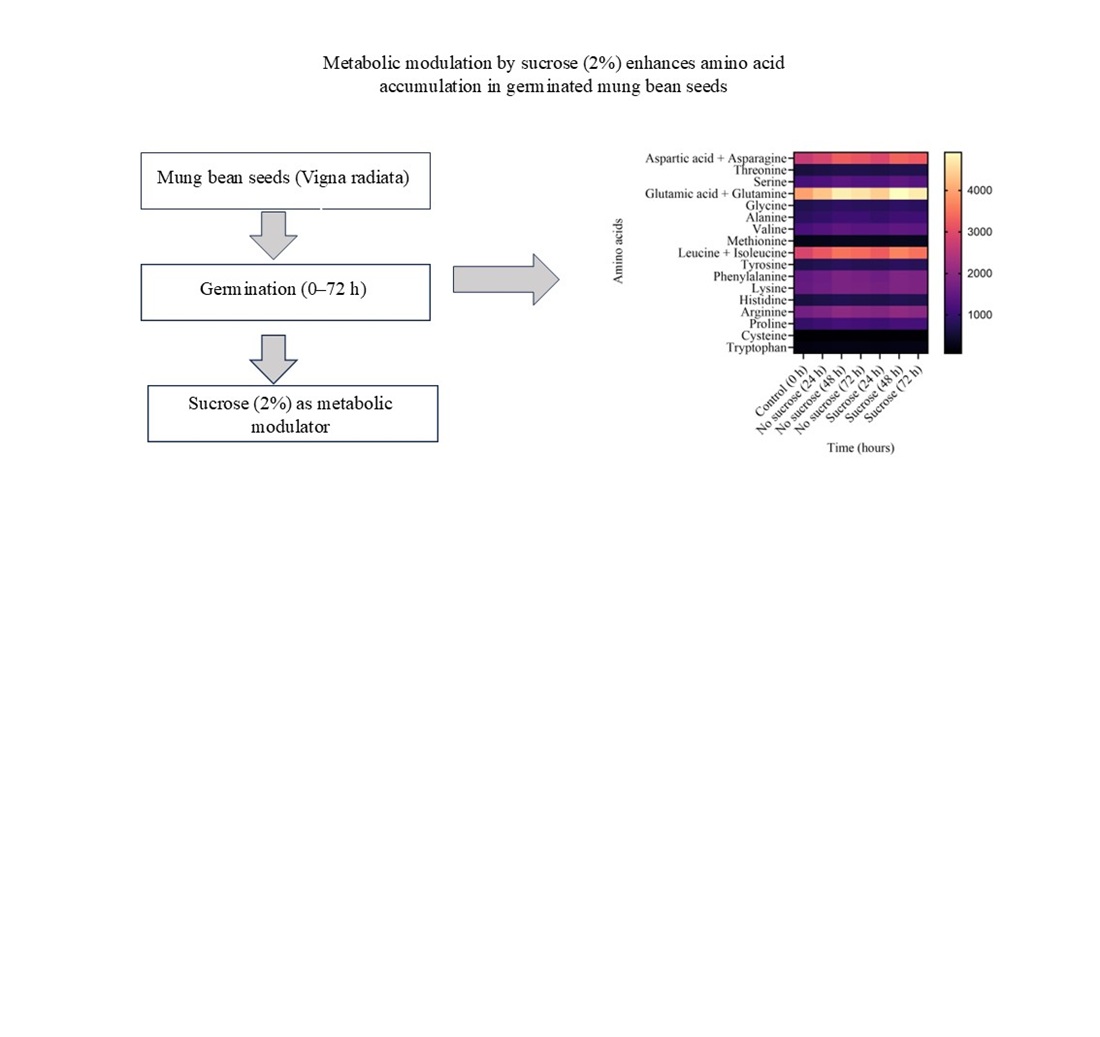
Seeds were germinated in distilled water (control) and in a 2% sucrose solution for 24, 48, and 72 hours. Amino acid composition was analyzed using high-performance liquid chromatography (HPLC) with fluorescence detection.
Sucrose addition led to a clear increase in amino acid content during germination, with the strongest effect observed after 48 hours. Total amino acid content increased from 21,539 to 26,656 mg/100 g dry weight (+23.8%). The most noticeable changes were found for essential amino acids, including lysine (+20.7%), valine (+23.9%), and branched-chain amino acids (leucine and isoleucine, +26.2%). Glutamic and aspartic acids also increased by about 24%, which may be linked to improved taste characteristics.
In general, sucrose influenced metabolic processes and resulted in a 20–25% increase in amino acid content without the use of microbial cultures. The optimal germination time was around 48 hours.
These results suggest that controlled germination with carbohydrate addition can be used as a simple approach to improve plant protein quality in functional food products.
References
- Day, L., Cakebread, J. A., Loveday, S. M. (2022). Food proteins from animals and plants: Differences in the nutritional and functional properties. Trends in Food Science & Technology, 119, 428–442. https://doi.org/10.1016/j.tifs.2021.12.020
- The State of Food Security and Nutrition in the World 2024 (2024). FAO. https://doi.org/10.4060/cd1254en
- Aguirre-Garcia, Y. L., Nery-Flores, S. D., Campos-Muzquiz, L. G., Flores-Gallegos, A. C., Palomo-Ligas, L., Ascacio-Valdés, J. A. et al. (2024). Lactic Acid Fermentation in the Food Industry and Bio-Preservation of Food. Fermentation, 10 (3), 168. https://doi.org/10.3390/fermentation10030168
- Elhalis, H., See, X. Y., Osen, R., Chin, X. H., Chow, Y. (2023). Significance of Fermentation in Plant-Based Meat Analogs: A Critical Review of Nutrition, and Safety-Related Aspects. Foods, 12 (17), 3222. https://doi.org/10.3390/foods12173222
- Martineau-Côté, D., Achouri, A., Karboune, S., L’Hocine, L. (2022). Faba Bean: An Untapped Source of Quality Plant Proteins and Bioactives. Nutrients, 14 (8), 1541. https://doi.org/10.3390/nu14081541
- Tarahi, M. (2024). The Potential Application of Mung Bean (Vigna radiata L.) Protein in Plant‐Based Food Analogs: A Review. Legume Science, 6 (4). https://doi.org/10.1002/leg3.70011
- Hadidi, M., Hossienpour, Y., Nooshkam, M., Mahfouzi, M., Gharagozlou, M., Aliakbari, F. S. et al. (2023). Green leaf proteins: a sustainable source of edible plant-based proteins. Critical Reviews in Food Science and Nutrition, 64 (29), 10855–10872. https://doi.org/10.1080/10408398.2023.2229436
- Kong, Y., Jing, L., Huang, D. (2022). Plant proteins as the functional building block of edible microcarriers for cell-based meat culture application. Critical Reviews in Food Science and Nutrition, 64 (15), 4966–4976. https://doi.org/10.1080/10408398.2022.2147144
- Yang, R., Zhu, L., Meng, D., Wang, Q., Zhou, K., Wang, Z., Zhou, Z. (2021). Proteins from leguminous plants: from structure, property to the function in encapsulation/binding and delivery of bioactive compounds. Critical Reviews in Food Science and Nutrition, 62 (19), 5203–5223. https://doi.org/10.1080/10408398.2021.1883545
- Amaral, A. L., Ferreira, E. S., Silva, M. A., Neves, V. A., Demonte, A. (2017). The Vicilin protein (Vigna radiata L.) of mung bean as a functional food. Nutrition & Food Science, 47 (6), 907–916. https://doi.org/10.1108/nfs-05-2017-0089
- Siriparu, P., Panyatip, P., Pota, T., Ratha, J., Yongram, C., Srisongkram, T. et al. (2022). Effect of Germination and Illumination on Melatonin and Its Metabolites, Phenolic Content, and Antioxidant Activity in Mung Bean Sprouts. Plants, 11 (21), 2990. https://doi.org/10.3390/plants11212990
- Arbab Sakandar, H., Chen, Y., Peng, C., Chen, X., Imran, M., Zhang, H. (2021). Impact of Fermentation on Antinutritional Factors and Protein Degradation of Legume Seeds: A Review. Food Reviews International, 39 (3), 1227–1249. https://doi.org/10.1080/87559129.2021.1931300
- Nkhata, S. G., Ayua, E., Kamau, E. H., Shingiro, J. (2018). Fermentation and germination improve nutritional value of cereals and legumes through activation of endogenous enzymes. Food Science & Nutrition, 6 (8), 2446–2458. https://doi.org/10.1002/fsn3.846
- Kponouglo, K., Kouba, M., Good, M., Grosset, N., Aichaoui, L., Gagnaire, V. et al. (2025). Sprouted grains fermentation: a comprehensive review of current knowledge, benefits, challenges, and perspectives. Systems Microbiology and Biomanufacturing, 5 (4), 1395–1414. https://doi.org/10.1007/s43393-025-00366-z
- Makenova, A., Mussayeva, S. (2025). Amino Acid Profiles of Sprouted Mung Bean (Vigna radiata) Under Fermentation Conditions. Zenodo. https://doi.org/10.5281/zenodo.15094675
- Monerri, C., Garcia‐Luis, A., Guardiola, J. L. (1986). Sugar and starch changes in pea cotyledons during germination. Physiologia Plantarum, 67 (1), 49–54. https://doi.org/10.1111/j.1399-3054.1986.tb01261.x
- Wu, H., Rui, X., Li, W., Chen, X., Jiang, M., Dong, M. (2015). Mung bean (Vigna radiata) as probiotic food through fermentation with Lactobacillus plantarum B1-6. LWT - Food Science and Technology, 63 (1), 445–451. https://doi.org/10.1016/j.lwt.2015.03.011
- Liang, Z., Sun, J., Yang, S., Wen, R., Liu, L., Du, P. et al. (2022). Fermentation of mung bean milk by Lactococcus lactis: Focus on the physicochemical properties, antioxidant capacities and sensory evaluation. Food Bioscience, 48, 101798. https://doi.org/10.1016/j.fbio.2022.101798
- Wei, Y., Wang, X., Shao, X., Xu, F., Wang, H. (2019). Sucrose treatment of mung bean seeds results in increased vitamin C, total phenolics, and antioxidant activity in mung bean sprouts. Food Science & Nutrition, 7 (12), 4037–4044. https://doi.org/10.1002/fsn3.1269
- Xue, Y., Chen, J., Wang, L., Wang, Y., Xu, F. (2024). Exploring the flavor changes in mung bean flour through Lactobacillus fermentation: insights from volatile compounds and non‐targeted metabolomics analysis. Journal of the Science of Food and Agriculture, 104 (12), 7238–7248. https://doi.org/10.1002/jsfa.13545
Downloads
Published
How to Cite
Issue
Section
License
Copyright (c) 2026 Aliya Makenova, Saltanat Mussayeva, Dina Dautkanova, Zhibek Ussembayeva, Nurlan Dautkanov

This work is licensed under a Creative Commons Attribution 4.0 International License.
The consolidation and conditions for the transfer of copyright (identification of authorship) is carried out in the License Agreement. In particular, the authors reserve the right to the authorship of their manuscript and transfer the first publication of this work to the journal under the terms of the Creative Commons CC BY license. At the same time, they have the right to conclude on their own additional agreements concerning the non-exclusive distribution of the work in the form in which it was published by this journal, but provided that the link to the first publication of the article in this journal is preserved.
A license agreement is a document in which the author warrants that he/she owns all copyright for the work (manuscript, article, etc.).
The authors, signing the License Agreement with TECHNOLOGY CENTER PC, have all rights to the further use of their work, provided that they link to our edition in which the work was published.
According to the terms of the License Agreement, the Publisher TECHNOLOGY CENTER PC does not take away your copyrights and receives permission from the authors to use and dissemination of the publication through the world's scientific resources (own electronic resources, scientometric databases, repositories, libraries, etc.).
In the absence of a signed License Agreement or in the absence of this agreement of identifiers allowing to identify the identity of the author, the editors have no right to work with the manuscript.
It is important to remember that there is another type of agreement between authors and publishers – when copyright is transferred from the authors to the publisher. In this case, the authors lose ownership of their work and may not use it in any way.








