Prioritizing construction delay types and mitigation strategies using an integrated RCA-FAHP-RII framework
DOI:
https://doi.org/10.15587/1729-4061.2026.357222Keywords:
construction delay, FAHP, project management, RCA, RII, road constructionAbstract
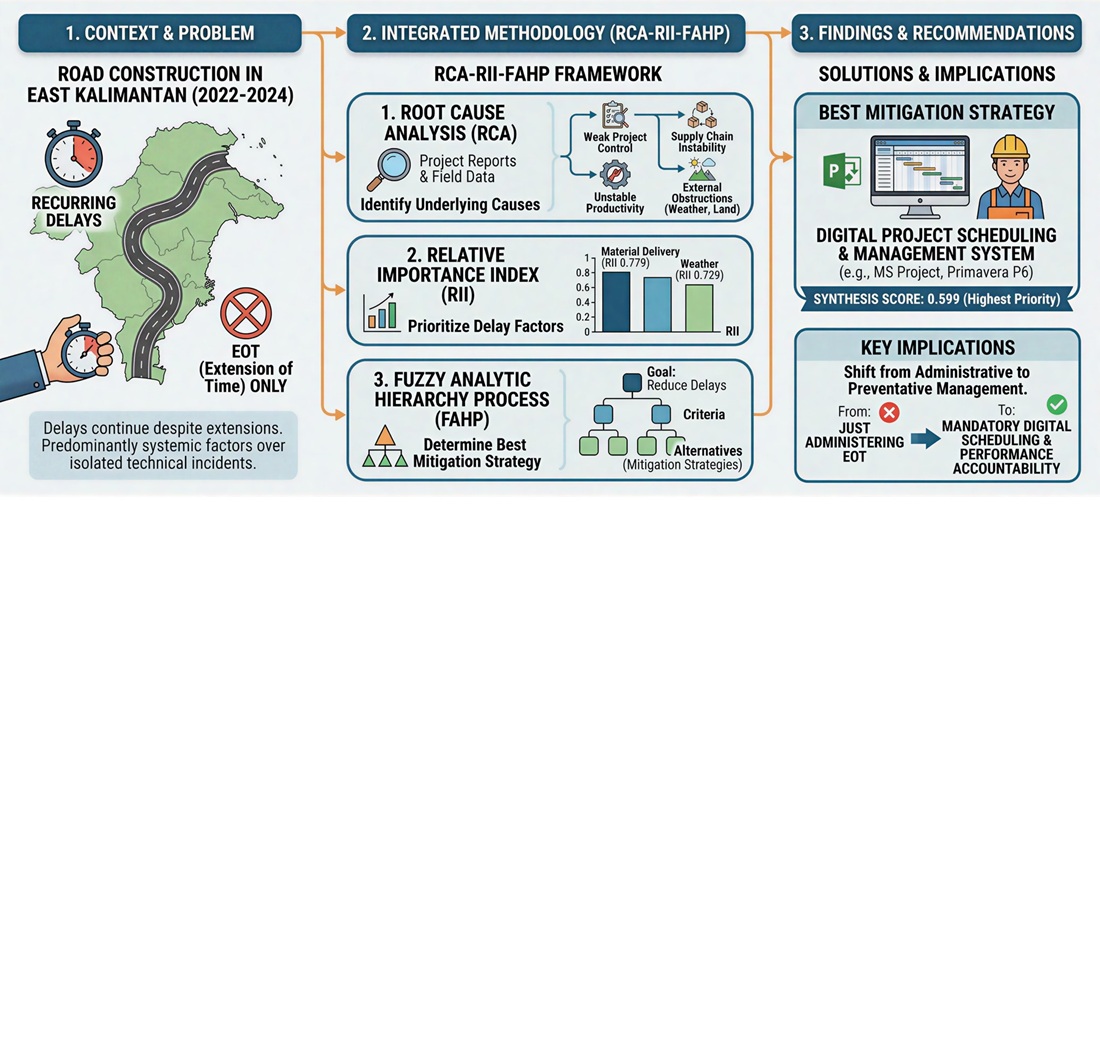
The object of this study is completed road construction projects in East Kalimantan that experienced negative schedule deviations during the 2022–2024 period. The problem addressed in this study is the persistence of construction delays that remain unresolved despite the frequent application of time extensions, indicating systemic weaknesses in planning, control, and governance. The results show that the most significant delay factors from RCA (root cause analysis) are weak project control and operational planning, unreliable material and procurement supply chains, unstable productivity in critical on‑site activities, and unanticipated external constraints. The fuzzy analytics hierarchy process (FAHP) results indicate that the adoption of digital-based project management and scheduling systems is the most effective mitigation strategy, achieving the highest synthesis score of 0.599 compared to other alternatives. This result is further supported by sensitivity analysis, confirming the stability of the ranking. From the relatives importance index (RII) analysis, weather-related factors emerge as the most significant contributors to delays, with a factor-level score of 0.729, followed by time factors (0.662) and equipment factors (0.643). At the indicator level, delays in material delivery show the highest individual impact, with an RII value of 0.779. Overall, five out of six major delay factor groups fall within the “high importance” category, highlighting the dominant role of systemic and operational issues rather than isolated technical problems. These results are explained by deficiencies in preventive planning and integrated control mechanisms, which lead to delayed decision‑making and reactive project management practices. The distinctive feature of the proposed results lies in the integration of causal identification, priority weighting, and policy‑oriented decision support, enabling delays to be addressed systematically rather than administratively. The results can be applied by public infrastructure agencies using digital scheduling systems, performance‑based evaluations, and stronger accountability mechanisms, especially in regions with fast infrastructure development
References
- Pramesti, N. P., Basuki, I. (2025). Challenges and Opportunities in Managing Large-Scale Infrastructure Projects: The Case of Indonesia’s New Capital Nusantara. Jurnal Teknik Sipil, 25 (2), 1930–1943. https://doi.org/10.26418/jts.v25i2.92564
- Peraturan Gubernur Provinsi Kalimantan Timur Nomor 06 Tahun 2024 tentang Tata Cara Pemberian Kesempatan Menyelesaikan Pekerjaan Melampaui Tahun Anggaran (2024). Available at: https://peraturan.bpk.go.id/Download/348605/Pergub%20Kaltim%206-2024%20ttg%20Tata%20Cara%20Pemberian%20Kesempatan%20Menyelesaikan%20Pekerjaan%20Melampaui%20Tahun%20Anggaran.pdf
- Mekanisme Pelaksanaan Anggaran atas Pekerjaan yang Belum Diselesaikan pada Akhir Tahun Anggaran (2023). Available at: https://peraturan.bpk.go.id/Details/271188/pmk-no-109-tahun-2023
- Irawan, J. (2025). Analysis of The Delay in The Implementation of Toll Road Project Work. Eduvest - Journal of Universal Studies, 5 (2), 1499–1508. https://doi.org/10.59188/eduvest.v5i2.1716
- Junata, H., Jumas, D. Y., Rita, E. (2025). Factors Causing Delays in Road Construction Projects in Kerinci Regency. RIGGS: Journal of Artificial Intelligence and Digital Business, 4 (3), 4528–4535. https://doi.org/10.31004/riggs.v4i3.2667
- Antoniou, F. (2021). Delay Risk Assessment Models for Road Projects. Systems, 9 (3), 70. https://doi.org/10.3390/systems9030070
- Ovalle, O. R., Correa-Cepeda, D., Estrada-Cifuentes, J. P., Mopan, Y. A. (2024). Analysis and prioritisation of critical delay factors in construction projects: A Colombian case. Organization, Technology and Management in Construction: An International Journal, 16 (1), 237–250. https://doi.org/10.2478/otmcj-2024-0017
- Nassar, N. K. (2009). An integrated framework for evaluation of performance of construction projects. PMI® Global Congress. Available at: https://www.pmi.org/learning/library/evaluation-performance-construction-projects-6751
- Devi, L. P., Sindhu (2025). Delay Analysis of Infrastructure Construction Projects in India. Journal of the Institution of Engineers (India): Series A, 106 (3), 763–771. https://doi.org/10.1007/s40030-025-00899-5
- Rauf, R., Wulandari, L. K., Manaha, Y. P. (2023). Performance Evaluation of Supervisory Consultants on Road Reconstruction Projects in East Kalimantan, Indonesia. International Journal of Scientific Engineering and Science, 7 (2). Available at: https://ijses.com/wp-content/uploads/2023/02/22-IJSES-V7N2.pdf
- Florez, L., Castro, D., Medaglia, A. L. (2012). Maximizing Labor Stability As a Sustainability Performance Indicator in Project Scheduling. Construction Research Congress 2012, 465–474. https://doi.org/10.1061/9780784412329.047
- Florez, L., Castro-Lacouture, D., Medaglia, A. L. (2013). Sustainable workforce scheduling in construction program management. Journal of the Operational Research Society, 64 (8), 1169–1181. https://doi.org/10.1057/jors.2012.164
- Berta, K. K., Tesfaye, M. (2025). Determinants of road construction project delay in the case of Woliso–Ambo road construction. Scientific Reports, 15 (1). https://doi.org/10.1038/s41598-025-86852-9
- Castañeda, K., Sánchez, O., Herrera, R. F., Mejía, G. (2025). Deficiencies causes in road construction scheduling: Perspectives from construction professionals. Heliyon, 11 (2), e41514. https://doi.org/10.1016/j.heliyon.2024.e41514
- Fais, Y. R., Soetjipto, J. W., Widayanto, E. (2025). Handling Strategy of Project Road Reconstruction Delays. Selected Articles from the 8th International Conference on Architecture and Civil Engineering, 740–755. https://doi.org/10.1007/978-981-96-5654-7_68
- van der Meer, J., Hartmann, A., van der Horst, A., Dewulf, G. (2019). Multi-criteria decision analysis and quality of design decisions in infrastructure tenders: a contractor’s perspective. Construction Management and Economics, 38 (2), 172–188. https://doi.org/10.1080/01446193.2019.1577559
- Assaf, S. A., Al-Hejji, S. (2006). Causes of delay in large construction projects. International Journal of Project Management, 24 (4), 349–357. https://doi.org/10.1016/j.ijproman.2005.11.010
- Doloi, H., Sawhney, A., Iyer, K. C., Rentala, S. (2012). Analysing factors affecting delays in Indian construction projects. International Journal of Project Management, 30 (4), 479–489. https://doi.org/10.1016/j.ijproman.2011.10.004
- Ram, A., Paul, D. P. (2015). Study on construction sequence delay for road infrastructure projects. IOSR Journal of Mechanical and Civil Engineering, 12 (2), 15–21. Available at: https://www.iosrjournals.org/iosr-jmce/papers/vol12-issue2/Version-6/D012261521.pdf
Downloads
Published
How to Cite
Issue
Section
License
Copyright (c) 2026 Amir Amir, Sutanto Hidayat, Jimmy Jimmy

This work is licensed under a Creative Commons Attribution 4.0 International License.
The consolidation and conditions for the transfer of copyright (identification of authorship) is carried out in the License Agreement. In particular, the authors reserve the right to the authorship of their manuscript and transfer the first publication of this work to the journal under the terms of the Creative Commons CC BY license. At the same time, they have the right to conclude on their own additional agreements concerning the non-exclusive distribution of the work in the form in which it was published by this journal, but provided that the link to the first publication of the article in this journal is preserved.
A license agreement is a document in which the author warrants that he/she owns all copyright for the work (manuscript, article, etc.).
The authors, signing the License Agreement with TECHNOLOGY CENTER PC, have all rights to the further use of their work, provided that they link to our edition in which the work was published.
According to the terms of the License Agreement, the Publisher TECHNOLOGY CENTER PC does not take away your copyrights and receives permission from the authors to use and dissemination of the publication through the world's scientific resources (own electronic resources, scientometric databases, repositories, libraries, etc.).
In the absence of a signed License Agreement or in the absence of this agreement of identifiers allowing to identify the identity of the author, the editors have no right to work with the manuscript.
It is important to remember that there is another type of agreement between authors and publishers – when copyright is transferred from the authors to the publisher. In this case, the authors lose ownership of their work and may not use it in any way.








