Determining the influence of barrel length on the ballistic characteristics of hunting cartridges
DOI:
https://doi.org/10.15587/1729-4061.2026.357602Keywords:
hunting rifle, powder charge, standard deviation, area of damage, dispersion modelAbstract
A hunting rifle with a variable barrel length has been examined in this study. The task addressed was to determine the ballistic indicators of hunting cartridges for different barrel lengths.
A standard deviation in shot distribution on the target and the area of damage by hunting cartridges depending on the length of the hunting rifle barrel were established. The influence of barrel length on the ballistic characteristics of hunting cartridges was investigated by conducting a multifactorial experiment according to the D-optimal Box-Behnken plan.
As a result of experimental studies, it was found that the maximum value of standard deviation in shot distribution at the level of 21 cm is achieved with a barrel length of 150 mm and a shot charge mass of 36 g. At the same time, the gunpowder charge did not have a significant effect on the standard deviation in shot distribution on the target. The standard deviation of shot distribution has maximum values when the powder charge is maximum while the shot mass is minimum.
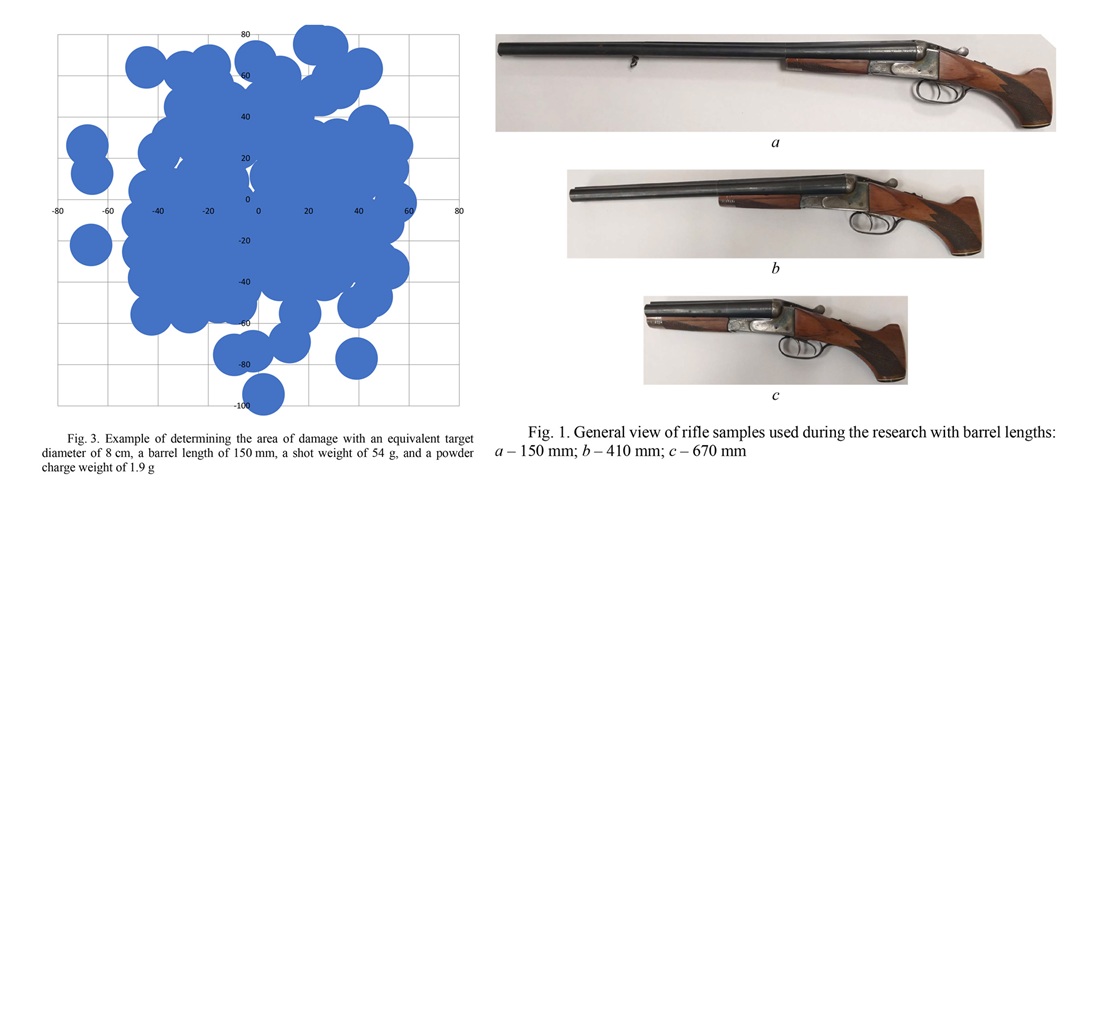
The area of damage was modeled by increasing the penetration point on the target to the size of the total equivalent diameter of the most vulnerable elements of unmanned aerial vehicles (UAVs) with FPV (First-Person View) piloting. On a target with an equivalent diameter of 8 cm, the area of damage has a maximum value of 1.2 m2 with a barrel length of 150 mm, a powder charge mass of 2.28 g and a shot charge mass of 54 g. Reducing the mass of the shot charge and the mass of the powder charge leads to a decrease in the area of damage at any barrel length.
The practical significance of the results is that they could be applied to improve cartridges and individual means of defeating UAVs with FPV piloting. In addition, they might be used in automatic protection systems that are promising for installation on combat vehicles
References
- Mekdad, Y., Aris, A., Babun, L., Fergougui, A. E., Conti, M., Lazzeretti, R., Uluagac, A. S. (2023). A survey on security and privacy issues of UAVs. Computer Networks, 224, 109626. https://doi.org/10.1016/j.comnet.2023.109626
- Kumar, N., Chaudhary, A. (2024). Surveying cybersecurity vulnerabilities and countermeasures for enhancing UAV security. Computer Networks, 252, 110695. https://doi.org/10.1016/j.comnet.2024.110695
- Guitton, M. J. (2021). Fighting the Locusts: Implementing Military Countermeasures Against Drones and Drone Swarms. Scandinavian Journal of Military Studies, 4 (1), 26–36. https://doi.org/10.31374/sjms.53
- Wang, J., Liu, Y., Song, H. (2021). Counter-Unmanned Aircraft System(s) (C-UAS): State of the Art, Challenges, and Future Trends. IEEE Aerospace and Electronic Systems Magazine, 36 (3), 4–29. https://doi.org/10.1109/maes.2020.3015537
- Xu, L., Luo, Z. (2025). Anti-UAV detection and identification technology: Fundamentals, methods and challenges. Physical Communication, 71, 102676. https://doi.org/10.1016/j.phycom.2025.102676
- Tyurin, V., Martyniuk, O., Mirnenko, V., Open’ko, P., Korenivska, I. (2019). General Approach to Counter Unmanned Aerial Vehicles. 2019 IEEE 5th International Conference Actual Problems of Unmanned Aerial Vehicles Developments (APUAVD), 75–78. https://doi.org/10.1109/apuavd47061.2019.8943859
- Tytarenko, O., Abramov, S., Ktitorov, M., Synytsina, Y. (2025). Countering FPV Drones: Insights from Ukraine’s Combat Experience. Advances in Military Technology, 20 (2), 421–434. https://doi.org/10.3849/aimt.01998
- Mirnenko, V., Novichenko, S., Doska, O., Open’ko, P., Avramenko, O., Kurban, V. (2022). Methodology for Assessing the Level of Threats when Using Small Arms against Unmanned Aerial Vehicles. Advances in Military Technology, 17 (1), 107–120. https://doi.org/10.3849/aimt.01486
- Hambling, D. (2024). Drone vs drone is the new warfare. New Scientist, 264 (3512), 16. https://doi.org/10.1016/s0262-4079(24)01806-2
- Maitre, M., Chiaravalle, A., Horder, M., Chadwick, S., Beavis, A. (2021). Evaluating the effect of barrel length on pellet distribution patterns of sawn-off shotguns. Forensic Science International, 320, 110685. https://doi.org/10.1016/j.forsciint.2021.110685
- Kerkhoff, W., Maitimu, K., Pater, K. D. H., de Jong, M. A. (2023). The relationship between pellet size and shotgun dispersion patterns. Journal of Forensic Sciences, 69 (2), 461–468. https://doi.org/10.1111/1556-4029.15427
- Rotter, G., Correzzola, C., Del Ángel, V. F., Daminato, E., Causin, V. (2022). Characterisation of plastic wads: A useful approach for elucidating shooting accidents and homicides involving shotguns. Forensic Science International, 332, 111194. https://doi.org/10.1016/j.forsciint.2022.111194
- Oura, P., Junno, A., Junno, J.-A. (2021). Deep learning in forensic shotgun pattern interpretation – A proof-of-concept study. Legal Medicine, 53, 101960. https://doi.org/10.1016/j.legalmed.2021.101960
- Meric, Ç., Polat, M. Ö., Altun, G. (2020). Shot range estimation of shotgun grain-loaded cartridges. Forensic Science International, 314, 110375. https://doi.org/10.1016/j.forsciint.2020.110375
- Golub, V., Bisyk, S., Golub, G., Tsyvenkova, N., Dubok, I., Shkvarskyi, O. et al. (2025). Determining the ballistic characteristics of hunting cartridges. Eastern-European Journal of Enterprise Technologies, 4 (3 (136)), 15–24. https://doi.org/10.15587/1729-4061.2025.336049
- Horvath, F., Gardner, K., Siegel, J. (1993). Range of Fire Estimates from Shotgun Pellet Patterns: The Effect of Shell and Barrel Temperature. Journal of Forensic Sciences, 38 (3), 585–592. https://doi.org/10.1520/jfs13442j
- Kostorrizos, A., Spiliopoulou, C., Moraitis, Κ., Papadodima, S. (2023). Determination of Firing Distance based on Pellet Dispersion. Austin Journal of Forensic Science and Criminology, 10 (1). https://doi.org/10.26420/austinjforensicscicriminol.2023.1094
- Golub, G. A., Kukharets, S. M., Tsyvenkova, N. M., Golubenko, A. A., Kalenichenko, P. S. (2018). Research on a boiler furnace module effectiveness working on small fracture wastes. INMATEH-Agricultural Engineering, 55 (2), 9–18. Available at: https://www.cabidigitallibrary.org/doi/pdf/10.5555/20183391971
- PlotDigitizer. Available at: https://plotdigitizer.com
- Golub, V., Kurban, V., Sedov, S., Golub, G. (2022). Classification of Combat Wheeled Vehicles Using Cluster Analysis Methods. Advances in Military Technology, 17 (1), 5–16. https://doi.org/10.3849/aimt.01499
Downloads
Published
How to Cite
Issue
Section
License
Copyright (c) 2026 Victor Golub, Serhii Bisyk, Gennadii Golub, Ihor Zozulevych, Oleksandr Kuprinenko, Leonid Davydovs’kyi, Sviatoslav Sedov, Oleh Aristarkhov

This work is licensed under a Creative Commons Attribution 4.0 International License.
The consolidation and conditions for the transfer of copyright (identification of authorship) is carried out in the License Agreement. In particular, the authors reserve the right to the authorship of their manuscript and transfer the first publication of this work to the journal under the terms of the Creative Commons CC BY license. At the same time, they have the right to conclude on their own additional agreements concerning the non-exclusive distribution of the work in the form in which it was published by this journal, but provided that the link to the first publication of the article in this journal is preserved.
A license agreement is a document in which the author warrants that he/she owns all copyright for the work (manuscript, article, etc.).
The authors, signing the License Agreement with TECHNOLOGY CENTER PC, have all rights to the further use of their work, provided that they link to our edition in which the work was published.
According to the terms of the License Agreement, the Publisher TECHNOLOGY CENTER PC does not take away your copyrights and receives permission from the authors to use and dissemination of the publication through the world's scientific resources (own electronic resources, scientometric databases, repositories, libraries, etc.).
In the absence of a signed License Agreement or in the absence of this agreement of identifiers allowing to identify the identity of the author, the editors have no right to work with the manuscript.
It is important to remember that there is another type of agreement between authors and publishers – when copyright is transferred from the authors to the publisher. In this case, the authors lose ownership of their work and may not use it in any way.








