Improvement of the hydration technology of walnut oil with non-standard quality indicators
DOI:
https://doi.org/10.15587/1729-4061.2026.357685Keywords:
walnut oil, water hydration, acid hydration, content of phosphorus-containing substancesAbstract
The object of the study is the hydration process of walnut oil with non-standard quality indicators.
Walnut oil is used in the food, cosmetic industry, and for technical purposes. Phosphorus-containing substances worsen the consumer and technological properties of oils, complicate the purification processes and use in chemical reactions. Hydration allows to remove phosphorus-containing substances by treating with water, acids, or enzyme preparations.
The hydration of walnut oil with an increased mass fraction of phosphorus-containing substances, as well as moisture and volatile substances was studied. The qualitative indicators of the initial oil: mass fraction of phosphorus-containing substances (in terms of stearooleolecithin) 0.56%, mass fraction of moisture and volatile substances 0.4%, peroxide value 3.2 ½ O mmol/kg, acid value 2.5 mg KOH/g.
The oil was previously subjected to water hydration under the following conditions: temperature 55°C, added water concentration 1.0%, settling time 2 h. The mass fraction of phosphorus-containing substances decreased to 0.49%.
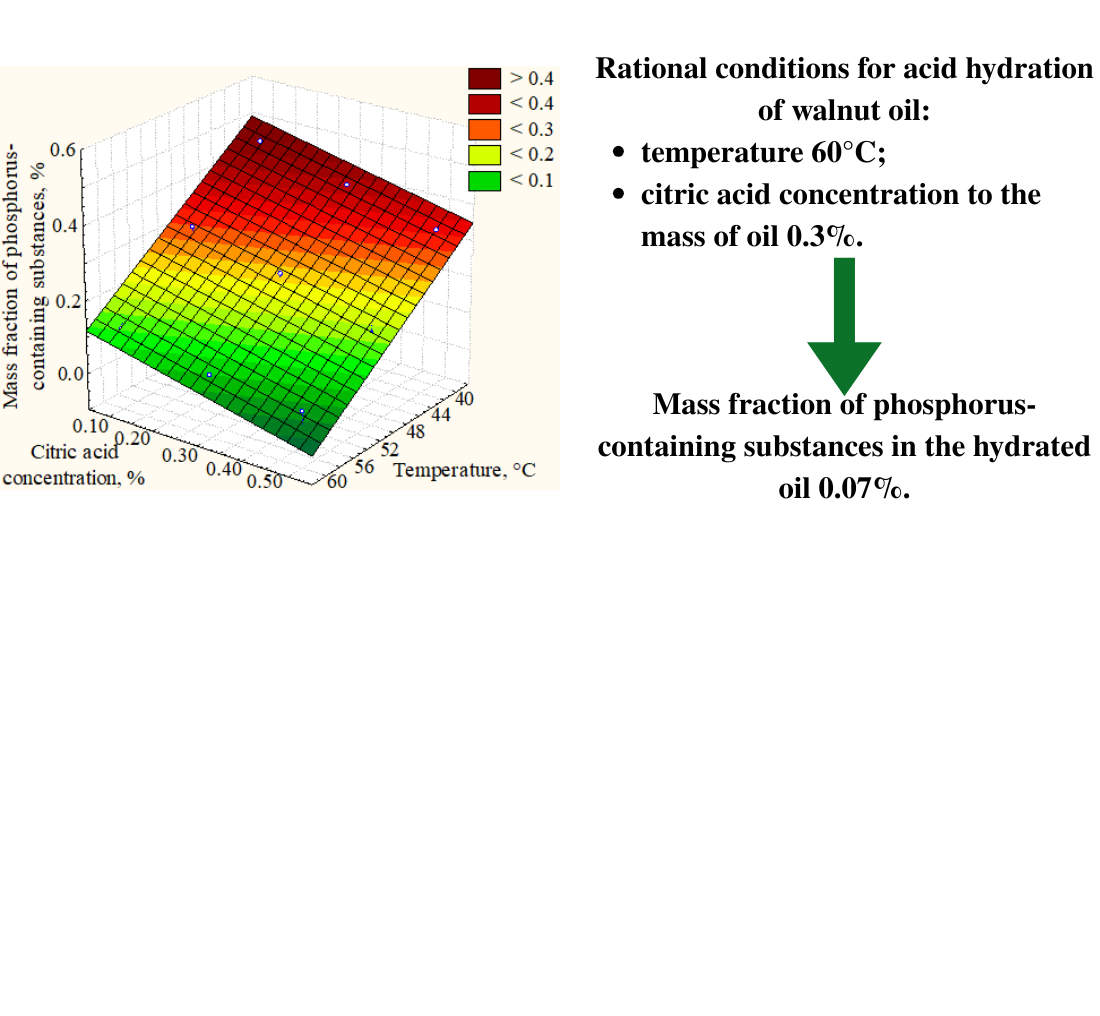
Further reduction of the mass fraction of phosphorus-containing substances was carried out using citric acid (50% solution). Rational conditions for acid hydration were established: temperature 60°C, citric acid concentration to the mass of oil 0.3%. After that, the mass fraction of phosphorus-containing substances in the hydrated oil was 0.07%.
The hydrated oil was subjected to drying under vacuum conditions (95°C, 1 h). The mass fraction of moisture and volatile substances in the dried hydrated oil was 0.1%.
Effective extraction of phosphorus-containing substances from the oil was achieved by gradually conducting water and acid hydration and establishing rational conditions for acid hydration.
The results of the work make it possible to effectively carry out hydration of walnut oil and other oils with an increased content of phosphorus-containing substances.
References
- Liu, L., Cai, H., Zhang, Y., Jin, Q., Wang, X., Jin, J. (2024). Chemical compositions and oxidative stabilities of cold‐pressed walnut oils (Juglans regia L.): Effects of chemical refining, water degumming, and molecular distillation. Journal of Food Science, 89 (11), 7589–7598. https://doi.org/10.1111/1750-3841.17402
- Martínez, M. L., Labuckas, D. O., Lamarque, A. L., Maestri, D. M. (2010). Walnut (Juglans regia L.): genetic resources, chemistry, by‐products. Journal of the Science of Food and Agriculture, 90 (12), 1959–1967. https://doi.org/10.1002/jsfa.4059
- Ma, X., Huang, C., Zheng, C., Wang, W., Ying, H., Liu, C. (2024). Effect of oil extraction methods on walnut oil quality characteristics and the functional properties of walnut protein isolate. Food Chemistry, 438, 138052. https://doi.org/10.1016/j.foodchem.2023.138052
- Gao, Y., Zhang, N., Li, X., Qu, L., Li, Y., Yu, X. (2024). Volatile, glycerides, tocopherol, phytosterols, and triterpene alcohol in 31 commercial walnut oils from three countries. Journal of Food Composition and Analysis, 136, 106831. https://doi.org/10.1016/j.jfca.2024.106831
- Elouafy, Y., El Idrissi, Z., El Yadini, A., Harhar, H., Alshahrani, M., AL Awadh, A. et al. (2022). Variations in Antioxidant Capacity, Oxidative Stability, and Physicochemical Quality Parameters of Walnut (Juglans regia) Oil with Roasting and Accelerated Storage Conditions. Molecules, 27 (22), 7693. https://doi.org/10.3390/molecules27227693
- Turek, K., Wszołek, M., Domagała, J. (2025). Effect of starter culture and lipase type in probiotic yogurt and sour milk with the addition of hydrolyzed walnut oil on free fatty acid, fatty acid, and conjugated linoleic acid content during fermentation and storage. Journal of Dairy Science, 108 (8), 8027–8046. https://doi.org/10.3168/jds.2025-26591
- Hazar, H., Akcay, C., Sevinc, H. (2025). Impact of CeO2 nanoparticles and crude walnut oil-diesel blends on combustion, performance, and emission characteristics of a diesel engine. Applied Thermal Engineering, 279, 128082. https://doi.org/10.1016/j.applthermaleng.2025.128082
- Bala, K. L., Broadway, A. A., Kumar, A. (2019). Effect of process parameters on degummimg of wild walnut (Juglans regia L.) heijuga oil of Manipur, India. The Pharma Innovation Journal, 8 (5), 144–148. Available at: https://www.thepharmajournal.com/archives/2019/vol8issue6/PartC/8-5-76-509.pdf
- Wang, D., Zhang, R., Wang, X., Feng, B., Zhang, Y. (2015). Study on refining process of cold pressed method for walnut oil and its effective composition. Journal of Shaanxi Normal University (Natural Science Edition), 43 (4), 103–108. Available at: https://jsnu.magtech.com.cn/EN/Y2015/V43/I4/103
- Ma, X., Huang, C., Zheng, C., Long, F., Zhao, M., Liu, C. (2024). Impact of deacidification processes on the quality and oxidative stability of walnut oil. Oil Crop Science, 9 (4), 247–254. https://doi.org/10.1016/j.ocsci.2024.10.001
- Wu, Y., Zhou, R., Wang, Z., Wang, B., Yang, Y., Ju, X., He, R. (2019). The effect of refining process on the physicochemical properties and micronutrients of rapeseed oils. PLOS ONE, 14 (3), e0212879. https://doi.org/10.1371/journal.pone.0212879
- Cheng, Y., Yuan, M., Liu, Y., Wu, Z., Zhang, W., Wang, G., Cong, Y. (2025). Ultralow phosphorus achievement in vegetable oil degumming: Synergistic effects of citric acid chelation and trace NaOH flocculation. LWT, 237, 118779. https://doi.org/10.1016/j.lwt.2025.118779
- Mouadili, H., Kamal, O., Khoudali, S., Jihar, K., Dabachi, M. A., Ambaye, A. D. et al. (2026). Novel membrane process for degumming of crude vegetable oils. Journal of Food Engineering, 415, 113065. https://doi.org/10.1016/j.jfoodeng.2026.113065
- Adhami, K., Asadollahzadeh, H., Ghazizadeh, M. (2019). A novel process for simultaneous degumming and deacidification of Soybean, Canola and Sunflower oils by tetrabutylphosphonium phosphate ionic liquid. Journal of Industrial and Engineering Chemistry, 76, 245–250. https://doi.org/10.1016/j.jiec.2019.03.048
- Liu, X., Huang, C., Lan, D., Wang, W., Wang, Y. (2025). Combining phospholipase A1 with monoacylglycerol lipase for crude vegetable oil degumming through improved oil-water separation. Food Chemistry, 467, 142366. https://doi.org/10.1016/j.foodchem.2024.142366
- Lamas, D. L., Constenla, D. T., Raab, D. (2016). Effect of degumming process on physicochemical properties of sunflower oil. Biocatalysis and Agricultural Biotechnology, 6, 138–143. https://doi.org/10.1016/j.bcab.2016.03.007
- Dihora, H., Kumar, P., Gohil, V., Nandha, N., Mondal, M., Singh, P. S. (2026). Solvent-resistant modified polypropylene membranes for edible oil degumming. Journal of Environmental Chemical Engineering, 14 (1), 120829. https://doi.org/10.1016/j.jece.2025.120829
Downloads
Published
How to Cite
Issue
Section
License
Copyright (c) 2026 Gabriella Birta, Vladyslav Knysh, Anatolii Shostia, Svitlana Usenko, Liubov Morozova, Yurii Burgu, Nataliia Ofilenko, Yevhen Semenko, Ivan Kostenko, Roman Mylostyvyi

This work is licensed under a Creative Commons Attribution 4.0 International License.
The consolidation and conditions for the transfer of copyright (identification of authorship) is carried out in the License Agreement. In particular, the authors reserve the right to the authorship of their manuscript and transfer the first publication of this work to the journal under the terms of the Creative Commons CC BY license. At the same time, they have the right to conclude on their own additional agreements concerning the non-exclusive distribution of the work in the form in which it was published by this journal, but provided that the link to the first publication of the article in this journal is preserved.
A license agreement is a document in which the author warrants that he/she owns all copyright for the work (manuscript, article, etc.).
The authors, signing the License Agreement with TECHNOLOGY CENTER PC, have all rights to the further use of their work, provided that they link to our edition in which the work was published.
According to the terms of the License Agreement, the Publisher TECHNOLOGY CENTER PC does not take away your copyrights and receives permission from the authors to use and dissemination of the publication through the world's scientific resources (own electronic resources, scientometric databases, repositories, libraries, etc.).
In the absence of a signed License Agreement or in the absence of this agreement of identifiers allowing to identify the identity of the author, the editors have no right to work with the manuscript.
It is important to remember that there is another type of agreement between authors and publishers – when copyright is transferred from the authors to the publisher. In this case, the authors lose ownership of their work and may not use it in any way.








