Удосконалення технології гідратації олії волоського горіха з нестандартними якісними показниками
DOI:
https://doi.org/10.15587/1729-4061.2026.357685Ключові слова:
олія волоського горіха, водна гідратація, кислотна гідратація, вміст фосфоровмісних речовинАнотація
Об’єктом дослідження є процес гідратації олії волоського горіха з нестандартними якісними показниками.
Олія волоського горіха використовується в харчовій, косметичній промисловості, в технічних цілях. Фосфоровмісні речовини погіршують споживчі та технологічні властивості олій, ускладнюють процеси очищення та застосування у хімічних реакціях. Гідратація дозволяє видаляти фосфоровмісні речовини шляхом обробки водою, кислотами або ферментними препаратами.
Досліджено гідратацію олії волоського горіха з підвищеною масовою часткою фосфоровмісних речовин, а також вологи та летких речовин. Якісні показники початкової олії: масова частка фосфоровмісних речовин (у перерахунку на стеароолеолецитин) 0,56%, масова частка вологи та летких речовин 0,4%, пероксидне число 3,2 ½ О ммоль/кг, кислотне число 2,5 мг КОН/г.
Олію попередньо піддавали водній гідратації за умов: температура 55°C, концентрація доданої води 1,0%, час відстоювання 2 год. Масова частка фосфоровмісних речовин знизилася до 0,49%.
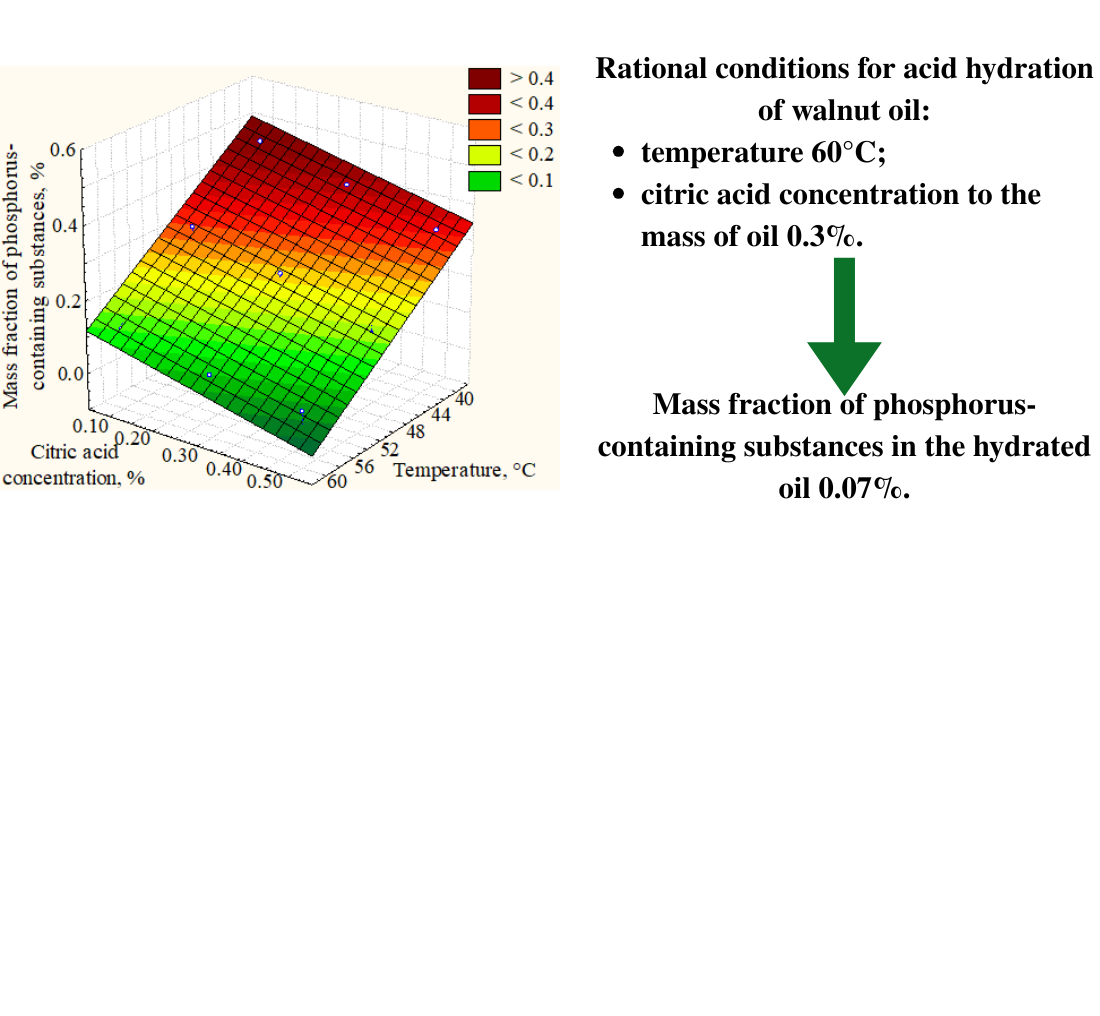
Подальше зниження масової частки фосфоровмісних речовин проводили з використанням лимонної кислоти (50% розчин). Встановлено раціональні умови кислотної гідратації: температура 60°C, концентрація лимонної кислоти до маси олії 0,3%. Після цього масова частка фосфоровмісних речовин в гідратованій олії склала 0,07%.
Гідратовану олію піддавали висушуванню за умов вакууму (95°С, 1 год). Масова частка вологи та летких речовин у висушеній гідратованій олії склала 0,1%.
Ефективне вилучення фосфоровмісних речовин з олії досягнуто поступовим проведенням водної та кислотної гідратації та встановленням раціональних умов кислотної гідратації.
Результати роботи дають можливість ефективно проводити гідратацію олії волоського горіха та інших олій з підвищеним вмістом фосфоровмісних речовин
Посилання
- Liu, L., Cai, H., Zhang, Y., Jin, Q., Wang, X., Jin, J. (2024). Chemical compositions and oxidative stabilities of cold‐pressed walnut oils (Juglans regia L.): Effects of chemical refining, water degumming, and molecular distillation. Journal of Food Science, 89 (11), 7589–7598. https://doi.org/10.1111/1750-3841.17402
- Martínez, M. L., Labuckas, D. O., Lamarque, A. L., Maestri, D. M. (2010). Walnut (Juglans regia L.): genetic resources, chemistry, by‐products. Journal of the Science of Food and Agriculture, 90 (12), 1959–1967. https://doi.org/10.1002/jsfa.4059
- Ma, X., Huang, C., Zheng, C., Wang, W., Ying, H., Liu, C. (2024). Effect of oil extraction methods on walnut oil quality characteristics and the functional properties of walnut protein isolate. Food Chemistry, 438, 138052. https://doi.org/10.1016/j.foodchem.2023.138052
- Gao, Y., Zhang, N., Li, X., Qu, L., Li, Y., Yu, X. (2024). Volatile, glycerides, tocopherol, phytosterols, and triterpene alcohol in 31 commercial walnut oils from three countries. Journal of Food Composition and Analysis, 136, 106831. https://doi.org/10.1016/j.jfca.2024.106831
- Elouafy, Y., El Idrissi, Z., El Yadini, A., Harhar, H., Alshahrani, M., AL Awadh, A. et al. (2022). Variations in Antioxidant Capacity, Oxidative Stability, and Physicochemical Quality Parameters of Walnut (Juglans regia) Oil with Roasting and Accelerated Storage Conditions. Molecules, 27 (22), 7693. https://doi.org/10.3390/molecules27227693
- Turek, K., Wszołek, M., Domagała, J. (2025). Effect of starter culture and lipase type in probiotic yogurt and sour milk with the addition of hydrolyzed walnut oil on free fatty acid, fatty acid, and conjugated linoleic acid content during fermentation and storage. Journal of Dairy Science, 108 (8), 8027–8046. https://doi.org/10.3168/jds.2025-26591
- Hazar, H., Akcay, C., Sevinc, H. (2025). Impact of CeO2 nanoparticles and crude walnut oil-diesel blends on combustion, performance, and emission characteristics of a diesel engine. Applied Thermal Engineering, 279, 128082. https://doi.org/10.1016/j.applthermaleng.2025.128082
- Bala, K. L., Broadway, A. A., Kumar, A. (2019). Effect of process parameters on degummimg of wild walnut (Juglans regia L.) heijuga oil of Manipur, India. The Pharma Innovation Journal, 8 (5), 144–148. Available at: https://www.thepharmajournal.com/archives/2019/vol8issue6/PartC/8-5-76-509.pdf
- Wang, D., Zhang, R., Wang, X., Feng, B., Zhang, Y. (2015). Study on refining process of cold pressed method for walnut oil and its effective composition. Journal of Shaanxi Normal University (Natural Science Edition), 43 (4), 103–108. Available at: https://jsnu.magtech.com.cn/EN/Y2015/V43/I4/103
- Ma, X., Huang, C., Zheng, C., Long, F., Zhao, M., Liu, C. (2024). Impact of deacidification processes on the quality and oxidative stability of walnut oil. Oil Crop Science, 9 (4), 247–254. https://doi.org/10.1016/j.ocsci.2024.10.001
- Wu, Y., Zhou, R., Wang, Z., Wang, B., Yang, Y., Ju, X., He, R. (2019). The effect of refining process on the physicochemical properties and micronutrients of rapeseed oils. PLOS ONE, 14 (3), e0212879. https://doi.org/10.1371/journal.pone.0212879
- Cheng, Y., Yuan, M., Liu, Y., Wu, Z., Zhang, W., Wang, G., Cong, Y. (2025). Ultralow phosphorus achievement in vegetable oil degumming: Synergistic effects of citric acid chelation and trace NaOH flocculation. LWT, 237, 118779. https://doi.org/10.1016/j.lwt.2025.118779
- Mouadili, H., Kamal, O., Khoudali, S., Jihar, K., Dabachi, M. A., Ambaye, A. D. et al. (2026). Novel membrane process for degumming of crude vegetable oils. Journal of Food Engineering, 415, 113065. https://doi.org/10.1016/j.jfoodeng.2026.113065
- Adhami, K., Asadollahzadeh, H., Ghazizadeh, M. (2019). A novel process for simultaneous degumming and deacidification of Soybean, Canola and Sunflower oils by tetrabutylphosphonium phosphate ionic liquid. Journal of Industrial and Engineering Chemistry, 76, 245–250. https://doi.org/10.1016/j.jiec.2019.03.048
- Liu, X., Huang, C., Lan, D., Wang, W., Wang, Y. (2025). Combining phospholipase A1 with monoacylglycerol lipase for crude vegetable oil degumming through improved oil-water separation. Food Chemistry, 467, 142366. https://doi.org/10.1016/j.foodchem.2024.142366
- Lamas, D. L., Constenla, D. T., Raab, D. (2016). Effect of degumming process on physicochemical properties of sunflower oil. Biocatalysis and Agricultural Biotechnology, 6, 138–143. https://doi.org/10.1016/j.bcab.2016.03.007
- Dihora, H., Kumar, P., Gohil, V., Nandha, N., Mondal, M., Singh, P. S. (2026). Solvent-resistant modified polypropylene membranes for edible oil degumming. Journal of Environmental Chemical Engineering, 14 (1), 120829. https://doi.org/10.1016/j.jece.2025.120829
##submission.downloads##
Опубліковано
Як цитувати
Номер
Розділ
Ліцензія
Авторське право (c) 2026 Gabriella Birta, Vladyslav Knysh, Anatolii Shostia, Svitlana Usenko, Liubov Morozova, Yurii Burgu, Nataliia Ofilenko, Yevhen Semenko, Ivan Kostenko, Roman Mylostyvyi

Ця робота ліцензується відповідно до Creative Commons Attribution 4.0 International License.
Закріплення та умови передачі авторських прав (ідентифікація авторства) здійснюється у Ліцензійному договорі. Зокрема, автори залишають за собою право на авторство свого рукопису та передають журналу право першої публікації цієї роботи на умовах ліцензії Creative Commons CC BY. При цьому вони мають право укладати самостійно додаткові угоди, що стосуються неексклюзивного поширення роботи у тому вигляді, в якому вона була опублікована цим журналом, але за умови збереження посилання на першу публікацію статті в цьому журналі.
Ліцензійний договір – це документ, в якому автор гарантує, що володіє усіма авторськими правами на твір (рукопис, статтю, тощо).
Автори, підписуючи Ліцензійний договір з ПП «ТЕХНОЛОГІЧНИЙ ЦЕНТР», мають усі права на подальше використання свого твору за умови посилання на наше видання, в якому твір опублікований. Відповідно до умов Ліцензійного договору, Видавець ПП «ТЕХНОЛОГІЧНИЙ ЦЕНТР» не забирає ваші авторські права та отримує від авторів дозвіл на використання та розповсюдження публікації через світові наукові ресурси (власні електронні ресурси, наукометричні бази даних, репозитарії, бібліотеки тощо).
За відсутності підписаного Ліцензійного договору або за відсутністю вказаних в цьому договорі ідентифікаторів, що дають змогу ідентифікувати особу автора, редакція не має права працювати з рукописом.
Важливо пам’ятати, що існує і інший тип угоди між авторами та видавцями – коли авторські права передаються від авторів до видавця. В такому разі автори втрачають права власності на свій твір та не можуть його використовувати в будь-який спосіб.