Construction of a parameterized analytical model for full life-cycle emissions assessment in climate comparison of energy solutions for transport systems
DOI:
https://doi.org/10.15587/1729-4061.2026.358472Keywords:
Well-to-Wheel (WTW), transport decarbonization, life-cycle emissions, decarbonization investment asymmetry, transport technologiesAbstract
This study investigates the process of assessing the climate efficiency of alternative energy solutions in transport systems within the full life-cycle Well-to-Wheel (WTW) approach.
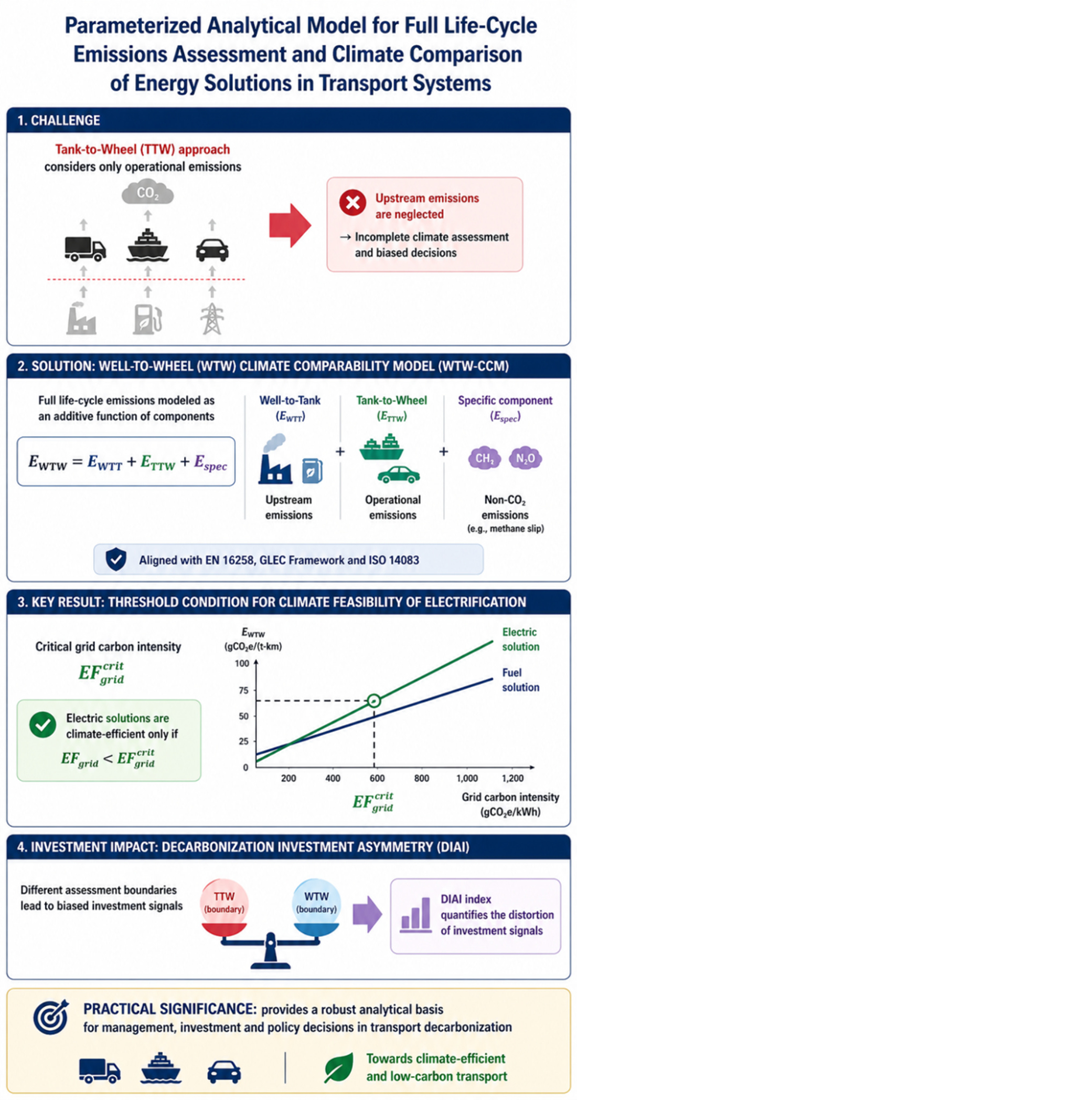
The task addressed relates to the methodological inconsistency of climate comparison results when applying the Tank-to-Wheel (TTW) approach, which considers only operational emissions and neglects upstream components associated with the production and supply of energy resources. This leads to a systemic gap between estimated and actual full life-cycle climate effects of energy alternatives.
A parameterized analytical model of climate comparability, the WTW Climate Comparability Model (WTW-CCM), has been built to formalize the dependence of full life-cycle emissions on energy chain parameters. The structure of full life-cycle emissions is substantiated as the sum of Well-to-Tank, Tank-to-Wheel, and specific components. The model is aligned with international methodological frameworks EN 16258, the GLEC Framework, and ISO 14083.
The climate efficiency of energy solutions has been shown to be parameter-dependent and determined by the carbon intensity of the energy system and methane slip emissions. A threshold criterion in the form of a critical grid carbon intensity has been derived. It is demonstrated that electric solutions become climate-efficient only under specific parametric conditions.
The possibility of inversion of climate efficiency of alternatives has been demonstrated. The phenomenon of decarbonization investment asymmetry has been formalized; the DIAI index has been proposed for the quantitative assessment of distortions in investment signals. It was substantiated that different assessment boundaries (TTW and WTW) lead to the formation of incommensurable investment priorities.
The practical significance includes the application of the model for substantiating managerial and investment decisions in transport decarbonization
References
- Net Zero by 2050 (2021). OECD. https://doi.org/10.1787/c8328405-en
- Transport. International Energy Agency (IEA). Available at: https://www.iea.org/topics/transport
- BS EN 16258:2012. Methodology for calculation and declaration of energy consumption and GHG emissions of transport services (freight and passengers) - (Withdrawn Standard). The British Standards Institution. Available at: https://standardsdevelopment.bsigroup.com/projects/2011-00080
- Global Logistics Emissions Council framework. For logistics emissions accounting and reporting (Version 3.0). Smart Freight Centre. Available at: https://smart-freight-centre-media.s3.amazonaws.com/documents/GLEC_FRAMEWORK_v3_UPDATED_02_04_24.pdf
- ISO 14083:2023. Greenhouse gases – Quantification and reporting of greenhouse gas emissions arising from transport chain operations. Available at: https://www.iso.org/standard/78864.html
- JEC well-to-tank report V5 – JEC well-to-wheels analysis – Well-to-wheels analysis of future automotive fuels and powertrains in the European context (2020). European Union. https://doi.org/10.2760/100379
- Bicer, Y., Dincer, I. (2018). Life cycle environmental impact assessments and comparisons of alternative fuels for clean vehicles. Resources, Conservation and Recycling, 132, 141–157. https://doi.org/10.1016/j.resconrec.2018.01.036
- Ou, X., Yan, X., Zhang, X., Liu, Z. (2012). Life-cycle analysis on energy consumption and GHG emission intensities of alternative vehicle fuels in China. Applied Energy, 90 (1), 218–224. https://doi.org/10.1016/j.apenergy.2011.03.032
- Balcombe, P., Anderson, K., Speirs, J., Brandon, N., Hawkes, A. (2016). The Natural Gas Supply Chain: The Importance of Methane and Carbon Dioxide Emissions. ACS Sustainable Chemistry & Engineering, 5 (1), 3–20. https://doi.org/10.1021/acssuschemeng.6b00144
- Balcombe, P., Speirs, J. F., Brandon, N. P., Hawkes, A. D. (2018). Methane emissions: choosing the right climate metric and time horizon. Environmental Science: Processes & Impacts, 20 (10), 1323–1339. https://doi.org/10.1039/c8em00414e
- Pavlenko, N., Comer, B., Zhou, Y., Clark, N., Rutherford, D. (2020). The climate implications of using LNG as a marine fuel (2020). International Council on Clean Transportation (ICCT). Available at: https://theicct.org/publication/the-climate-implications-of-using-lng-as-a-marine-fuel/
- Climate Change 2021 – The Physical Science Basis (2023). Cambridge University Press. https://doi.org/10.1017/9781009157896
- Kyryllova, O. V., Kyryllova, V. Yu. (2021). Dekarbonizatsiya morskoi haluzi: hlobalni initsiatyvy i lokalni diyi. Marine Power Plants and Operation 2021 (MPP&O-2021): materialy III Mizhnarodnoi naukovo-praktychnoi morskoi konferentsiyi kafedry SEU i TE ONMU.
- Kyryllova, О., Kyryllova, V. (2024). “Smart Ports” as an innovative vector of technological transformation and digitalization of ports: from idea to concept and practical implementation. Transport Development, 4 (23), 77–95. https://doi.org/10.33082/td.2024.4-23.07
- Kyryllova, O. V., Kyryllova, V. Yu., Mahamadov, O. R. (2024). The concept of “Smart Port” in the context of global trends of integration of intelligent transport and information technologies in the port industry. Scientific Notes of Taurida National V.I. Vernadsky University. Series: Technical Sciences, 2 (5), 81–87. https://doi.org/10.32782/2663-5941/2024.5.2/14
Downloads
Published
How to Cite
Issue
Section
License
Copyright (c) 2026 Valeriia Kyryllova, Olena Kyryllova

This work is licensed under a Creative Commons Attribution 4.0 International License.
The consolidation and conditions for the transfer of copyright (identification of authorship) is carried out in the License Agreement. In particular, the authors reserve the right to the authorship of their manuscript and transfer the first publication of this work to the journal under the terms of the Creative Commons CC BY license. At the same time, they have the right to conclude on their own additional agreements concerning the non-exclusive distribution of the work in the form in which it was published by this journal, but provided that the link to the first publication of the article in this journal is preserved.
A license agreement is a document in which the author warrants that he/she owns all copyright for the work (manuscript, article, etc.).
The authors, signing the License Agreement with TECHNOLOGY CENTER PC, have all rights to the further use of their work, provided that they link to our edition in which the work was published.
According to the terms of the License Agreement, the Publisher TECHNOLOGY CENTER PC does not take away your copyrights and receives permission from the authors to use and dissemination of the publication through the world's scientific resources (own electronic resources, scientometric databases, repositories, libraries, etc.).
In the absence of a signed License Agreement or in the absence of this agreement of identifiers allowing to identify the identity of the author, the editors have no right to work with the manuscript.
It is important to remember that there is another type of agreement between authors and publishers – when copyright is transferred from the authors to the publisher. In this case, the authors lose ownership of their work and may not use it in any way.








