Determining the effect of soy methyl ether additives to commercial diesel fuels on oil change interval in a 1.5 Renault diesel engine, model K9K
DOI:
https://doi.org/10.15587/1729-4061.2026.358837Keywords:
alternative fuels, biodiesel, replacement terms, service lifeAbstract
This study explores viscosity-temperature characteristics of Castrol GTX RN-Spec 5W-30 engine oil and its oxidation resistance. The task addressed investigates the effect of adding SME to diesel fuels on the timing of oil changes in the engine.
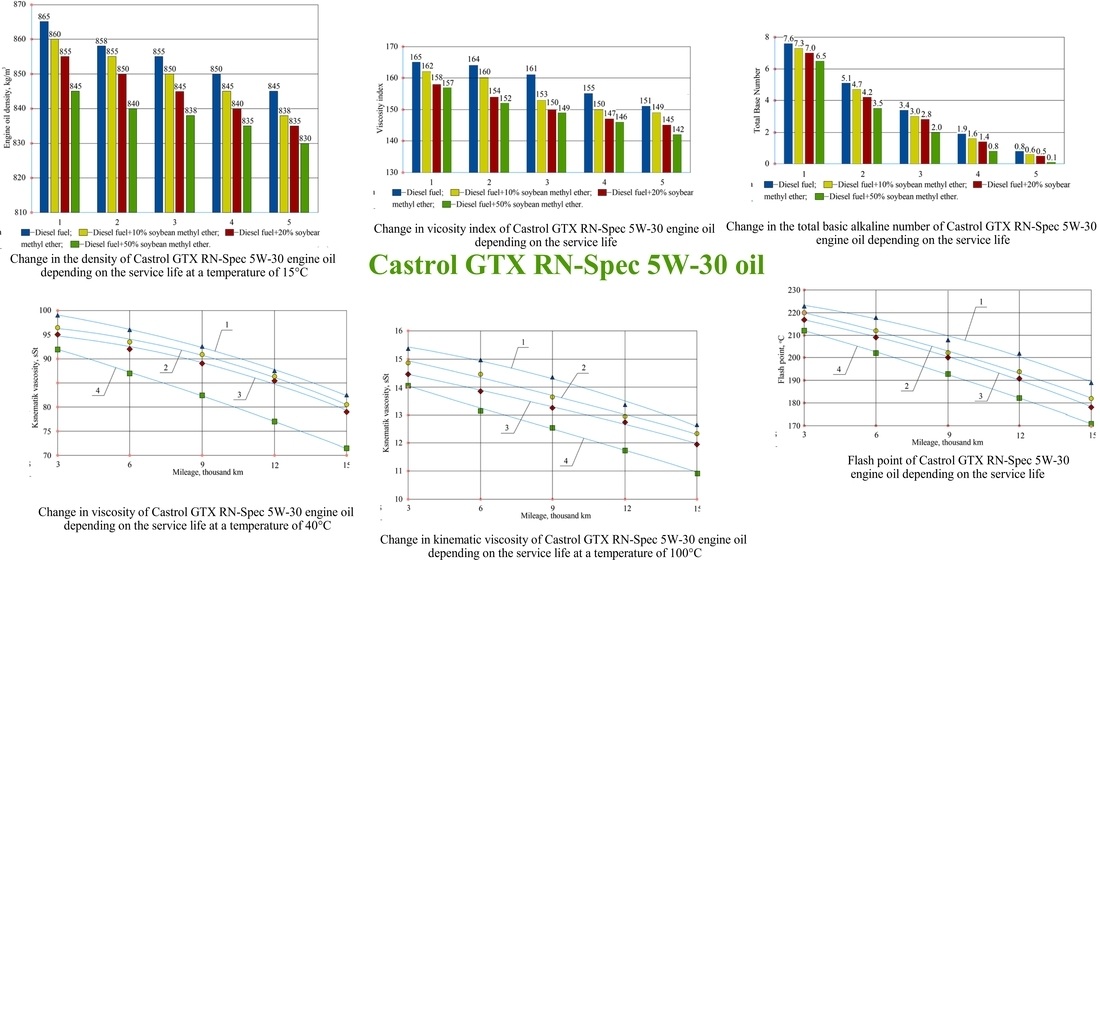
The results showed that the maximum service life of Castrol GTX RN-Spec 5W-30 oil under specified conditions is 12 thousand km when operating on commercial diesel fuel. In the case of using mixtures of diesel fuel and 10, 20, and 50 vol. % SME, the maximum service life of cars before oil replacement according to viscosity-temperature characteristics is reduced from 9 to 6 thousand km, respectively.
The total base number (TBN) indicator of all experimental samples of engine oils reaches a critical value after a run of 9 thousand km. In general, the use of fuel mixtures with biodiesel based on soybean methyl ether in an amount of up to 50 vol. % does not require a significant reduction in the oil replacement period according to the TBN indicator.
The deterioration in the viscosity-temperature characteristics of Castrol GTX RN-Spec 5W-30 engine oil is explained by the fact that biodiesel fuel based on soybean methyl ether has a lower heat of combustion. The fuel mixtures do not have time to completely burn in the engine cylinders and, being washed away with the oil into the sump, partially dilute it.
The accumulation of biodiesel fuel in engine oil also contributes to a decrease in the alkaline number of Castrol GTX RN-Spec 5W-30 engine oil and accelerates its oxidation process.
The findings made it possible to move from general assumptions to specific regulations – reducing oil change intervals by 20–50% or introducing specialized engine oils.
The results of this work could be used in the field of car service to adjust the mileage limits before oil change when operating cars on biodiesel fuel
References
- Kryshtopa, S., Górski, K., Longwic, R., Smigins, R., Kryshtopa, L. (2021). Increasing Parameters of Diesel Engines by Their Transformation for Methanol Conversion Products. Energies, 14 (6), 1710. https://doi.org/10.3390/en14061710
- Bembenek, M., Karwat, B., Melnyk, V., Mosora, Y. (2023). Research on the Impact of Supplying the Air-Cooled D21A1 Engine with RME B100 Biodiesel on Its Operating Parameters. Energies, 16 (18), 6430. https://doi.org/10.3390/en16186430
- Kryshtopa, S., Górski, K., Longwic, R., Smigins, R., Kryshtopa, L., Matijošius, J. (2022). Using Hydrogen Reactors to Improve the Diesel Engine Performance. Energies, 15 (9), 3024. https://doi.org/10.3390/en15093024
- Bembenek, M., Melnyk, V., Mo, Y. (2024). Study of Parameters of the Mixture and Heat Generation of the DD15 Diesel Engine of the Sandvik LH514 Loader in the Process of Using Alternative Fuels Based on RME. Acta Mechanica et Automatica, 18 (2), 169–176. https://doi.org/10.2478/ama-2024-0021
- Kryshtopa, S., Kryshtopa, L., Melnyk, V., Dolishnii, B., Prunko, I., Demianchuk, Y. (2017). Experimental research on diesel engine working on a mixture of diesel fuel and fusel oils. Transport Problems, 12 (2), 53–63. https://doi.org/10.20858/tp.2017.12.2.6
- Kryshtopa, S., Kryshtopa, L., Panchuk, M., Smigins, R., Dolishnii, B. (2021). Composition and energy value research of pyrolise gases. IOP Conference Series: Earth and Environmental Science, 628 (1), 12008. https://doi.org/10.1088/1755-1315/628/1/012008
- Bembenek, M., Melnyk, V., Karwat, B., Hnyp, M., Kowalski, Ł., Mosora, Y. (2024). Jerusalem Artichoke as a Raw Material for Manufacturing Alternative Fuels for Gasoline Internal Combustion Engines. Energies, 17 (10), 2378. https://doi.org/10.3390/en17102378
- Bembenek, M., Melnyk, V., Karwat, B., Rokita, T., Hnyp, M., Mosora, Y., Warguła, Ł. (2024). Study of the Technical and Operational Parameters of Injectors Using Biogas Fuel. Energies, 17 (21), 5445. https://doi.org/10.3390/en17215445
- Idzior, M. (2021). Aging of engine oils and their influence on the wear of an internal combustion engine. Combustion Engines, 185 (2), 15–20. https://doi.org/10.19206/ce-138033
- Sala, R., Węglarz, K., Suchecki, A. (2023). Analysis of lubricating oil degradation and its influence on brake specific fuel consumption of a light-duty compression-ignition engine running a durability cycle on a test stand. Combustion Engines. https://doi.org/10.19206/ce-169488
- Rostek, E., Babiak, M. (2019). The experimental analysis of engine oil degradation utilizing selected thermoanalytical methods. Transportation Research Procedia, 40, 82–89. https://doi.org/10.1016/j.trpro.2019.07.014
- Carrera-Rodríguez, M., Villegas-Alcaraz, J. F., Salazar-Hernández, C., Mendoza-Miranda, J. M., Jiménez-Islas, H., Segovia Hernández, J. G. et al. (2022). Monitoring of oil lubrication limits, fuel consumption, and excess CO2 production on civilian vehicles in Mexico. Energy, 257, 124765. https://doi.org/10.1016/j.energy.2022.124765
- Lee, P., Stark, M. S., Wilkinson, J. J., Priest, M., Lindsay Smith, J. R. et al. (2005). The Degradation of Lubricants in Gasoline Engines: Development of a Test Procedure to Evaluate Engine Oil Degradation and its Consequences for Rheology. Tribology and Interface Engineering Series, 593–602. https://doi.org/10.1016/s0167-8922(05)80061-6
- Gołębiowski, W., Wolak, A., Zając, G. (2018). Definition of oil change intervals based on the analysis of selected physicochemical properties of used engine oils. Combustion Engines, 172 (1), 44–50. https://doi.org/10.19206/ce-2018-105
- Zaharia, C., Niculescu, R., Năstase, M., Clenci, A., Iorga-Simăn, V. (2022). Engine oil analysis to evaluate the degree of its wear during the period of operation of the vehicle. IOP Conference Series: Materials Science and Engineering, 1220 (1), 12037. https://doi.org/10.1088/1757-899x/1220/1/012037
- Gupta, J. G., Agarwal, A. K. (2021). Engine durability and lubricating oil tribology study of a biodiesel fuelled common rail direct injection medium-duty transportation diesel engine. Wear, 486-487, 204104. https://doi.org/10.1016/j.wear.2021.204104
- Agocs, A., Budnyk, S., Frauscher, M., Ronai, B., Besser, C., Dörr, N. (2020). Comparing oil condition in diesel and gasoline engines. Industrial Lubrication and Tribology, 72 (8), 1033–1039. https://doi.org/10.1108/ilt-10-2019-0457
- Smigins, R., Amatnieks, K., Birkavs, A., Górski, K., Kryshtopa, S. (2023). Studies on Engine Oil Degradation Characteristics in a Field Test with Passenger Cars. Energies, 16 (24), 7955. https://doi.org/10.3390/en16247955
- Zdrodowski, R., Gangopadhyay, A., Anderson, J. E., Ruona, W. C., Uy, D., Simko, S. J. (2010). Effect of Biodiesel (B20) on Vehicle-Aged Engine Oil Properties. SAE International Journal of Fuels and Lubricants, 03 (2), 579–597. https://doi.org/10.4271/2010-01-2103
- Costa, H. L., Spikes, H. (2014). Effects of Ethanol Contamination on Friction and Elastohydrodynamic Film Thickness of Engine Oils. Tribology Transactions, 58 (1), 158–168. https://doi.org/10.1080/10402004.2014.957369
- Nagy, A. L., Agocs, A., Ronai, B., Raffai, P., Rohde-Brandenburger, J., Besser, C., Dörr, N. (2021). Rapid Fleet Condition Analysis through Correlating Basic Vehicle Tracking Data with Engine Oil FT-IR Spectra. Lubricants, 9 (12), 114. https://doi.org/10.3390/lubricants9120114
- Hazar, H., Telceken, T., Sevinc, H. (2022). An experimental study on emission of a diesel engine fuelled with SME (safflower methyl ester) and diesel fuel. Energy, 241, 122915. https://doi.org/10.1016/j.energy.2021.122915
- Zhao, J., He, Y., Wang, Y., Wang, W., Yan, L., Luo, J. (2016). An investigation on the tribological properties of multilayer graphene and MoS2 nanosheets as additives used in hydraulic applications. Tribology International, 97, 14–20. https://doi.org/10.1016/j.triboint.2015.12.006
- Melnyk, V., Romanyshyn, L., Mosora, Y., Kotwica, K. (2023). Technology of Obtaining Mixed Alternative Fuel Based on Organic Substances for Mining Technological Transport Engines. Management Systems in Production Engineering, 31 (1), 71–77. https://doi.org/10.2478/mspe-2023-0009
- CASTROL. Available at: https://castroloil.com.ua
- ASTM STANDARD D4052. Available at: https://www.scribd.com/document/706293661/ASTM-D4052
- ASTM STANDARD D445. Available at: https://www.scribd.com/document/506667547/ASTM-D445
- ASTM STANDARD D2270. Available at: https://www.scribd.com/document/767645400/D2270
- ASTM STANDARD D93. Available at: https://www.scribd.com/document/761580223/ASTM-D93
- ASTM STANDARD D4739. Available at: https://www.scribd.com/document/731083705/ASTM-D4739
- Blanco-Rodríguez, J., Simón-Montero, X., Cortada-García, M., Maroto, S., Porteiro, J. (2024). Modelling the impact of reducing lubricant viscosity on a conventional passenger car fuel economy and wear protection. Results in Engineering, 24, 103159. https://doi.org/10.1016/j.rineng.2024.103159
- Kalogiannis, K., Desai, P., Mian, O., Mainwaring, R. (2018). Simulated Bearing Durability and Friction Reduction with Ultra-Low Viscosity Oils. SAE Technical Paper Series, 1. https://doi.org/10.4271/2018-01-1802
- Lee, P., Zhmud, B. (2021). Low Friction Powertrains: Current Advances in Lubricants and Coatings. Lubricants, 9 (8), 74. https://doi.org/10.3390/lubricants9080074
- Tomanik, E., Profito, F., Sheets, B., Souza, R. (2020). Combined lubricant–surface system approach for potential passenger car CO2 reduction on piston-ring-cylinder bore assembly. Tribology International, 149, 105514. https://doi.org/10.1016/j.triboint.2018.12.014
- Zhang, Y., Ma, Z., Feng, Y., Diao, Z., Liu, Z. (2021). The Effects of Ultra-Low Viscosity Engine Oil on Mechanical Efficiency and Fuel Economy. Energies, 14 (8), 2320. https://doi.org/10.3390/en14082320
Downloads
Published
How to Cite
Issue
Section
License
Copyright (c) 2026 Vasyl Melnyk, Maria Hnyp, Ihor Zakhara, Ivan Mykytii

This work is licensed under a Creative Commons Attribution 4.0 International License.
The consolidation and conditions for the transfer of copyright (identification of authorship) is carried out in the License Agreement. In particular, the authors reserve the right to the authorship of their manuscript and transfer the first publication of this work to the journal under the terms of the Creative Commons CC BY license. At the same time, they have the right to conclude on their own additional agreements concerning the non-exclusive distribution of the work in the form in which it was published by this journal, but provided that the link to the first publication of the article in this journal is preserved.
A license agreement is a document in which the author warrants that he/she owns all copyright for the work (manuscript, article, etc.).
The authors, signing the License Agreement with TECHNOLOGY CENTER PC, have all rights to the further use of their work, provided that they link to our edition in which the work was published.
According to the terms of the License Agreement, the Publisher TECHNOLOGY CENTER PC does not take away your copyrights and receives permission from the authors to use and dissemination of the publication through the world's scientific resources (own electronic resources, scientometric databases, repositories, libraries, etc.).
In the absence of a signed License Agreement or in the absence of this agreement of identifiers allowing to identify the identity of the author, the editors have no right to work with the manuscript.
It is important to remember that there is another type of agreement between authors and publishers – when copyright is transferred from the authors to the publisher. In this case, the authors lose ownership of their work and may not use it in any way.








