Detection of the influence of flexographic printing speed on the occurence of the bouncing effect on imprints
DOI:
https://doi.org/10.15587/1729-4061.2026.359494Keywords:
high-speed flexographic machines, vibration effects, imprints, tone value increment (TVI)Abstract
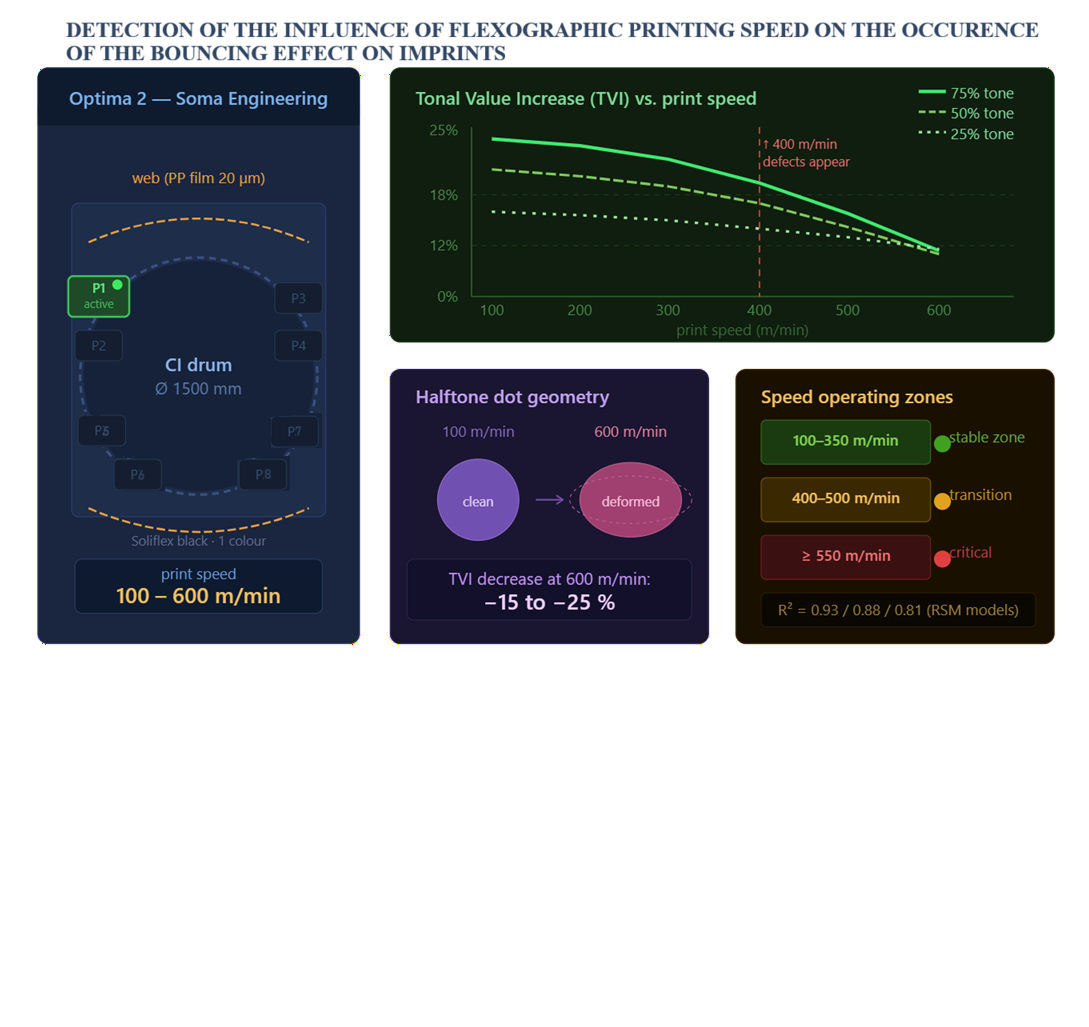
The paper studies the influence of flexographic printing speed on the manifestation of the bouncing effect and imprint quality indicators. Printing was carried out on an Optima 2 flexographic machine (Soma Engineering, Czech Republic) on a white polypropylene film with a thickness of 20 μm. The study was carried out using a test printing form containing solid fills, raster areas (25%, 50%, 75%), linear elements and gradients. The geometric parameters of the lines were analyzed using an electron microscope. Spectrodensitometric studies of optical density and dot gain (TVI) in three zones across the width of the web were also conducted. The appearance of vibration defects in the form of banding and doubling of elements was observed at printing speeds of more than 400 m/min. It was found that with an increase in printing speed from 100 to 600 m/min, the TVI value decreases on average by 15–25% depending on the tone.
Based on the results obtained, second-order regression models were constructed that describe the dependence of TVI on printing speed and position on the web. Based on these models, the corresponding response surfaces were synthesized and analyzed. For a tone of 75%, a pronounced nonlinear nature of the process is observed (R2 = 0.93), for 50% – moderate nonlinearity (R2 = 0.88), for 25% – almost linear dependence (R2 = 0.81). The adequacy of the models was confirmed by the Fisher criterion, and the homogeneity of the experimental data – by the Cochran criterion.
It was found that the position on the web is a significant factor determining the distribution of TVI, which indicates the spatial heterogeneity of the printing process. The results obtained can be used to optimize high-speed flexographic printing modes and reduce vibration defects during the manufacture of packaging products
References
- CI flexo printing machine market report. Cognitive Market Research. Available at: https://www.cognitivemarketresearch.com/ci-flexo-printing-machine-market-report
- Havenko, S., Telegina, T., Wieczorek, M. (2025). The studies on the impact of the printing speed on the quality of flexographic prints performed on PET film. Packaging Review. Available at: https://packagingreview.eu/wp-content/uploads/2025/12/PACKAGING-REVIEW_4_2025.pdf
- Hamblyn, A. (2015). Effect of plate characteristics on ink transfer in flexographic printing. Swansea University. Available at: https://www.proquest.com/openview/200b0f092b10dc8a3d669c794a6579d6/1?pq-origsite=gscholar&cbl=2026366
- Keawkul, P., Pachonklaew, P., Waleetorncheepsawat, B. (2022). Optimization of printing conditions to achieve effective ink transfer in flexographic printing. Journal of Printing Science and Technology, 59 (6), 298–302. https://doi.org/10.11413/nig.59.298
- Folea, G. V., Bălan, E., Mohora, C. (2020). Considerations on quality assurance for flexographic print products. Annals of the Academy of Romanian Scientists, Series on Engineering Sciences, 12 (1), 33–47. https://doi.org/10.56082/annalsarscieng.2020.1.33
- Petrović, S., Kašiković, N., Novaković, D., Ozcan, A. (2021). Influence of the compressible flexographic sleeve exploitation on print quality. Tehnički vjesnik, 28 (2), 391–400. https://doi.org/10.17559/tv-20191114164921
- Vasile, P. D. (2016). Methods for improving process control and correction in flexographic printing. Sesiunea Ştiințifică Studențească. Available at: https://www.fiir.upb.ro/Upload/Studenti/SSS_2016/lucrarile_sesiunii_stud_2016/L01_Balan_Emilia.pdf
- Dendge, R. R. (2023). Analysis of dot gain produced by interactions of flexographic plate and anilox roll screen frequencies. Acta Graphica, 31 (1), 35–44. Available at: https://hrcak.srce.hr/file/434151
- Żołek-Tryznowska, Z., Rombel, M., Petriaszwili, G., Dedijer, S., Kašiković, N. (2020). Influence of Some Flexographic Printing Process Conditions on the Optical Density and Tonal Value Increase of Overprinted Plastic Films. Coatings, 10 (9), 816. https://doi.org/10.3390/coatings10090816
- Bould, D. C., Hamblyn, S. M., Gethin, D. T., Claypole, T. C. (2011). Effect of impression pressure and anilox specification on solid and halftone density. Proceedings of the Institution of Mechanical Engineers, Part B: Journal of Engineering Manufacture, 225 (5), 699–709. https://doi.org/10.1177/2041297510394072
- Phill, J., Houssin, A., Moncek, J., Chan, C. Y. (2013). Flexographic Printing Redesign. University of Manitoba. http://hdl.handle.net/1993/35586
- Johnson, J., Rättö, P., Lestelius, M., Blohm, E. (2004). Measuring the dynamic pressure in a flexographic central impression printing press. Nordic Pulp & Paper Research Journal, 19 (1), 84–88. https://doi.org/10.3183/npprj-2004-19-01-p084-088
- FIRST 7.0 Design Guide. Flexographic Technical Association. Available at: https://www.flexography.org/training-resources/resource-library/flexographic-image-reproduction-specifications-and-tolerances-first/design-guide/
- Havenko, S., Labetska, M., Telehina, T. (2024). Study of flexographic imprints using the methods of optical and electron microscopy. Sixteenth International Conference on Correlation Optics, 35. https://doi.org/10.1117/12.3012269
Downloads
Published
How to Cite
Issue
Section
License
Copyright (c) 2026 Svitlana Havenko, Tetiana Telegina, Marta Labetska

This work is licensed under a Creative Commons Attribution 4.0 International License.
The consolidation and conditions for the transfer of copyright (identification of authorship) is carried out in the License Agreement. In particular, the authors reserve the right to the authorship of their manuscript and transfer the first publication of this work to the journal under the terms of the Creative Commons CC BY license. At the same time, they have the right to conclude on their own additional agreements concerning the non-exclusive distribution of the work in the form in which it was published by this journal, but provided that the link to the first publication of the article in this journal is preserved.
A license agreement is a document in which the author warrants that he/she owns all copyright for the work (manuscript, article, etc.).
The authors, signing the License Agreement with TECHNOLOGY CENTER PC, have all rights to the further use of their work, provided that they link to our edition in which the work was published.
According to the terms of the License Agreement, the Publisher TECHNOLOGY CENTER PC does not take away your copyrights and receives permission from the authors to use and dissemination of the publication through the world's scientific resources (own electronic resources, scientometric databases, repositories, libraries, etc.).
In the absence of a signed License Agreement or in the absence of this agreement of identifiers allowing to identify the identity of the author, the editors have no right to work with the manuscript.
It is important to remember that there is another type of agreement between authors and publishers – when copyright is transferred from the authors to the publisher. In this case, the authors lose ownership of their work and may not use it in any way.








