Identification of factors influencing the composition and quality of wine material
DOI:
https://doi.org/10.15587/1729-4061.2026.360314Keywords:
wine material, phenolic compounds, anthocyanins, thermovinification, fortification, tartaric acidAbstract
The object of the study is the production technology of high-quality Cahors wines. Although a number of studies have been conducted on the production of Cahors wines, the factors affecting the composition and quality of the wine material-particularly the regime of thermal treatment of the mash, as well as the type of alcohol and the method of fortification and their influence on the physicochemical composition of Cahors wine material-have not been sufficiently studied.
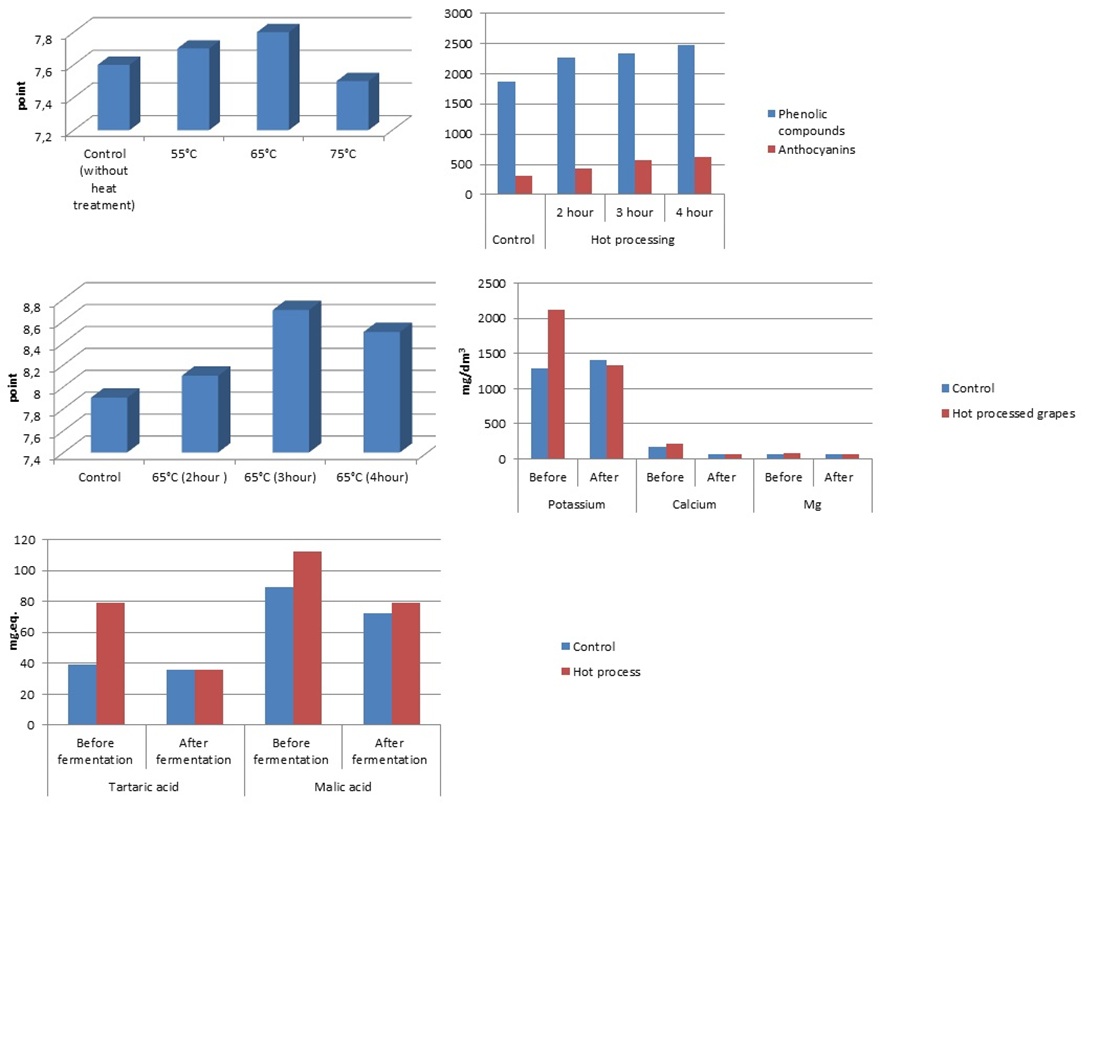
The total content of phenolic compounds in the control sample produced by the white winemaking method was 980 mg/dm3, whereas it reached 2740 mg/dm3 in the red winemaking method, 3230 mg/dm3 during thermovinification, and 3860 mg/dm3 in the Kurdamir method. A similar pattern, with some exceptions, was observed for color compounds. Relatively prolonged thermal treatment (4 hours) resulted in a pronounced caramelized note in taste and was evaluated 0.2 points lower than the preceding variant. In terms of quality, the second variant subjected to thermal treatment at 65°C for 3 hours performed better, receiving a score of 8.7 points. According to the results of organoleptic analysis, samples fortified with wheat alcohol were rated 0.9–1.6 points higher than the others.
Determining the effects of technological methods on the composition and quality of Cahors wine material samples, the duration of CO2 maceration, and the changes in physicochemical composition caused by thermal treatment, as well as the correct selection and use of alcohol for Cahors wines, is of practical importance for production. The results obtained can be applied in wineries and wine-producing enterprises
References
- Miele, A. (2021). Wine composition of Merlot and Cabernet Sauvignon vine clones under the environmental conditions of Serra Gaúcha, Brazil. Food Science and Technology, 41, 116–122. https://doi.org/10.1590/fst.10520
- Zhang, K., Zhang, Z.-Z., Yuan, L., Gao, X.-T., Li, Q. (2021). Difference and characteristics of anthocyanin from Cabernet Sauvignon and Merlot cultivated at five regions in Xinjiang. Food Science and Technology, 41, 72–80. https://doi.org/10.1590/fst.11020
- Arslan Kulcan, A., Öziyci, H. R., Tetik, N., Karhan, M. (2015). Changes In Turbidity, Total Phenolic And Anthocyanin Contents Of Clear Red Grape Juice During Processing. Gida / the Journal of Food, 40 (6), 311–317. https://doi.org/10.15237/gida.gd15029
- Mota, R. V. d., Peregrino, I., Silva, C. P. C., Raimundo, R. H. P., Fernandes, F. d. P., Souza, C. R. d. (2021). Row orientation effects on chemical composition and aromatic profile of Syrah winter wines. Food Science and Technology, 41 (2), 412–417. https://doi.org/10.1590/fst.38219
- Liu, C., Wang, L., Wang, J., Wu, B., Liu, W., Fan, P., Liang, Z., Li, S. (2013). Resveratrols in Vitis berry skins and leaves: Their extraction and analysis by HPLC. Food Chemistry, 136 (2), 643–649. https://doi.org/10.1016/j.foodchem.2012.08.017
- Bayram, M., Kayalar, M., Kaya, C., Topuz, S. (2016). Şarapta Fenolik ve Aroma Bileşikleri Üzerine ‘Teruar’ın Etkisi. Gaziosmanpaşa Bilimsel Araştırma Dergisi, 13, 35–46. Available at: https://izlik.org/JA87MM97SC
- Jara-Palacios, M. J., Hernanz, D., González-Manzano, S., Santos-Buelga, C., Escudero-Gilete, M. L., Heredia, F. J. (2014). Detailed phenolic composition of white grape by-products by RRLC/MS and measurement of the antioxidant activity. Talanta, 125, 51–57. https://doi.org/10.1016/j.talanta.2014.02.065
- Guler, A. (2023). Effects of different maceration techniques on the colour, polyphenols and antioxidant capacity of grape juice. Food Chemistry, 404, 134603. https://doi.org/10.1016/j.foodchem.2022.134603
- Baron, M., Kumsta, M., Sumczynski, D., Mlcek, J., Jurikova, T., Sochor, J. (2018). Einfluss der Dauer der Mazeration auf den Gehalt von Antioxidantien im Traubensaft. Erwerbs-Obstbau, 60, 37–45. https://doi.org/10.1007/s10341-018-0385-7
- Puzovic, A., Mikulic-Petkovsek, M. (2024). Comparative Evaluation of Conventional and Emerging Maceration Techniques for Enhancing Bioactive Compounds in Aronia Juice. Foods, 13 (20), 3255. https://doi.org/10.3390/foods13203255
- Puzovic, A., Pelacci, M., Simkova, K., Hudina, M., Rusjan, D., Veberic, R., Mikulic-Petkovsek, M. (2024). Effect of Heat Pasteurization and Enzymatic Maceration on Yield, Color, Sugars, Organic Acids, and Phenolic Content in the ‘Merlot Kanthus’ Grape Juice. Beverages, 10 (3), 66. https://doi.org/10.3390/beverages10030066
- Błaszak, M., Lachowicz-Wiśniewska, S., Kapusta, I., Szewczuk, M., Ochmian, I. (2025). Enhanced Extraction of Polyphenols, Physicochemical Properties, and Microbial Control in Vitis vinifera L. Juice Using Ultrasound-Assisted Maceration. Molecules, 30 (3), 587. https://doi.org/10.3390/molecules30030587
- Gu, X., Liu, Y., Suo, R., Yu, Q., Xue, C., Wang, J. et al. (2025). Effects of different low-temperature maceration times on the chemical and sensory characteristics of Syrah wine. Food Chemistry, 463, 141230. https://doi.org/10.1016/j.foodchem.2024.141230
- Wojdyło, A., Samoticha, J., Chmielewska, J. (2021). Effect of different pre-treatment maceration techniques on the content of phenolic compounds and color of Dornfelder wines elaborated in cold climate. Food Chemistry, 339, 127888. https://doi.org/10.1016/j.foodchem.2020.127888
- Mallard, J., Valentin, D., Ballester, J. (2025). Oxidation in white wine: The point of view of winemakers from areas with different oenological practices. Food Research International, 199, 115341. https://doi.org/10.1016/j.foodres.2024.115341
- Benucci, I., Cerreti, M., Esti, M. (2024). Dosing oxygen from the early stages of white winemaking: Effect on oxidation–reduction potential, browning stability, volatile composition, and sensory properties. Food Chemistry, 432, 137243. https://doi.org/10.1016/j.foodchem.2023.137243
- Ailer, Š., Jakabová, S., Benešová, L., Ivanova-Petropulos, V. (2022). Wine Faults: State of Knowledge in Reductive Aromas, Oxidation and Atypical Aging, Prevention, and Correction Methods. Molecules, 27 (11), 3535. https://doi.org/10.3390/molecules27113535
- Mercanti, N., Macaluso, M., Pieracci, Y., Brazzarola, F., Palla, F., Verdini, P. G., Zinnai, A. (2024). Enhancing wine shelf-life: Insights into factors influencing oxidation and preservation. Heliyon, 10 (15), e35688. https://doi.org/10.1016/j.heliyon.2024.e35688
- Fia, G., Bucalossi, G., Proserpio, C., Vincenzi, S. (2021). Unripe grapes: an overview of the composition, traditional and innovative applications, and extraction methods of a promising waste of viticulture. Australian Journal of Grape and Wine Research, 28 (1), 8–26. https://doi.org/10.1111/ajgw.12522
- Olejar, K. J., Ricci, A., Swift, S., Zujovic, Z., Gordon, K. C., Fedrizzi, B. et al. (2019). Characterization of an Antioxidant and Antimicrobial Extract from Cool Climate, White Grape Marc. Antioxidants, 8 (7), 232. https://doi.org/10.3390/antiox8070232
- Ferreira, R. M., Costa, A. M., Pinto, C. A., Silva, A. M. S., Saraiva, J. A., Cardoso, S. M. (2023). Impact of Fermentation and Pasteurization on the Physico-Chemical and Phytochemical Composition of Opuntia ficus-indica Juices. Foods, 12 (11), 2096. https://doi.org/10.3390/foods12112096
- Fataliyev, H., Malikov, A., Lezgiyev, Y., Gadimova, N., Musayev, T., Aliyeva, G. (2024). Identifying of the wine-making potential of the autochthon madrasa grape variety of different colors and quality. Eastern-European Journal of Enterprise Technologies, 2 (11 (128)), 56–63. https://doi.org/10.15587/1729-4061.2024.302971
- Fataliyev, H., Malikov, A., Lazgiyev, Y., Haydarov, E., Agayeva, S., Baloghlanova, K. et al. (2023). Effect Of Maceration Regime On Phenolic Compound Quantity And Color Quality Of Madrasa Wine Samples. Food Science and Technology, 17 (4). https://doi.org/10.15673/fst.v17i4.2784
- Fataliyev, H., Lezgiyev, Y., Aghazade, Y., Gadimova, N., Heydarov, E., Ismailov, M. (2024). Identifying the influence of various technological techniques on the indicators of the composition of bunches and wine samples of the madras grape variety. Eastern-European Journal of Enterprise Technologies, 6 (11 (132)), 50–62. https://doi.org/10.15587/1729-4061.2024.318532
- Fataliyev, H., Aghazade, Y., Heydarov, E., Gadimova, N., Ismayilov, M., Imanova, K. (2025). Identifying the factors affecting the production of juice and wine from the autochthonous Bayanshira grape variety. Eastern-European Journal of Enterprise Technologies, 1 (11 (133)), 38–50. https://doi.org/10.15587/1729-4061.2025.323382
- Fataliyev, H., Isgandarova, S., Gadimova, N., Mammadova, A., Ismailov, M., Mammadzade, M. (2024). Identification of the effect of ripening conditions on the yield of rose hips and their processed products. Eastern-European Journal of Enterprise Technologies, 4 (11 (130)), 26–35. https://doi.org/10.15587/1729-4061.2024.309597
- Fataliyev, H., Mammadzade, M., Ismayılov, M., Gadimova, N., Mammadova, N., Musayev, T. (2025). Identifying the factors affecting the preparation of wine material from cherry fruits. Eastern-European Journal of Enterprise Technologies, 2 (11 (134)), 77–88. https://doi.org/10.15587/1729-4061.2025.326471
- Gadimova, N., Fataliyev, H., Heydarov, E., Lezgiyev, Y., Isgandarova, S. (2023). Development of a model and optimization of the interaction of factors in the grain malting process and its application in the production of functional beverages. Eastern-European Journal of Enterprise Technologies, 5 (11 (125)), 43–56. https://doi.org/10.15587/1729-4061.2023.289421
- Gadimova, N., Fataliyev, H., Allahverdiyeva, Z., Musayev, T., Akhundova, N., Babashli, A. (2022). Obtaining and investigation of the chemical composition of powdered malt and polymalt extracts for application in the production of non-alcoholic functional beverages. Eastern-European Journal of Enterprise Technologies, 5 (11 (119)), 66–74. https://doi.org/10.15587/1729-4061.2022.265762
- Salimov, V., Huseynova, A., Guliyeva, A., Alizade, S., Mammadova, R. (2025). Assessment of Biomorphological and Economically Important Traits of some Local Grape Varieties and Clones of Azerbaijan. Advances in Biology & Earth Sciences, 10 (2), 303–313. https://doi.org/10.62476/abes.102303
- Fataliyev, H. K. (2012). Winemaking practicum. Baku: Elm, 328. Available at: http://anl.az/el/Kitab/2013/Azf-272480.pdf
- Sheskin, D. J. (2020). Handbook of Parametric and Nonparametric Statistical Procedures. Chapman and Hall/CRC. https://doi.org/10.1201/9780429186196
Downloads
Published
How to Cite
Issue
Section
License
Copyright (c) 2026 Hasil Fataliyev, Vugar Mikayilov, Mehman Ismayilov, Elnur Heydarov, Natavan Gadimova, Shabnam Fataliyeva

This work is licensed under a Creative Commons Attribution 4.0 International License.
The consolidation and conditions for the transfer of copyright (identification of authorship) is carried out in the License Agreement. In particular, the authors reserve the right to the authorship of their manuscript and transfer the first publication of this work to the journal under the terms of the Creative Commons CC BY license. At the same time, they have the right to conclude on their own additional agreements concerning the non-exclusive distribution of the work in the form in which it was published by this journal, but provided that the link to the first publication of the article in this journal is preserved.
A license agreement is a document in which the author warrants that he/she owns all copyright for the work (manuscript, article, etc.).
The authors, signing the License Agreement with TECHNOLOGY CENTER PC, have all rights to the further use of their work, provided that they link to our edition in which the work was published.
According to the terms of the License Agreement, the Publisher TECHNOLOGY CENTER PC does not take away your copyrights and receives permission from the authors to use and dissemination of the publication through the world's scientific resources (own electronic resources, scientometric databases, repositories, libraries, etc.).
In the absence of a signed License Agreement or in the absence of this agreement of identifiers allowing to identify the identity of the author, the editors have no right to work with the manuscript.
It is important to remember that there is another type of agreement between authors and publishers – when copyright is transferred from the authors to the publisher. In this case, the authors lose ownership of their work and may not use it in any way.








