Визначення факторів, що впливають на склад та якість виноматеріалу
DOI:
https://doi.org/10.15587/1729-4061.2026.360314Ключові слова:
виноматеріал, фенольні сполуки, антоціани, термовініфікація, збагачення, винна кислотаАнотація
Об'єктом дослідження є технологія виробництва високоякісних кагорів. Не зважаючи на те, що було проведено низку досліджень щодо виробництва кагорів, фактори, що впливають на склад та якість виноматеріалу, зокрема режим термічної обробки затору, а також вид спирту та спосіб збагачення та їх вплив на фізико-хімічний склад кагору, недостатньо вивчені.
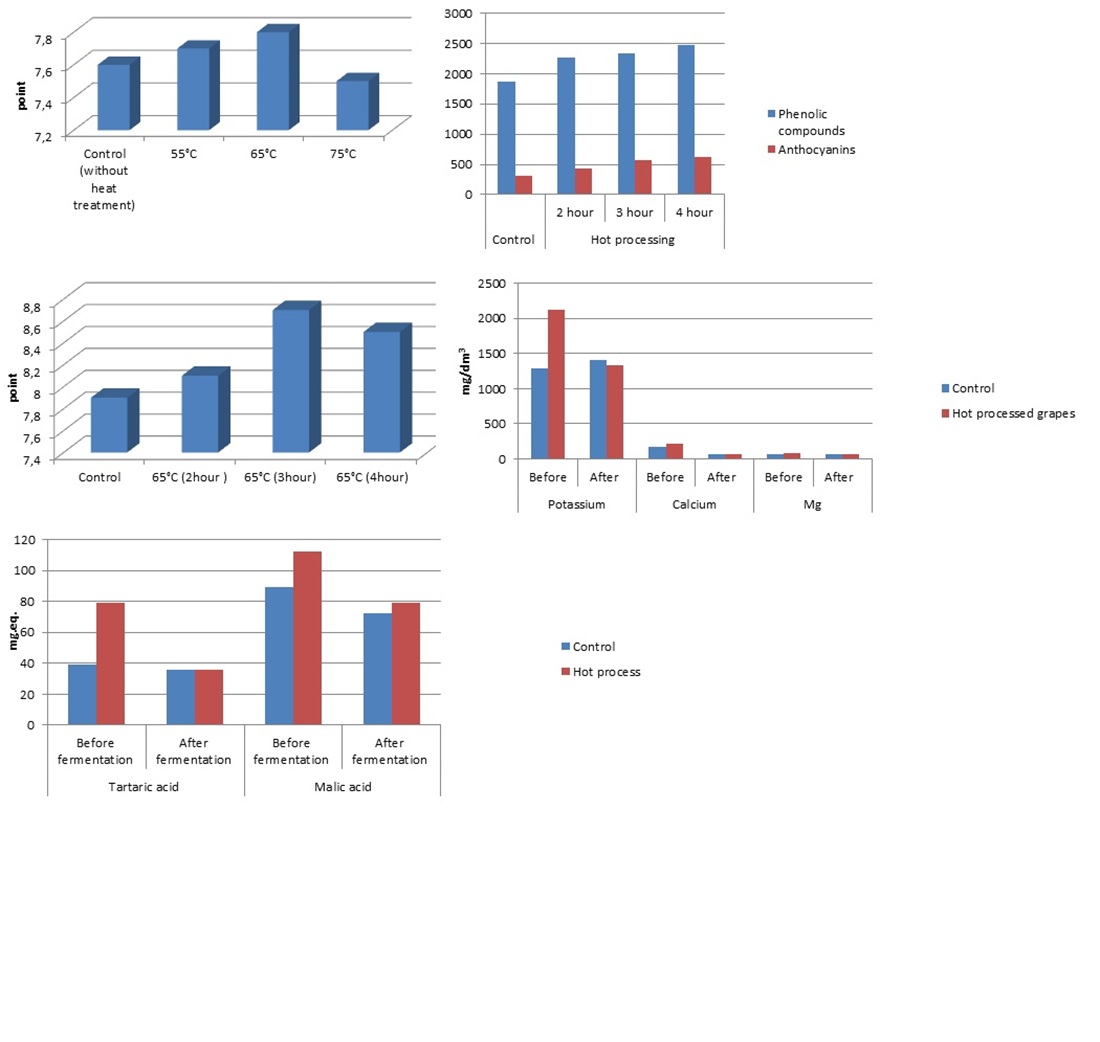
Загальний вміст фенольних сполук у контрольному зразку, виготовленому методом білого виноробства, становив 980 мг/дм3, тоді як у методі червоного виноробства він досяг 2740 мг/дм3, при термовініфікації – 3230 мг/дм3 та у методі Курдаміра – 3860 мг/дм3. Подібна закономірність, за деякими винятками, спостерігалася для кольорових сполук. Відносно тривала термічна обробка (4 години) призвела до вираженої карамелізованої нотки у смаку та була оцінена на 0,2 бала нижче, ніж попередній варіант. За якістю другий варіант, підданий термічній обробці при 65°C протягом 3 годин, показав кращі результати, отримавши оцінку 8,7 бала. За результатами органолептичного аналізу зразки, збагачені пшеничним спиртом, отримали оцінку на 0,9–1,6 бала вище за інші.
Визначення впливу технологічних методів на склад та якість зразків виноматеріалу Кагор, тривалості мацерації CO2 та змін фізико-хімічного складу, спричинених термічною обробкою, а також правильний вибір та використання спирту для вин Кагор, має практичне значення для виробництва. Отримані результати можуть бути застосовані на виноробнях та виноробних підприємствах
Посилання
- Miele, A. (2021). Wine composition of Merlot and Cabernet Sauvignon vine clones under the environmental conditions of Serra Gaúcha, Brazil. Food Science and Technology, 41, 116–122. https://doi.org/10.1590/fst.10520
- Zhang, K., Zhang, Z.-Z., Yuan, L., Gao, X.-T., Li, Q. (2021). Difference and characteristics of anthocyanin from Cabernet Sauvignon and Merlot cultivated at five regions in Xinjiang. Food Science and Technology, 41, 72–80. https://doi.org/10.1590/fst.11020
- Arslan Kulcan, A., Öziyci, H. R., Tetik, N., Karhan, M. (2015). Changes In Turbidity, Total Phenolic And Anthocyanin Contents Of Clear Red Grape Juice During Processing. Gida / the Journal of Food, 40 (6), 311–317. https://doi.org/10.15237/gida.gd15029
- Mota, R. V. d., Peregrino, I., Silva, C. P. C., Raimundo, R. H. P., Fernandes, F. d. P., Souza, C. R. d. (2021). Row orientation effects on chemical composition and aromatic profile of Syrah winter wines. Food Science and Technology, 41 (2), 412–417. https://doi.org/10.1590/fst.38219
- Liu, C., Wang, L., Wang, J., Wu, B., Liu, W., Fan, P., Liang, Z., Li, S. (2013). Resveratrols in Vitis berry skins and leaves: Their extraction and analysis by HPLC. Food Chemistry, 136 (2), 643–649. https://doi.org/10.1016/j.foodchem.2012.08.017
- Bayram, M., Kayalar, M., Kaya, C., Topuz, S. (2016). Şarapta Fenolik ve Aroma Bileşikleri Üzerine ‘Teruar’ın Etkisi. Gaziosmanpaşa Bilimsel Araştırma Dergisi, 13, 35–46. Available at: https://izlik.org/JA87MM97SC
- Jara-Palacios, M. J., Hernanz, D., González-Manzano, S., Santos-Buelga, C., Escudero-Gilete, M. L., Heredia, F. J. (2014). Detailed phenolic composition of white grape by-products by RRLC/MS and measurement of the antioxidant activity. Talanta, 125, 51–57. https://doi.org/10.1016/j.talanta.2014.02.065
- Guler, A. (2023). Effects of different maceration techniques on the colour, polyphenols and antioxidant capacity of grape juice. Food Chemistry, 404, 134603. https://doi.org/10.1016/j.foodchem.2022.134603
- Baron, M., Kumsta, M., Sumczynski, D., Mlcek, J., Jurikova, T., Sochor, J. (2018). Einfluss der Dauer der Mazeration auf den Gehalt von Antioxidantien im Traubensaft. Erwerbs-Obstbau, 60, 37–45. https://doi.org/10.1007/s10341-018-0385-7
- Puzovic, A., Mikulic-Petkovsek, M. (2024). Comparative Evaluation of Conventional and Emerging Maceration Techniques for Enhancing Bioactive Compounds in Aronia Juice. Foods, 13 (20), 3255. https://doi.org/10.3390/foods13203255
- Puzovic, A., Pelacci, M., Simkova, K., Hudina, M., Rusjan, D., Veberic, R., Mikulic-Petkovsek, M. (2024). Effect of Heat Pasteurization and Enzymatic Maceration on Yield, Color, Sugars, Organic Acids, and Phenolic Content in the ‘Merlot Kanthus’ Grape Juice. Beverages, 10 (3), 66. https://doi.org/10.3390/beverages10030066
- Błaszak, M., Lachowicz-Wiśniewska, S., Kapusta, I., Szewczuk, M., Ochmian, I. (2025). Enhanced Extraction of Polyphenols, Physicochemical Properties, and Microbial Control in Vitis vinifera L. Juice Using Ultrasound-Assisted Maceration. Molecules, 30 (3), 587. https://doi.org/10.3390/molecules30030587
- Gu, X., Liu, Y., Suo, R., Yu, Q., Xue, C., Wang, J. et al. (2025). Effects of different low-temperature maceration times on the chemical and sensory characteristics of Syrah wine. Food Chemistry, 463, 141230. https://doi.org/10.1016/j.foodchem.2024.141230
- Wojdyło, A., Samoticha, J., Chmielewska, J. (2021). Effect of different pre-treatment maceration techniques on the content of phenolic compounds and color of Dornfelder wines elaborated in cold climate. Food Chemistry, 339, 127888. https://doi.org/10.1016/j.foodchem.2020.127888
- Mallard, J., Valentin, D., Ballester, J. (2025). Oxidation in white wine: The point of view of winemakers from areas with different oenological practices. Food Research International, 199, 115341. https://doi.org/10.1016/j.foodres.2024.115341
- Benucci, I., Cerreti, M., Esti, M. (2024). Dosing oxygen from the early stages of white winemaking: Effect on oxidation–reduction potential, browning stability, volatile composition, and sensory properties. Food Chemistry, 432, 137243. https://doi.org/10.1016/j.foodchem.2023.137243
- Ailer, Š., Jakabová, S., Benešová, L., Ivanova-Petropulos, V. (2022). Wine Faults: State of Knowledge in Reductive Aromas, Oxidation and Atypical Aging, Prevention, and Correction Methods. Molecules, 27 (11), 3535. https://doi.org/10.3390/molecules27113535
- Mercanti, N., Macaluso, M., Pieracci, Y., Brazzarola, F., Palla, F., Verdini, P. G., Zinnai, A. (2024). Enhancing wine shelf-life: Insights into factors influencing oxidation and preservation. Heliyon, 10 (15), e35688. https://doi.org/10.1016/j.heliyon.2024.e35688
- Fia, G., Bucalossi, G., Proserpio, C., Vincenzi, S. (2021). Unripe grapes: an overview of the composition, traditional and innovative applications, and extraction methods of a promising waste of viticulture. Australian Journal of Grape and Wine Research, 28 (1), 8–26. https://doi.org/10.1111/ajgw.12522
- Olejar, K. J., Ricci, A., Swift, S., Zujovic, Z., Gordon, K. C., Fedrizzi, B. et al. (2019). Characterization of an Antioxidant and Antimicrobial Extract from Cool Climate, White Grape Marc. Antioxidants, 8 (7), 232. https://doi.org/10.3390/antiox8070232
- Ferreira, R. M., Costa, A. M., Pinto, C. A., Silva, A. M. S., Saraiva, J. A., Cardoso, S. M. (2023). Impact of Fermentation and Pasteurization on the Physico-Chemical and Phytochemical Composition of Opuntia ficus-indica Juices. Foods, 12 (11), 2096. https://doi.org/10.3390/foods12112096
- Fataliyev, H., Malikov, A., Lezgiyev, Y., Gadimova, N., Musayev, T., Aliyeva, G. (2024). Identifying of the wine-making potential of the autochthon madrasa grape variety of different colors and quality. Eastern-European Journal of Enterprise Technologies, 2 (11 (128)), 56–63. https://doi.org/10.15587/1729-4061.2024.302971
- Fataliyev, H., Malikov, A., Lazgiyev, Y., Haydarov, E., Agayeva, S., Baloghlanova, K. et al. (2023). Effect Of Maceration Regime On Phenolic Compound Quantity And Color Quality Of Madrasa Wine Samples. Food Science and Technology, 17 (4). https://doi.org/10.15673/fst.v17i4.2784
- Fataliyev, H., Lezgiyev, Y., Aghazade, Y., Gadimova, N., Heydarov, E., Ismailov, M. (2024). Identifying the influence of various technological techniques on the indicators of the composition of bunches and wine samples of the madras grape variety. Eastern-European Journal of Enterprise Technologies, 6 (11 (132)), 50–62. https://doi.org/10.15587/1729-4061.2024.318532
- Fataliyev, H., Aghazade, Y., Heydarov, E., Gadimova, N., Ismayilov, M., Imanova, K. (2025). Identifying the factors affecting the production of juice and wine from the autochthonous Bayanshira grape variety. Eastern-European Journal of Enterprise Technologies, 1 (11 (133)), 38–50. https://doi.org/10.15587/1729-4061.2025.323382
- Fataliyev, H., Isgandarova, S., Gadimova, N., Mammadova, A., Ismailov, M., Mammadzade, M. (2024). Identification of the effect of ripening conditions on the yield of rose hips and their processed products. Eastern-European Journal of Enterprise Technologies, 4 (11 (130)), 26–35. https://doi.org/10.15587/1729-4061.2024.309597
- Fataliyev, H., Mammadzade, M., Ismayılov, M., Gadimova, N., Mammadova, N., Musayev, T. (2025). Identifying the factors affecting the preparation of wine material from cherry fruits. Eastern-European Journal of Enterprise Technologies, 2 (11 (134)), 77–88. https://doi.org/10.15587/1729-4061.2025.326471
- Gadimova, N., Fataliyev, H., Heydarov, E., Lezgiyev, Y., Isgandarova, S. (2023). Development of a model and optimization of the interaction of factors in the grain malting process and its application in the production of functional beverages. Eastern-European Journal of Enterprise Technologies, 5 (11 (125)), 43–56. https://doi.org/10.15587/1729-4061.2023.289421
- Gadimova, N., Fataliyev, H., Allahverdiyeva, Z., Musayev, T., Akhundova, N., Babashli, A. (2022). Obtaining and investigation of the chemical composition of powdered malt and polymalt extracts for application in the production of non-alcoholic functional beverages. Eastern-European Journal of Enterprise Technologies, 5 (11 (119)), 66–74. https://doi.org/10.15587/1729-4061.2022.265762
- Salimov, V., Huseynova, A., Guliyeva, A., Alizade, S., Mammadova, R. (2025). Assessment of Biomorphological and Economically Important Traits of some Local Grape Varieties and Clones of Azerbaijan. Advances in Biology & Earth Sciences, 10 (2), 303–313. https://doi.org/10.62476/abes.102303
- Fataliyev, H. K. (2012). Winemaking practicum. Baku: Elm, 328. Available at: http://anl.az/el/Kitab/2013/Azf-272480.pdf
- Sheskin, D. J. (2020). Handbook of Parametric and Nonparametric Statistical Procedures. Chapman and Hall/CRC. https://doi.org/10.1201/9780429186196
##submission.downloads##
Опубліковано
Як цитувати
Номер
Розділ
Ліцензія
Авторське право (c) 2026 Hasil Fataliyev, Vugar Mikayilov, Mehman Ismayilov, Elnur Heydarov, Natavan Gadimova, Shabnam Fataliyeva

Ця робота ліцензується відповідно до Creative Commons Attribution 4.0 International License.
Закріплення та умови передачі авторських прав (ідентифікація авторства) здійснюється у Ліцензійному договорі. Зокрема, автори залишають за собою право на авторство свого рукопису та передають журналу право першої публікації цієї роботи на умовах ліцензії Creative Commons CC BY. При цьому вони мають право укладати самостійно додаткові угоди, що стосуються неексклюзивного поширення роботи у тому вигляді, в якому вона була опублікована цим журналом, але за умови збереження посилання на першу публікацію статті в цьому журналі.
Ліцензійний договір – це документ, в якому автор гарантує, що володіє усіма авторськими правами на твір (рукопис, статтю, тощо).
Автори, підписуючи Ліцензійний договір з ПП «ТЕХНОЛОГІЧНИЙ ЦЕНТР», мають усі права на подальше використання свого твору за умови посилання на наше видання, в якому твір опублікований. Відповідно до умов Ліцензійного договору, Видавець ПП «ТЕХНОЛОГІЧНИЙ ЦЕНТР» не забирає ваші авторські права та отримує від авторів дозвіл на використання та розповсюдження публікації через світові наукові ресурси (власні електронні ресурси, наукометричні бази даних, репозитарії, бібліотеки тощо).
За відсутності підписаного Ліцензійного договору або за відсутністю вказаних в цьому договорі ідентифікаторів, що дають змогу ідентифікувати особу автора, редакція не має права працювати з рукописом.
Важливо пам’ятати, що існує і інший тип угоди між авторами та видавцями – коли авторські права передаються від авторів до видавця. В такому разі автори втрачають права власності на свій твір та не можуть його використовувати в будь-який спосіб.