Fuzzy optimization of heterogeneous smart city server networks under uncertainty in mountainous terrain
DOI:
https://doi.org/10.15587/1729-4061.2026.360833Keywords:
fuzzy inference systems, heterogeneous networks, resource allocation, energy resource optimization, fault tolerance, computing network in a smart cityAbstract
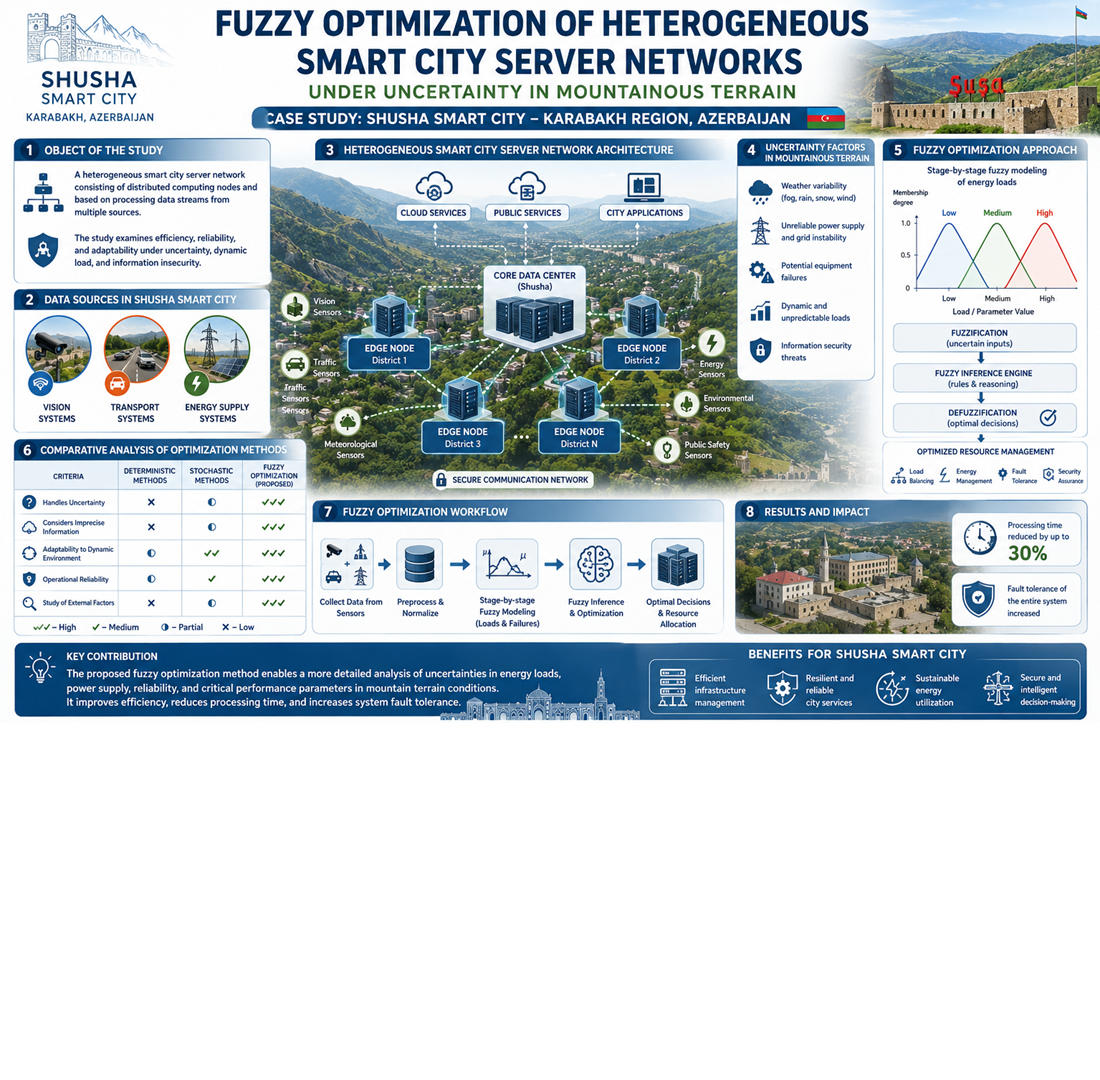
The object of this study is a heterogeneous smart city server network consisting of distributed computing nodes and based on processing data streams from multiple sources. This article examines the efficiency, reliability, and adaptability of a heterogeneous smart city server network under conditions of uncertainty, dynamic load, and information insecurity. A comparative analysis of modern methods for managing information resources in heterogeneous server networks applied to smart city infrastructure is provided.
The advantages and feasibility of using a fuzzy optimization method to improve the efficiency of a heterogeneous smart city server network are substantiated. Based on measurement data from vision, transport, and energy supply sensors, a network architecture for the server infrastructure of the Shusha smart city system, located in the Karabakh region of Azerbaijan, is proposed.
To solve this problem, the advantages of a fuzzy optimization model are substantiated, and it is found that this model can improve the performance of the Shusha smart city heterogeneous server network under uncertainty. To address this problem, a new method for stage-by-stage fuzzy modeling of energy loads arising from influencing meteorological parameters and potential failures was proposed. Unlike traditional deterministic and stochastic optimization methods, the applied fuzzy optimization method allowed for a more detailed study of external factors in the Shusha smart city system, uncertainty regarding the grid power supply, operational reliability, and the criticality of network performance parameters. The results obtained during the study show that processing time is reduced by up to 30%, and fault tolerance of the entire system is increased. This method ensures efficiency and practical application for the development and operation of a heterogeneous server in the Shusha smart city system
References
- Harchol-Balter, M. (2013). Performance Modeling and Design of Computer Systems. Cambridge University Press, 541. Available at: https://assets.cambridge.org/97811070/27503/frontmatter/9781107027503_frontmatter.pdf
- Goren, G., Vargaftik, S., Moses, Y. (2021). Stochastic Coordination in Heterogeneous Load Balancing Systems. Proceedings of the 2021 ACM Symposium on Principles of Distributed Computing, 403–414. https://doi.org/10.1145/3465084.3467923
- Zhang, C., Patras, P., Haddadi, H. (2019). Deep Learning in Mobile and Wireless Networking: A Survey. IEEE Communications Surveys & Tutorials, 21 (3), 2224–2287. https://doi.org/10.1109/comst.2019.2904897
- Zadeh, L. A. (2015). Fuzzy logic – a personal perspective. Fuzzy Sets and Systems, 281, 4–20. https://doi.org/10.1016/j.fss.2015.05.009
- Bibri, S. E., Krogstie, J. (2017). Smart sustainable cities of the future: An extensive interdisciplinary literature review. Sustainable Cities and Society, 31, 183–212. https://doi.org/10.1016/j.scs.2017.02.016
- Ebadifard, F., Babamir, S. M. (2018). APSO‐based task scheduling algorithm improved using a load‐balancing technique for the cloud computing environment. Concurrency and Computation: Practice and Experience, 30 (12). https://doi.org/10.1002/cpe.4368
- Cai, T., Liu, M., Xia, Y. (2021). Individual Data Protected Integrative Regression Analysis of High-Dimensional Heterogeneous Data. Journal of the American Statistical Association, 117 (540), 2105–2119. https://doi.org/10.1080/01621459.2021.1904958
- Mellal, M. A., Al-Dahidi, S., Williams, E. J. (2020). System reliability optimization with heterogeneous components using hosted cuckoo optimization algorithm. Reliability Engineering & System Safety, 203, 107110. https://doi.org/10.1016/j.ress.2020.107110
- Martinez, L., Herrera, F. (2000). A 2-tuple fuzzy linguistic representation model for computing with words. IEEE Transactions on Fuzzy Systems, 8 (6), 746–752. https://doi.org/10.1109/91.890332
- Mutua, P. W., Mbuthia, M. (2020). Intelligent Multi-coloured Lighting System Design with Fuzzy Logic Controller. APTIKOM Journal on Computer Science and Information Technologies, 1 (3), 128–140. https://doi.org/10.34306/csit.v1i3.58
- Wu, H., Xu, Z. (2020). Fuzzy Logic in Decision Support: Methods, Applications and Future Trends. International Journal Of Computers Communications & Control, 16 (1). https://doi.org/10.15837/ijccc.2021.1.4044
- Atzori, L., Iera, A., Morabito, G. (2010). The Internet of Things: A survey. Computer Networks, 54 (15), 2787–2805. https://doi.org/10.1016/j.comnet.2010.05.010
- Ross, T. J. (2010). Fuzzy Logic with Engineering Applications. John Wiley & Sons. Available at: https://pzs.dstu.dp.ua/logic/bibl/engineering.pdf
- Gou, Y., Zhang, T., Yang, T., Liu, J., Song, S., Cui, J.-H. (2023). A Deep MARL-Based Power-Management Strategy for Improving the Fair Reuse of UWSNs. IEEE Internet of Things Journal, 10 (7), 6507–6522. https://doi.org/10.1109/jiot.2022.3226953
- Tan, W. W., Chua, T. W. (2007). Uncertain Rule-Based Fuzzy Logic Systems: Introduction and New Directions (Mendel, J.M.; 2001) [book review]. IEEE Computational Intelligence Magazine, 2 (1), 72–73. https://doi.org/10.1109/mci.2007.357196
- Su, Y., Liwang, M., Gao, Z., Huang, L., Du, X., Guizani, M. (2021). Optimal Cooperative Relaying and Power Control for IoUT Networks With Reinforcement Learning. IEEE Internet of Things Journal, 8 (2), 791–801. https://doi.org/10.1109/jiot.2020.3008178
- Lim, C., Cho, G.-H., Kim, J. (2021). Understanding the linkages of smart-city technologies and applications: Key lessons from a text mining approach and a call for future research. Technological Forecasting and Social Change, 170, 120893. https://doi.org/10.1016/j.techfore.2021.120893
- Alam, T. (2021). Cloud-Based IoT Applications and Their Roles in Smart Cities. Smart Cities, 4 (3), 1196–1219. https://doi.org/10.3390/smartcities4030064
- Islam, K. Y., Ahmad, I., Habibi, D., Jin, J., Waqas, M. (2022). Lifetime Maximization in Underwater Wireless Communication Networks. IEEE Sensors Journal, 22 (15), 15549–15560. https://doi.org/10.1109/jsen.2022.3186032
- Gubbi, J., Buyya, R., Marusic, S., Palaniswami, M. (2013). Internet of Things (IoT): A vision, architectural elements, and future directions. Future Generation Computer Systems, 29 (7), 1645–1660. https://doi.org/10.1016/j.future.2013.01.010
- Garg, S. K., Versteeg, S., Buyya, R. (2013). A framework for ranking of cloud computing services. Future Generation Computer Systems, 29 (4), 1012–1023. https://doi.org/10.1016/j.future.2012.06.006
- Alhashimi, H. F., Hindia, M. N., Dimyati, K., Hanafi, E. B., Alden, F. Z., Qamar, F., Nguyen, Q. N. (2025). Survey on AI-Enabled Resource Management for 6G Heterogeneous Networks: Recent Research, Challenges, and Future Trends. Computers, Materials & Continua, 83 (3), 3585–3622. https://doi.org/10.32604/cmc.2025.062867
- Gupta, P., Ding, B., Guan, C., Ding, D. (2024). Generative AI: A systematic review using topic modelling techniques. Data and Information Management, 8 (2), 100066. https://doi.org/10.1016/j.dim.2024.100066
- Ahmed, M., Naser Mahmood, A., Hu, J. (2016). A survey of network anomaly detection techniques. Journal of Network and Computer Applications, 60, 19–31. https://doi.org/10.1016/j.jnca.2015.11.016
- Soft Computing and Optimization (2022). Springer Proceedings in Mathematics & Statistics. Springer Nature Singapore. https://doi.org/10.1007/978-981-19-6406-0
- Mao, Y., You, C., Zhang, J., Huang, K., Letaief, K. B. (2017). A Survey on Mobile Edge Computing: The Communication Perspective. IEEE Communications Surveys & Tutorials, 19 (4), 2322–2358. https://doi.org/10.1109/comst.2017.2745201
- Sun, G., Guan, X., Yi, X., Zhou, Z. (2018). An innovative TOPSIS approach based on hesitant fuzzy correlation coefficient and its applications. Applied Soft Computing, 68, 249–267. https://doi.org/10.1016/j.asoc.2018.04.004
- Cuervo, E., Balasubramanian, A., Cho, D.-k., Wolman, A., Saroiu, S., Chandra, R., Bahl, P. (2010). MAUI. Proceedings of the 8th International Conference on Mobile Systems, Applications, and Services, 49–62. https://doi.org/10.1145/1814433.1814441
- Karimzadeh-Farshbafan, M., Shah-Mansouri, V., Niyato, D. (2020). Reliability Aware Service Placement Using a Viterbi-Based Algorithm. IEEE Transactions on Network and Service Management, 17 (1), 622–636. https://doi.org/10.1109/tnsm.2019.2959818
- Ullah, I., Arishi, A., Singh, S. K., Alharbi, F., Ibrahim, A. H., Islam, M. et al. (2025). Autonomous network management for 6G communication: A comprehensive survey. Digital Communications and Networks, 11 (6), 1917–1940. https://doi.org/10.1016/j.dcan.2025.07.001
Downloads
Published
How to Cite
Issue
Section
License
Copyright (c) 2026 Javanshir Mammadov, Esmira Mehbaliyeva

This work is licensed under a Creative Commons Attribution 4.0 International License.
The consolidation and conditions for the transfer of copyright (identification of authorship) is carried out in the License Agreement. In particular, the authors reserve the right to the authorship of their manuscript and transfer the first publication of this work to the journal under the terms of the Creative Commons CC BY license. At the same time, they have the right to conclude on their own additional agreements concerning the non-exclusive distribution of the work in the form in which it was published by this journal, but provided that the link to the first publication of the article in this journal is preserved.
A license agreement is a document in which the author warrants that he/she owns all copyright for the work (manuscript, article, etc.).
The authors, signing the License Agreement with TECHNOLOGY CENTER PC, have all rights to the further use of their work, provided that they link to our edition in which the work was published.
According to the terms of the License Agreement, the Publisher TECHNOLOGY CENTER PC does not take away your copyrights and receives permission from the authors to use and dissemination of the publication through the world's scientific resources (own electronic resources, scientometric databases, repositories, libraries, etc.).
In the absence of a signed License Agreement or in the absence of this agreement of identifiers allowing to identify the identity of the author, the editors have no right to work with the manuscript.
It is important to remember that there is another type of agreement between authors and publishers – when copyright is transferred from the authors to the publisher. In this case, the authors lose ownership of their work and may not use it in any way.








