Нечітка оптимізація гетерогенних мереж серверів розумного міста в умовах невизначеності в гірській місцевості
DOI:
https://doi.org/10.15587/1729-4061.2026.360833Ключові слова:
системи нечіткого висновку, гетерогенні мережі, розподіл ресурсів, оптимізація енергетичних ресурсів, відмовостійкість, обчислювальна мережа в розумному містіАнотація
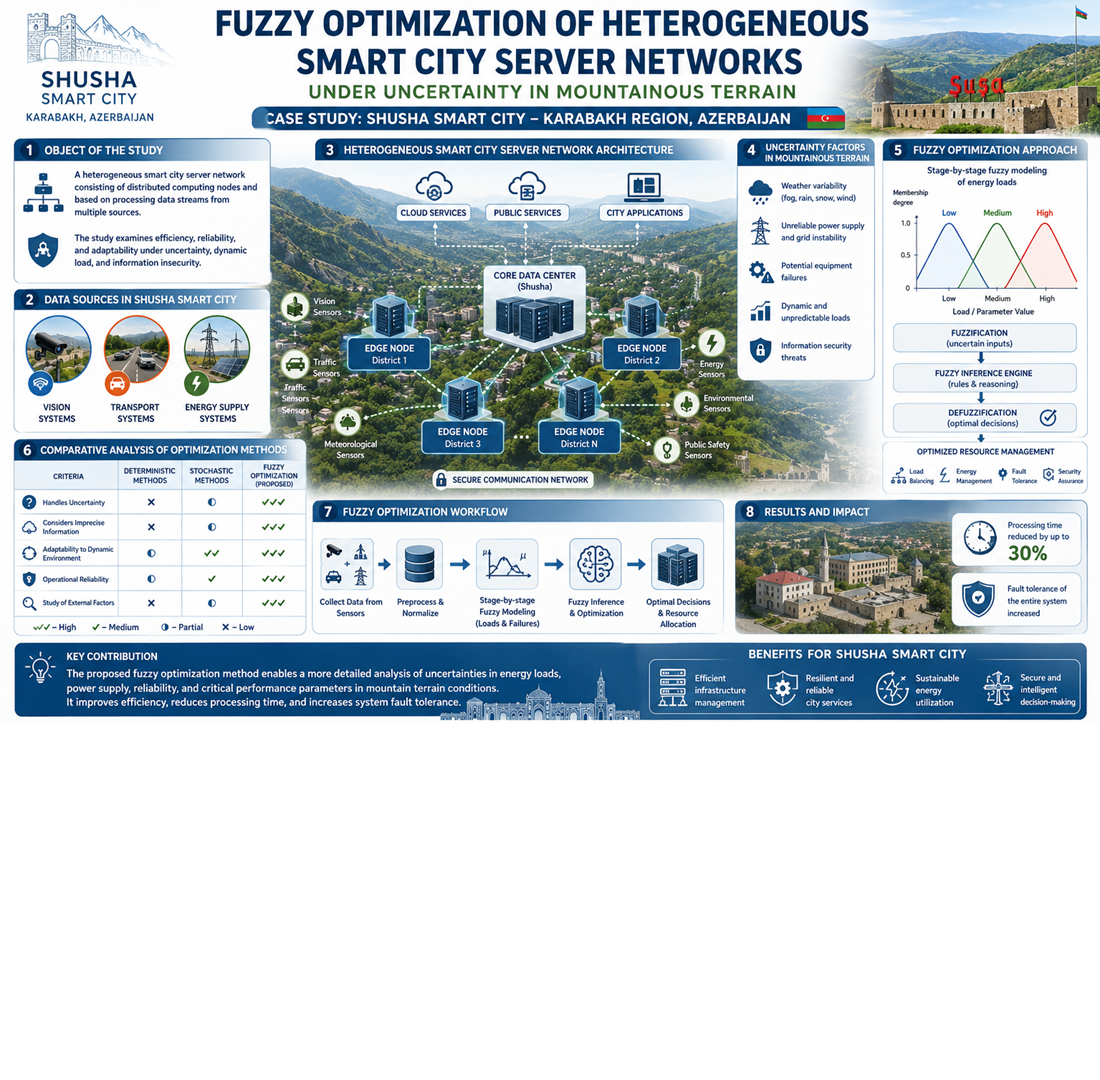
Об’єктом цього дослідження є гетерогенна мережа серверів розумного міста, що складається з розподілених обчислювальних вузлів та базується на обробці потоків даних з кількох джерел. У цій статті розглядається ефективність, надійність та адаптивність гетерогенної мережі серверів розумного міста в умовах невизначеності, динамічного навантаження та інформаційної незахищеності. Наведено порівняльний аналіз сучасних методів управління інформаційними ресурсами в гетерогенних мережах серверів, що застосовуються до інфраструктури розумного міста.
Обґрунтовано переваги та доцільність використання методу нечіткої оптимізації для підвищення ефективності гетерогенної мережі серверів розумного міста. На основі даних вимірювань від датчиків зору, транспорту та енергопостачання запропоновано мережеву архітектуру для серверної інфраструктури системи розумного міста Шуша, розташованого в Карабахському регіоні Азербайджану.
Для вирішення цієї проблеми обґрунтовано переваги моделі нечіткої оптимізації та встановлено, що ця модель може покращити продуктивність гетерогенної мережі серверів розумного міста Шуша в умовах невизначеності. Для вирішення цієї проблеми запропоновано новий метод поетапного нечіткого моделювання енергетичних навантажень, що виникають внаслідок впливу метеорологічних параметрів та потенційних збоїв. На відміну від традиційних детерміністичних та стохастичних методів оптимізації, застосований метод нечіткої оптимізації дозволив детальніше дослідити зовнішні фактори в системі розумного міста Шуша, невизначеність щодо живлення мережі, надійність експлуатації та критичність параметрів продуктивності мережі. Результати, отримані в ході дослідження, показують, що час обробки скорочується до 30%, а відмовостійкість усієї системи підвищується. Цей метод забезпечує ефективність та практичне застосування для розробки та експлуатації гетерогенного сервера в системі розумного міста Шуша
Посилання
- Harchol-Balter, M. (2013). Performance Modeling and Design of Computer Systems. Cambridge University Press, 541. Available at: https://assets.cambridge.org/97811070/27503/frontmatter/9781107027503_frontmatter.pdf
- Goren, G., Vargaftik, S., Moses, Y. (2021). Stochastic Coordination in Heterogeneous Load Balancing Systems. Proceedings of the 2021 ACM Symposium on Principles of Distributed Computing, 403–414. https://doi.org/10.1145/3465084.3467923
- Zhang, C., Patras, P., Haddadi, H. (2019). Deep Learning in Mobile and Wireless Networking: A Survey. IEEE Communications Surveys & Tutorials, 21 (3), 2224–2287. https://doi.org/10.1109/comst.2019.2904897
- Zadeh, L. A. (2015). Fuzzy logic – a personal perspective. Fuzzy Sets and Systems, 281, 4–20. https://doi.org/10.1016/j.fss.2015.05.009
- Bibri, S. E., Krogstie, J. (2017). Smart sustainable cities of the future: An extensive interdisciplinary literature review. Sustainable Cities and Society, 31, 183–212. https://doi.org/10.1016/j.scs.2017.02.016
- Ebadifard, F., Babamir, S. M. (2018). APSO‐based task scheduling algorithm improved using a load‐balancing technique for the cloud computing environment. Concurrency and Computation: Practice and Experience, 30 (12). https://doi.org/10.1002/cpe.4368
- Cai, T., Liu, M., Xia, Y. (2021). Individual Data Protected Integrative Regression Analysis of High-Dimensional Heterogeneous Data. Journal of the American Statistical Association, 117 (540), 2105–2119. https://doi.org/10.1080/01621459.2021.1904958
- Mellal, M. A., Al-Dahidi, S., Williams, E. J. (2020). System reliability optimization with heterogeneous components using hosted cuckoo optimization algorithm. Reliability Engineering & System Safety, 203, 107110. https://doi.org/10.1016/j.ress.2020.107110
- Martinez, L., Herrera, F. (2000). A 2-tuple fuzzy linguistic representation model for computing with words. IEEE Transactions on Fuzzy Systems, 8 (6), 746–752. https://doi.org/10.1109/91.890332
- Mutua, P. W., Mbuthia, M. (2020). Intelligent Multi-coloured Lighting System Design with Fuzzy Logic Controller. APTIKOM Journal on Computer Science and Information Technologies, 1 (3), 128–140. https://doi.org/10.34306/csit.v1i3.58
- Wu, H., Xu, Z. (2020). Fuzzy Logic in Decision Support: Methods, Applications and Future Trends. International Journal Of Computers Communications & Control, 16 (1). https://doi.org/10.15837/ijccc.2021.1.4044
- Atzori, L., Iera, A., Morabito, G. (2010). The Internet of Things: A survey. Computer Networks, 54 (15), 2787–2805. https://doi.org/10.1016/j.comnet.2010.05.010
- Ross, T. J. (2010). Fuzzy Logic with Engineering Applications. John Wiley & Sons. Available at: https://pzs.dstu.dp.ua/logic/bibl/engineering.pdf
- Gou, Y., Zhang, T., Yang, T., Liu, J., Song, S., Cui, J.-H. (2023). A Deep MARL-Based Power-Management Strategy for Improving the Fair Reuse of UWSNs. IEEE Internet of Things Journal, 10 (7), 6507–6522. https://doi.org/10.1109/jiot.2022.3226953
- Tan, W. W., Chua, T. W. (2007). Uncertain Rule-Based Fuzzy Logic Systems: Introduction and New Directions (Mendel, J.M.; 2001) [book review]. IEEE Computational Intelligence Magazine, 2 (1), 72–73. https://doi.org/10.1109/mci.2007.357196
- Su, Y., Liwang, M., Gao, Z., Huang, L., Du, X., Guizani, M. (2021). Optimal Cooperative Relaying and Power Control for IoUT Networks With Reinforcement Learning. IEEE Internet of Things Journal, 8 (2), 791–801. https://doi.org/10.1109/jiot.2020.3008178
- Lim, C., Cho, G.-H., Kim, J. (2021). Understanding the linkages of smart-city technologies and applications: Key lessons from a text mining approach and a call for future research. Technological Forecasting and Social Change, 170, 120893. https://doi.org/10.1016/j.techfore.2021.120893
- Alam, T. (2021). Cloud-Based IoT Applications and Their Roles in Smart Cities. Smart Cities, 4 (3), 1196–1219. https://doi.org/10.3390/smartcities4030064
- Islam, K. Y., Ahmad, I., Habibi, D., Jin, J., Waqas, M. (2022). Lifetime Maximization in Underwater Wireless Communication Networks. IEEE Sensors Journal, 22 (15), 15549–15560. https://doi.org/10.1109/jsen.2022.3186032
- Gubbi, J., Buyya, R., Marusic, S., Palaniswami, M. (2013). Internet of Things (IoT): A vision, architectural elements, and future directions. Future Generation Computer Systems, 29 (7), 1645–1660. https://doi.org/10.1016/j.future.2013.01.010
- Garg, S. K., Versteeg, S., Buyya, R. (2013). A framework for ranking of cloud computing services. Future Generation Computer Systems, 29 (4), 1012–1023. https://doi.org/10.1016/j.future.2012.06.006
- Alhashimi, H. F., Hindia, M. N., Dimyati, K., Hanafi, E. B., Alden, F. Z., Qamar, F., Nguyen, Q. N. (2025). Survey on AI-Enabled Resource Management for 6G Heterogeneous Networks: Recent Research, Challenges, and Future Trends. Computers, Materials & Continua, 83 (3), 3585–3622. https://doi.org/10.32604/cmc.2025.062867
- Gupta, P., Ding, B., Guan, C., Ding, D. (2024). Generative AI: A systematic review using topic modelling techniques. Data and Information Management, 8 (2), 100066. https://doi.org/10.1016/j.dim.2024.100066
- Ahmed, M., Naser Mahmood, A., Hu, J. (2016). A survey of network anomaly detection techniques. Journal of Network and Computer Applications, 60, 19–31. https://doi.org/10.1016/j.jnca.2015.11.016
- Soft Computing and Optimization (2022). Springer Proceedings in Mathematics & Statistics. Springer Nature Singapore. https://doi.org/10.1007/978-981-19-6406-0
- Mao, Y., You, C., Zhang, J., Huang, K., Letaief, K. B. (2017). A Survey on Mobile Edge Computing: The Communication Perspective. IEEE Communications Surveys & Tutorials, 19 (4), 2322–2358. https://doi.org/10.1109/comst.2017.2745201
- Sun, G., Guan, X., Yi, X., Zhou, Z. (2018). An innovative TOPSIS approach based on hesitant fuzzy correlation coefficient and its applications. Applied Soft Computing, 68, 249–267. https://doi.org/10.1016/j.asoc.2018.04.004
- Cuervo, E., Balasubramanian, A., Cho, D.-k., Wolman, A., Saroiu, S., Chandra, R., Bahl, P. (2010). MAUI. Proceedings of the 8th International Conference on Mobile Systems, Applications, and Services, 49–62. https://doi.org/10.1145/1814433.1814441
- Karimzadeh-Farshbafan, M., Shah-Mansouri, V., Niyato, D. (2020). Reliability Aware Service Placement Using a Viterbi-Based Algorithm. IEEE Transactions on Network and Service Management, 17 (1), 622–636. https://doi.org/10.1109/tnsm.2019.2959818
- Ullah, I., Arishi, A., Singh, S. K., Alharbi, F., Ibrahim, A. H., Islam, M. et al. (2025). Autonomous network management for 6G communication: A comprehensive survey. Digital Communications and Networks, 11 (6), 1917–1940. https://doi.org/10.1016/j.dcan.2025.07.001
##submission.downloads##
Опубліковано
Як цитувати
Номер
Розділ
Ліцензія
Авторське право (c) 2026 Javanshir Mammadov, Esmira Mehbaliyeva

Ця робота ліцензується відповідно до Creative Commons Attribution 4.0 International License.
Закріплення та умови передачі авторських прав (ідентифікація авторства) здійснюється у Ліцензійному договорі. Зокрема, автори залишають за собою право на авторство свого рукопису та передають журналу право першої публікації цієї роботи на умовах ліцензії Creative Commons CC BY. При цьому вони мають право укладати самостійно додаткові угоди, що стосуються неексклюзивного поширення роботи у тому вигляді, в якому вона була опублікована цим журналом, але за умови збереження посилання на першу публікацію статті в цьому журналі.
Ліцензійний договір – це документ, в якому автор гарантує, що володіє усіма авторськими правами на твір (рукопис, статтю, тощо).
Автори, підписуючи Ліцензійний договір з ПП «ТЕХНОЛОГІЧНИЙ ЦЕНТР», мають усі права на подальше використання свого твору за умови посилання на наше видання, в якому твір опублікований. Відповідно до умов Ліцензійного договору, Видавець ПП «ТЕХНОЛОГІЧНИЙ ЦЕНТР» не забирає ваші авторські права та отримує від авторів дозвіл на використання та розповсюдження публікації через світові наукові ресурси (власні електронні ресурси, наукометричні бази даних, репозитарії, бібліотеки тощо).
За відсутності підписаного Ліцензійного договору або за відсутністю вказаних в цьому договорі ідентифікаторів, що дають змогу ідентифікувати особу автора, редакція не має права працювати з рукописом.
Важливо пам’ятати, що існує і інший тип угоди між авторами та видавцями – коли авторські права передаються від авторів до видавця. В такому разі автори втрачають права власності на свій твір та не можуть його використовувати в будь-який спосіб.