Design of an information and computer system for automated control over transport flows at machinery and instrument manufacturing enterprises
DOI:
https://doi.org/10.15587/1729-4061.2026.361146Keywords:
information and computer system, automated transport flow control, metaheuristic optimization, flexible production systemAbstract
This study investigates the process of managing transport flows at machine-building and instrument-building enterprises. The task addressed relates to the need for fast and effective information processing and making correct and justified logistics decisions, their automated adjustment in real time throughout the entire production life cycle.
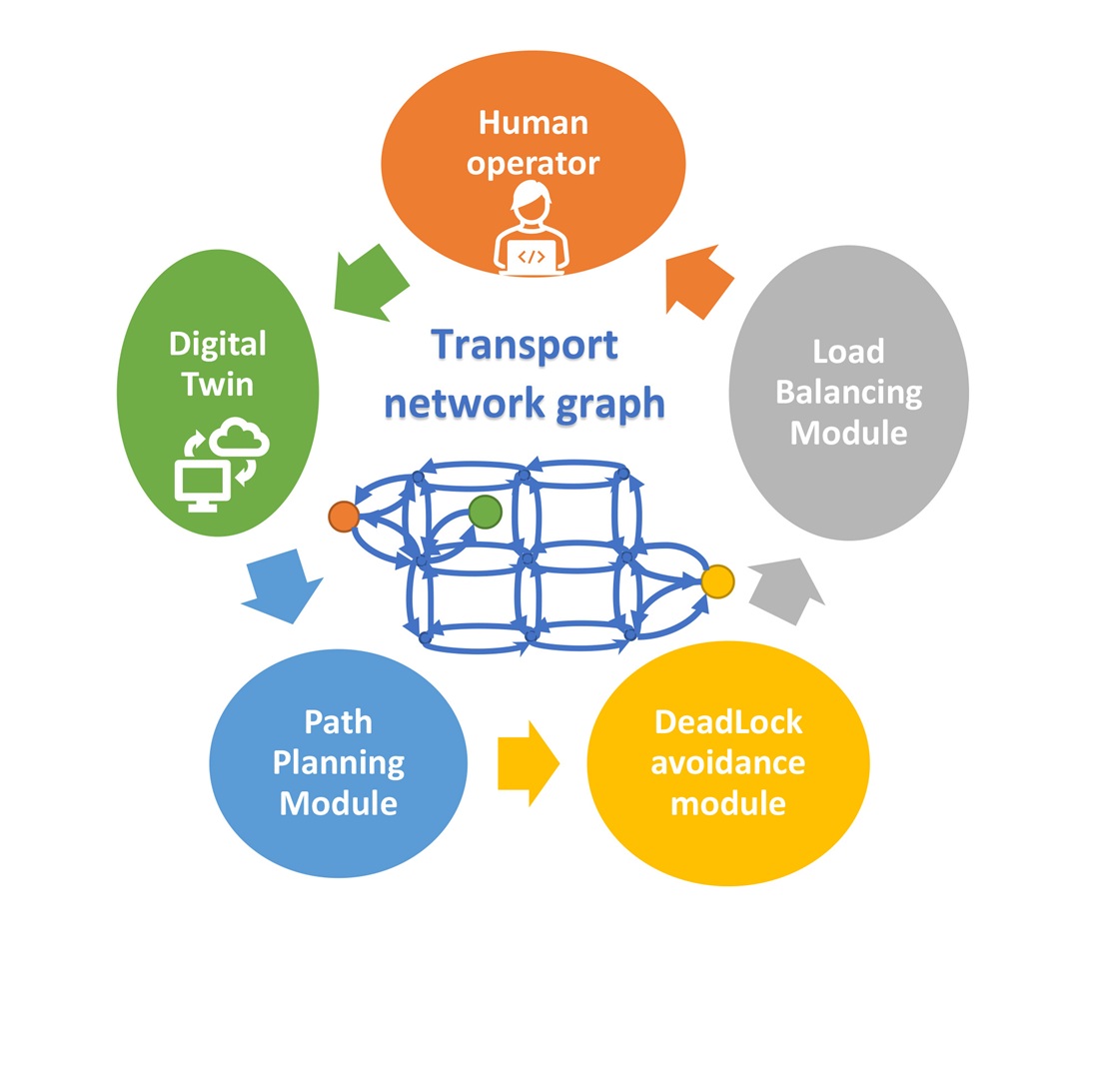
To that end, an information and computer system (ICS) has been designed for automated management of transport flows at machine-building and instrument-building enterprises. Its operation is to determine, coordinate, and adjust technological routes for a set of transportation means (TrMs) under an automated mode and in real time when organizing production environment. It is noteworthy that the newly designed ICS covers both internal and external shop logistics levels, ensuring synchronization of territorially distributed elements of flexible production systems of machine-building and instrument-building.
Owing to the use of the ant algorithm for task distribution between TrMs and the modified A* algorithm with spatial-temporal graph expansion, the ICS capability to make operational decisions based on the “concept of compromises” has been implemented. The newly designed ICS also demonstrates high performance – preventing deadlocks in 24.9 ms and balancing the TrMs load in 500 ms.
In addition, it has been experimentally proven that the total length of technological routes has been reduced by 1.3 times, and the idle runs of TrMs by 2.5 times. It is obvious that route optimization contributes to reducing the carbon footprint, which corresponds to the Sustainable Development Goals by 2030. Also, reducing the labor intensity of work and the intellectual load on the operator has an obvious social effect
References
- Cherepanska, I., Sazonov, A., Melnychuk, P., Melnychuk, D., Kalchuk, S., Pryadko, V., Yanovsky, V. (2024). Design of an information-computer system for the automated modeling of systems for automatic orientation of production objects in the machine and instrument industries. Eastern-European Journal of Enterprise Technologies, 3 (2 (129)), 6–19. https://doi.org/10.15587/1729-4061.2024.306516
- THE 17 GOALS. Available at: https://sdgs.un.org/goals
- Placzek, E., Osieczko-Potoczna, K. (2025). Importance of intralogistics solutions in a manufacturing company - research results. Management, 1, 343–361. https://doi.org/10.58691/man/203796
- Liu, R., Shin, S.-Y. (2025). A Review of Traffic Flow Prediction Methods in Intelligent Transportation System Construction. Applied Sciences, 15 (7), 3866. https://doi.org/10.3390/app15073866
- Goutham, M., Stockar, S. (2024). Resilient Fleet Management for Energy-Aware Intra-Factory Logistics. 2024 American Control Conference (ACC), 839–844. https://doi.org/10.23919/acc60939.2024.10644599
- Vzhesnievskyi, M., Chala, O. (2024). Automation of internal warehouse manufacturing logistics processes for the implementation of the industry 4.0 concept: energy saving, productivity, mobility, modularity, autonomy. Control, Navigation and Communication Systems, 2 (76). https://doi.org/10.26906/sunz.2024.2.034
- Nevliudov, I., Vzhesnievskyi, M., Romashov, Y., Chala, O. (2023). Mathematical modeling of mechatronic shuttles as automation objects for multilevel systems of intra-warehouse logistics. Innovative Technologies and Scientific Solutions for Industries, 4 (26), 135–144. https://doi.org/10.30837/itssi.2023.26.135
- Nevliudov, I., Maksymova, S., Chala, O., Bronnikov, A., Vzhesnievskyi, M. (2023). Automated Logistics Processes Improvement in Logistics Facilities. Multidisciplinary Journal of Science and Technology, 3 (3), 157–170. Available at: https://mjstjournal.com/index.php/mjst/article/view/202
- Wang, T., Hu, Q., Lim, A. (2022). An exact algorithm for two-dimensional vector packing problem with volumetric weight and general costs. European Journal of Operational Research, 300 (1), 20–34. https://doi.org/10.1016/j.ejor.2021.10.011
- Dorigo, M., Stützle, T. (2004). Ant Colony Optimization. MIT Press. https://doi.org/10.7551/mitpress/1290.001.0001
- Holovina, O. (2023). Modern technologies in transportation logistics management. International Science Journal of Management, Economics & Finance, 2 (3), 35–42. https://doi.org/10.46299/j.isjmef.20230203.04
- Chung, S.-H. (2021). Applications of smart technologies in logistics and transport: A review. Transportation Research Part E: Logistics and Transportation Review, 153, 102455. https://doi.org/10.1016/j.tre.2021.102455
- Bulková, Z., Gašparík, J., Čamaj, J. (2025). Implementation of automated systems in logistics: The key to efficiency and environmental sustainability. Transportation Research Procedia, 87, 1–10. https://doi.org/10.1016/j.trpro.2025.04.100
- Capua, M. D., Ciaramella, A., De Prisco, A. (2023). Machine Learning and Computer Vision for the automation of processes in advanced logistics: the Integrated Logistic Platform (ILP) 4.0. Procedia Computer Science, 217, 326–338. https://doi.org/10.1016/j.procs.2022.12.228
- Padovano, A., Longo, F., Nicoletti, L., Mirabelli, G. (2018). A Digital Twin based Service Oriented Application for a 4.0 Knowledge Navigation in the Smart Factory. IFAC-PapersOnLine, 51 (11), 631–636. https://doi.org/10.1016/j.ifacol.2018.08.389
- Cherepanska, I., Sazonov, A., Kyrychuk, Y., Melnychuk, P., Melnychuk, D., Nazarenko, N. et al. (2024). Design of an intelligent module for detecting signs of information security threats and the emergence of unreliable data. Eastern-European Journal of Enterprise Technologies, 6 (2 (132)), 49–63. https://doi.org/10.15587/1729-4061.2024.317000
Downloads
Published
How to Cite
Issue
Section
License
Copyright (c) 2026 Irina Cherepanska, Artem Sazonov, Dmytro Tereshchenko, Petro Melnychuk, Dmytro Melnychuk, Sergii Kalchuk, Valery Yanovsky, Yurii Honcharenko, Oleh Sokolovskyi, Liudmyla Savchenko

This work is licensed under a Creative Commons Attribution 4.0 International License.
The consolidation and conditions for the transfer of copyright (identification of authorship) is carried out in the License Agreement. In particular, the authors reserve the right to the authorship of their manuscript and transfer the first publication of this work to the journal under the terms of the Creative Commons CC BY license. At the same time, they have the right to conclude on their own additional agreements concerning the non-exclusive distribution of the work in the form in which it was published by this journal, but provided that the link to the first publication of the article in this journal is preserved.
A license agreement is a document in which the author warrants that he/she owns all copyright for the work (manuscript, article, etc.).
The authors, signing the License Agreement with TECHNOLOGY CENTER PC, have all rights to the further use of their work, provided that they link to our edition in which the work was published.
According to the terms of the License Agreement, the Publisher TECHNOLOGY CENTER PC does not take away your copyrights and receives permission from the authors to use and dissemination of the publication through the world's scientific resources (own electronic resources, scientometric databases, repositories, libraries, etc.).
In the absence of a signed License Agreement or in the absence of this agreement of identifiers allowing to identify the identity of the author, the editors have no right to work with the manuscript.
It is important to remember that there is another type of agreement between authors and publishers – when copyright is transferred from the authors to the publisher. In this case, the authors lose ownership of their work and may not use it in any way.








