Defining a rational locomotive maintenance system considering a cost-based risk acceptability threshold
DOI:
https://doi.org/10.15587/1729-4061.2026.362728Keywords:
locomotive, risk-oriented maintenance strategy, dependent failures, value at riskAbstract
This study examines a locomotive technical maintenance system, represented as a set of interconnected nodes with a predefined structure of dependent failures.
The task addressed is to determine a rational locomotive maintenance system in which the total costs for planned and unplanned repairs are minimal provided that the risk of failures does not exceed the limit level set by the "value at risk" criterion. A risk-oriented mathematical model for the construction of a rational maintenance system has been proposed, in which dependent failures are taken into account by "waves" of failures. An optimization problem has been stated to minimize the total costs for planned and unplanned repairs provided that the risk level is not exceeded.
To model dependent failures, a structure of node connections was constructed, which makes it possible to assess the risk of failure of nodes and the system as a whole, taking into account economic consequences.
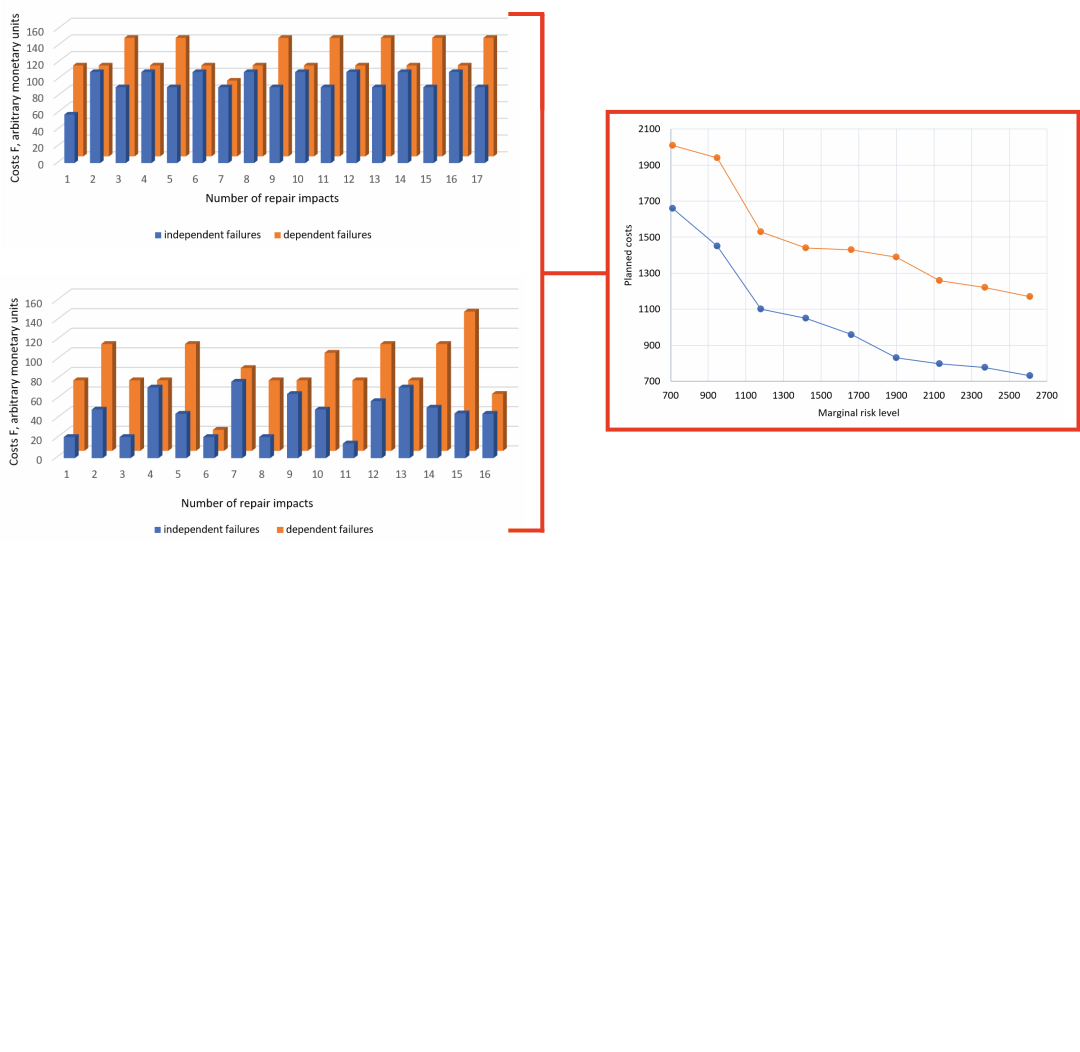
Based on the results from modeling a set of maintenance strategies, a nonlinear nature of change in total costs with an increase in the permissible level of risk was revealed; a ranking of elements by the frequency of the need for repair impact was obtained. This is explained by the redistribution between planned and unplanned repairs when changing the adopted risk threshold. It is shown that taking into account dependent failures increases the cost estimate for the maintenance system compared to the independent failure model by 18–47% depending on the adopted risk threshold. A distinctive feature of the approach is the combination of the “value at risk” criterion with the consideration of dependent failures within a single strategy selection procedure, which provides a comparison of strategies on the “risk-cost” scale.
The results of the study could be used when planning the volume and frequency of maintenance and repair of a locomotive fleet. The practical application is to establish the correspondence between the accepted acceptable risk level and a technical maintenance and repair (TM&R) strategy
References
- Puzyr, V., Datsun, Y., Obozny, O., Pyvo, V. (2019). Development of a repair technology for locomotive units on the basis of the theory of decision. IOP Conference Series: Materials Science and Engineering, 664 (1), 12029. https://doi.org/10.1088/1757-899x/664/1/012029
- Bosov, A. A., Bodnar, E. B., Mosendz, A. I. (2001). Osnovnaya zadacha sovershenstvovaniya sistemy planovo-predupreditelnyh remontov lokomotivov. Visnik Shidnoukr. nac. un-t, 7 (41), 93–97.
- Bobyl, V. V. (2016). Finansovi ryzyky bankiv: teoriya ta praktyka upravlinnia v umovakh kryzy. Dnipropetrovsk: Dnipropetr. nats. un-et zalizn. transp. imeni akad. V. Lazariana, 300.
- Grenčík, J., Poprocký, R., Galliková, J., Volna, P. (2018). Use of risk assessment methods in maintenance for more reliable rolling stock operation. MATEC Web of Conferences, 157, 4002. https://doi.org/10.1051/matecconf/201815704002
- Szkoda, M., Satora, M. (2018). Assessment of the permissibility of the risk of changing the strategy for the maintenance of rail vehicles based on the example of a selected locomotive type. Proceedings of the Institution of Mechanical Engineers, Part F: Journal of Rail and Rapid Transit, 233 (9), 906–925. https://doi.org/10.1177/0954409718819180
- Datsun, Y., Filatov, A. (2014). Investigation of failures of wheel pairs of locomotives in operation using fmea-methodology. Collection of Scientific Works of the Ukrainian State University of Railway Transport, 147, 87–91. https://doi.org/10.18664/1994-7852.147.2014.74610
- Matusevych, O. O. (2015). Udoskonalennia metodolohiyi systemy tekhnichnoho obsluhovuvannia i remontu tiahovykh pidstantsiy. Dnipropetrovsk: Dnipropetr. nats. un-t zalizn. transp. im. akad. V. Lazariana, 295.
- Puzyr, V., Krasheninin, O., Datsun, Y., Obozny, O., Shapatina, O., Zadesenets, V. (2021). Choice of locomotive park maintenance strategy when introducing the service. Collection of Scientific Works of the State University of Infrastructure and Technologies Series “Transport Systems and Technologies”, 1 (38), 14–23. https://doi.org/10.32703/2617-9040-2021-38-14-2
- Belodedenko, S. V., Ibragimov, M. S. (2017). Voprosy periodichnosti kontrolej tehnicheskogo sostoyaniya mehanicheskih sistem v metallurgii. Dnepr: LizunovPress, 78.
- Falendysh, A. P., Chyhyryk, N. D., Sumtsov, A. L., Kletska, O. V. (2019). The choice of the strategy of technical operation of modernized shunting locomotives. Naukovyi Visnyk Natsionalnoho Hirnychoho Universytetu, 2, 43–50. https://doi.org/10.29202/nvngu/2019-2/7
- Babyak, M., Keršys, R., Neduzha, L. (2020). Improving the Dependability Evaluation Technique of a Transport Vehicle. Proceedings of 24th International Scientific Conference. Transport Means 2020. Pt. II. Kaunas, 646–651.
- Falendysh, A., Sumtsov, A., Artemenko, O., Klecka, O. (2016). Simulation of changes in the steady state availability factor of shunting locomotives for various maintenance systems. Eastern-European Journal of Enterprise Technologies, 1 (3 (79)), 24–31. https://doi.org/10.15587/1729-4061.2016.60640
- Bodnar, B., Bolzhelarskyi, Y., Ochkasov, O., Hryshechkina, T., Černiauskaite, L. (2018). Determination of integrated indicator for analysis of the traffic safety condition for traction rolling stock. Paper presented at the 12th International Conference on Intelligent Technologies in Logistics and Mechatronics Systems, ITELMS 2018. Panevėžys, 45–54.
- Bodnar, B., Ochkasov, O., Bodnar, E., Hryshechkina, T., Keršys, R. (2018). Safety performance analysis of the movement and operation of locomotives. Proceedings of 22nd International Scientific Conference, 839–843.
- Bodnar, B., Ochkasov, O., Ochkasov, M. (2021). Devising a procedure for calculating the technical condition index of locomotive nodes based on monitoring results. Eastern-European Journal of Enterprise Technologies, 5 (3 (113)), 37–45. https://doi.org/10.15587/1729-4061.2021.242478
- Ochkasov, O. B., Ocheretniuk, M. V. (2021). Pidkhody do modeliuvannia systemy upravlinnia lokomotyvnym parkom z urakhuvanniam ryzykiv. Inzhynirynh kryz ta ryzykiv transportnykh posluh: zb. dop. Mizhnar. nauk.-metod. konf. Mariupol, 304–307. Available at: https://www.researchgate.net/profile/Dmytro-Bugayko/publication/360962880_RIZIKI_AVIACIJNOGO_TRANSPORTU_V_UMOVAH_PANDEMII_COVID-19/links/6295c9f355273755ebc4d859/RIZIKI-AVIACIJNOGO-TRANSPORTU-V-UMOVAH-PANDEMII-COVID-19.pdf
- Bosov, A. A., Loza, P. A. (2015). Teoreticheskie osnovy racionalnogo soderzhaniya podvizhnogo sostava zheleznyh dorog. Dnepropetrovsk: Izdvo OOO predpriyatie «Driant», 252.
- Hryshechkina, T. (2017). Mathematical model of the rational maintenance system of railway transport technical objects. Transport Systems and Transportation Technologies, 14, 30–35. https://doi.org/10.15802/tstt2017/123165
- Bodnar, B. E., Ochkasov, O. B., Hryshechkina, T. S., Bodnar, E. B. (2019). Choosing the system of locomotive maintenance in view of the effect of dependent failures. Science and Transport Progress, 6 (78), 47–58. https://doi.org/10.15802/stp2018/15482
- Bosov, A. A., Hryshechkina, T. S., Savchenko, L. M. (2009). Mathematical modeling of a technical object dependent failures. Science and Transport Progress, 28, 192–132. https://doi.org/10.15802/stp2009/13618
Downloads
Published
How to Cite
Issue
Section
License
Copyright (c) 2026 Borys Bodnar, Oleksandr Ochkasov, Tetiana Hryshechkina, Oleksandr Zhovnirenko

This work is licensed under a Creative Commons Attribution 4.0 International License.
The consolidation and conditions for the transfer of copyright (identification of authorship) is carried out in the License Agreement. In particular, the authors reserve the right to the authorship of their manuscript and transfer the first publication of this work to the journal under the terms of the Creative Commons CC BY license. At the same time, they have the right to conclude on their own additional agreements concerning the non-exclusive distribution of the work in the form in which it was published by this journal, but provided that the link to the first publication of the article in this journal is preserved.
A license agreement is a document in which the author warrants that he/she owns all copyright for the work (manuscript, article, etc.).
The authors, signing the License Agreement with TECHNOLOGY CENTER PC, have all rights to the further use of their work, provided that they link to our edition in which the work was published.
According to the terms of the License Agreement, the Publisher TECHNOLOGY CENTER PC does not take away your copyrights and receives permission from the authors to use and dissemination of the publication through the world's scientific resources (own electronic resources, scientometric databases, repositories, libraries, etc.).
In the absence of a signed License Agreement or in the absence of this agreement of identifiers allowing to identify the identity of the author, the editors have no right to work with the manuscript.
It is important to remember that there is another type of agreement between authors and publishers – when copyright is transferred from the authors to the publisher. In this case, the authors lose ownership of their work and may not use it in any way.