Improving a generalized approach to assessing the level of competence development of scientific and pedagogical staff at higher military educational institutions
DOI:
https://doi.org/10.15587/1729-4061.2026.363508Keywords:
assessment of competencies, sources of origin of competencies, scientific and pedagogical workers, principal component methodAbstract
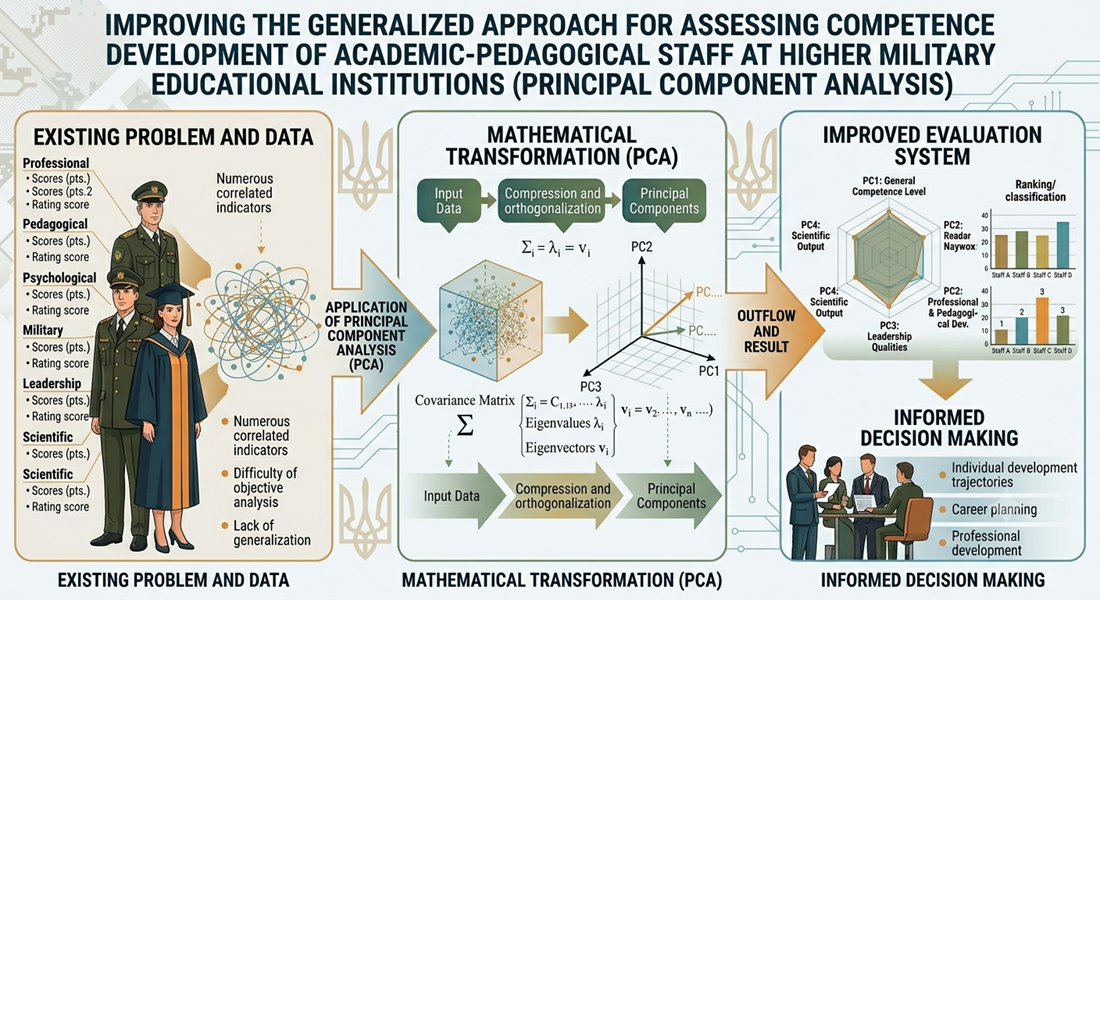
This work assesses the level of competencies development by the scientific and pedagogical workers at higher military educational institutions.
The task addressed is the need to increase objectivity and accuracy in assessing the level of development of the competencies of scientific and pedagogical workers at higher military educational institutions.
Within the framework of this study, a generalized approach to assessing the level of development of the competencies of scientific and pedagogical workers at higher military educational institutions includes a methodology and an assessment procedure.
The methodology for assessing the level of development of the competencies of scientific and pedagogical workers at higher military educational institutions has been improved by applying the principal component method to it.
That has made it possible, in contrast to conventional methodologies based on simple averaging of assessment results, to eliminate multicollinearity, ensure maximum objectivity and accuracy in assessing the level of development of the competencies of scientific and pedagogical workers at higher military educational institutions.
It is proven that ignoring internal correlations leads to the loss of important information and a biased assessment of the level of development of the competencies of scientific and pedagogical workers at higher military educational institutions.
The procedure for assessing the level of development of the competencies of scientific and pedagogical workers at higher military educational institutions has been improved, which is based on an improved methodology, which made it possible to increase the objectivity and accuracy of the assessment by 16.6%.
It has been confirmed that taking into account the sources of origin of the competencies of scientific and pedagogical workers at higher military educational institutions is an important component for their objective and accurate assessment.
The practical significance of the improved approach to assessing the level of development of competencies in the activities of personnel services at higher military educational institutions has been determined
References
- Maistrenko, O., Artamoshchenko, V., Petushkov, V., Shcherba, A., Balandin, M., Stetsiv, S. et al. (2022). Improving the methodological approach to determining the number of postpostgraduates planned for admission. Eastern-European Journal of Enterprise Technologies, 3 (3 (117)), 43–56. https://doi.org/10.15587/1729-4061.2022.259707
- Matviishyn, Ye. H., Mylyanyk, R. V. (2023). Evaluating the development of managerial competencies through the prism of the organization’s performance. Efficiency of Public Administration, 70/71, 73–79. https://doi.org/10.36930/507010
- Vynokurov, D. (2022). Methodological approach for assessing the level of competence of the variable composition of a training center. Modern Information Technologies in the Sphere of Security and Defence, 44 (2), 69–73. https://doi.org/10.33099/2311-7249/2022-44-2-69-73
- Pravdyvets, O. (2025). Justification of the choice of indicators and criteria for assessing the qualifications of military accounting inspectors. Ukrainian Journal of Applied Economics and Technology, 2025 (2), 353–358. https://doi.org/10.36887/2415-8453-2025-2-69
- Pushkarova, Y. (2025). Diagnostic tools for research competence in pharmaceutical education. Scientific Works of Interregional Academy of Personnel Management. Pedagogical sciences, 3 (66), 61–66. https://doi.org/10.32689/maup.ped.2025.3.10
- Gorodianska, L. V. (2024). Modeling and assessment of renewal level of person’s competence potential. Journal of Strategic Economic Research, 2, 74–92. https://doi.org/10.30857/2786-5398.2024.2.8
- Kulikov, O. (2023). Judge performance indicator evaluation system: improvement continues. Uzhhorod National University Herald. Series: Law, 2 (79), 276–284. https://doi.org/10.24144/2307-3322.2023.79.2.43
- Hlushak, O., Semeniaka, S., Zinchenko, N., Solomko, V. (2025). Assessment of stability factors of information security systems using regression analysis methods. Cybersecurity: Education, Science, Technique, 3 (31), 333. https://doi.org/10.28925/2663-4023.2025.31.1023
- Greenacre, M., Groenen, P. J. F., Hastie, T., D’Enza, A. I., Markos, A., Tuzhilina, E. (2022). Principal component analysis. Nature Reviews Methods Primers, 2 (1). https://doi.org/10.1038/s43586-022-00184-w
- Bakhrushyn, V. Ye. (2011). Metody analizu danykh. Zaporizhzhia: KPU, 268. Available at: http://elib.chdtu.edu.ua/e-books/4122
- Sysoliatin, D. I. (2925). Decomposition of competencies of academic staff with consideration of contemporary requirements. Science and Defense, 3, 53–61. https://doi.org/10.33099/2618-1614-2025-30-3-53-61
- Maistrenko, O., Khoma, V., Kurban, V., Mozghova, Y., Voitenko, S., Babych, O. et al. (2025). Improvement of the approach to choosing the optimal strategy for assessing a military serviceman. Eastern-European Journal of Enterprise Technologies, 3 (3 (135)), 37–48. https://doi.org/10.15587/1729-4061.2025.329088
- Kalkbrenner, M. T. (2024). Choosing Between Cronbach’s Coefficient Alpha, McDonald’s Coefficient Omega, and Coefficient H : Confidence Intervals and the Advantages and Drawbacks of Interpretive Guidelines. Measurement and Evaluation in Counseling and Development, 57 (2), 93–105. https://doi.org/10.1080/07481756.2023.2283637
- Maistrenko, O., Khoma, V., Shcherba, A., Olshevskyi, Y., Pereverzin, Y., Popkov, O. et al. (2022). Improving a procedure for determining the factors that influence the need of higher education institutions for specialists of the highest qualification. Eastern-European Journal of Enterprise Technologies, 1 (3 (115)), 86–96. https://doi.org/10.15587/1729-4061.2022.251027
- Gordiienko-Mytrofanova, I., Pidchasov, Y., Sauta, S., Kobzieva, I. (2018). The problem of sample representativeness for conducting experimental and broad psychological research. Psycholinguistics, 23 (1), 11–46. https://doi.org/10.5281/zenodo.1212360
- Boxplotanalyse in Excel: Schnell und Einfache Anleitung. Available at: https://www.tutkit.com/de/text-tutorials/4182-boxplotanalyse-in-excel-schnell-und-einfache-anleitung#google_vignette
- Statystychni kryteriyi vyiavlennia hrubykh pomylok. Available at: http://ebooks.git-elt.hneu.edu.ua/babap/2-4-id2-4.html
- Kryteriyi perevirky vidpovidnosti normalnomu zakonu rozpodilu. Available at: https://biem.sumdu.edu.ua/images/stories/docs/NC/NMS/15_04_2011.pdf
- Perevirka normalnosti vybirky za dopomohoiu kryteriu Kolmohorova-Smyrnova z vykorystanniam paketa SPSS. Available at: https://lib.chmnu.edu.ua/pdf/posibnuku/210/26.pdf
- Shcho take hrafik Q-Q dlia riznykh rozpodiliv? Available at: https://hash.kozak.cx.ua/ukraincyam/shho-take-grafik-q-q-dlya-riznikh-rozpodiliv.html
- Begun, S., Sakharuk, M. (2020). Multicoll inearity and its influence on the estimation of model parameters. Young Scientist, 4 (80). https://doi.org/10.32839/2304-5809/2020-4-80-56
- Renichenko, Ye. O. (2021). Perevirka prypushchennia pro nezalezhnist ta normalnyi rozpodil vypadkovoi velychyny v modeli tsinoutvorennia na osnovnyi kapital. Available at: https://ekmair.ukma.edu.ua/bitstreams/8f14a90f-be07-4876-8839-ed7264555345/download
- Yakovlyev, M. (2010). Factor analysis of causes of social and political tranformations in bertelsmann transformation index 2010. Naukovi zapysky, 108, 12–16. Available at: https://ekmair.ukma.edu.ua/bitstreams/8b5fdc02-e01c-4568-af90-12ba4e4d349c/download
- Shcho take KMO i proba Bartletta? Available at: https://bishche.figa.cx.ua/maysternist/shho-take-kmo-i-proba-bartletta.html
- Chudakova, V. (2024). Realization of correlation analysis, construction of a “correlation matrix” and “correlation pleiades”, features of the relationship and interdependence of the empirical data of the study “priority of psychological competence of the competitiveness of the individual” (according to the methodology of V. Chudakova), based on the results of mathematical and statistical analysis using the SPSS program, digital and STEM methods (part 16). Education and Development of Gifted Personality, 3 (94), 69–85. https://doi.org/10.32405/2309-3935-2024-3(94)-69-85
- Sun, R., Ma, T., Liu, S., Sathye, M. (2019). Improved Covariance Matrix Estimation for Portfolio Risk Measurement: A Review. Journal of Risk and Financial Management, 12 (1), 48. https://doi.org/10.3390/jrfm12010048
- Bytsiura, L. (2020). Formuvannia stratehiyi enerhoefektyvnosti na pidpryiemstvi. Ternopil. Available at: https://dspace.wunu.edu.ua/bitstream/316497/41388/1/dis%20bytsiura.pdf
- Braeken, J., van Assen, M. A. L. M. (2017). An empirical Kaiser criterion. Psychological Methods, 22 (3), 450–466. https://doi.org/10.1037/met0000074
- Klymchuk, V. O. (2006). Faktornyi analiz: vykorystannia u psykholohichnykh doslidzhenniakh. Praktychna psykholohiya ta sotsialna robota, 8, 43–48. Available at: https://eprints.zu.edu.ua/4128/1/8.pdf
- Dlia choho vykorystovuietsia kiltseva diahrama? Available at: https://studfile.net/preview/7404159/page:2/
Downloads
Published
How to Cite
Issue
Section
License
Copyright (c) 2026 Oleksandr Maistrenko, Denys Sysolyatin, Volodymyr Kurban, Oleksandr Karavanov, Serhii Voitenk, Olha Babуch, Andrii Diakov, Oleksandr Lykholot, Serhii Horbenko, Nataliia Rusenko

This work is licensed under a Creative Commons Attribution 4.0 International License.
The consolidation and conditions for the transfer of copyright (identification of authorship) is carried out in the License Agreement. In particular, the authors reserve the right to the authorship of their manuscript and transfer the first publication of this work to the journal under the terms of the Creative Commons CC BY license. At the same time, they have the right to conclude on their own additional agreements concerning the non-exclusive distribution of the work in the form in which it was published by this journal, but provided that the link to the first publication of the article in this journal is preserved.
A license agreement is a document in which the author warrants that he/she owns all copyright for the work (manuscript, article, etc.).
The authors, signing the License Agreement with TECHNOLOGY CENTER PC, have all rights to the further use of their work, provided that they link to our edition in which the work was published.
According to the terms of the License Agreement, the Publisher TECHNOLOGY CENTER PC does not take away your copyrights and receives permission from the authors to use and dissemination of the publication through the world's scientific resources (own electronic resources, scientometric databases, repositories, libraries, etc.).
In the absence of a signed License Agreement or in the absence of this agreement of identifiers allowing to identify the identity of the author, the editors have no right to work with the manuscript.
It is important to remember that there is another type of agreement between authors and publishers – when copyright is transferred from the authors to the publisher. In this case, the authors lose ownership of their work and may not use it in any way.








