Designing a toolkit for assessing the financial and investment potential of enterprises for the implementation of energy saving measures
DOI:
https://doi.org/10.15587/1729-4061.2026.364237Keywords:
financial and investment potential, energy saving at the enterprise, personnel competence, energy-saving projectAbstract
This work assesses the financial and investment potential of enterprises for implementing energy-saving measures. The task addressed is to design an effective toolset for such an assessment. This study has made it possible to contribute to solving this task.
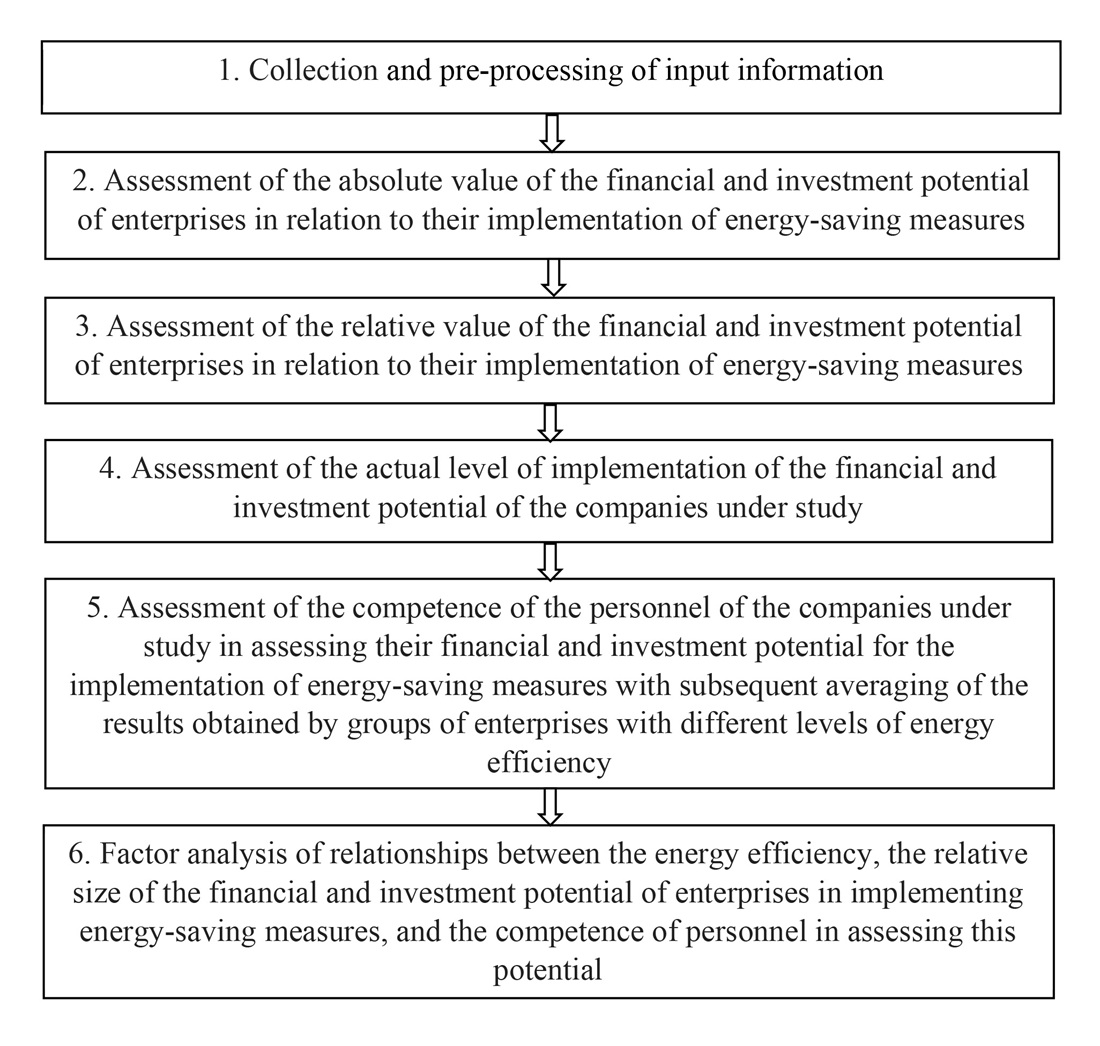
Specifically, components in the financial and investment potential of enterprises in implementing energy-saving measures have been identified. Indicators for assessing the specified potential and its components were constructed. It was proposed to carry out such an assessment in several stages using an optimization approach.
The designed toolset was tested on a sample of 105 enterprises belonging to three energy-intensive industries. The financial and investment potential of the studied enterprises in implementing energy-saving measures was assessed. It was established that the main limiting factor of the magnitude of this potential is its financial component. The level of use of this potential by the studied companies was calculated. It was found that this level for enterprises with high energy intensity of production varies by industry from 37.19% to 44.29%. It was found that with increasing energy efficiency, the size of the financial and investment potential of the studied enterprises for their implementation of energy-saving measures decreases but the level of realization of this potential increases.
The proposed toolkit is suitable for use both at the level of individual companies and at the industry level. Its application could allow company managers to more reasonably approach the development of financial and investment strategies for implementing energy-saving measures
References
- Klymash, N., Bagatska, K., Melnychuk, O., Zhuk, O., Kondratiuk, O., Edeh, F. O. (2026). Determinants of investment potential in the context of ensuring the economic sustainability of enterprises. Naukovyi Visnyk Natsionalnoho Hirnychoho Universytetu, 2, 167–175. https://doi.org/10.33271/nvngu/2026-2/167
- Prokhorova, V., Yemelyanov, O., Koleshchuk, O., Mnykh, O., Us, Y. (2024). Development of tools for assessing the impact of logistics communications on investment activities of enterprises in the context of capital movement. Eastern-European Journal of Enterprise Technologies, 3 (13 (129)), 34–45. https://doi.org/10.15587/1729-4061.2024.304257
- Krylovskyi, V. (2024). Increasing the financial potential of investment activity of business entities. Economics, Entrepreneurship, Management, 11 (1), 65–76. https://doi.org/10.56318/eem2024.02.065
- Yurkiv, R. (2021). Formation and use of financial potential of investment activity of small enterprises. Three Seas Economic Journal, 2 (1), 104–109. https://doi.org/10.30525/2661-5150/2021-1-17
- Yepifanova, I., Dzhedzhula, V., Kosaruk, O., Saulyak, A. (2022). Management of the investment potential of food industry enterprises. Innovation and Sustainability, 2, 8–17. https://doi.org/10.31649/ins.2022.2.8.17
- Yemelyanov, O., Petrushka, T., Koleshchuk, O., Petrushka, K., Dzhedzhula, V. (2026). Impact of Energy-Saving Technological Changes on the Level of Competitiveness of Enterprises. Data-Centric Business and Applications, 267–284. https://doi.org/10.1007/978-3-032-06608-4_14
- Backman, F. (2017). Barriers to Energy Efficiency in Swedish Non-Energy-Intensive Micro- and Small-Sized Enterprises – A Case Study of a Local Energy Program. Energies, 10 (1), 100. https://doi.org/10.3390/en10010100
- Valencik, R., Cervenka, J. (2016). Analysis Tools of Connecting Investment Opportunities and Investment Means in the Area of Small and Medium-Sized Enterprises. European Research Studies Journal, XIX (4), 130–139. https://doi.org/10.35808/ersj/586
- Yepifanova, I., Dzhedzhula, V. (2020). Methodology of evaluation of innovative potential of enterprises. Agricultural and Resource Economics: International Scientific E-Journal, 6 (3), 171–190. https://doi.org/10.51599/are.2020.06.03.10
- Prokhorova, V., Mrykhina, O., Koleshchuk, O., Slastianykova, K., Harmatiy, M. (2023). The holistic evaluation system of R&D results under the circular economy conditions. Eastern-European Journal of Enterprise Technologies, 6 (13 (126)), 15–23. https://doi.org/10.15587/1729-4061.2023.291380
- Zalutska, K., Morklyanyk, B., Balanyuk, Y., Maslak, T., Malyk, M. (2025). Conceptual principles for building a balanced and competitive development portfolio for a diversified enterprise. Technology Audit and Production Reserves, 4 (4 (84)), 30–38. https://doi.org/10.15587/2706-5448.2025.336245
- Laitner, J. A. (2013). An overview of the energy efficiency potential. Environmental Innovation and Societal Transitions, 9, 38–42. https://doi.org/10.1016/j.eist.2013.09.005
- Feng, C., Wang, M. (2017). Analysis of energy efficiency and energy savings potential in China’s provincial industrial sectors. Journal of Cleaner Production, 164, 1531–1541. https://doi.org/10.1016/j.jclepro.2017.07.081
- Zhou, N., Khanna, N., Feng, W., Ke, J., Levine, M. (2018). Scenarios of energy efficiency and CO2 emissions reduction potential in the buildings sector in China to year 2050. Nature Energy, 3 (11), 978–984. https://doi.org/10.1038/s41560-018-0253-6
- Yemelyanov, O., Petrushka, I., Zahoretska, O., Petrushka, K., Havryliak, A. (2023). Information support for managing energy-saving technological changes at enterprises. Procedia Computer Science, 217, 258–267. https://doi.org/10.1016/j.procs.2022.12.221
- Prokhorova, V. V., Yemelyanov, O. Y., Koleshchuk, O. Y., Antonenko, N. S., Zaitseva, A. S. (2023). Information support for management of energy-saving economic development of enterprises. Naukovyi Visnyk Natsionalnoho Hirnychoho Universytetu, 6, 175–183. https://doi.org/10.33271/nvngu/2023-6/175
- Yemelyanov, O., Petrushka, T., Koleshchuk, O., Petrushka, K., Mashkovskyi, M. (2026). The Impact of the Level of Information Support for Technological Change Management on the Scope, Speed, and Effectiveness of Its Implementation in Enterprises. Procedia Computer Science, 277, 948–957. https://doi.org/10.1016/j.procs.2026.02.135
- Solnørdal, M., Foss, L. (2018). Closing the Energy Efficiency Gap – A Systematic Review of Empirical Articles on Drivers to Energy Efficiency in Manufacturing Firms. Energies, 11 (3), 518. https://doi.org/10.3390/en11030518
- Chen, Y.-S. (2007). The Driver of Green Innovation and Green Image – Green Core Competence. Journal of Business Ethics, 81 (3), 531–543. https://doi.org/10.1007/s10551-007-9522-1
- Klemke-Pitek, M., Majchrzak, M. (2022). Pro-Ecological Activities and Shaping the Competitive Advantage of Small and Medium-Sized Enterprises in the Aspect of Sustainable Energy Management. Energies, 15 (6), 2192. https://doi.org/10.3390/en15062192
- König, W., Löbbe, S., Büttner, S., Schneider, C. (2020). Establishing Energy Efficiency – Drivers for Energy Efficiency in German Manufacturing Small- and Medium-Sized Enterprises. Energies, 13 (19), 5144. https://doi.org/10.3390/en13195144
- Angori, G., Aristei, D. (2018). A Panel Data Analysis of Firms’ Access to Credit in the Euro Area: Endogenous Selection, Individual Heterogeneity and Time Persistence. SSRN Electronic Journal. https://doi.org/10.2139/ssrn.3254358
- Rostamkalaei, A., Freel, M. (2015). The cost of growth: small firms and the pricing of bank loans. Small Business Economics, 46 (2), 255–272. https://doi.org/10.1007/s11187-015-9681-x
- Bhalli, M. T., Hashmi, S. M., Majeed, A. (2017). Impact of Credit Constraints on Firms Growth: A Case Study of Manufacturing Sector of Pakistan. Journal of Quantitative Methods, 1 (1), 4–40. https://doi.org/10.29145/2017/jqm/010102
- Prokhorova, V. V., Yemelyanov, O. Y., Koleshchuk, O. Y., Petrushka, K. I. (2023). Tools for assessing obstacles in implementation of energy saving measures by enterprises. Naukovyi Visnyk Natsionalnoho Hirnychoho Universytetu, 1, 160–168. https://doi.org/10.33271/nvngu/2023-1/160
- Dong, J., Huo, H. (2017). Identification of Financing Barriers to Energy Efficiency in Small and Medium-Sized Enterprises by Integrating the Fuzzy Delphi and Fuzzy DEMATEL Approaches. Energies, 10 (8), 1172. https://doi.org/10.3390/en10081172
Downloads
Published
How to Cite
Issue
Section
License
Copyright (c) 2026 Viktoriia Prokhorova, Olexandr Yemelyanov, Orest Koleshchuk, Svitlana Shepelenko, Krystyna Slastianykova, Dmytro Havras

This work is licensed under a Creative Commons Attribution 4.0 International License.
The consolidation and conditions for the transfer of copyright (identification of authorship) is carried out in the License Agreement. In particular, the authors reserve the right to the authorship of their manuscript and transfer the first publication of this work to the journal under the terms of the Creative Commons CC BY license. At the same time, they have the right to conclude on their own additional agreements concerning the non-exclusive distribution of the work in the form in which it was published by this journal, but provided that the link to the first publication of the article in this journal is preserved.
A license agreement is a document in which the author warrants that he/she owns all copyright for the work (manuscript, article, etc.).
The authors, signing the License Agreement with TECHNOLOGY CENTER PC, have all rights to the further use of their work, provided that they link to our edition in which the work was published.
According to the terms of the License Agreement, the Publisher TECHNOLOGY CENTER PC does not take away your copyrights and receives permission from the authors to use and dissemination of the publication through the world's scientific resources (own electronic resources, scientometric databases, repositories, libraries, etc.).
In the absence of a signed License Agreement or in the absence of this agreement of identifiers allowing to identify the identity of the author, the editors have no right to work with the manuscript.
It is important to remember that there is another type of agreement between authors and publishers – when copyright is transferred from the authors to the publisher. In this case, the authors lose ownership of their work and may not use it in any way.








