Construction of mathematical models of heat exchange in semi-infinite environments with foreign inclusions
DOI:
https://doi.org/10.15587/1729-4061.2026.364576Keywords:
temperature field, thermal conductivity of the material, thermal stability of structures, convective heat transfer, heat flowAbstract
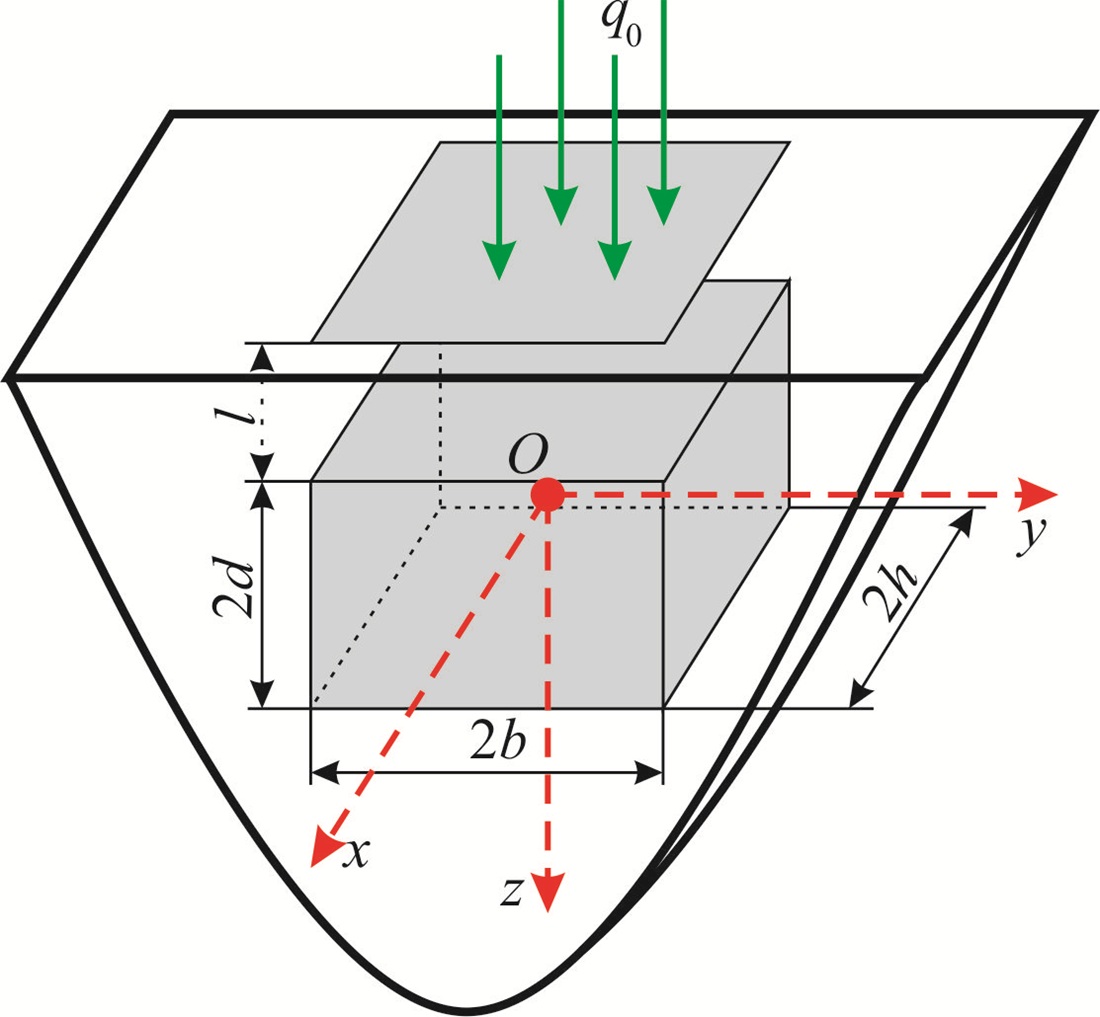
This study investigates heat transfer processes in isotropic semi-infinite 3D media with foreign inclusions, which are heated by internal sources and heat flow.
As a result of the thermal load during the operation of devices, significant temperature gradients arise. To analyze the temperature regimes and establish the effective operation of these devices, mathematical models for determining temperature fields have been constructed.
Based on the stated boundary value problems of thermal conductivity, their analytical solutions have been derived, which make it possible to obtain the temperature distribution and the behavior of temperature gradients in a heterogeneous medium. Using these solutions, numerical calculations of the temperature distribution in spatial coordinates for given geometric and thermophysical parameters have been performed.
For an effective description of the thermophysical parameters of heterogeneous semi-infinite 3D media, a symmetric unit function and the Dirac delta function have been used. As a result, second-order differential equations with partial derivatives and singular coefficients have been derived.
The numerical results reflect the temperature distribution in semi-infinite 3D media in spatial coordinates for the given geometric and thermophysical parameters. The numerical values of temperature for the selected half-space material (ceramics VK94-I) and inclusions (silicon, molybdenum) were obtained with an accuracy of 10-6.
The application of the constructed mathematical models of heat transfer contributes to investigating the thermal stability in semi-infinite 3D media with foreign inclusions. Using these models makes it possible to predict temperature regimes in devices, which is a prerequisite for improving their reliability and durability
References
- Yang, W., Zhou, Q., Zhai, Y., Lyu, D., Huang, Y., Wang, J. et al. (2019). Semi-analytical solution for steady state heat conduction in a heterogeneous half space with embedded cuboidal inhomogeneity. International Journal of Thermal Sciences, 139, 326–338. https://doi.org/10.1016/j.ijthermalsci.2019.02.019
- Wang, L., Guo, J., Wang, J. (2023). A continuum mixture model for transient heat conduction in multi-phase composites. International Journal of Engineering Science, 193, 103934. https://doi.org/10.1016/j.ijengsci.2023.103934
- Yang, W., Xiong, C., Zhou, Q., Huang, Y., Wang, J., Zhu, J. et al. (2020). Effects of friction heating on a half space involving ellipsoidal inclusions with non-uniform eigentemperature gradients. International Journal of Thermal Sciences, 151, 106278. https://doi.org/10.1016/j.ijthermalsci.2020.106278
- Ecsedi, I., Lengyel, Á. J. (2022). Neutral Inhomogeneities in a Two-dimensional Steady-state Heat Conduction Problem. Wseas Transactions on Heat and Mass Transfer, 17, 136–140. https://doi.org/10.37394/232012.2022.17.15
- Krysko, A., Awrejcewicz, J., Bodyagina, K., Makseev, A., Zhigalov, M., Krysko, V. (2021). Identifying inclusions in a non-uniform thermally conductive plate under external flows and internal heat sources using topological optimization. Mathematics and Mechanics of Solids, 27 (9), 1649–1671. https://doi.org/10.1177/10812865211048522
- Wu, C., Wang, T., Yin, H. (2025). Eshelby’s inclusion and inhomogeneity problems under harmonic heat transfer. Proceedings of the Royal Society A: Mathematical, Physical and Engineering Sciences, 481 (2318). https://doi.org/10.1098/rspa.2024.0824
- Ding, G., Li, P., Luo, X., Zhou, Q., Zhu, H., Zhang, Q., Liu, Y. (2025). Semi-analytical method for thermal field analysis of multiple arbitrarily shaped inhomogeneities in heterogeneous geological media. Computers & Geosciences, 205, 106025. https://doi.org/10.1016/j.cageo.2025.106025
- Çetin, B., Kuşcu, Y. F., Çetin, B., Tümüklü, Ö., Cole, K. D. (2021). Semi-analytical source (SAS) method for 3-D transient heat conduction problems with moving heat source of arbitrary shape. International Journal of Heat and Mass Transfer, 165, 120692. https://doi.org/10.1016/j.ijheatmasstransfer.2020.120692
- Channouf, S., Benhamou, J., Jami, M. (2024). Investigating convective and conductive heat transfer in square and circular heated bodies: A novel approach using coupled Runge-Kutta and lattice Boltzmann method. Thermal Science and Engineering Progress, 49, 102441. https://doi.org/10.1016/j.tsep.2024.102441
- Łach, Ł., Svyetlichnyy, D. (2025). Advances in Numerical Modeling for Heat Transfer and Thermal Management: A Review of Computational Approaches and Environmental Impacts. Energies, 18 (5), 1302. https://doi.org/10.3390/en18051302
- Zhang, Z., Zhou, D., Fang, H., Zhang, J., Li, X. (2021). Analysis of layered rectangular plates under thermo-mechanical loads considering temperature-dependent material properties. Applied Mathematical Modelling, 92, 244–260. https://doi.org/10.1016/j.apm.2020.10.036
- Brociek, R., Hetmaniok, E., Słota, D. (2024). Numerical Solution for the Heat Conduction Model with a Fractional Derivative and Temperature-Dependent Parameters. Symmetry, 16 (6), 667. https://doi.org/10.3390/sym16060667
- Havrysh, V. І. (2015). Nonlinear Boundary-Value Problem of Heat Conduction for a Layered Plate with Inclusion. Materials Science, 51 (3), 331–339. https://doi.org/10.1007/s11003-015-9846-4
- Havrysh, V., Kochan, V. (2023). Mathematical Models to Determine Temperature Fields in Heterogeneous Elements of Digital Devices with Thermal Sensitivity Taken into Account. 2023 IEEE 12th International Conference on Intelligent Data Acquisition and Advanced Computing Systems: Technology and Applications (IDAACS), 983–991. https://doi.org/10.1109/idaacs58523.2023.10348875
- Havrysh, V., Kolyasa, L. (2026). Mathematical modeling and analysis of heat transfer in structures with foreign elements. Naukovyi Visnyk Natsionalnoho Hirnychoho Universytetu, 1, 34–42. https://doi.org/10.33271/nvngu/2026-1/034
- Havrysh, V., Ivasyk, H., Kolyasa, L., Ovchar, I., Pelekh, Y., Bilas, O. (2017). Examining the temperature fields in flat piecewise- uniform structures. Eastern-European Journal of Enterprise Technologies, 2 (5 (86)), 23–32. https://doi.org/10.15587/1729-4061.2017.97272
Downloads
Published
How to Cite
Issue
Section
License
Copyright (c) 2026 Vasyl Havrysh, Svitlana Yatsyshyn, Halyna Klym, Mykhailo Stepaniak, Mihaylo Klymiuk

This work is licensed under a Creative Commons Attribution 4.0 International License.
The consolidation and conditions for the transfer of copyright (identification of authorship) is carried out in the License Agreement. In particular, the authors reserve the right to the authorship of their manuscript and transfer the first publication of this work to the journal under the terms of the Creative Commons CC BY license. At the same time, they have the right to conclude on their own additional agreements concerning the non-exclusive distribution of the work in the form in which it was published by this journal, but provided that the link to the first publication of the article in this journal is preserved.
A license agreement is a document in which the author warrants that he/she owns all copyright for the work (manuscript, article, etc.).
The authors, signing the License Agreement with TECHNOLOGY CENTER PC, have all rights to the further use of their work, provided that they link to our edition in which the work was published.
According to the terms of the License Agreement, the Publisher TECHNOLOGY CENTER PC does not take away your copyrights and receives permission from the authors to use and dissemination of the publication through the world's scientific resources (own electronic resources, scientometric databases, repositories, libraries, etc.).
In the absence of a signed License Agreement or in the absence of this agreement of identifiers allowing to identify the identity of the author, the editors have no right to work with the manuscript.
It is important to remember that there is another type of agreement between authors and publishers – when copyright is transferred from the authors to the publisher. In this case, the authors lose ownership of their work and may not use it in any way.








