Determining the optimal oxidation temperature of non-isothermal liquid fuels injections using modeling based on statistical droplet distribution
DOI:
https://doi.org/10.15587/1729-4061.2024.316100Keywords:
liquid fuel, atomization, combustion, emissions, single-hole injection, thermal enginesAbstract
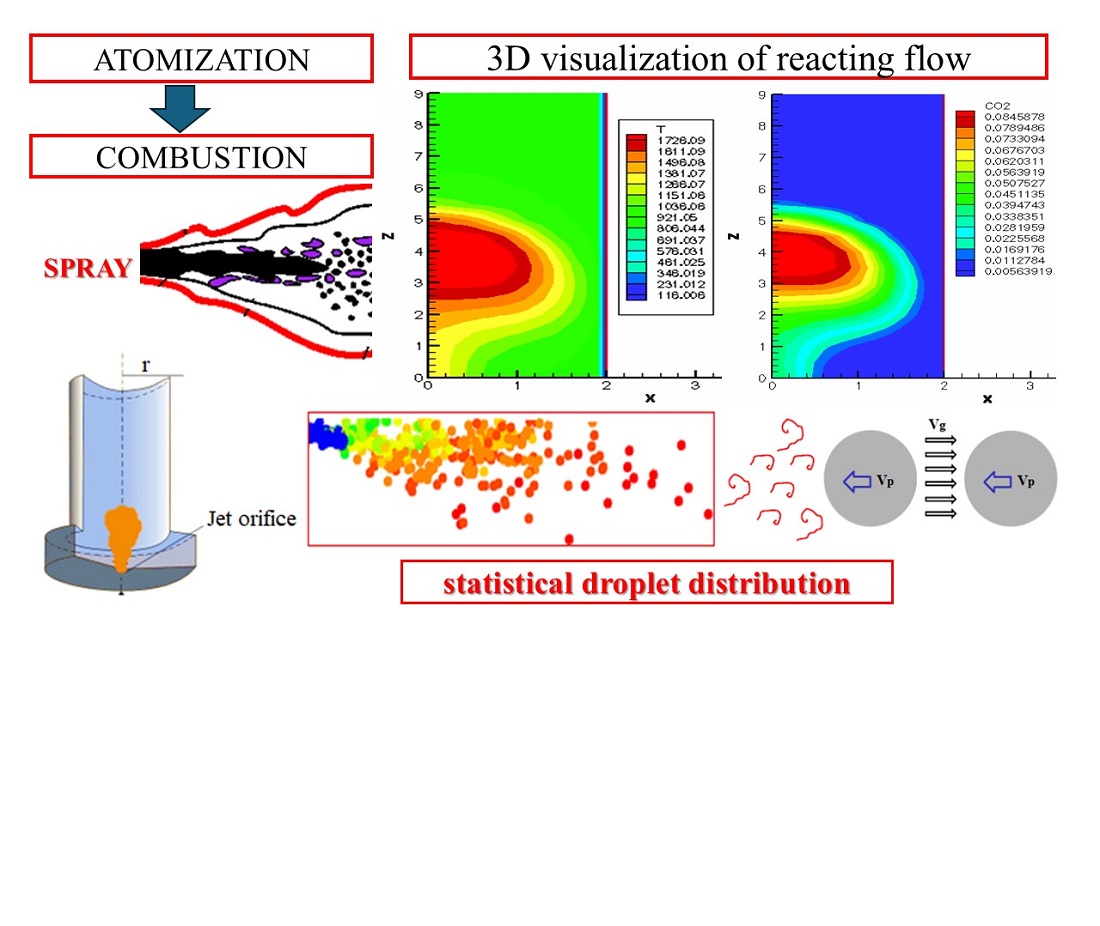
Single-hole injections of liquid hydrocarbon fuels (isooctane and dodecane) under high turbulence have been investigated using direct numerical simulation based on the statistical model considering the droplets’ atomization, distribution, and combustion. The study objects are the heat and mass transfer processes during atomization and combustion of liquid fuels injections within the combustion chambers of thermal engines. The temperature and carbon dioxide concentration distributions of the fuel-air mixture, the distributions of the droplets, their velocities, and the Sauter mean radius within the isooctane and dodecane oxidation in the engine’s combustion space were obtained. An investigation of the oxidizer’s initial temperature influence on the droplets’ atomization and combustion processes showed that the optimal temperature for both fuels is 900 K. The obtained modeling results were confirmed in good agreement with theoretical and experimental data.
Thanks to the integrated use of approaches from statistical theory, numerical algorithms and 3D computer modeling techniques, the results obtained are distinguished by high accuracy, efficiency in reducing computational resources, scientific novelty in the type of droplet atomization and suitability for practical application for technological solutions not only for single-hole, but also for multi-hole injections of liquid fuels and studying the jet-to-jet interaction phenomena.
The obtained research results can be applied in miscellaneous internal combustion engines development with different atomization types, which will allow us to contemporaneously settle the concerns of streamlining the combustion process, improving the completeness of fuel combustion and reducing emissions of harmful substances
References
- Messerle, V. E., Askarova, A. S., Bolegenova, S. A., Yu Maximov, V., Nugymanova, A. O. (2019). 3D-modelling of Kazakhstan low-grade coal burning in power boilers of thermal power plant with application of plasma gasification and stabilization technologies. Journal of Physics: Conference Series, 1261 (1), 012022. https://doi.org/10.1088/1742-6596/1261/1/012022
- Mislyuk, O., Khomenko, E., Yehorova, O., Zhytska, L. (2023). Assessing risk caused by atmospheric air pollution from motor vehicles to the health of population in urbanized areas. Eastern-European Journal of Enterprise Technologies, 1 (10 (121)), 19–26. https://doi.org/10.15587/1729-4061.2023.274174
- Zaporozhets, O., Synylo, K., Karpenko, S., Krupko, A. (2021). Improvementof the computer model of air pollution estimation due to emissions of stationary sources of airports and compressor stations. Eastern-European Journal of Enterprise Technologies, 3 (10 (111)), 54–64. https://doi.org/10.15587/1729-4061.2021.236125
- Bolegenova, S. A. (2024). Simulation of liquid fuel spray formation and distribution in a reacting turbulent flow. Eurasian Physical Technical Journal, 21 (2 (48)), 22–30. https://doi.org/10.31489/2024no2/22-30
- Ritchie, H., Roser, M. (2022). Our World in Data. Kazakhstan: CO2 Country Profile. Available at: https://ourworldindata.org/co2/country/kazakhstan
- Kazakhstan Greenhouse Gas (GHG) Emissions 1990-2024. Available at: https://www.macrotrends.net/global-metrics/countries/KAZ/kazakhstan/ghg-greenhouse-gas-emissions
- Ecological indicators of environmental monitoring and assessment. Bureau of National Statistics of the Agency for Strategic planning and reforms of the Republic of Kazakhstan. Available at: https://stat.gov.kz/en/ecologic-indicators/28463/greenhouse_gas_emissions/
- Statistics of environment. Key indicators. Bureau of National Statistics of the Agency for Strategic planning and reforms of the Republic of Kazakhstan. Available at: https://stat.gov.kz/en/industries/environment/stat-eco/
- Аskarova, А., Bolegenova, S., Маximov, V., Bekmukhamet, A., Gabitova, Z., Beketayeva, М. (2014). Control of Harmful Emissions Concentration into the Atmosphere of Megacities of Kazakhstan Republic. IERI Procedia, 10, 252–258. https://doi.org/10.1016/j.ieri.2014.09.085
- Bolegenova, S., Askarova, A., Ospanova, S., Zhumagaliyeva, S., Makanova, A., Aldiyarova, A. et al. (2024). Technology of reducing greenhouse gas emissions for decarbonization and decreasing anthropogenic pressure on the environment. Physical Sciences and Technology, 11 (1-2), 64–75. https://doi.org/10.26577/phst2024v11i1a8
- Reitz, R. D. (1987). Modeling atomization processes in high-pressure vaporizing sprays. Atomization and Spray Technology, 3, 309–337. Available at: https://uwmadison.app.box.com/v/AandS
- Villermaux, E. (2007). Fragmentation. Annual Review of Fluid Mechanics, 39 (1), 419–446. https://doi.org/10.1146/annurev.fluid.39.050905.110214
- Yi, Y., Reitz, R. D. (2004). Modeling the primary breakup of high-speed jets. Atomization and Sprays, 14 (1), 53–80. https://doi.org/10.1615/atomizspr.v14.i1.40
- Tanner, F. X. (2004). Development and validation of a cascade atomization and drop breakup model for high-velocity dense sprays. Atomization and Sprays, 14 (3), 211–242. https://doi.org/10.1615/atomizspr.v14.i3.20
- Anez, J., Ahmed, A., Hecht, N., Duret, B., Reveillon, J., Demoulin, F. X. (2019). Eulerian-Lagrangian spray atomization model coupled with interface capturing method for diesel injectors. International Journal of Multiphase Flow, 113, 325–342. https://doi.org/10.1016/j.ijmultiphaseflow.2018.10.009
- Arcoumanis, C., Gavaises, M. (1998). Linking nozzle flow with spray characteristics in a diesel fuel injection system. Atomization and Sprays, 8 (3), 307–347. https://doi.org/10.1615/atomizspr.v8.i3.50
- Andriotis, A., Gavaises, M., Arcoumanis, C. (2008). Vortex flow and cavitation in diesel injector nozzles. Journal of Fluid Mechanics, 610, 195–215. https://doi.org/10.1017/s0022112008002668
- Andriotis, A., Gavaises, M. (2009). Influence of vortex flow and cavitation on near-nozzle diesel spray dispersion angle. Atomization and Sprays, 19 (3), 247–261. https://doi.org/10.1615/atomizspr.v19.i3.30
- Berezovskaya, I. E. (2023). Investigation of the influence of liquid fuel injection rate on the combustion process using KIVA-II software. Eurasian Physical Technical Journal, 20(3(45)), 43–51. https://doi.org/10.31489/2023no3/43-51
- Gorokhovski, M. A., Oruganti, S. K. (2021). Stochastic models for the droplet motion and evaporation in under-resolved turbulent flows at a large Reynolds number. Journal of Fluid Mechanics, 932. https://doi.org/10.1017/jfm.2021.916
- Han, Z., Fan, L., Reitz, R. D. (1997). Multidimensional Modeling of Spray Atomization and Air-Fuel Mixing in a Direct-Injection Spark-Ignition Engine. SAE Technical Paper Series. https://doi.org/10.4271/970884
- Khan, M. M., Hélie, J., Gorokhovski, M. (2018). Computational methodology for non-evaporating spray in quiescent chamber using Large Eddy Simulation. International Journal of Multiphase Flow, 102, 102–118. https://doi.org/10.1016/j.ijmultiphaseflow.2018.01.025
- Dhande, D. Y., Sinaga, N., Dahe, K. B. (2021). Study on combustion, performance and exhaust emissions of bioethanol-gasoline blended spark ignition engine. Heliyon, 7 (3), e06380. https://doi.org/10.1016/j.heliyon.2021.e06380
- Sahoo, S., Srivastava, D. K. (2023). Numerical analysis of performance, combustion, and emission characteristics of PFI gasoline, PFI CNG, and DI CNG engine. Energy, 278, 127749. https://doi.org/10.1016/j.energy.2023.127749
- Askarova, A., Bolegenova, S., Ospanova, Sh., Slavinskaya, N., Aldiyarova, A., Ungarova, N. (2021). Simulation of non-isothermal liquid sprays under large-scale turbulence. Physical Sciences and Technology, 8 (2). https://doi.org/10.26577/phst.2021.v8.i2.04
- Chang, M., Kim, H., Zhou, B., Park, S. (2023). Spray collapse resistance of GDI injectors with different hole structures under flash boiling conditions. Energy, 268, 126689. https://doi.org/10.1016/j.energy.2023.126689
- Oruganti, S. K., Gorokhovski, M. A. (2024). Stochastic models in the under-resolved simulations of spray formation during high-speed liquid injection. Physics of Fluids, 36 (5). https://doi.org/10.1063/5.0206826
- Askarova, A., Bekmukhamet, A., Bolegenova, S., Ospanova, S., Symbat, B., Maximov, V. et al. (2016). 3-D Modeling of Heat and Mass Transfer during Combustion of Solid Fuel in Bkz-420-140-7C Combustion Chamber of Kazkhstan. Journal of Applied Fluid Mechanics, 9 (2), 699–709. https://doi.org/10.18869/acadpub.jafm.68.225.22881
- Leithner, R., Askarova, A., Bolegenova, S., Bolegenova, S., Maximov, V., Ospanova, S. et al. (2016). Computational modeling of heat and mass transfer processes in combustion chamber at power plant of Kazakhstan. MATEC Web of Conferences, 76, 06001. https://doi.org/10.1051/matecconf/20167606001
- Bolegenova, S., Askarova, A., Slavinskaya, N., Ospanova, Sh., Maxutkhanova, A., Aldiyarova, A., Yerbosynov, D. (2022). Statistical modeling of spray formation, combustion, and evaporation of liquid fuel droplets. Physical Sciences and Technology, 9 (2). https://doi.org/10.26577/phst.2022.v9.i2.09
- Khan, M. M., Hélie, J., Gorokhovski, M., Sheikh, N. A. (2017). Experimental and numerical study of flash boiling in gasoline direct injection sprays. Applied Thermal Engineering, 123, 377–389. https://doi.org/10.1016/j.applthermaleng.2017.05.102
- Gorokhovski, M., Jouanguy, J., Chtab-Desportes, A. (2009). Stochastic model of the near-to-injector spray formation assisted by a high-speed coaxial gas jet. Fluid Dynamics Research, 41 (3), 035509. https://doi.org/10.1088/0169-5983/41/3/035509
- Arcoumanis, C., Cutter, P., Whitelaw, D. S. (1998). Heat Transfer Processes in Diesel Engines. Chemical Engineering Research and Design, 76 (2), 124–132. https://doi.org/10.1205/026387698524695
- Huang, J., Zhao, X. (2019). Numerical simulations of atomization and evaporation in liquid jet flows. International Journal of Multiphase Flow, 119, 180–193. https://doi.org/10.1016/j.ijmultiphaseflow.2019.07.018
- García-Contreras, R., Armas, O., Mata, C., Villanueva, O. (2017). Impact of Gas To Liquid and diesel fuels on the engine cold start. Fuel, 203, 298–307. https://doi.org/10.1016/j.fuel.2017.04.116
- Dhar, A., Tauzia, X., Maiboom, A. (2016). Phenomenological models for prediction of spray penetration and mixture properties for different injection profiles. Fuel, 171, 136–142. https://doi.org/10.1016/j.fuel.2015.12.022
- Zhu, L., Wu, K., Zhang, E., She, Y., Zhan, W., Liu, Q. (2015). A modified model for calculating Theoretical Flame Temperature in blast furnace and its application. Journal of Iron and Steel Research International, 22 (1), 9–14. https://doi.org/10.1016/s1006-706x(15)60002-4
Downloads
Published
How to Cite
Issue
Section
License
Copyright (c) 2024 Aliya Askarova, Saltanat Bolegenova, Shynar Ospanova, Symbat Bolegenova, Gulzhakhan Baidullayeva, Kazyret Berdikhan, Akbota Nussipzhan

This work is licensed under a Creative Commons Attribution 4.0 International License.
The consolidation and conditions for the transfer of copyright (identification of authorship) is carried out in the License Agreement. In particular, the authors reserve the right to the authorship of their manuscript and transfer the first publication of this work to the journal under the terms of the Creative Commons CC BY license. At the same time, they have the right to conclude on their own additional agreements concerning the non-exclusive distribution of the work in the form in which it was published by this journal, but provided that the link to the first publication of the article in this journal is preserved.
A license agreement is a document in which the author warrants that he/she owns all copyright for the work (manuscript, article, etc.).
The authors, signing the License Agreement with TECHNOLOGY CENTER PC, have all rights to the further use of their work, provided that they link to our edition in which the work was published.
According to the terms of the License Agreement, the Publisher TECHNOLOGY CENTER PC does not take away your copyrights and receives permission from the authors to use and dissemination of the publication through the world's scientific resources (own electronic resources, scientometric databases, repositories, libraries, etc.).
In the absence of a signed License Agreement or in the absence of this agreement of identifiers allowing to identify the identity of the author, the editors have no right to work with the manuscript.
It is important to remember that there is another type of agreement between authors and publishers – when copyright is transferred from the authors to the publisher. In this case, the authors lose ownership of their work and may not use it in any way.





