Identifying the influence of inhomogeneities in multimode optical fibers on the quality of signal transmission
DOI:
https://doi.org/10.15587/1729-4061.2025.317214Keywords:
optical fibers, signal attenuation, tensile loads, compressive loads, pulse dispersionAbstract
The object of this study is fiber-optic communication lines operating under increased mechanical loads arising during cable installation, operation in aggressive environments, or on moving objects. The problem lies in the insufficient understanding of the impact of mechanical loads on the parameters of optical fibers, which complicates their use in challenging operating conditions. The aim of the work is to improve the reliability and durability of such lines by studying the effect of tensile and compressive loads on the characteristics of multimode optical fibers (MOFs).
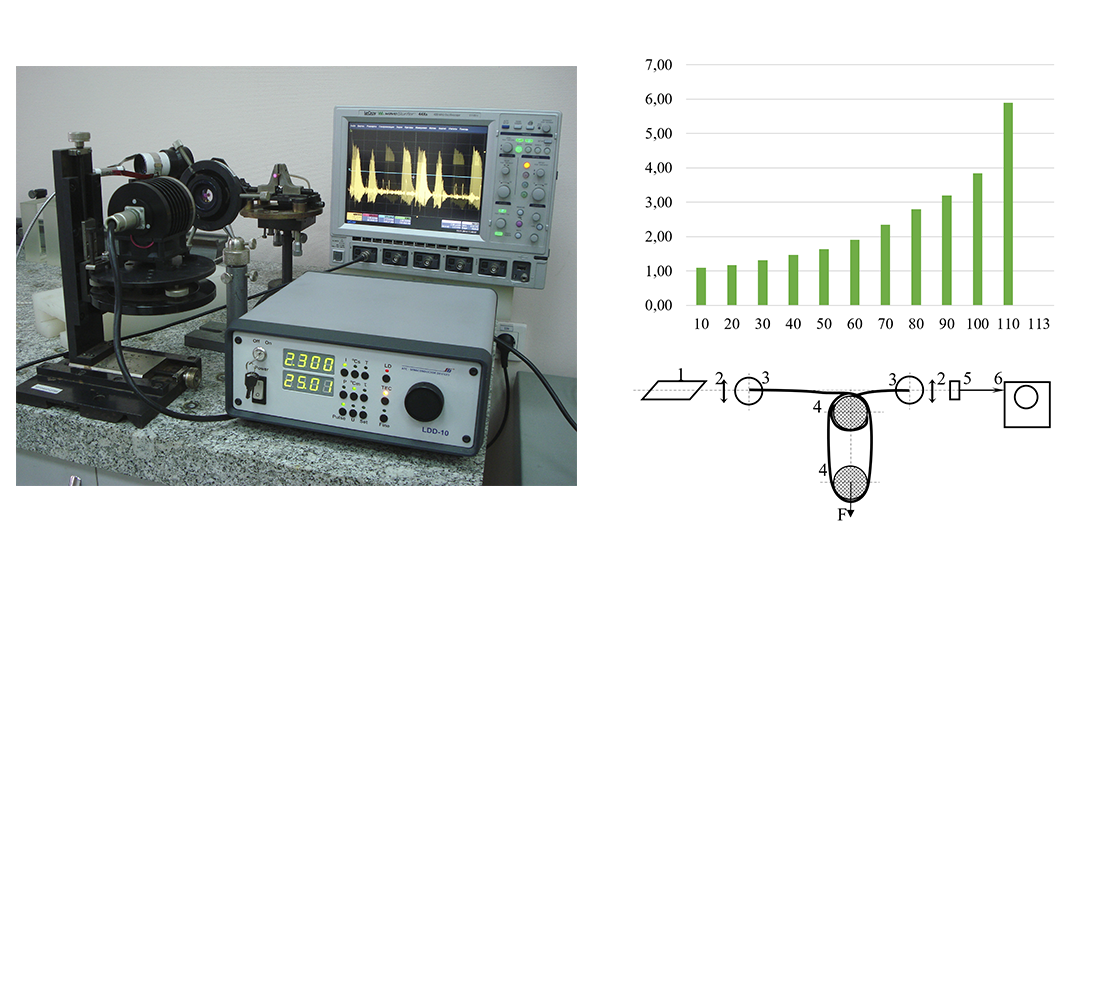
During the experiments, the initial attenuation values (1.09 dB/km) and their changes under tensile loads were measured. Test samples, approximately 20 meters long, were subjected to gradually increasing tensile force. Prolonged exposure to the load significantly increased the attenuation coefficient, particularly in the shortwave part of the spectrum. Fiber failure occurred after 113 minutes, indicating a critical reduction in strength. This effect can be attributed to the intensification of material inhomogeneities in the fiber, leading to increased light scattering.
The impact of compressive loads on dispersion was studied at a wavelength of 1.06 μm. It was found that the shortwave spectrum is more sensitive to deformations due to the specific structure of the fiber. A comprehensive analysis of the loads identified critical factors affecting the reliability of MOFs. The results obtained enable the prediction of the durability of fiber-optic communication lines, accounting for mechanical impacts in their design and developing recommendations for improved operation. The practical significance lies in applying the findings to enhance fiber condition assessment methods and create more reliable communication systems
References
- Ospanova, N. A., Kemel’bekov, B. Zh., Bakhtiyarova, E. A., Zhetpisbaeva, A. T., Kulakaeva, A. E., Kosyakov, I. O. (2015). Extinction Coefficient of Optical Fibers Irradiated by Thermal Neutrons and Compressed. Russian Physics Journal, 58 (3), 289–292. https://doi.org/10.1007/s11182-015-0496-7
- Ospanova, N. A., Kemelbekov, B. Z., Bekmagambetova, Z. M., Lipskaya, M. A., Portnov, E. L. (2014). The study on the dependence of attenuation coefficient from crushing force parameters in optical fiber. Life Science Journal, 11 (3), 396–398.
- Balandin, S. F., Donchenko, V. A., Myshkin, V. F., Potekaev, A. I., Khan, V. A., Orazymbetova, A. K., Ospanova, N. A. (2022). Ionization Processes in a Carbon Aerosol Upon Exposure to Long Laser Pulses. I. Russian Physics Journal, 65 (2), 355–364. https://doi.org/10.1007/s11182-022-02643-z
- Balandin, S. F., Donchenko, V. A., Myshkin, V. F., Potekaev, A. I., Khan, V. A., Orazymbetova, A. K., Ospanova, N. A. (2022). Ionization Processes in a Carbon Aerosol Upon Exposure to Long Laser Pulses. II. Russian Physics Journal, 65 (4), 683–687. https://doi.org/10.1007/s11182-022-02685-3
- Myshkin, V. F., Khan, V. A., Izhoykin, D. A., Orazymbetova, A. K., Ospanovа, N. A., Kargulova, A. N. et al. (2018). Reduction of data processing error of heterogeneous system laser sensing. 24th International Symposium on Atmospheric and Ocean Optics: Atmospheric Physics, 388. https://doi.org/10.1117/12.2506127
- Castilone, R. J., Glaesemann, G. S., Hanson, T. A. (2002). Relationship between mirror dimensions and failure stress for optical fibers. Optical Fiber and Fiber Component Mechanical Reliability and Testing II, 4639, 11–20. https://doi.org/10.1117/12.481339
- Zitelli, M. (2024). Optical solitons in multimode fibers: recent advances. Journal of the Optical Society of America B, 41 (8), 1655. https://doi.org/10.1364/josab.528242
- Sun, Y., Parra-Rivas, P., Agrawal, G. P., Hansson, T., Antonelli, C., Mecozzi, A. et al. (2024). Multimode solitons in optical fibers: a review. Photonics Research, 12 (11), 2581. https://doi.org/10.1364/prj.531393
- Glaesemann, G. (2017). Optical Fiber Mechanical Reliability. Report number: WP8002. https://doi.org/10.13140/RG.2.2.16449.74083
- Bachmann, P. K., Hermann, W., Wehr, H., Wiechert, D. U. (1987). Stress in optical waveguides 2: Fibers. Applied Optics, 26 (7), 1175. https://doi.org/10.1364/ao.26.001175
- He, Y., Li, Y., Li, N. (2017). Temperature-independent evanescent wave sensor made of a stress-released silica optical fiber taper. Optical Fiber Technology, 36, 237–244. https://doi.org/10.1016/j.yofte.2017.04.001
- Matthewson, M. J. (1993). Optical fiber mechanical testing techniques. Fiber Optics Reliability and Testing: A Critical Review, 10272, 1027205. https://doi.org/10.1117/12.181373
- Thomason, J. L., Kao, C. C., Ure, J., Yang, L. (2013). The strength of glass fibre reinforcement after exposure to elevated composite processing temperatures. Journal of Materials Science, 49 (1), 153–162. https://doi.org/10.1007/s10853-013-7689-7
- Sonnenfeld, C., Sulejmani, S., Geernaert, T., Eve, S., Gomina, M., Mergo, P. et al. (2014). Mechanical Strength of Microstructured Optical Fibers. Journal of Lightwave Technology, 32 (12), 2193–2201. https://doi.org/10.1109/jlt.2014.2322201
- Veng, T., Edvold, B. (2013). Method for Measuring Optical Fiber Strain Applied to Determine Strain in Fusion Splice Protectors. IEEE Photonics Technology Letters, 25 (15), 1517–1519. https://doi.org/10.1109/lpt.2013.2268205
- Glaesemann, G. S. (1991). Optical Fiber Failure Probability Predictions from Long-Length Strength Distributions. Proc. Int. Wire Cable Symp., 40, 819–825.
- Fuller, E. R., Wiederhorn, S. M., Ritter, J. E., Oates, P. B. (1980). Proof testing of ceramics. Journal of Materials Science, 15 (9), 2282–2295. https://doi.org/10.1007/bf00552318
- Bulatov, M. I., Shatsov, A. A., Grigorev, N. S., Malkov, N. A. (2023). Strength, crack resistance and optical losses of heat-treated silica fibers coated with non-ferrous metal. Optical Fiber Technology, 75, 103174. https://doi.org/10.1016/j.yofte.2022.103174
- Ma, Z., Wang, Z., Liu, H., Pang, F., Chen, Z., Wang, T. (2019). Tensile strength and failure behavior of bare single mode fibers. Optical Fiber Technology, 52, 101966. https://doi.org/10.1016/j.yofte.2019.101966
- Kiefer, P., Deubener, J., Müller, R., Behrens, H. (2020). Statistical analysis of propagation rates of indentation-induced radial cracks in soda-lime-silica glass. Journal of Non-Crystalline Solids, 527, 119739. https://doi.org/10.1016/j.jnoncrysol.2019.119739
- TIA/EIA-455-31C. Proof Testing Optical Fibers by Tension. Telecommunications Industry Association.
- Taissariyeva, K. N., Ilipbaeva, L., Dzhobalaeva, G. (2016). Researching the method of providing harmonicity to multi-level inverter. Photonics Applications in Astronomy, Communications, Industry, and High-Energy Physics Experiments 2016, 10031, 1003123. https://doi.org/10.1117/12.2249145
Downloads
Published
How to Cite
Issue
Section
License
Copyright (c) 2025 Nurzhamal Ospanova, Aigul Orazymbetova, Yelena Bakhtiyarova, Marina Lipskaya, Yerdaulet Beibit

This work is licensed under a Creative Commons Attribution 4.0 International License.
The consolidation and conditions for the transfer of copyright (identification of authorship) is carried out in the License Agreement. In particular, the authors reserve the right to the authorship of their manuscript and transfer the first publication of this work to the journal under the terms of the Creative Commons CC BY license. At the same time, they have the right to conclude on their own additional agreements concerning the non-exclusive distribution of the work in the form in which it was published by this journal, but provided that the link to the first publication of the article in this journal is preserved.
A license agreement is a document in which the author warrants that he/she owns all copyright for the work (manuscript, article, etc.).
The authors, signing the License Agreement with TECHNOLOGY CENTER PC, have all rights to the further use of their work, provided that they link to our edition in which the work was published.
According to the terms of the License Agreement, the Publisher TECHNOLOGY CENTER PC does not take away your copyrights and receives permission from the authors to use and dissemination of the publication through the world's scientific resources (own electronic resources, scientometric databases, repositories, libraries, etc.).
In the absence of a signed License Agreement or in the absence of this agreement of identifiers allowing to identify the identity of the author, the editors have no right to work with the manuscript.
It is important to remember that there is another type of agreement between authors and publishers – when copyright is transferred from the authors to the publisher. In this case, the authors lose ownership of their work and may not use it in any way.







