Devising a forward propagation artificial neural network application technology for nowcasting weather elements
DOI:
https://doi.org/10.15587/1729-4061.2025.321664Keywords:
forward propagation artificial neural network, nowcasting of weather elementsAbstract
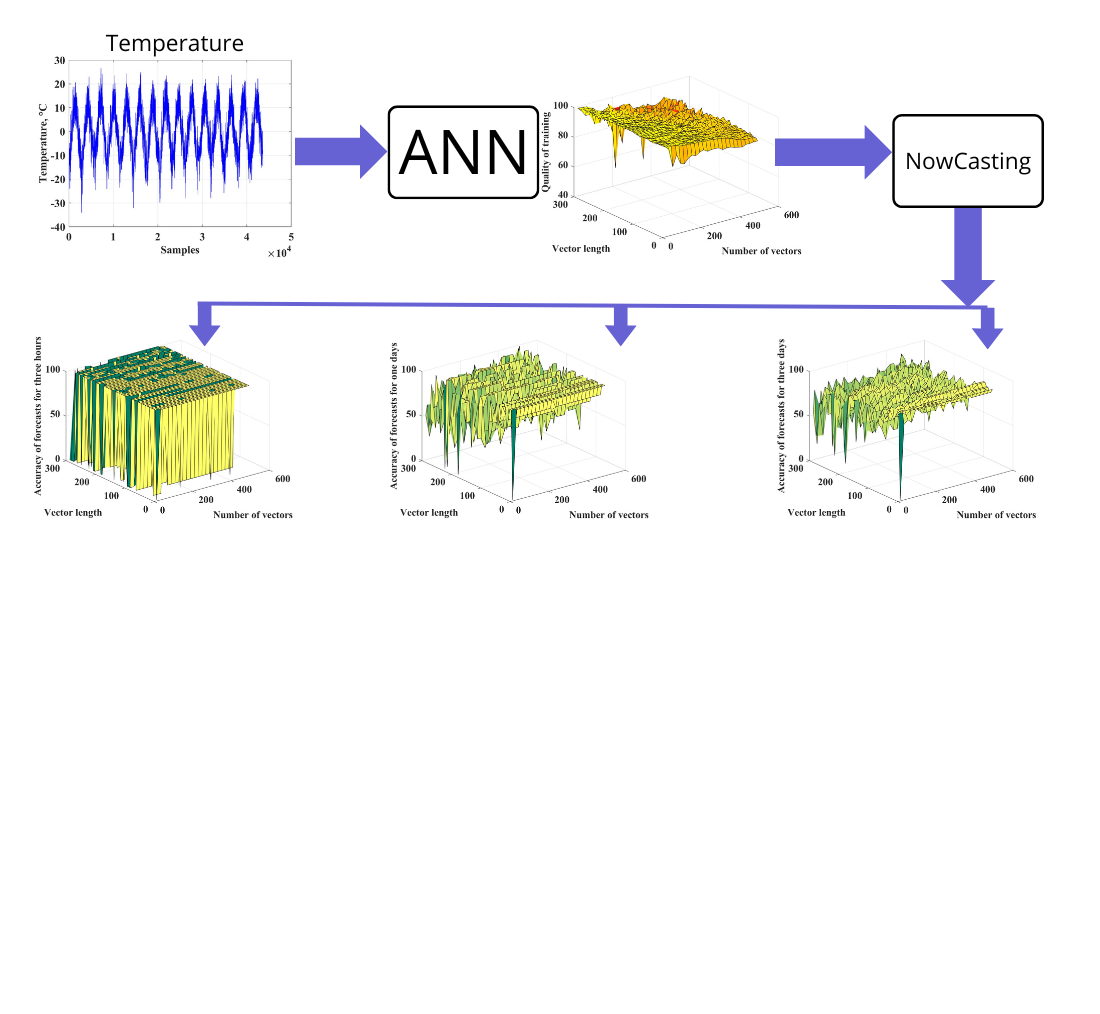
The object of this paper is the procedure of applying a forward-propagation artificial neural network of surface learning for the purpose of short-term forecasting one of the weather elements – the temperature of the near-surface air layer. Known methods to forecast weather elements, namely, hydrodynamic, physical-statistical, and synoptic, have been successfully supplemented in recent years by forecasting using artificial neural networks. It has become possible to build large networks for a large amount of training data for deep learning. However, the level of development of the theory of artificial neural networks does not make it possible to build the required network. Therefore, when solving applied tasks such as the one reported in this paper, the developer has to build a forecasting system blindly or based on some heuristic considerations, experimenting with neural networks. At the same time, the path of network complexity often does not lead to a qualitative improvement in forecasting results. Therefore, during the research, the main problem to be solved was to optimize the use of a simple neural network with a well-developed training algorithm for the purpose of nowcasting meteorological elements. The optimization criterion adopted was the surface air temperature short-term forecast accuracy at different time intervals. The parameters enabling the achievement of optimality are the parameters of the data that train the network and the parameters of the network itself. By selecting these parameters, a high accuracy rate for short-term forecasts of different timeliness has been achieved. The accuracy of a three-hour forecast reaches 100 percent. The same value is achieved for the forecast accuracy with a one-day lead time. Predicting temperature values for three days has an accuracy rate exceeding 90 percent
References
- Moustris, K., Larissi, I., Nastos, P. T., Koukouletsos, K., Paliatsos, A. G. (2012). 24-Hours Ahead Forecasting of PM10 Concentrations Using Artificial Neural Networks in the Greater Athens Area, Greece. Advances in Meteorology, Climatology and Atmospheric Physics, 1121–1126. https://doi.org/10.1007/978-3-642-29172-2_156
- Lei, Y., Zhao, D., Cai, H. (2015). Prediction of length-of-day using extreme learning machine. Geodesy and Geodynamics, 6 (2), 151–159. https://doi.org/10.1016/j.geog.2014.12.007
- Koprinska, I., Wu, D., Wang, Z. (2018). Convolutional Neural Networks for Energy Time Series Forecasting. 2018 International Joint Conference on Neural Networks (IJCNN), 1–8. https://doi.org/10.1109/ijcnn.2018.8489399
- Taylor, J. W., Buizza, R. (2002). Neural network load forecasting with weather ensemble predictions. IEEE Transactions on Power Systems, 17 (3), 626–632. https://doi.org/10.1109/tpwrs.2002.800906
- Maqsood, I., Khan, M., Abraham, A. (2004). An ensemble of neural networks for weather forecasting. Neural Computing and Applications, 13 (2). https://doi.org/10.1007/s00521-004-0413-4
- Maqsood, I., Abraham, A. (2007). Weather analysis using ensemble of connectionist learning paradigms. Applied Soft Computing, 7 (3), 995–1004. https://doi.org/10.1016/j.asoc.2006.06.005
- Maqsood, I., Khan, M. R., Abraham, A. (2003). Weather Forecasting Models Using Ensembles of Neural Networks. Intelligent Systems Design and Applications, 33–42. https://doi.org/10.1007/978-3-540-44999-7_4
- Harnist, B., Pulkkinen, S., Mäkinen, T. (2024). DEUCE v1.0: a neural network for probabilistic precipitation nowcasting with aleatoric and epistemic uncertainties. Geoscientific Model Development, 17 (9), 3839–3866. https://doi.org/10.5194/gmd-17-3839-2024
- Espeholt, L., Agrawal, S., Sønderby, C., Kumar, M., Heek, J., Bromberg, C. et al. (2022). Deep learning for twelve hour precipitation forecasts. Nature Communications, 13 (1). https://doi.org/10.1038/s41467-022-32483-x
- Bi, K., Xie, L., Zhang, H., Chen, X., Gu, X., Tian, Q. (2023). Accurate medium-range global weather forecasting with 3D neural networks. Nature, 619 (7970), 533–538. https://doi.org/10.1038/s41586-023-06185-3
- Clare, M. C. A., Jamil, O., Morcrette, C. J. (2021). Combining distribution‐based neural networks to predict weather forecast probabilities. Quarterly Journal of the Royal Meteorological Society, 147 (741), 4337–4357. https://doi.org/10.1002/qj.4180
- Yang, Q., Giezendanner, J., Civitarese, D. S., Jakubik, J., Schmitt, E., Chandra, A. et al. (2024). Multi-modal graph neural networks for localized off-grid weather forecasting. arXiv. https://doi.org/10.48550/arXiv.2410.12938
- Chaudhuri, S., Das, D., Sarkar, I., Goswami, S. (2015). Multilayer Perceptron Model for Nowcasting Visibility from Surface Observations: Results and Sensitivity to Dissimilar Station Altitudes. Pure and Applied Geophysics, 172 (10), 2813–2829. https://doi.org/10.1007/s00024-015-1065-2
- Perelygin, B., Tkach, T., Gnatovskaya, A. (2021). Preparing data and determining parameters for a feedforward neural network used for short-term air temperature forecasting. Short Paper Proceedings of the 2nd International Conference on Intellectual Systems and Information Technologies (ISIT 2021) co-located with 1st International Forum "Digital Reality" (DRForum 2021). Odesa, 56–61. Available at: https://ceur-ws.org/Vol-3126/paper8.pdf
- Nastanova z meteorolohichnoho prohnozuvannia. Ukrainskyi hidrometerolohichnyi tsentr. Kyiv, 35. Available at: https://www.meteo.gov.ua/f/pro_nas/normatuvni_akt/Nastanova%20z%20meteoprognozuvannia.pdf
Downloads
Published
How to Cite
Issue
Section
License
Copyright (c) 2025 Boris Perelygin, Halyna Borovska, Hanna Hnatovska, Andrey Sergienko, Tetiana Tkach, Nataliia Shtefan

This work is licensed under a Creative Commons Attribution 4.0 International License.
The consolidation and conditions for the transfer of copyright (identification of authorship) is carried out in the License Agreement. In particular, the authors reserve the right to the authorship of their manuscript and transfer the first publication of this work to the journal under the terms of the Creative Commons CC BY license. At the same time, they have the right to conclude on their own additional agreements concerning the non-exclusive distribution of the work in the form in which it was published by this journal, but provided that the link to the first publication of the article in this journal is preserved.
A license agreement is a document in which the author warrants that he/she owns all copyright for the work (manuscript, article, etc.).
The authors, signing the License Agreement with TECHNOLOGY CENTER PC, have all rights to the further use of their work, provided that they link to our edition in which the work was published.
According to the terms of the License Agreement, the Publisher TECHNOLOGY CENTER PC does not take away your copyrights and receives permission from the authors to use and dissemination of the publication through the world's scientific resources (own electronic resources, scientometric databases, repositories, libraries, etc.).
In the absence of a signed License Agreement or in the absence of this agreement of identifiers allowing to identify the identity of the author, the editors have no right to work with the manuscript.
It is important to remember that there is another type of agreement between authors and publishers – when copyright is transferred from the authors to the publisher. In this case, the authors lose ownership of their work and may not use it in any way.







