Development of the emulsion protein-fat system composition
DOI:
https://doi.org/10.15587/1729-4061.2025.321856Keywords:
emulsion protein-fat system, flax seeds, soybean meal, alpha-linolenic acid, technological indicatorsAbstract
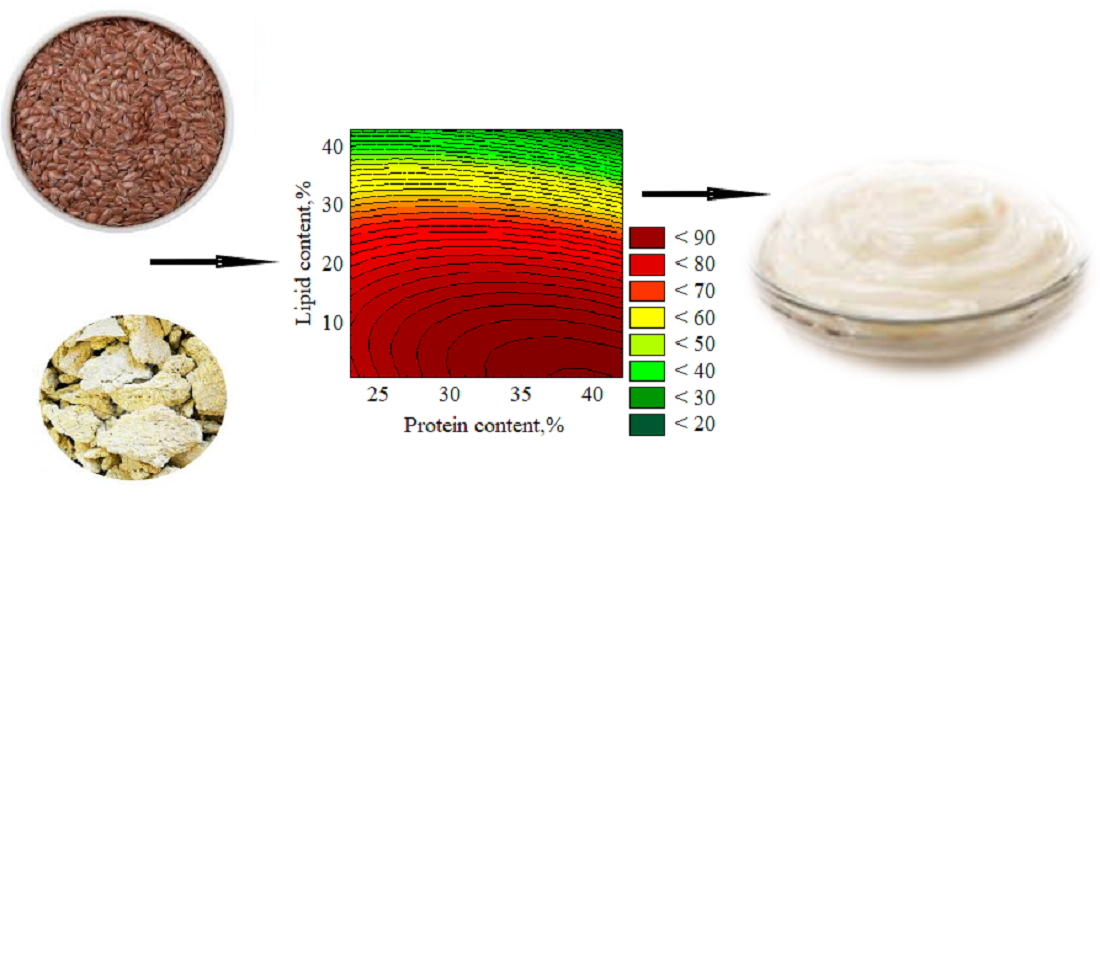
The object of the study is the technological indicators of the emulsion protein-fat system developed on the basis of oilseeds and their processing products. The research problem is the need to stabilize the emulsion of the protein-fat system of plant origin. The solution to the problem of adjusting the technological indicators of emulsion protein-fat systems based on flax seeds and soybean meal is considered, in particular, the stability of the emulsion and resistance to oxidative damage. An emulsion protein-fat system with an increased content of ω-3 polyunsaturated fatty acids (ALA) based on a mixture of flax seeds and soybean meal is developed. The influence of the ratio of raw materials on the stability of the emulsion system is investigated. It was found that the rational ratio of flax seeds (40 %) and soybean meal (60 %) provides high resistance of the lipid component to oxidative damage, which is confirmed by the increase in the peroxide value by only 0.9 mmol ½O/kg after 30 days of storage. The effect of stabilizers – xanthan gum (0.5 %) and polyoxyethylene (20) sorbitan monolaurate (0.2 %) – on the stability of the emulsion protein-fat system during 30-day storage at a temperature of 4 °C was studied.
The emulsion system of the developed composition is characterized by a lower protein content compared to the reference sample (by 8 %), however, this disadvantage is compensated by the balance of the fatty acid composition, a significantly higher content of ω-3 PUFA (9.8 % vs. 0 %) and lipids (17.7 % vs. 1.1 %). Such characteristics significantly increase its nutritional value. The developed protein-fat system has significant potential for implementation in the food industry, contributing to the creation of new products with a high ALA content and expanding the range of emulsion products that meet modern standards of healthy nutrition
References
- Petik, I., Litvinenko, O., Kalyna, V., Ilinska, O., Raiko, V., Filenko, O. et al. (2023). Development of extruded animal feed based on fat and oil industry waste. Eastern-European Journal of Enterprise Technologies, 2 (11 (122)), 112–120. https://doi.org/10.15587/1729-4061.2023.275509
- Petik, I., Litvinenko, O., Stankevych, S., Zabrodina, I., Ponomarova, M., Kotliar, O. et al. (2024). Determination of the cellulose- and lipid-containing components influence on the extrudate technological indicators. Eastern-European Journal of Enterprise Technologies, 2 (6 (128)), 6–13. https://doi.org/10.15587/1729-4061.2024.301843
- Belinska, A., Ryshchenko, I., Bliznjuk, O., Masalitina, N., Siedykh, K., Zolotarova, S. et al. (2024). Development of a method for inactivating lipoxygenases in linseed using chemical reagents. Technology Organic and Inorganic Substances, 4 (6 (130)), 14–21. https://doi.org/10.15587/1729-4061.2024.309079
- Kunitsia, E., Kalyna, V., Haliasnyi, I., Siedykh, K., Kotliar, O., Dikhtyar, A. et al. (2023). Development of a flavored oil composition based on hemp oil with increased resistance to oxidation. Eastern-European Journal of Enterprise Technologies, 5 (11 (125)), 26–33. https://doi.org/10.15587/1729-4061.2023.287436
- Elaine, E., Bhandari, B., Tan, C. P., Nyam, K. L. (2024). Recent Advances in the Formation, Stability, and Emerging Food Application of Water-in-Oil-in-Water Double Emulsion Carriers. Food and Bioprocess Technology, 17 (11), 3440–3460. https://doi.org/10.1007/s11947-024-03350-y
- El-Sayed, S. M., Hashim, A. F. (2024). Development of emulsion foams based on healthier oleogels and their application as low-fat replacers for whipped cream. Journal of Food Measurement and Characterization, 18 (11), 9142–9155. https://doi.org/10.1007/s11694-024-02866-3
- Lingiardi, N., Galante, M., Spelzini, D. (2023). Emulsion Gels Based on Quinoa Protein Hydrolysates, Alginate, and High-Oleic Sunflower Oil: Evaluation of Their Physicochemical and Textural Properties. Food Biophysics, 19 (2), 298–309. https://doi.org/10.1007/s11483-023-09817-3
- Singh, R., Sá, A. G. A., Sharma, S., Nadimi, M., Paliwal, J., House, J. D., Koksel, F. (2023). Effects of Feed Moisture Content on the Physical and Nutritional Quality Attributes of Sunflower Meal-based High-Moisture Meat Analogues. Food and Bioprocess Technology, 17 (7), 1897–1913. https://doi.org/10.1007/s11947-023-03225-8
- Didar, Z., Khodaparast, M. H. H., Goharjoo, B. (2024). Flaxseed mucilage - stabilized double emulsion for vitamin D delivery in Hazelnut milk ice cream: in vitro stability and storage. Journal of Food Science and Technology. https://doi.org/10.1007/s13197-024-06078-x
- Zhu, T., Ma, L., Jiang, H., Li, W., Guo, X., Yang, C., Bu, G. (2023). Functional, structural properties of pea protein isolate-xylooligosaccharide glycosylated conjugate and its application in O/W emulsion preparation. Journal of Food Measurement and Characterization, 17 (6), 6135–6143. https://doi.org/10.1007/s11694-023-02102-4
- Li, X., Zhou, S., Chen, H., Zhang, R., Wang, L. (2024). Pomelo Fiber-Stabilized Oil-in-Water Emulsion Gels: Fat Mimetic in Plant-Based Ice Cream. Food and Bioprocess Technology, 18 (1), 422–432. https://doi.org/10.1007/s11947-024-03446-5
- Li, H., Zhang, L., Cao, H., Liu, T., Xi, Z., Li, H. et al. (2023). Whey Protein-Based High Internal Phase Emulsion Gel Characterization and Its Effect on the Textural and Melting Properties of Processed Cheese. Food and Bioprocess Technology, 17 (7), 2061–2075. https://doi.org/10.1007/s11947-023-03239-2
- Sulaiman, N. S., Zaini, H. M., Akanda, M. J. H., Heong, M. H., Chai, A., Pindi, W. (2024). Improving Functionality of Myofibrillar Protein: A Comparative Study on Fat Types on the Resulting Gelling and Microstructure Properties. Food and Bioprocess Technology, 17 (12), 5260–5272. https://doi.org/10.1007/s11947-024-03436-7
- Ashfaq, A., Osama, K., Yousuf, O., Younis, K. (2024). Protein-based Emulsion Hydrogels and Their Application in the Development of Sustainable Food Products. Plant Foods for Human Nutrition, 79 (4), 759–768. https://doi.org/10.1007/s11130-024-01214-6
- Lingiardi, N., Galante, M., Spelzini, D. (2024). Development of Bioactive Quinoa Protein Hydrolysate-based Emulsion Gels: Evaluation of Their Antioxidant and Rheological Properties. Food Biophysics, 20 (1). https://doi.org/10.1007/s11483-024-09899-7
- Papchenko, V., Matveeva, T., Bochkarev, S., Belinska, A., Kunitsia, E., Chernukha, A. et al. (2020). Development of amino acid balanced food systems based on wheat flour and oilseed meal. Eastern-European Journal of Enterprise Technologies, 3 (11 (105)), 66–76. https://doi.org/10.15587/1729-4061.2020.203664
- Bui, A. T. H., Cozzolino, D., Zisu, B., Chandrapala, J. (2021). Influence of Fat Concentration on the Volatile Production in Model Whey Protein Systems as Affected by Low Frequency Ultrasound. Food and Bioprocess Technology, 14 (6), 1169–1183. https://doi.org/10.1007/s11947-021-02619-w
- Kalyna, V., Stankevych, S., Zabrodina, I., Shubina, L., Chuiko, M., Mikheeva, O. et al. (2024). Development of the composition of anoxidation-stable dressing with high nutritional value. Eastern-European Journal of Enterprise Technologies, 1 (11 (127)), 29–37. https://doi.org/10.15587/1729-4061.2024.296621
- Kunitsia, E., Popov, M., Gontar, T., Stankevych, S., Zabrodina, I., Stepankova, G. et al. (2024). Determination of the influence of hemp oil-based emulsion systems composition on the oxidation products content during storage. Eastern-European Journal of Enterprise Technologies, 3 (6 (129)), 6–13. https://doi.org/10.15587/1729-4061.2024.304466
Downloads
Published
How to Cite
Issue
Section
License
Copyright (c) 2025 Tatiana Matveeva, Serhii Stankevych, Viktoriia Kalyna, Tetiana Chaika, Aliona Dikhtyar, Svetlana Omelchenko, Oleh Kotliar, Lidiia Shubina, Tetiana Novozhylova, Olena Zolotukhina

This work is licensed under a Creative Commons Attribution 4.0 International License.
The consolidation and conditions for the transfer of copyright (identification of authorship) is carried out in the License Agreement. In particular, the authors reserve the right to the authorship of their manuscript and transfer the first publication of this work to the journal under the terms of the Creative Commons CC BY license. At the same time, they have the right to conclude on their own additional agreements concerning the non-exclusive distribution of the work in the form in which it was published by this journal, but provided that the link to the first publication of the article in this journal is preserved.
A license agreement is a document in which the author warrants that he/she owns all copyright for the work (manuscript, article, etc.).
The authors, signing the License Agreement with TECHNOLOGY CENTER PC, have all rights to the further use of their work, provided that they link to our edition in which the work was published.
According to the terms of the License Agreement, the Publisher TECHNOLOGY CENTER PC does not take away your copyrights and receives permission from the authors to use and dissemination of the publication through the world's scientific resources (own electronic resources, scientometric databases, repositories, libraries, etc.).
In the absence of a signed License Agreement or in the absence of this agreement of identifiers allowing to identify the identity of the author, the editors have no right to work with the manuscript.
It is important to remember that there is another type of agreement between authors and publishers – when copyright is transferred from the authors to the publisher. In this case, the authors lose ownership of their work and may not use it in any way.







