Determining the amplitude-frequency characteristics of an electric train car floor
DOI:
https://doi.org/10.15587/1729-4061.2025.321962Keywords:
railroad transport, passenger cars, car floor vibration, amplitude-frequency characteristics, passenger comfortAbstract
The object of this study is the process of vibration propagation through the floor of a passenger railroad car from the base to passenger seats. The problem addressed relates to the influence of the structure of an electric train car floor on its anti-vibration properties, in particular the role of rubber shock absorbers in the process of damping floor vibrations. A mathematical model of the vibration propagation chain from the base of the car to the top layer of the floor was built. As a source of vibrations in the mathematical model, the kinematic disturbance of the base of the car was used. Two variants of the floor structure were studied – with five layers and with seven layers. The parameters of the floor layers obtained experimentally by the method of free oscillations were used in the calculations.
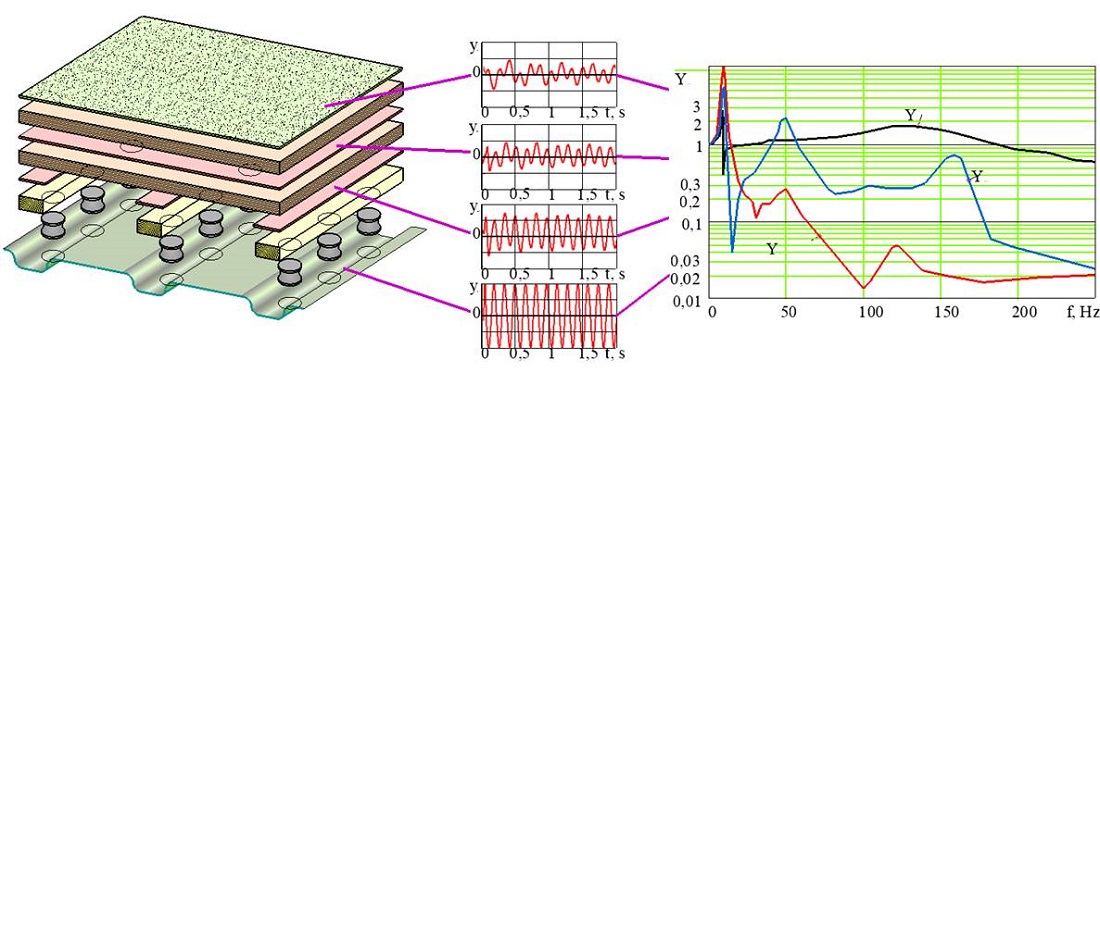
Based on the application of specific parameters of the floor layers, a transition was performed from distributed mass, elastic, and dissipative parameters to concentrated ones. The solution to the system of differential equations of oscillations was obtained in the form of time functions of displacements and velocities of floor elements. Layer-by-layer amplitude-frequency characteristics (AFR) of the floor were constructed. Zones of resonant frequencies of the oscillating system of the car floor have been determined. The dependence of the influence of the degree of passenger loading on the resonance frequency of floor surface oscillations was established. When the load changes from minimum to maximum, the resonant frequency decreases from 15–22 Hz to 8–12 Hz.
It has been confirmed that the influence of parameters of the layer of rubber shock absorbers on the floor AFR is decisive for its vibration protection. When comparing the two floor variants under consideration, there were no advantages of a seven-layer floor over a five-layer floor. AFR for the first and second layers of plywood flooring are identical.
Based on the data on "dangerous" vibration frequencies for humans, the preferred value for the shock absorber installation diagram was derived – 5–6 units/m2, which could prove useful under the conditions of modernization of suburban electric train cars
References
- Kulbovskyi, I., Sapronova, S., Holub, H., Tkachenko, V., Afanasieva, I., Safronov, O. (2019). Development of a model for managing the quality of repair and maintenance of rolling stock in transport infrastructure projects. Proceedings of 23rd International Scientific Conference. Transport Means 2019, 201–205. Available at: https://transportmeans.ktu.edu/wp-content/uploads/sites/307/2018/02/Transport-means-2019-Part-1.pdf
- Shostak, Y., Holovashchenko, O., Reshetnikov, Y., Tkachenko, V. (2024). Improving the technological process of balancing electric machine rotors on a balancing machine. Applied Mechanics, 4 (7 (130)), 60–69. LOCKSS. https://doi.org/10.15587/1729-4061.2024.309867
- Gong, D., Duan, Y., Wang, K., Zhou, J. (2019). Modelling rubber dynamic stiffness for numerical predictions of the effects of temperature and speed on the vibration of a railway vehicle car body. Journal of Sound and Vibration, 449, 121–139. https://doi.org/10.1016/j.jsv.2019.02.037
- Nassiri, P., Koohpaei, A. R., Zeraati, H., Shalkouhi, P. J. (2011). Train Passengers Comfort with Regard to Whole-Body Vibration. Journal of Low Frequency Noise, Vibration and Active Control, 30 (2), 125–136. https://doi.org/10.1260/0263-0923.30.2.125
- Gong, D., Wang, K., Duan, Y., Zhou, J. (2019). Car body floor vibration of high-speed railway vehicles and its reduction. Journal of Low Frequency Noise, Vibration and Active Control, 39 (4), 925–938. https://doi.org/10.1177/1461348419850921
- You, T., Zhou, J., Thompson, D. J., Gong, D., Chen, J., Sun, Y. (2021). Vibration reduction of a high-speed train floor using multiple dynamic vibration absorbers. Vehicle System Dynamics, 60 (9), 2919–2940. https://doi.org/10.1080/00423114.2021.1928248
- Dižo, J., Blatnický, M., Gerlici, J., Leitner, B., Melnik, R., Semenov, S. et al. (2021). Evaluation of Ride Comfort in a Railway Passenger Car Depending on a Change of Suspension Parameters. Sensors, 21 (23), 8138. https://doi.org/10.3390/s21238138
- La Paglia, I., Li, Q., Ripamonti, F., Corradi, R. (2023). Experimental and numerical investigation of the dynamics of the floating floor and passenger seats of a railway vehicle. In Proceedings of the 29th International Congress on Sound and Vibration, 1–7. Available at: https://re.public.polimi.it/bitstream/11311/1249627/1/full_paper_36_20230429103100641.pdf
- Wu, J., Qiu, Y. (2021). Modelling and ride comfort analysis of a coupled track-train-seat-human model with lateral, vertical and roll vibrations. Vehicle System Dynamics, 60 (9), 2988–3023. https://doi.org/10.1080/00423114.2021.1933088
- Han, S., Chen, F., Yu, Y., Zheng, Z., Chen, L., Wang, G. (2022). Bamboo-Inspired Renewable, Lightweight, and Vibration-Damping Laminated Structural Materials for the Floor of a Railroad Car. ACS Applied Materials & Interfaces, 14 (37), 42645–42655. https://doi.org/10.1021/acsami.2c09785
- Fan, R., Meng, G., Yang, J., He, C. (2009). Experimental study of the effect of viscoelastic damping materials on noise and vibration reduction within railway vehicles. Journal of Sound and Vibration, 319 (1-2), 58–76. https://doi.org/10.1016/j.jsv.2008.03.071
- Kumar, V., Rastogi, V., Pathak, P. (2016). Simulation for whole-body vibration to assess ride comfort of a low–medium speed railway vehicle. SIMULATION, 93 (3), 225–236. https://doi.org/10.1177/0037549716679254
- Sugiono, S., Oktavianty, O., Sulistyarini, D. H., Nugroho, W. S., Wiryawan, E. et al. (2021). Analysis of Train Passenger Comfort Related to the Vibration and Heat It Creates. Proceedings of the Second Asia Pacific International Conference on Industrial Engineering and Operations Management, 3518–3525. Available at: http://ieomsociety.org/proceedings/2021indonesia/605.pdf
- Rébillat, M., Boutillon, X. (2011). Measurement of relevant elastic and damping material properties in sandwich thick plates. Journal of Sound and Vibration, 330 (25), 6098–6121. https://doi.org/10.1016/j.jsv.2011.07.015
- McIntyre, M. E., Woodhouse, J. (1988). On measuring the elastic and damping constants of orthotropic sheet materials. Acta Metallurgica, 36 (6), 1397–1416. https://doi.org/10.1016/0001-6160(88)90209-x
- Botelho, E. C., Campos, A. N., de Barros, E., Pardini, L. C., Rezende, M. C. (2005). Damping behavior of continuous fiber/metal composite materials by the free vibration method. Composites Part B: Engineering, 37 (2-3), 255–263. https://doi.org/10.1016/j.compositesb.2005.04.003
- Cheli, F., Corradi, R. (2011). On rail vehicle vibrations induced by track unevenness: Analysis of the excitation mechanism. Journal of Sound and Vibration, 330 (15), 3744–3765. https://doi.org/10.1016/j.jsv.2011.02.025
- Wang, Q., Zeng, J., Wei, L., Zhou, C., Zhu, B. (2017). Reduction of vertical abnormal vibration in carbodies of low-floor railway trains by using a dynamic vibration absorber. Proceedings of the Institution of Mechanical Engineers, Part F: Journal of Rail and Rapid Transit, 232 (5), 1437–1447. https://doi.org/10.1177/0954409717731234
- Tomioka, T., Takigami, T. (2015). Experimental and numerical study on the effect due to passengers on flexural vibrations in railway vehicle carbodies. Journal of Sound and Vibration, 343, 1–19. https://doi.org/10.1016/j.jsv.2015.01.001
Downloads
Published
How to Cite
Issue
Section
License
Copyright (c) 2025 Oleh Holovashchenko, Yaroslav Shostak, Viktor Tkachenko

This work is licensed under a Creative Commons Attribution 4.0 International License.
The consolidation and conditions for the transfer of copyright (identification of authorship) is carried out in the License Agreement. In particular, the authors reserve the right to the authorship of their manuscript and transfer the first publication of this work to the journal under the terms of the Creative Commons CC BY license. At the same time, they have the right to conclude on their own additional agreements concerning the non-exclusive distribution of the work in the form in which it was published by this journal, but provided that the link to the first publication of the article in this journal is preserved.
A license agreement is a document in which the author warrants that he/she owns all copyright for the work (manuscript, article, etc.).
The authors, signing the License Agreement with TECHNOLOGY CENTER PC, have all rights to the further use of their work, provided that they link to our edition in which the work was published.
According to the terms of the License Agreement, the Publisher TECHNOLOGY CENTER PC does not take away your copyrights and receives permission from the authors to use and dissemination of the publication through the world's scientific resources (own electronic resources, scientometric databases, repositories, libraries, etc.).
In the absence of a signed License Agreement or in the absence of this agreement of identifiers allowing to identify the identity of the author, the editors have no right to work with the manuscript.
It is important to remember that there is another type of agreement between authors and publishers – when copyright is transferred from the authors to the publisher. In this case, the authors lose ownership of their work and may not use it in any way.







