Визначення впливу імпульсного ультрафіолетового (УФ) випромінювання високої потужності на Bacillus anthracis
DOI:
https://doi.org/10.15587/1729-4061.2025.322730Ключові слова:
бактерицидна дія, знезараження, санація навколишнього середовища, сибірка, спори, імпульсне ультрафіолетове випромінюванняАнотація
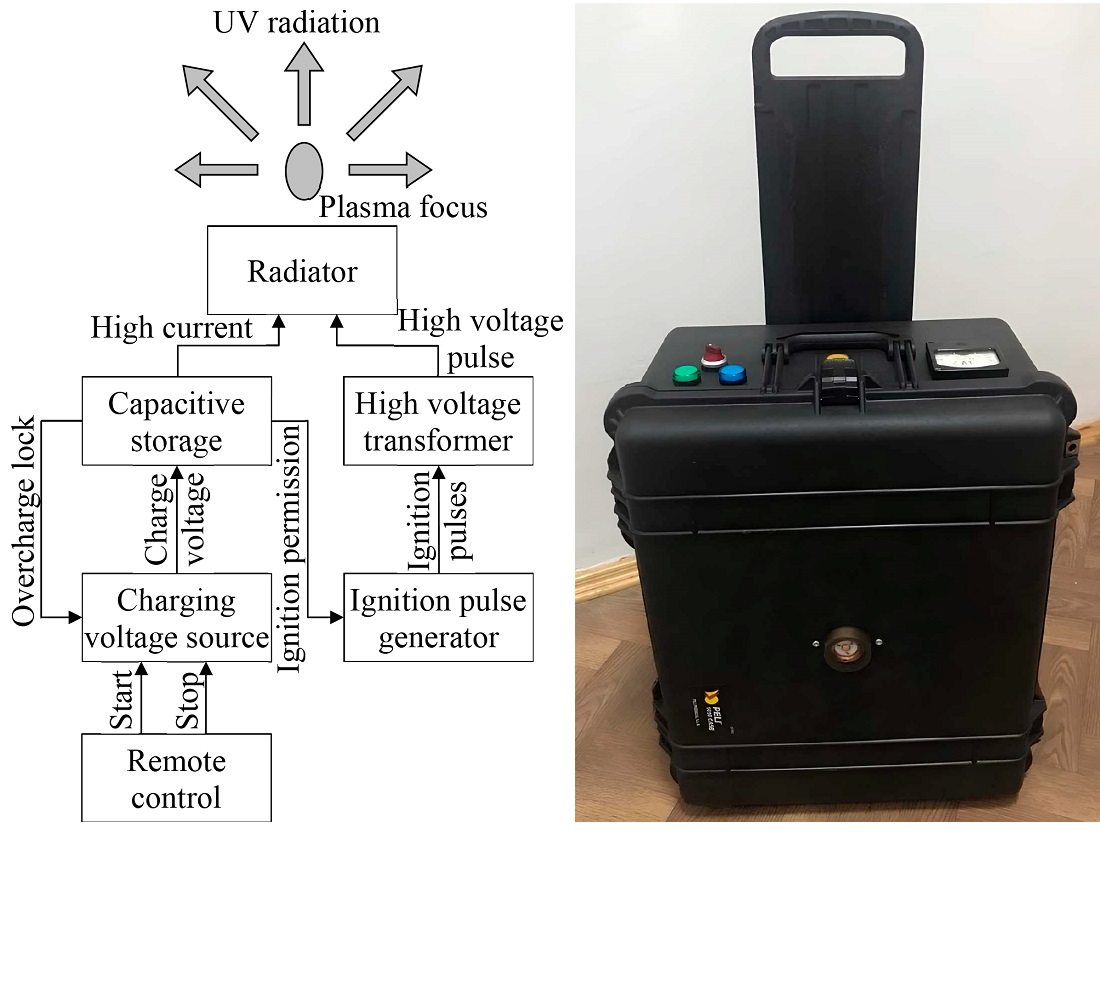
Об’єктом дослідження є імпульсне ультрафіолетове випромінювання високої потужності та його вплив на спори Bacillus anthracis. Знищення патогенної мікрофлори на об’єктах навколишнього середовища є запорукою стійкого епізоотологічного благополуччя. Показано, що дією потужних імпульсів ефект знищення патогенної мікрофлори досягається протягом короткої серії та навіть поодиноких експозицій. При цьому використовували імпульсний УФ-стерилізатор на основі магнітоплазмового компресора з потужністю імпульсного потоку ультрафіолету від 3,6 МВт з довжиною хвилі 185‒320 нм ультрафіолетового випромінювання. Показано перспективи технології імпульсної стерилізації. Як результат лабораторних випробувань установлено, що ступінь загибелі спор тест-мікроорганізму Bacillus anthracis CTI, нанесених на дерев’яні пластини, становить lg 2,5; нанесених на пластикові пластини ‒ lg 3,2, тоді як ступінь загибелі спор, нанесених на металеві пластини становить lg 4,0. Виходячи з отриманих результатів, дерево та пластик потребують більшої уваги при виборі методів дезінфекції через їх нижчу ефективність у цьому контексті. Висока резистентність спорових мікроорганізмів обумовлює застосування великих дозових навантажень для знешкодження збудника сибірки.
Запропонована методика знезараження є актуальною і може бути використана лабораторіями ветеринарної медицини, тваринницькими господарствами різних форм власності, науковою спільнотою і промисловими підприємствами з виготовлення технологічного обладнання. Подальший розвиток дослідження повинен бути спрямований на розроблення та удосконалення способів боротьби з патогенними мікроорганізмами та забезпечення стійкого епізоотичного благополуччя
Посилання
- Paliy, A., Aliiev, E., Paliy, A., Ishchenko, K., Shkromada, O., Musiienko, Y. et al. (2021). Development of a device for cleansing cow udder teats and testing it under industrial conditions. Eastern-European Journal of Enterprise Technologies, 1 (1 (109)), 43–53. https://doi.org/10.15587/1729-4061.2021.224927
- Hernandez-Patlan, D., Tellez-Isaias, G., Hernandez-Velasco, X., Solis-Cruz, B. (2023). Editorial: Technological strategies to improve animal health and production. Frontiers in Veterinary Science, 10. https://doi.org/10.3389/fvets.2023.1206170
- Mata, F. (2021). A Framework for Using Epidemiology in Animal Welfare Science. Journal of Applied Animal Welfare Science, 26 (3), 361–373. https://doi.org/10.1080/10888705.2021.1981902
- Rozman, U., Pušnik, M., Kmetec, S., Duh, D., Šostar Turk, S. (2021). Reduced Susceptibility and Increased Resistance of Bacteria against Disinfectants: A Systematic Review. Microorganisms, 9 (12), 2550. https://doi.org/10.3390/microorganisms9122550
- Paliy, A. P. (2018). Differential Sensitivity of Mycobacterium to Chlorine Disinfectants. Mikrobiolohichnyi Zhurnal, 80 (2), 104–116. https://doi.org/10.15407/microbiolj80.02.104
- Korniienko, L. Y., Ukhovskyi, V. V., Moroz, O. A., Chechet, O. M., Haidei, O. S., Tsarenko, T. M. et al. (2022). Epizootological and epidemiological situation of anthrax in Ukraine in the context of mandatory specific prevention in susceptible animals. Regulatory Mechanisms in Biosystems, 13 (4), 346–353. https://doi.org/10.15421/022245
- Dong, F., Chen, J., Li, C., Ma, X., Jiang, J., Lin, Q. et al. (2019). Evidence-based analysis on the toxicity of disinfection byproducts in vivo and in vitro for disinfection selection. Water Research, 165, 114976. https://doi.org/10.1016/j.watres.2019.114976
- Rodionova, K., Khimych, M., Paliy, A. (2021). Veterinary and sanitary assessment and disinfection of refrigerator chambers of meat processing enterprises. Potravinarstvo Slovak Journal of Food Sciences, 15, 616–626. https://doi.org/10.5219/1628
- Tong, C., Hu, H., Chen, G., Li, Z., Li, A., Zhang, J. (2021). Disinfectant resistance in bacteria: Mechanisms, spread, and resolution strategies. Environmental Research, 195, 110897. https://doi.org/10.1016/j.envres.2021.110897
- Sandri, A., Tessari, A., Giannetti, D., Cetti, A., Lleo, M. M., Boschi, F. (2023). UV-A Radiation: Safe Human Exposure and Antibacterial Activity. International Journal of Molecular Sciences, 24 (9), 8331. https://doi.org/10.3390/ijms24098331
- Sliney, D. H., Stuck, B. E. (2021). A Need to Revise Human Exposure Limits for Ultraviolet UV‐C Radiation. Photochemistry and Photobiology, 97 (3), 485–492. https://doi.org/10.1111/php.13402
- Guidelines on limits of exposure to ultraviolet radiation of wavelengths between 180 nm and 400 nm (incoherent optical radiation) (2004). Health Physics, 87 (2), 171–186. https://doi.org/10.1097/00004032-200408000-00006
- Bourouiba, L. (2020). Turbulent Gas Clouds and Respiratory Pathogen Emissions. JAMA, 323 (18), 1837–1838. https://doi.org/10.1001/jama.2020.4756
- Paliy, A. P., Sumakova, N. V., Mashkey, A. M., Petrov, R. V., Paliy, A. P., Ishchenko, K. V. (2018). Contamination of animal-keeping premises with eggs of parasitic worms. Biosystems Diversity, 26 (4), 327–333. https://doi.org/10.15421/011848
- Paliy, A., Sumakova, N., Petrov, R., Shkromada, O., Ulko, L., Palii, A. (2019). Contamination of urbanized territories with eggs of helmiths of animals. Biosystems Diversity, 27 (2), 118–124. https://doi.org/10.15421/011916
- Zhang, H. J., Han, Q. Y., Zhang, S. D. (2013). 254 nm Radiant Efficiency of High Output Low Pressure Mercury Discharge Lamps with Neon-Argon Buffer Gas. Applied Mechanics and Materials, 325-326, 409–412. https://doi.org/10.4028/www.scientific.net/amm.325-326.409
- Rowe, J. P., Lambe, A. T., Brune, W. H. (2020). Technical Note: Effect of varying the λ = 185 and 254 nm photon flux ratio on radical generation in oxidation flow reactors. Atmospheric Chemistry and Physics, 20 (21), 13417–13424. https://doi.org/10.5194/acp-20-13417-2020
- Terri, M., Mancianti, N., Trionfetti, F., Casciaro, B., de Turris, V., Raponi, G. et al. (2022). Exposure to b-LED Light While Exerting Antimicrobial Activity on Gram-Negative and -Positive Bacteria Promotes Transient EMT-like Changes and Growth Arrest in Keratinocytes. International Journal of Molecular Sciences, 23 (3), 1896. https://doi.org/10.3390/ijms23031896
- Gerchman, Y., Mamane, H., Friedman, N., Mandelboim, M. (2020). UV-LED disinfection of Coronavirus: Wavelength effect. Journal of Photochemistry and Photobiology B: Biology, 212, 112044. https://doi.org/10.1016/j.jphotobiol.2020.112044
- Kowalski, W. (2009). UV Effects on Materials. Ultraviolet Germicidal Irradiation Handbook, 361–381. https://doi.org/10.1007/978-3-642-01999-9_15
- van der Starre, C. M., Cremers-Pijpers, S. A. J., van Rossum, C., Bowles, E. C., Tostmann, A. (2022). The in situ efficacy of whole room disinfection devices: a literature review with practical recommendations for implementation. Antimicrobial Resistance & Infection Control, 11 (1). https://doi.org/10.1186/s13756-022-01183-y
- Knudson, G. B. (1986). Photoreactivation of ultraviolet-irradiated, plasmid-bearing, and plasmid-free strains of Bacillus anthracis. Applied and Environmental Microbiology, 52 (3), 444–449. https://doi.org/10.1128/aem.52.3.444-449.1986
- Rao, B. K., Kumar, P., Rao, S., Gurung, B. (2011). Bactericidal effect of ultraviolet C (UVC), direct and filtered through transparent plastic, on gram-positive cocci: an in vitro study. Ostomy/Wound Management, 57 (7), 46–52.
- Chumakov, V. I., Slichenko, N. I., Stolarhuk, A. V., Egorov, A. M., Lonin, Yu. F. (2004). Simulation of the thermal mechanism in semiconductors under action of pulsed electromagnetic field. Problems of Atomic Sience and Technology, 2, 203–205.
- Chumakov, V. I. (2015). Pat. No. 104719 UA. Pulse Sterilizer. No. u201508907; declareted: 15.09.2015; published: 10.02.2016, Bul. No. 3.
- Wood, J. P., Archer, J., Calfee, M. W., Serre, S., Mickelsen, L., Mikelonis, A. et al. (2020). Inactivation of Bacillus anthracis and Bacillus atrophaeus spores on different surfaces with ultraviolet light produced with a low-pressure mercury vapor lamp or light emitting diodes. Journal of Applied Microbiology, 131 (5), 2257–2269. https://doi.org/10.1111/jam.14791
- Oettler, M. J., Conraths, F. J., Roesler, U., Reiche, S., Homeier-Bachmann, T., Denzin, N. (2024). Efficiency of Virucidal Disinfectants on Wood Surfaces in Animal Husbandry. Microorganisms, 12 (5), 1019. https://doi.org/10.3390/microorganisms12051019
##submission.downloads##
Опубліковано
Як цитувати
Номер
Розділ
Ліцензія
Авторське право (c) 2025 Volodymyr Chumakov, Nataliіa Pinchuk, Oksana Kharchenko, Vasyl Muraveynik, Mykhailo Ostrizhnyi, Vitaliy Tsymbalyuk, Nadiia Polka, Vitaliy Bolotin, Oleksandr Kornieikov, Anatoliy Paliy

Ця робота ліцензується відповідно до Creative Commons Attribution 4.0 International License.
Закріплення та умови передачі авторських прав (ідентифікація авторства) здійснюється у Ліцензійному договорі. Зокрема, автори залишають за собою право на авторство свого рукопису та передають журналу право першої публікації цієї роботи на умовах ліцензії Creative Commons CC BY. При цьому вони мають право укладати самостійно додаткові угоди, що стосуються неексклюзивного поширення роботи у тому вигляді, в якому вона була опублікована цим журналом, але за умови збереження посилання на першу публікацію статті в цьому журналі.
Ліцензійний договір – це документ, в якому автор гарантує, що володіє усіма авторськими правами на твір (рукопис, статтю, тощо).
Автори, підписуючи Ліцензійний договір з ПП «ТЕХНОЛОГІЧНИЙ ЦЕНТР», мають усі права на подальше використання свого твору за умови посилання на наше видання, в якому твір опублікований. Відповідно до умов Ліцензійного договору, Видавець ПП «ТЕХНОЛОГІЧНИЙ ЦЕНТР» не забирає ваші авторські права та отримує від авторів дозвіл на використання та розповсюдження публікації через світові наукові ресурси (власні електронні ресурси, наукометричні бази даних, репозитарії, бібліотеки тощо).
За відсутності підписаного Ліцензійного договору або за відсутністю вказаних в цьому договорі ідентифікаторів, що дають змогу ідентифікувати особу автора, редакція не має права працювати з рукописом.
Важливо пам’ятати, що існує і інший тип угоди між авторами та видавцями – коли авторські права передаються від авторів до видавця. В такому разі автори втрачають права власності на свій твір та не можуть його використовувати в будь-який спосіб.