Identifying of rotor converter effects on the chopper control slip ring induction motor performances under grid voltage unbalance
DOI:
https://doi.org/10.15587/1729-4061.2025.322918Keywords:
WRIMDS, rotor chopper circuit, voltage unbalance, harmonic analysis, torque pulsationAbstract
A lot of major industrial applications use three-phase Wound Rotor Induction Motor Drive Systems (WRIMDS), particularly in cement mills because of their performance control capabilities. When a power supply is subjected to the unbalanced voltages, the motor performance is affected. The object of the study is the Wound Rotor Induction Motor Drive Systems under unbalanced supply voltage. The subject of this research is the effect of harmonics under unbalanced supply conditions on the rotor circuit of WRIM with the presence of rectifiers and the chopper circuit. The investigation assesses the stator current, the rotor current, and electromagnetic torque components using a mathematical equivalent circuit representation.
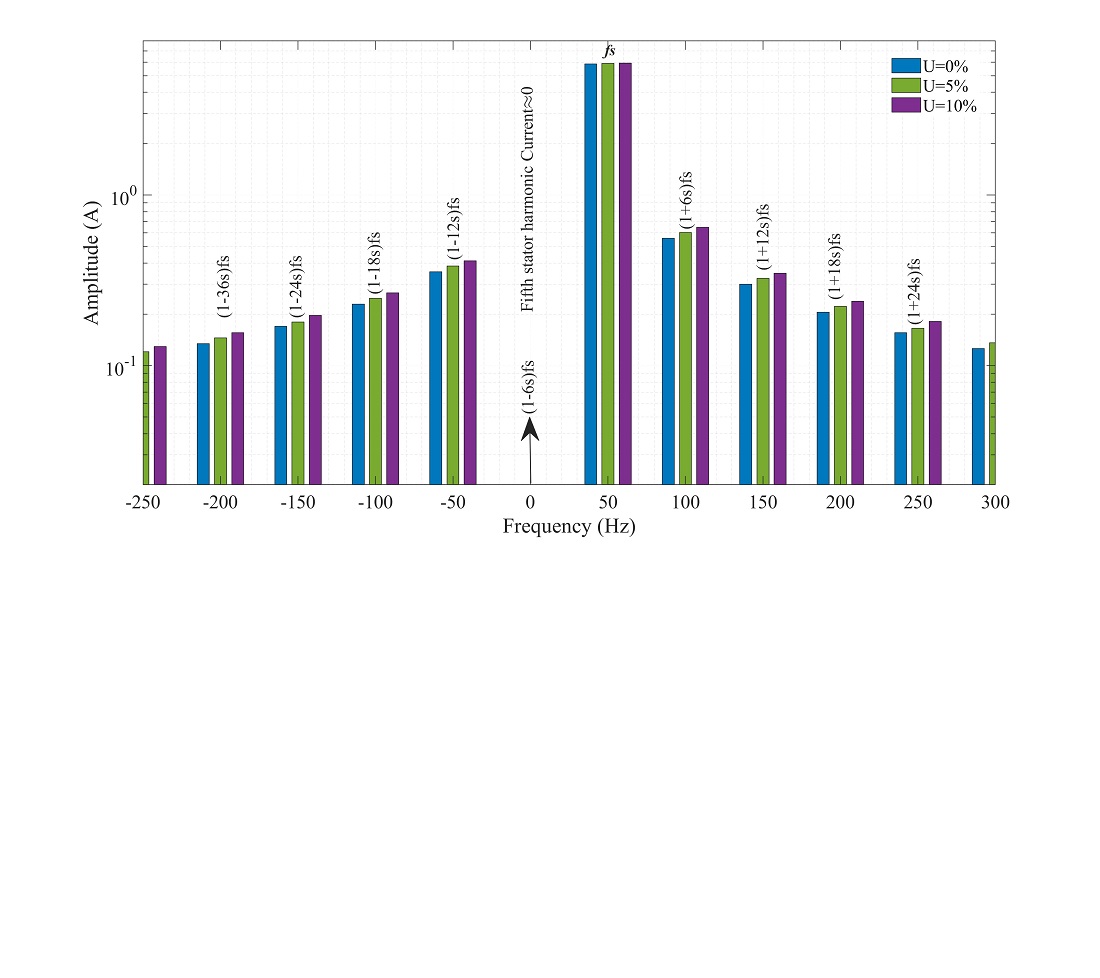
The analysis of this study presents the way for predicting the whole harmonic frequencies that belong to the currents of the stator, the rotor current, and the electromagnetic torque in terms of supply frequency and the rotor slip. The simulation and the proposed mathematical model results have shown good accuracy. The results show that the performance of WRIM, the variation of the motor currents, and the torque pulsation are dependent on the magnitude of the voltage unbalance factor and the duty cycle of the chopper circuit.
The results of this study demonstrate that the unbalanced supply voltage has a negative impact on the increase of stator harmonic currents injected from the rotor side, rotor harmonic currents, and torque pulsation; as a result, the performance of WRIMDS has been derated. It is noticed from the results that the obtained currents are accurate, excluding the currents at a slip of one sixth in which a noteworthy variance is observed. The speed ripple is increased by 0.38 %, and torque ripple by 16.6 % when the voltage supply unbalance factor varies from (0 to 10) %
References
- De Almeida, A. T., Ferreira, F. J. T. E., Fong, J. A. C. (2011). Standards for Efficiency of Electric Motors. IEEE Industry Applications Magazine, 17 (1), 12–19. https://doi.org/10.1109/mias.2010.939427
- von Jouanne, A., Banerjee, B. (2001). Assessment of voltage unbalance. IEEE Transactions on Power Delivery, 16 (4), 782–790. https://doi.org/10.1109/61.956770
- Raval, P. P., Joshi, H. I., Krishnaraj, V., Mihir, P. (2020). Speed Control of Three Phase Slip Ring Induction Motor Using Chopper. International Journal of Engineering Development and Research, 8 (2), 419–424. Available at: https://rjwave.org/ijedr/viewpaperforall.php?paper=IJEDR2002072
- Shen, T., Chen, B., Gong, Y. (2001). Study on rotor igbt chopper control for induction motor drive. Journal of Shanghai University (English Edition), 5 (1), 66–70. https://doi.org/10.1007/s11741-001-0031-7
- Outeiro, M., Saraiva, E. (2004). Harmonics on the Electromagnetic Torque of a Slip Energy Recovery System with Two Thyristor Bridges and no DC Coil. Available at: https://www.researchgate.net/publication/255594732_Harmonics_on_the_Electromagnetic_Torque_of_a_Slip_Energy_Recovery_System_with_Two_Thyristor_Bridges_and_no_DC_Coil
- Wang, L., Chiniforoosh, S., Jatskevich, J. (2008). Simulation and analysis of starting transients in rotor-chopper-controlled doubly-fed induction motors. 2008 IEEE Canada Electric Power Conference, 1–6. https://doi.org/10.1109/epc.2008.4763329
- Ameen, H. F. (2011). Computer simulation and mathematical modelling of static rotor resistance chopper control of WRIM by reference frame theory. Procedia Computer Science, 3, 1009–1017. https://doi.org/10.1016/j.procs.2010.12.166
- Ameen, H. F. (2023). The Influence of Rotor Converters on the Behavior of Static Rotor Resistance Control of Induction Motor under Supply Voltages Asymmetry. Zanco Journal of Pure and Applied Sciences, 35 (5), 24–39. https://doi.org/10.21271/zjpas.35.5.3
- Kumar, R., Dogra, R., Aggarwal, P. (2017). Rotor side speed control methods using MATLAB/Simulink for wound induction motor. International Journal of Mechanical and Mechatronics Engineering, 11 (7), 1385–1393. Available at: https://www.academia.edu/39371161/Rotor_Side_Speed_Control_Methods_Using_MATLABSimulink_for_Wound_Induction_Motor20190604_49311_1htn90w
- Bhardwaj, S. R., Rahi, O. P., Sharma, V. (2018). Comparative Analysis of Induction Motor Drive with Chopper Controlled SPRS Employing Various Inverter Configurations. IETE Journal of Research, 65 (3), 329–341. https://doi.org/10.1080/03772063.2018.1431065
- Bajjuri, N. K., Jain, A. K. (2019). Torque Ripple Reduction in Double-Inverter Fed Wound Rotor Induction Machine Drives Using PWM Techniques. IEEE Transactions on Industrial Electronics, 66 (6), 4250–4261. https://doi.org/10.1109/tie.2018.2866110
- Adekitan, A. I., Abdulkareem, A. (2016). The significance of the mode of voltage imbalance on the operation and energy losses of a 3-phase induction motor. Engineering and Applied Science Research, 46 (3), 200–209. https://doi.org/10.14456/easr.2019.23
- El-Kharashi, E., Massoud, J. G., Al-Ahmar, M. A. (2019). The impact of the unbalance in both the voltage and the frequency on the performance of single and cascaded induction motors. Energy, 181, 561–575. https://doi.org/10.1016/j.energy.2019.05.169
- Donolo, P. D., Pezzani, C. M., Bossio, G. R., De Angelo, C. H., Donolo, M. A. (2020). Derating of Induction Motors Due to Power Quality Issues Considering the Motor Efficiency Class. IEEE Transactions on Industry Applications, 56 (2), 961–969. https://doi.org/10.1109/tia.2020.2965859
- Hilmi, A., Fadhil, A. (2021). Performance Analysis and Modeling of SRRCCIM under the Impact of Unbalance Supply Voltage. Journal of Electrical and Electronics Engineering, 14 (1), 5–10. Available at: https://www.researchgate.net/profile/Hilmi-Ameen-2/publication/360969591_Performance_Analysis_and_Modeling_of_SRRCCIM_under_the_Impact_of_Unbalance_Supply_Voltage/links/62960eb9c660ab61f8549751/Performance-Analysis-and-Modeling-of-SRRCCIM-under-the-Impact-of-Unbalance-Supply-Voltage.pdf
- Tabora, J. M., De Lima Tostes, M. E., Bezerra, U. H., De Matos, E. O., Filho, C. L. P., Soares, T. M., Rodrigues, C. E. M. (2021). Assessing Energy Efficiency and Power Quality Impacts Due to High-Efficiency Motors Operating Under Nonideal Energy Supply. IEEE Access, 9, 121871–121882. https://doi.org/10.1109/access.2021.3109622
- Papathanassiou, S. A., Papadopoulos, M. P. (2001). On the harmonics of the slip energy recovery drive. IEEE Power Engineering Review, 21 (4), 55–57. https://doi.org/10.1109/39.916352
- Tsoumas, I. P. (2016). Motor-Converter Synchronization Phenomena in a Subsynchronous Cascade Drive. IEEE Transactions on Industry Applications, 52 (6), 4806–4815. https://doi.org/10.1109/tia.2016.2587776
Downloads
Published
How to Cite
Issue
Section
License
Copyright (c) 2025 Hilmi Fadhil Ameen, Ali Abdulqadir Rasool

This work is licensed under a Creative Commons Attribution 4.0 International License.
The consolidation and conditions for the transfer of copyright (identification of authorship) is carried out in the License Agreement. In particular, the authors reserve the right to the authorship of their manuscript and transfer the first publication of this work to the journal under the terms of the Creative Commons CC BY license. At the same time, they have the right to conclude on their own additional agreements concerning the non-exclusive distribution of the work in the form in which it was published by this journal, but provided that the link to the first publication of the article in this journal is preserved.
A license agreement is a document in which the author warrants that he/she owns all copyright for the work (manuscript, article, etc.).
The authors, signing the License Agreement with TECHNOLOGY CENTER PC, have all rights to the further use of their work, provided that they link to our edition in which the work was published.
According to the terms of the License Agreement, the Publisher TECHNOLOGY CENTER PC does not take away your copyrights and receives permission from the authors to use and dissemination of the publication through the world's scientific resources (own electronic resources, scientometric databases, repositories, libraries, etc.).
In the absence of a signed License Agreement or in the absence of this agreement of identifiers allowing to identify the identity of the author, the editors have no right to work with the manuscript.
It is important to remember that there is another type of agreement between authors and publishers – when copyright is transferred from the authors to the publisher. In this case, the authors lose ownership of their work and may not use it in any way.







