Розробка методики оцінки надійності розподільних електричних мереж напругою до 110 кВ
DOI:
https://doi.org/10.15587/1729-4061.2025.322920Ключові слова:
розподільні мережі, надійність електроенергії, Марківські процеси, оцінка резервування, інтенсивність відмовАнотація
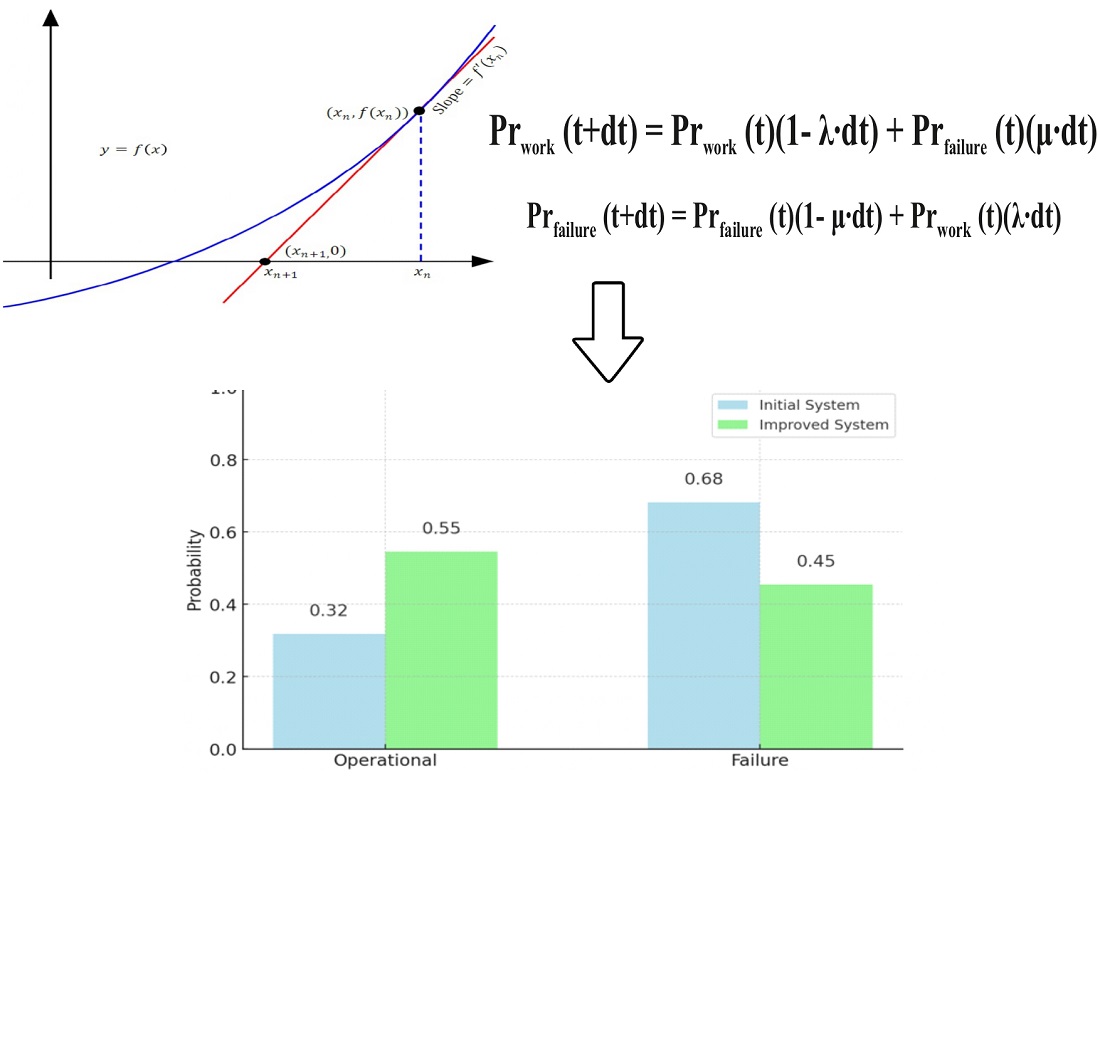
Дослідження зосереджено на оцінці надійності розподільних електромереж, що працюють з напругою до 110 кВ, вирішуючи проблеми збільшення навантажень, старіння інфраструктури та інтеграції відновлюваних джерел енергії. Запропоновано новий метод і модель для оцінки надійності, що включає частоту відмов, час відновлення та топологічні характеристики мереж. Дослідження визначає критичні фактори, що впливають на надійність мережі, включаючи рівень резервування, умови експлуатації та кліматичні впливи. Помітні результати показують, що точки мережі з кількома з’єднаннями фідерів демонструють найвищу надійність, що перевищує 99,99 %, тоді як точки з конфігурацією з одним трансформатором є найбільш вразливими до збоїв. Середня частота відмов для повітряних ліній розрахована на рівні 1,29 відмов на 100 км на рік, а час відновлення досягає до 40 годин для критичних вузлів.
Результати пояснюються взаємодією структурних і експлуатаційних факторів, де резервування значно підвищує надійність, а застаріле обладнання збільшує вразливість. Відмінною рисою дослідження є використання Марківських процесів для динамічного моделювання збоїв і відновлення, пропонуючи комплексну структуру порівняно з традиційними статичними методами. Практичні застосування результатів включають удосконалення дизайну мережі за рахунок покращеного резервування, оптимізацію стратегій обслуговування критичних елементів та підтримку інтеграції технологій Smart Grid. Ці висновки сприяють розробці більш стійких і ефективних мереж розподілу електроенергії, адаптованих до сучасних експлуатаційних вимог
Посилання
- Singh, S., Singh, S. (2024). Advancements and Challenges in Integrating Renewable Energy Sources Into Distribution Grid Systems: A Comprehensive Review. Journal of Energy Resources Technology, 146 (9). https://doi.org/10.1115/1.4065503
- Kaverin, V., Abisheva, D., Em, G., Kalinin, A., Yugay, V. (2022). Studying Partial Discharge Currents of High Voltage Power Line Suspension Insulators. International Journal on Energy Conversion (IRECON), 10 (3), 88. https://doi.org/10.15866/irecon.v10i3.21769
- Kayumov, D., Bulatbaev, F., Kayumova, I., Breido, J., Bulatbayeva, Y. (2023). An engineering approach for the qualitative assessment of the luminous flux of led lamps. International Journal of Energy for a Clean Environment, 24 (1), 31–43. https://doi.org/10.1615/interjenercleanenv.2022043776
- Wang, Y., Zheng, Q., Guo, M., Xiao, H., Si, C., Chen, W. (2022). Reliability Improvement of Distribution Network with Distributed Generation Sources and Diversified Loads. LOW VOLTAGE APPARATUS, 2, 63–67. Available at: http://www.eaes-seari.com/Jwk_dqynxgljs/EN/abstract/abstract480.shtml
- Soltan, S., Mazauric, D., Zussman, G. (2017). Analysis of Failures in Power Grids. IEEE Transactions on Control of Network Systems, 4 (2), 288–300. https://doi.org/10.1109/tcns.2015.2498464
- Wu, Y., Fan, T., Huang, T. (2020). Electric Power Distribution System Reliability Evaluation Considering the Impact of Weather on Component Failure and Pre-Arranged Maintenance. IEEE Access, 8, 87800–87809. https://doi.org/10.1109/access.2020.2993087
- Tatkeyeva, G., Bauyrzhanuly, M., Gaukhar, A., Assainov, G., Khabdullina, G., Tangirbergen, A. et al. (2024). Development of the logical system for forecasting wind characteristics in the urban conditions. EUREKA: Physics and Engineering, 2, 55–69. https://doi.org/10.21303/2461-4262.2024.003305
- Li, S., She, Y., Shi, K., Chen, Z. (2022). A Method for Evaluating Reliability and Failure Rate of DC Circuit Breakers. 2022 Global Conference on Robotics, Artificial Intelligence and Information Technology (GCRAIT), 578–581. https://doi.org/10.1109/gcrait55928.2022.00126
- Cao, H., Song, Y., Wang, S., Dai, F., Liu, J., Cheng, Q. (2024). Failure Mode Analysis and Identification Method Based on the External Characteristics of DC Circuit Breaker. 2024 China International Conference on Electricity Distribution (CICED), 01–05. https://doi.org/10.1109/ciced63421.2024.10754216
- Pande, P., Hussain, K., Pravallika, B., Al Ansari, M. S., Tharsanee, R. M., Acharya, S. (2024). Predictive Maintenance of Power Transformers in Distribution Network with Energy Management Using Deep Learning. 2024 5th International Conference on Intelligent Communication Technologies and Virtual Mobile Networks (ICICV), 581–586. https://doi.org/10.1109/icicv62344.2024.00098
- Biradar, V., Kakeri, D., Agasti, A. (2024). Machine Learning based Predictive Maintenance in Distribution Transformers. 2024 8th International Conference on Computing, Communication, Control and Automation (ICCUBEA), 1–5. https://doi.org/10.1109/iccubea61740.2024.10774993
- Reddy Shabad, P. K., Alrashide, A., Mohammed, O. (2021). Anomaly Detection in Smart Grids using Machine Learning. IECON 2021 – 47th Annual Conference of the IEEE Industrial Electronics Society, 1–8. https://doi.org/10.1109/iecon48115.2021.9589851
- Papaspiliotopoulos, V. A., Korres, G. N., Hatziargyriou, N. D. (2015). Protection coordination in modern distribution grids integrating optimization techniques with adaptive relay setting. 2015 IEEE Eindhoven PowerTech, 1–6. https://doi.org/10.1109/ptc.2015.7232558
- Rêma, G. S., Bonatto, B. D., de Lima, A. C. S., de Carvalho, A. T. (2024). Emerging Trends in Power Transformer Maintenance and Diagnostics: A Scoping Review of Asset Management Methodologies, Condition Assessment Techniques, and Oil Analysis. IEEE Access, 12, 111451–111467. https://doi.org/10.1109/access.2024.3441523
- Carletti, E., Amadei, F., Franzone, G., Rizzati, J., Cocchi, L., Bolognesi, M., Moschella, P. (2023). The reliability of the electrical distribution system using the Markov Modeling methodology. IET Conference Proceedings, 2023 (6), 1115–1119. https://doi.org/10.1049/icp.2023.0655
- Borges, C. L. T., Cantarino, E. (2011). Microgrids Reliability Evaluation with Renewable Distributed Generation and Storage Systems. IFAC Proceedings Volumes, 44 (1), 11695–11700. https://doi.org/10.3182/20110828-6-it-1002.01090
- Song, H., Zhang, B., Wang, M., Xiao, Y., Zhang, L., Zhong, H. (2022). A Fast Phase Optimization Approach of Distributed Scatterer for Multitemporal SAR Data Based on Gauss–Seidel Method. IEEE Geoscience and Remote Sensing Letters, 19, 1–5. https://doi.org/10.1109/lgrs.2021.3077493
- Hu, W. J. (2021). Momentum Method for Improving the Convergence of Newton-Raphson Method for Nonlinear Circuit Transient Simulations. 2021 IEEE International Conference on Computer Science, Artificial Intelligence and Electronic Engineering (CSAIEE), 296–303. https://doi.org/10.1109/csaiee54046.2021.9543125
- Wei, J., Cai, H., Jiang, T., Westermann, D. (2021). Research on Power System Network Equivalent with Different Methods. PESS 2021; Power and Energy Student Summit.
- Gupta, A. P., Mohapatra, A., Singh, S. N. (2018). Power System Network Equivalents: Key Issues and Challenges. TENCON 2018 - 2018 IEEE Region 10 Conference, 2291–2296. https://doi.org/10.1109/tencon.2018.8650397
- Aghili, J., Franck, E., Hild, R., Michel-Dansac, V., Vigon, V. (2025). Accelerating the convergence of Newton’s method for nonlinear elliptic PDEs using Fourier neural operators. Communications in Nonlinear Science and Numerical Simulation, 140, 108434. https://doi.org/10.1016/j.cnsns.2024.108434
- Ramli, S. P., Usama, M., Mokhlis, H., Wong, W. R., Hussain, M. H., Muhammad, M. A., Mansor, N. N. (2021). Optimal directional overcurrent relay coordination based on computational intelligence technique: a review. Turkish Journal of Electrical Engineering and Computer Sciences, 29 (3), 1284–1307. https://doi.org/10.3906/elk-2012-98
##submission.downloads##
Опубліковано
Як цитувати
Номер
Розділ
Ліцензія
Авторське право (c) 2025 Fariza Abilzhanova, Felix Bulatbaev, Aizada Kuanyshtaeva

Ця робота ліцензується відповідно до Creative Commons Attribution 4.0 International License.
Закріплення та умови передачі авторських прав (ідентифікація авторства) здійснюється у Ліцензійному договорі. Зокрема, автори залишають за собою право на авторство свого рукопису та передають журналу право першої публікації цієї роботи на умовах ліцензії Creative Commons CC BY. При цьому вони мають право укладати самостійно додаткові угоди, що стосуються неексклюзивного поширення роботи у тому вигляді, в якому вона була опублікована цим журналом, але за умови збереження посилання на першу публікацію статті в цьому журналі.
Ліцензійний договір – це документ, в якому автор гарантує, що володіє усіма авторськими правами на твір (рукопис, статтю, тощо).
Автори, підписуючи Ліцензійний договір з ПП «ТЕХНОЛОГІЧНИЙ ЦЕНТР», мають усі права на подальше використання свого твору за умови посилання на наше видання, в якому твір опублікований. Відповідно до умов Ліцензійного договору, Видавець ПП «ТЕХНОЛОГІЧНИЙ ЦЕНТР» не забирає ваші авторські права та отримує від авторів дозвіл на використання та розповсюдження публікації через світові наукові ресурси (власні електронні ресурси, наукометричні бази даних, репозитарії, бібліотеки тощо).
За відсутності підписаного Ліцензійного договору або за відсутністю вказаних в цьому договорі ідентифікаторів, що дають змогу ідентифікувати особу автора, редакція не має права працювати з рукописом.
Важливо пам’ятати, що існує і інший тип угоди між авторами та видавцями – коли авторські права передаються від авторів до видавця. В такому разі автори втрачають права власності на свій твір та не можуть його використовувати в будь-який спосіб.