Встановлення залежності каталітичної активності калій гліцерату від умов зберігання
DOI:
https://doi.org/10.15587/1729-4061.2025.322987Ключові слова:
каталізатор переетерифікування калій гліцерат, олеїн пальмовий, тригліцеридний склад, температура плавленняАнотація
Об’єктом дослідження є каталітична активність калій гліцерату в реакції хімічного переетерифікування пальмового олеїну.
Переетерифікування є важливим методом отримання жирів з необхідними показниками, поверхнево-активних речовин, альтернативного біопалива тощо. Промислові каталізатори хімічного переетерифікування є вибухо-, пожежонебезпечними, швидко втрачають активність. Більш безпечними та стійкими каталізаторами є гліцерати лужних металів.
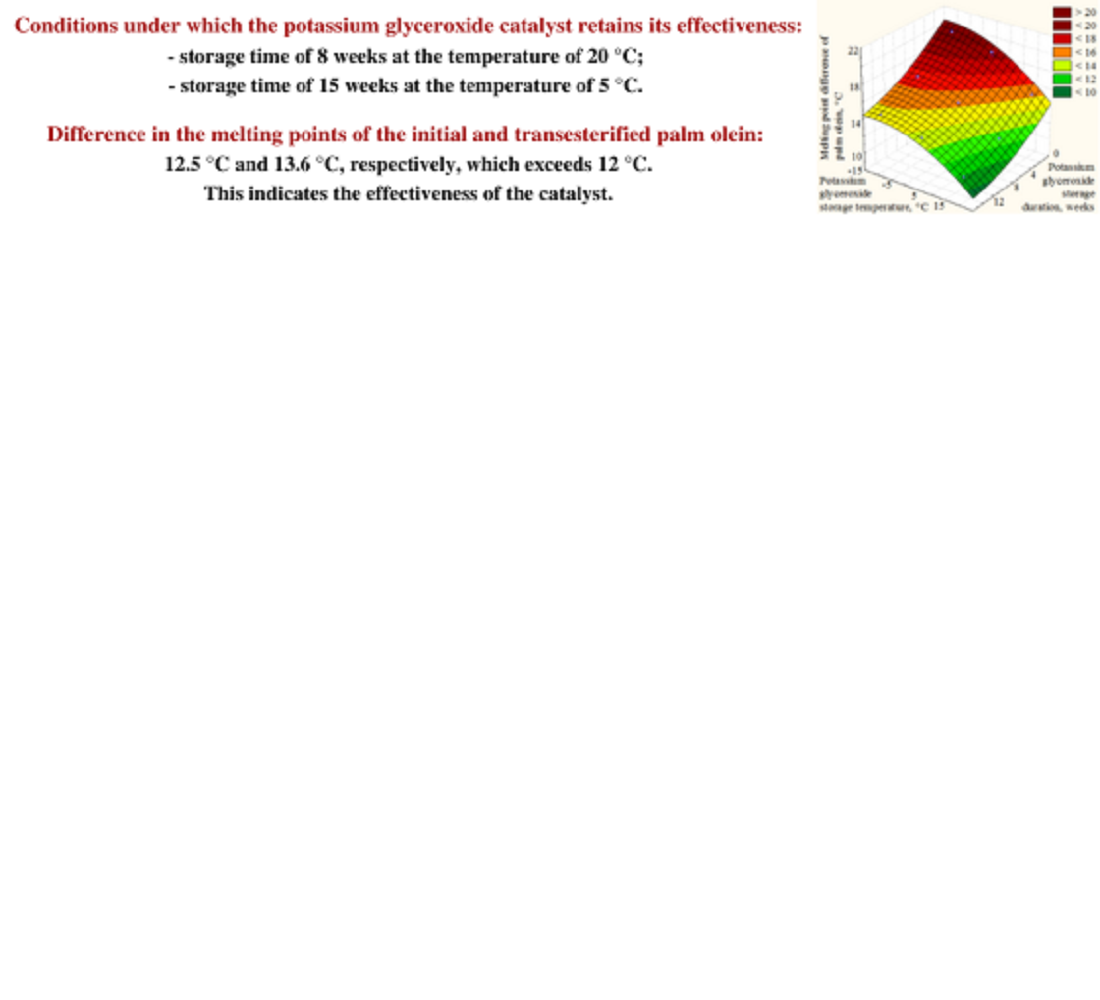
Досліджено залежність каталітичної активності калій гліцерату (CAS Number 43110-90-3) від умов зберігання. Як критерій ефективності каталізатору використано підвищення температури плавлення пальмового олеїну в результаті переетерифікування більше ніж на 12 °С. Використано олеїн пальмовий рафінований вибілений дезодорований (ДСТУ 4438:2005, CAS Number 93334-39-5) з показниками: пероксидне число 0,18 ½ О ммоль/кг, кислотне число 0,12 мг КОН/г, температура плавлення 22,2 °С.
Встановлено умови, за яких калій гліцерат зберігає ефективність: тривалість зберігання 8 тижнів за температури 20 °С; тривалість зберігання 15 тижнів за температури 5 °С. Різниця температур плавлення початкового та переетерифікованого олеїну склала 12,5 °С та 13,6 °С відповідно. За методом хроматографічного аналізу підтверджено зміну тригліцеридного складу переетерифікованого олеїну.
Встановлено, що промисловий каталізатор натрій метилат, який зберігався за цих же умов, втратив ефективність. Різниця температур плавлення початкового та переетерифікованого олеїну склала 7,5 °С та 9,7 °С відповідно.
Одержані дані дозволяють ефективно проводити процес переетерифікування жирів у присутності більш стійкого каталізатору калій гліцерату, який може бути попередньо вироблений та зберігатися на підприємстві
Посилання
- Sytnik, N., Demydov, I., Kunitsa, E. (2015). Effectiveness research of new catalyst for oil and fat interesterification by using chromatographic analysis. Technology Audit and Production Reserves, 6 (4 (26)), 8–13. https://doi.org/10.15587/2312-8372.2015.53285
- Malpartida, I., Maireles-Torres, P., Vereda, C., Rodríguez-Maroto, J. M., Halloumi, S., Lair, V. et al. (2020). Semi-continuous mechanochemical process for biodiesel production under heterogeneous catalysis using calcium diglyceroxide. Renewable Energy, 159, 117–126. https://doi.org/10.1016/j.renene.2020.05.020
- Sánchez, B. S., Benitez, B., Querini, C. A., Mendow, G. (2015). Transesterification of sunflower oil with ethanol using sodium ethoxide as catalyst. Effect of the reaction conditions. Fuel Processing Technology, 131, 29–35. https://doi.org/10.1016/j.fuproc.2014.10.043
- Catarino, M., Martins, S., Soares Dias, A. P., Costa Pereira, M. F., Gomes, J. (2019). Calcium diglyceroxide as a catalyst for biodiesel production. Journal of Environmental Chemical Engineering, 7 (3), 103099. https://doi.org/10.1016/j.jece.2019.103099
- Korchak, M., Bragin, O., Petrova, O., Shevchuk, N., Strikha, L., Stankevych, S. et al. (2022). Development of transesterification model for safe technology of chemical modification of oxidized fats. Eastern-European Journal of Enterprise Technologies, 6 (6 (120)), 14–19. https://doi.org/10.15587/1729-4061.2022.266931
- Lau, P.-C., Kwong, T.-L., Yung, K.-F. (2022). Manganese glycerolate catalyzed simultaneous esterification and transesterification: The kinetic and mechanistic study, and application in biodiesel and bio-lubricants synthesis. Renewable Energy, 189, 549–558. https://doi.org/10.1016/j.renene.2022.02.127
- Ferrero, G. O., Almeida, M. F., Alvim-Ferraz, M. C. M., Dias, J. M. (2015). Glycerol-enriched heterogeneous catalyst for biodiesel production from soybean oil and waste frying oil. Energy Conversion and Management, 89, 665–671. https://doi.org/10.1016/j.enconman.2014.10.032
- Lisboa, F. S., Ferreira, E. B., Silva, F. J. L. B., Silva, F. R. (2023). Structural stability and catalytic activity of calcium glycerolates in soybean oil methyl transesterification reactions. Reaction Kinetics, Mechanisms and Catalysis, 136 (2), 851–865. https://doi.org/10.1007/s11144-023-02391-2
- Ebadi Pour, N., Dumeignil, F., Katryniok, B., Delevoye, L., Revel, B., Paul, S. (2021). Investigating the active phase of Ca-based glycerol polymerization catalysts: On the importance of calcium glycerolate. Molecular Catalysis, 507, 111571. https://doi.org/10.1016/j.mcat.2021.111571
- Fá, A., Bechthold, P., Juan, A., Marchetti, J. M. (2024). The formation of calcium glycerolate as an active species in the synthesis of biodiesel. A DFT study. Applied Surface Science Advances, 24, 100657. https://doi.org/10.1016/j.apsadv.2024.100657
- Bradley, D., Levin, E., Rodriguez, C., Williard, P. G., Stanton, A., Socha, A. M. (2016). Equilibrium studies of canola oil transesterification using a sodium glyceroxide catalyst prepared from a biodiesel waste stream. Fuel Processing Technology, 146, 70–75. https://doi.org/10.1016/j.fuproc.2016.02.009
- Santos, S., Braun, J., Espíndola, G., da Silva, J., Renner, R., Fontoura, L. (2024). Sodium Glyceroxide: An Efficient Homogeneous Alkaline Catalyst for Biodiesel Synthesis. Journal of the Brazilian Chemical Society, 35 (7). https://doi.org/10.21577/0103-5053.20240013
- Wang, E., Shen, J., Wang, Y., Tang, S., Emami, S., Reaney, M. J. T. (2015). Production of biodiesel with lithium glyceroxide. Fuel, 160, 621–628. https://doi.org/10.1016/j.fuel.2015.07.101
- Liang, X., Fei, H., Zhou, C., Ye, X., Xie, Q., Wu, Z., Yu, S. et al. (2023). Zinc glycerolate: An unconventional heterogeneous catalyst for the glycerolysis of fatty acids in biodiesel production. Renewable Energy, 218, 119140. https://doi.org/10.1016/j.renene.2023.119140
- Pradhan, S., Shen, J., Emami, S., Mohanty, P., Naik, S. N., Dalai, A. K., Reaney, M. J. T. (2017). Synthesis of potassium glyceroxide catalyst for sustainable green fuel (biodiesel) production. Journal of Industrial and Engineering Chemistry, 46, 266–272. https://doi.org/10.1016/j.jiec.2016.10.038
- Erisna, D., Arita, S., Hadiah, F. (2024). Transesterification Process of Biodiesel with Potassium Glycerolate Catalyst. Indonesian Journal of Fundamental and Applied Chemistry, 9 (1), 1–8. https://doi.org/10.24845/ijfac.v9.i1.1
- Theam, K. L., Islam, A., Choo, Y. M., Taufiq-Yap, Y. H. (2015). Biodiesel from low cost palm stearin using metal doped methoxide solid catalyst. Industrial Crops and Products, 76, 281–289. https://doi.org/10.1016/j.indcrop.2015.06.058
##submission.downloads##
Опубліковано
Як цитувати
Номер
Розділ
Ліцензія
Авторське право (c) 2025 Liubov Morozova, Vita Glavatchuk, Oleksandr Minieiev, Tetiana Tkachenko, Larysa Marushko, Svitlana Korolchuk, Tanya Savchuk, Anastasiia Kolesnyk, Valentyna Mohutova, Roman Mylostyvyi

Ця робота ліцензується відповідно до Creative Commons Attribution 4.0 International License.
Закріплення та умови передачі авторських прав (ідентифікація авторства) здійснюється у Ліцензійному договорі. Зокрема, автори залишають за собою право на авторство свого рукопису та передають журналу право першої публікації цієї роботи на умовах ліцензії Creative Commons CC BY. При цьому вони мають право укладати самостійно додаткові угоди, що стосуються неексклюзивного поширення роботи у тому вигляді, в якому вона була опублікована цим журналом, але за умови збереження посилання на першу публікацію статті в цьому журналі.
Ліцензійний договір – це документ, в якому автор гарантує, що володіє усіма авторськими правами на твір (рукопис, статтю, тощо).
Автори, підписуючи Ліцензійний договір з ПП «ТЕХНОЛОГІЧНИЙ ЦЕНТР», мають усі права на подальше використання свого твору за умови посилання на наше видання, в якому твір опублікований. Відповідно до умов Ліцензійного договору, Видавець ПП «ТЕХНОЛОГІЧНИЙ ЦЕНТР» не забирає ваші авторські права та отримує від авторів дозвіл на використання та розповсюдження публікації через світові наукові ресурси (власні електронні ресурси, наукометричні бази даних, репозитарії, бібліотеки тощо).
За відсутності підписаного Ліцензійного договору або за відсутністю вказаних в цьому договорі ідентифікаторів, що дають змогу ідентифікувати особу автора, редакція не має права працювати з рукописом.
Важливо пам’ятати, що існує і інший тип угоди між авторами та видавцями – коли авторські права передаються від авторів до видавця. В такому разі автори втрачають права власності на свій твір та не можуть його використовувати в будь-який спосіб.