Розробка методу розв’язання багатокритеріальної задачі про найкоротший маршрут з нечіткими вихідними даними
DOI:
https://doi.org/10.15587/1729-4061.2025.322991Ключові слова:
багатофакторна оптимізація, оптимальний маршрут, нечіткі дані, функція приналежності, нечіткий критерійАнотація
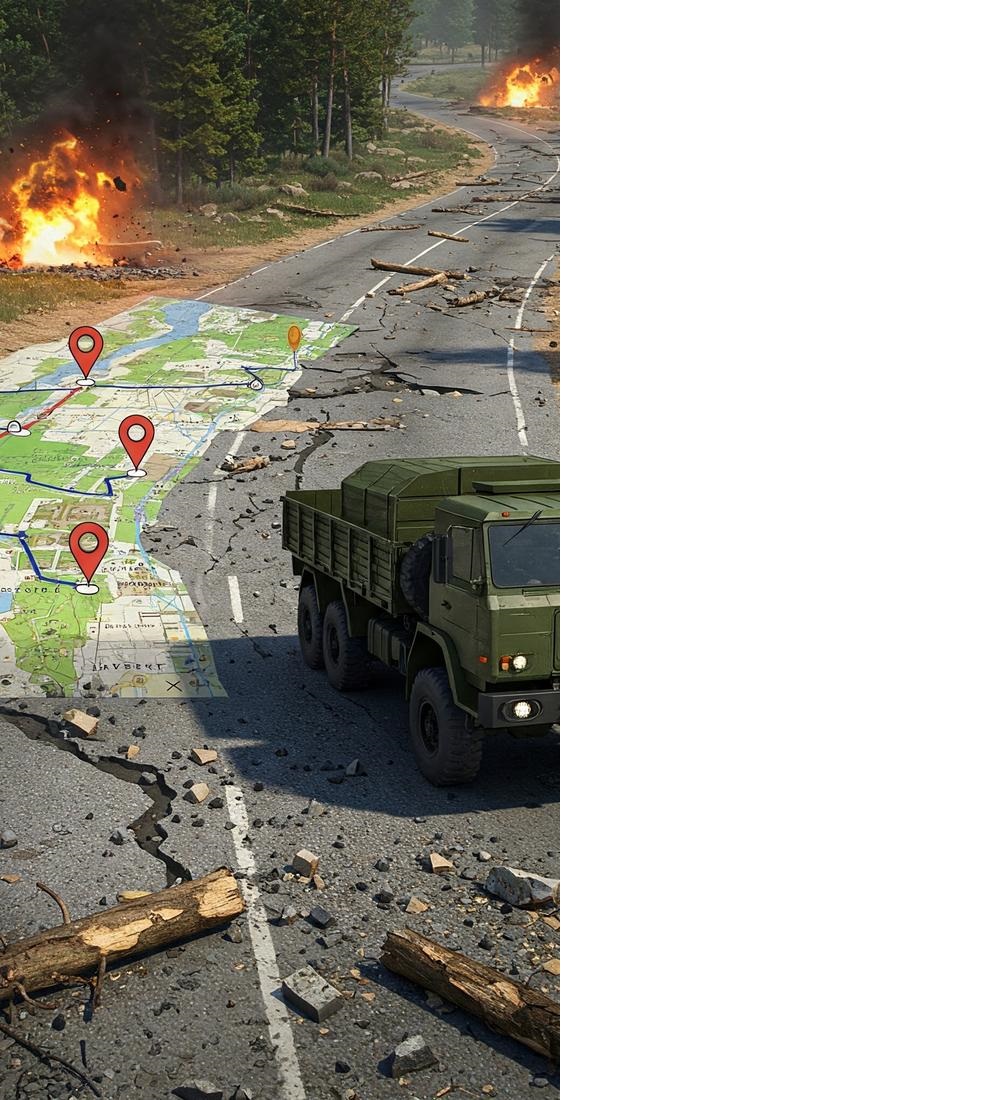
Об'єктом дослідження є оптимізація маршрутів автомобільних вантажоперевезень в умовах воєнного стану або надзвичайних ситуацій. У роботі вирішувалася проблема розробки моделі та методу розв'язання багатокритеріальної задачі про найкоротший маршрут з урахуванням нечіткості вихідних даних та множинності критеріїв оптимізації. Вихідними даними є довжини комунікацій, рівень їх безпеки та якість дорожнього покриття, представлені елементами нечітких множин з відповідними функціями приналежності, та граф дорожньої мережі. Введення системи правил, за якими обирається оптимальна за трьома критеріями комунікація, дозволило сформулювати узагальнений нечіткий критерій оптимізації для ребер графу, представлений функцією приналежності нечіткої мети. Цей критерій використовується як вага ребер в розробленому методі розв’язання поставленої задачі і дозволяє одночасно врахувати нечіткість вихідних даних та кілька критеріїв оптимізації. Метод розв’язання задачі базується на модифікованому алгоритмі Дейкстри. Для обробки нечітких даних використовується нечітке логічне виведення для формування узагальненого критерію оптимізації та підхід Беллмана-Заде для задачі оптимізації. Результатами розв’язання задачі є оптимальний маршрут, його довжина, рівень безпеки та якості дорожнього покриття. Для розглянутої дорожньої мережі довжина оптимального маршруту (41 км) не є найменшою, порівняно з іншими методами (від 19 км до 50 км), але рівень безпеки маршруту високий (0,75). Це обумовлено значеннями вагових коефіцієнтів критеріїв оптимізації. Застосування цього методу для оптимізації маршрутів вантажних перевезень в умовах воєнного стану дозволить підвищити ефективність та надійність транспортних систем в умовах невизначеності
Посилання
- Sebayang, V. N. C., Rosyida, I. (2022). Implementations of Dijkstra Algorithm for Searching the Shortest Route of Ojek Online and a Fuzzy Inference System for Setting the Fare Based on Distance and Difficulty of Terrain (Case Study: in Semarang City, Indonesia). Proceedings of the International Conference on Mathematics, Geometry, Statistics, and Computation (IC-MaGeStiC 2021). https://doi.org/10.2991/acsr.k.220202.016
- Tordecilla, R. D., Martins, L. do C., Panadero, J., Copado, P. J., Perez-Bernabeu, E., Juan, A. A. (2021). Fuzzy Simheuristics for Optimizing Transportation Systems: Dealing with Stochastic and Fuzzy Uncertainty. Applied Sciences, 11 (17), 7950. https://doi.org/10.3390/app11177950
- Aroniadi, C., Beligiannis, G. N. (2024). Solving the Fuzzy Transportation Problem by a Novel Particle Swarm Optimization Approach. Applied Sciences, 14 (13), 5885. https://doi.org/10.3390/app14135885
- Ntakolia, C., Lyridis, D. V. (2021). A Swarm Intelligence Graph-Based Pathfinding Algorithm Based on Fuzzy Logic (SIGPAF): A Case Study on Unmanned Surface Vehicle Multi-Objective Path Planning. Journal of Marine Science and Engineering, 9 (11), 1243. https://doi.org/10.3390/jmse9111243
- Wang, C.-N., Dang, T.-T., Le, T. Q., Kewcharoenwong, P. (2020). Transportation Optimization Models for Intermodal Networks with Fuzzy Node Capacity, Detour Factor, and Vehicle Utilization Constraints. Mathematics, 8 (12), 2109. https://doi.org/10.3390/math8122109
- Milošević, T., Pamučar, D., Chatterjee, P. (2021). Model for selecting a route for the transport of hazardous materials using a fuzzy logic system. Vojnotehnicki Glasnik, 69 (2), 355–390. https://doi.org/10.5937/vojtehg69-29629
- Lin, L., Wu, C., Ma, L. (2020). A genetic algorithm for the fuzzy shortest path problem in a fuzzy network. Complex & Intelligent Systems, 7 (1), 225–234. https://doi.org/10.1007/s40747-020-00195-8
- Ortega, J., Tóth, J., Moslem, S., Péter, T., Duleba, S. (2020). An Integrated Approach of Analytic Hierarchy Process and Triangular Fuzzy Sets for Analyzing the Park-and-Ride Facility Location Problem. Symmetry, 12 (8), 1225. https://doi.org/10.3390/sym12081225
- Matviienko, O. I., Miroshnichenko, O. O. (2024). Application of fuzzy vector optimization methods for diet compilation. Bulletin of the National Technical University “KhPI”. Series: Mathematical Modeling in Engineering and Technologies, 2, 46–54. https://doi.org/10.20998/2222-0631.2023.02(5).05
- Matviienko, O., Zakutnii, S. (2024). Fuzzy logic in the problems of determining the economic parameters of project implementation. Innovative Technologies and Scientific Solutions for Industries, 1 (27), 96–108. https://doi.org/10.30837/itssi.2024.27.096
- Bellman, R. E., Zadeh, L. A. (1970). Decision-Making in a Fuzzy Environment. Management Science, 17 (4), B-141–B-164. https://doi.org/10.1287/mnsc.17.4.b141
##submission.downloads##
Опубліковано
Як цитувати
Номер
Розділ
Ліцензія
Авторське право (c) 2025 Olha Matviienko, Oleksandr Miroshnichenko

Ця робота ліцензується відповідно до Creative Commons Attribution 4.0 International License.
Закріплення та умови передачі авторських прав (ідентифікація авторства) здійснюється у Ліцензійному договорі. Зокрема, автори залишають за собою право на авторство свого рукопису та передають журналу право першої публікації цієї роботи на умовах ліцензії Creative Commons CC BY. При цьому вони мають право укладати самостійно додаткові угоди, що стосуються неексклюзивного поширення роботи у тому вигляді, в якому вона була опублікована цим журналом, але за умови збереження посилання на першу публікацію статті в цьому журналі.
Ліцензійний договір – це документ, в якому автор гарантує, що володіє усіма авторськими правами на твір (рукопис, статтю, тощо).
Автори, підписуючи Ліцензійний договір з ПП «ТЕХНОЛОГІЧНИЙ ЦЕНТР», мають усі права на подальше використання свого твору за умови посилання на наше видання, в якому твір опублікований. Відповідно до умов Ліцензійного договору, Видавець ПП «ТЕХНОЛОГІЧНИЙ ЦЕНТР» не забирає ваші авторські права та отримує від авторів дозвіл на використання та розповсюдження публікації через світові наукові ресурси (власні електронні ресурси, наукометричні бази даних, репозитарії, бібліотеки тощо).
За відсутності підписаного Ліцензійного договору або за відсутністю вказаних в цьому договорі ідентифікаторів, що дають змогу ідентифікувати особу автора, редакція не має права працювати з рукописом.
Важливо пам’ятати, що існує і інший тип угоди між авторами та видавцями – коли авторські права передаються від авторів до видавця. В такому разі автори втрачають права власності на свій твір та не можуть його використовувати в будь-який спосіб.