Development a predictive optimization model to minimize delays and inefficiencies at special ports
DOI:
https://doi.org/10.15587/1729-4061.2025.323188Keywords:
Abstract
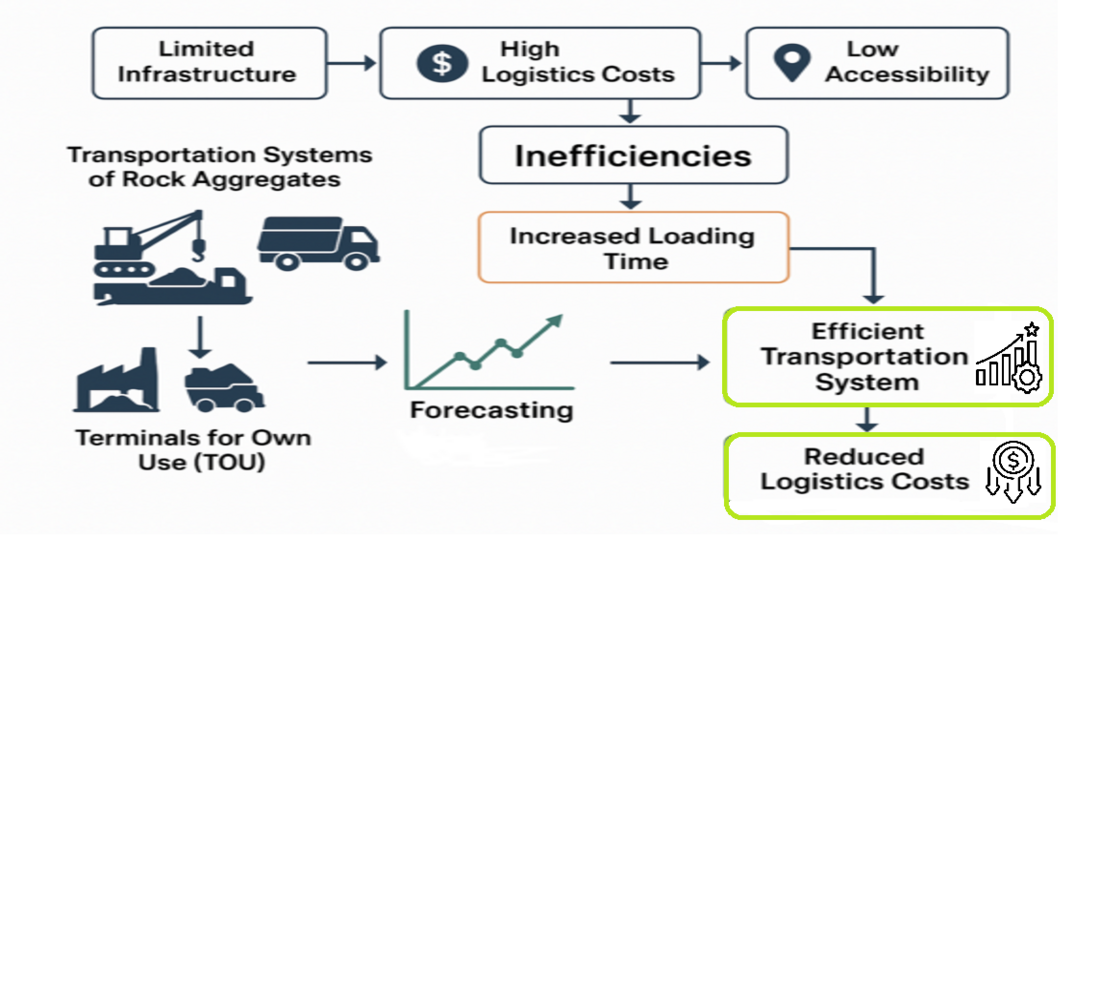
The object of this study is the transportation system of rock aggregates in an archipelagic logistics context, focusing on the integration of sea and land transportation modes at Terminals for Own Use (TOU) in Indonesia. In many island-based countries like Indonesia, maritime logistics efficiency plays a critical role in supporting economic competitiveness. However, challenges such as limited infrastructure, high logistics costs, and low accessibility persist, especially at Terminals for Own Use, where the loading and unloading of bulk commodities like rock aggregates can take 2–5 days due to equipment limitations. These inefficiencies increase mooring times and operational costs, weakening supply chain performance and industrial competitiveness. As demand for construction materials grows, optimizing port infrastructure and transportation connectivity becomes urgent. This study utilizes a Long Short-Term Memory (LSTM) model optimized with Particle Swarm Optimization (PSO) to improve the accuracy of rock aggregate demand forecasting. The model achieves a Mean Absolute Percentage Error (MAPE) of 0.46 % on training data and 5.26 % on test data, indicating high forecast reliability. Time series analysis identifies a downward trend in demand in 2022, indicating the importance of accurate forecasting in reducing inefficiencies. Better forecasting enables better port scheduling and inventory management, leading to a responsive logistics system. The results show that an efficient and demand-responsive transportation system significantly reduces loading time and overall logistics costs. The study highlights that a well-integrated forecasting approach can support better decision-making in port management and transportation planning. By optimizing transportation efficiency and connectivity, the proposed model offers insights for stakeholders, ensuring that future infrastructure planning is aligned with sustainability goals
References
- Tovar, B., Wall, A. (2022). The relationship between port-level maritime connectivity and efficiency. Journal of Transport Geography, 98, 103213. https://doi.org/10.1016/j.jtrangeo.2021.103213
- Surury, F., Syauqi, A., Purwanto, W. W. (2021). Multi-objective optimization of petroleum product logistics in Eastern Indonesia region. The Asian Journal of Shipping and Logistics, 37 (3), 220–230. https://doi.org/10.1016/j.ajsl.2021.05.003
- Seyedan, M., Mafakheri, F. (2020). Predictive big data analytics for supply chain demand forecasting: methods, applications, and research opportunities. Journal of Big Data, 7 (1). https://doi.org/10.1186/s40537-020-00329-2
- Interview on Operational Challenges at PT. Watu Meriba Jaya (2020). P. T. W. M. J. Mining Engineering Team Leader.
- Aldahmani, E., Alzubi, A., Iyiola, K. (2024). Demand Forecasting in Supply Chain Using Uni-Regression Deep Approximate Forecasting Model. Applied Sciences, 14 (18), 8110. https://doi.org/10.3390/app14188110
- Atmayudha, A., Syauqi, A., Purwanto, W. W. (2021). Green logistics of crude oil transportation: A multi-objective optimization approach. Cleaner Logistics and Supply Chain, 1, 100002. https://doi.org/10.1016/j.clscn.2021.100002
- Terrada, L., Khaili, M. E., Ouajji, H. (2022). Demand Forecasting Model using Deep Learning Methods for Supply Chain Management 4.0. International Journal of Advanced Computer Science and Applications, 13 (5). https://doi.org/10.14569/ijacsa.2022.0130581
- Liu, W., Sun, D., Xu, T. (2019). Integrated Production and Distribution Planning for the Iron Ore Concentrate. Mathematical Problems in Engineering, 2019 (1). https://doi.org/10.1155/2019/7948349
- Abolghasemi, M., Beh, E., Tarr, G., Gerlach, R. (2020). Demand forecasting in supply chain: The impact of demand volatility in the presence of promotion. Computers & Industrial Engineering, 142, 106380. https://doi.org/10.1016/j.cie.2020.106380
- Gundu, V., Simon, S. P. (2020). PSO–LSTM for short term forecast of heterogeneous time series electricity price signals. Journal of Ambient Intelligence and Humanized Computing, 12 (2), 2375–2385. https://doi.org/10.1007/s12652-020-02353-9
- Cui, T., Shi, Y., Wang, J., Ding, R., Li, J., Li, K. (2025). Practice of an improved many-objective route optimization algorithm in a multimodal transportation case under uncertain demand. Complex & Intelligent Systems, 11 (2). https://doi.org/10.1007/s40747-024-01725-4
- Binsfeld, T., Hamdan, S., Jouini, O., Gast, J. (2024). On the optimization of green multimodal transportation: a case study of the West German canal system. Annals of Operations Research. https://doi.org/10.1007/s10479-024-06075-5
Downloads
Published
How to Cite
Issue
Section
License
Copyright (c) 2025 Syarifuddin Ishak, Ludfi Djakfa, Achmad Wicaksono, Moch Abdillah Nafis

This work is licensed under a Creative Commons Attribution 4.0 International License.
The consolidation and conditions for the transfer of copyright (identification of authorship) is carried out in the License Agreement. In particular, the authors reserve the right to the authorship of their manuscript and transfer the first publication of this work to the journal under the terms of the Creative Commons CC BY license. At the same time, they have the right to conclude on their own additional agreements concerning the non-exclusive distribution of the work in the form in which it was published by this journal, but provided that the link to the first publication of the article in this journal is preserved.
A license agreement is a document in which the author warrants that he/she owns all copyright for the work (manuscript, article, etc.).
The authors, signing the License Agreement with TECHNOLOGY CENTER PC, have all rights to the further use of their work, provided that they link to our edition in which the work was published.
According to the terms of the License Agreement, the Publisher TECHNOLOGY CENTER PC does not take away your copyrights and receives permission from the authors to use and dissemination of the publication through the world's scientific resources (own electronic resources, scientometric databases, repositories, libraries, etc.).
In the absence of a signed License Agreement or in the absence of this agreement of identifiers allowing to identify the identity of the author, the editors have no right to work with the manuscript.
It is important to remember that there is another type of agreement between authors and publishers – when copyright is transferred from the authors to the publisher. In this case, the authors lose ownership of their work and may not use it in any way.








