Identification of optimal bamboo fiber content to enhance impact resistance of reinforced concrete
DOI:
https://doi.org/10.15587/1729-4061.2025.324343Keywords:
reinforced concrete, bamboo fibers, impact resistance, Toughness Modulus, impact force, deflection reductionAbstract
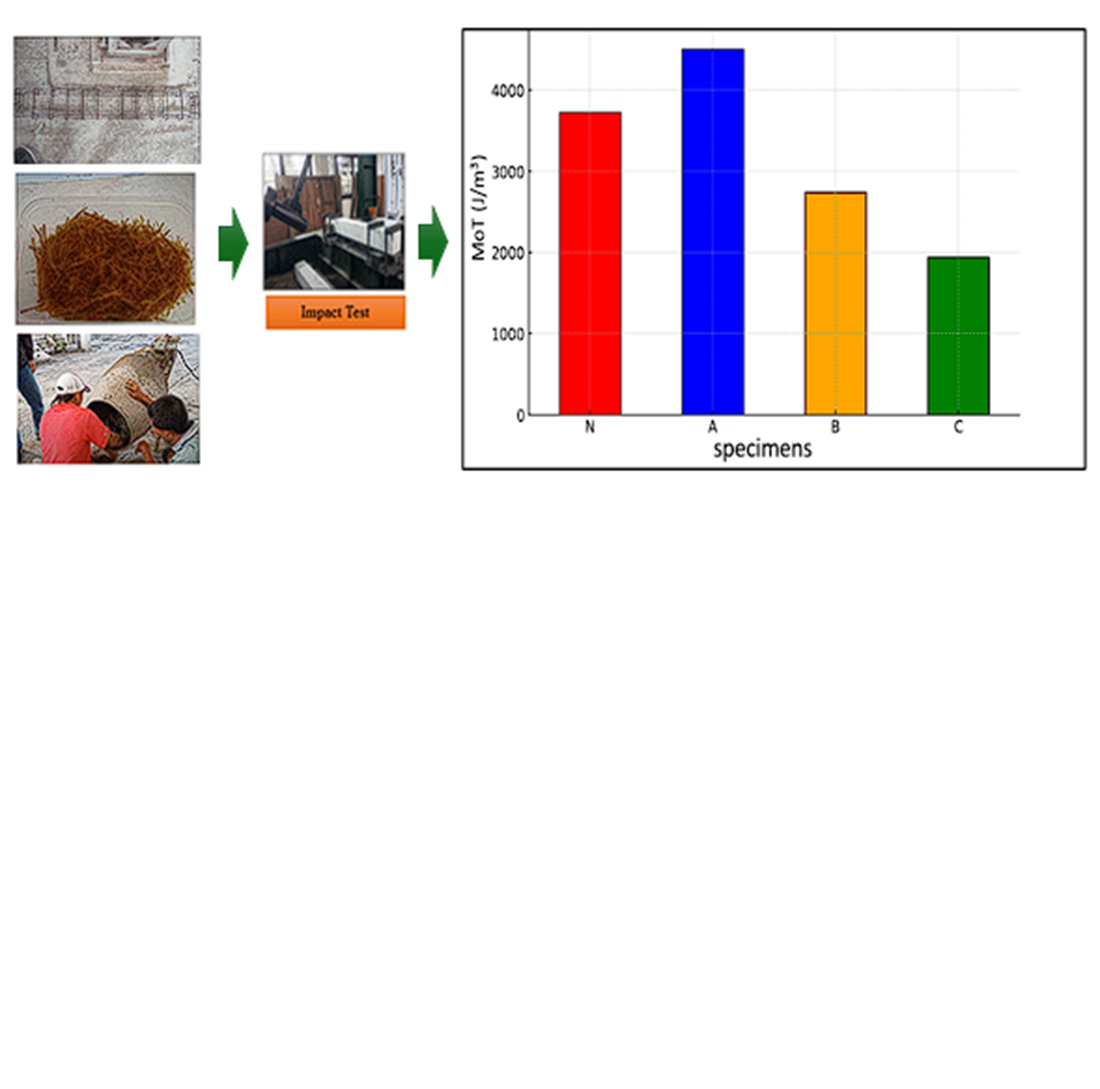
This research focuses on the impact resistance of reinforced concrete enhanced with bamboo fibers, aiming to evaluate the influence of varying bamboo fiber content on impact energy, deflection, and impact force. Reinforced concrete beams were prepared with bamboo fiber contents of 1.25%, 2.5%, and 3.75%, representing a range of low to high volume fractions. The primary objective was to examine how bamboo fiber addition improves the concrete’s mechanical performance under repeated impact loads and to determine the optimal fiber dosage for structural efficiency. The results indicate that the incorporation of bamboo fibers significantly reduces both maximum deflection and peak impact force. Notably, the 1.25% fiber content exhibited the highest increase in the Toughness Modulus (MoT), reflecting superior energy absorption capacity. Conversely, higher fiber contents (2.5% and 3.75%) led to a noticeable decline in MoT values, likely due to poor fiber dispersion and agglomeration effects. Graphical analysis of polynomial regression curves revealed that although bamboo fiber generally enhances energy absorption, each energy parameter exhibits a different trend. Released energy shows a moderately increasing trend with higher fiber content, but with high variability at elevated percentages, indicating inconsistency. Absorbed energy displays minor and inconsistent fluctuations across all fiber contents, suggesting limited fiber influence. In contrast, deformation energy peaked at 1.25% fiber content and declined sharply beyond 2.5%, implying that excessive fiber reduces the material’s deformation ability. These findings confirm that bamboo fibers are a viable, sustainable additive to improve the impact resistance of concrete
References
- Kazemi, M. T., Golsorkhtabar, H., Beygi, M. H. A., Gholamitabar, M. (2017). Fracture properties of steel fiber reinforced high strength concrete using work of fracture and size effect methods. Construction and Building Materials, 142, 482–489. https://doi.org/10.1016/j.conbuildmat.2017.03.089
- Dewi, S. M., Wijaya, M. N., N., C. R. (2017). The use of bamboo fiber in reinforced concrete beam to reduce crack. AIP Conference Proceedings. https://doi.org/10.1063/1.5003486
- Imbeau, P. (2012). Response of reinforced concrete columns subjected to impact loading. University of Ottawa. Available at: https://ruor.uottawa.ca/items/a8bc0aa4-3c8b-4d33-b657-2a6e3ec86a72
- Pham, T. M., Hao, H. (2016). Prediction of the impact force on reinforced concrete beams from a drop weight. Advances in Structural Engineering, 19 (11), 1710–1722. https://doi.org/10.1177/1369433216649384
- Li, X., Ashraf, M., Li, H., Zheng, X., Wang, H., Al-Deen, S., Hazell, P. J. (2019). An experimental investigation on Parallel Bamboo Strand Lumber specimens under quasi static and impact loading. Construction and Building Materials, 228, 116724. https://doi.org/10.1016/j.conbuildmat.2019.116724
- Bala, A., Gupta, S., Paradeshi, K. P., Dash, A. K. (2020). Behavior of bamboo wall panel under bullet impact load. Materials Today: Proceedings, 32, 904–909. https://doi.org/10.1016/j.matpr.2020.04.673
- Ramaswamy, H. S., Ahuja, B. M., Krishnamoorthy, S. (1983). Behaviour of concrete reinforced with jute, coir and bamboo fibres. International Journal of Cement Composites and Lightweight Concrete, 5 (1), 3–13. https://doi.org/10.1016/0262-5075(83)90044-1
- Zhang, X., Hao, H., Li, C. (2016). Experimental investigation of the response of precast segmental columns subjected to impact loading. International Journal of Impact Engineering, 95, 105–124. https://doi.org/10.1016/j.ijimpeng.2016.05.005
- Zhou, Y., Yang, J., Luo, X., Hwang, H.-J., Chen, H., Sun, J. et al. (2022). Pendulum impact loading tests of precast concrete columns with various column base connections. Engineering Structures, 252, 113736. https://doi.org/10.1016/j.engstruct.2021.113736
- Kim, Y., Oh, H. (2021). Comparison between Multiple Regression Analysis, Polynomial Regression Analysis, and an Artificial Neural Network for Tensile Strength Prediction of BFRP and GFRP. Materials, 14 (17), 4861. https://doi.org/10.3390/ma14174861
- Chen, B. C., Zou, M., Liu, G. M., Song, J. F., Wang, H. X. (2018). Experimental study on energy absorption of bionic tubes inspired by bamboo structures under axial crushing. International Journal of Impact Engineering, 115, 48–57. https://doi.org/10.1016/j.ijimpeng.2018.01.005
Downloads
Published
How to Cite
Issue
Section
License
Copyright (c) 2025 Vega Aditama, Sri Murni Dewi, Ari Wibowo, Ming Narto Wijaya

This work is licensed under a Creative Commons Attribution 4.0 International License.
The consolidation and conditions for the transfer of copyright (identification of authorship) is carried out in the License Agreement. In particular, the authors reserve the right to the authorship of their manuscript and transfer the first publication of this work to the journal under the terms of the Creative Commons CC BY license. At the same time, they have the right to conclude on their own additional agreements concerning the non-exclusive distribution of the work in the form in which it was published by this journal, but provided that the link to the first publication of the article in this journal is preserved.
A license agreement is a document in which the author warrants that he/she owns all copyright for the work (manuscript, article, etc.).
The authors, signing the License Agreement with TECHNOLOGY CENTER PC, have all rights to the further use of their work, provided that they link to our edition in which the work was published.
According to the terms of the License Agreement, the Publisher TECHNOLOGY CENTER PC does not take away your copyrights and receives permission from the authors to use and dissemination of the publication through the world's scientific resources (own electronic resources, scientometric databases, repositories, libraries, etc.).
In the absence of a signed License Agreement or in the absence of this agreement of identifiers allowing to identify the identity of the author, the editors have no right to work with the manuscript.
It is important to remember that there is another type of agreement between authors and publishers – when copyright is transferred from the authors to the publisher. In this case, the authors lose ownership of their work and may not use it in any way.







