Development of technology for producing juices from pumpkin, persimmon, and rosehip considering various extraction methods
DOI:
https://doi.org/10.15587/1729-4061.2025.324425Keywords:
juice extraction, heat treatment, waste recycling, bioactive components, natural dyesAbstract
The object of this study is the process of producing juice from pumpkin, persimmon, and rose hips. The task was to obtain a high yield of juice, while maintaining antioxidant properties and long-term storage.
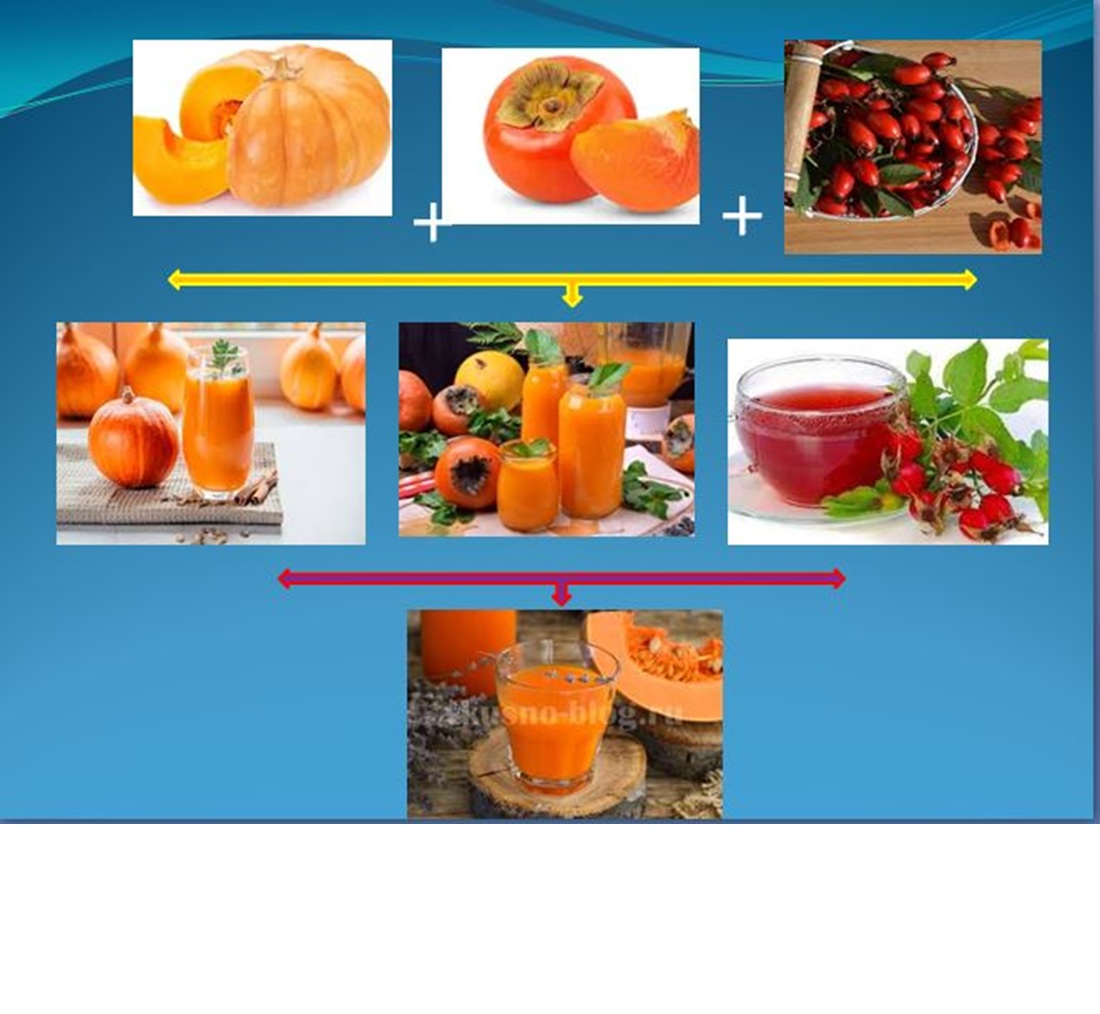
During the experiment, it was found that heat treatment significantly increases the yield of juice and its quality indicators. Thus, with heat treatment, the yield of pumpkin juice increased to 55.4 %, while without heat treatment it was 41.6 %. Similar results were obtained for persimmon, with the juice yield increased from 64.1 % to 74.1 %. Juice from rose hips was not extracted at all without heat treatment, but with treatment, the yield was 42 %. The content of bioactive substances such as β-carotene, vitamin C, and total sugar was also recorded, which confirms the effectiveness of heat treatment for increasing the nutritional value of juices. A process flow chart for producing juices with pulp from pumpkin and rose hips, clarified juice from persimmons, and blended juice from pumpkin, persimmon, and rose hips in a ratio of 50:30:20 has been constructed. The results of the study show that scalding fruits and berries in rapidly boiling water with periodic stirring for 3–5 minutes gives a high juice yield and maximally preserves the nutritional properties of the final product.
An additional finding of this study relates to the use of pumpkin waste to obtain natural dyes, which opens up new opportunities for the use of environmentally friendly substances in the food industry.
The results of this work can be used in the production of natural juices, as well as in the development of environmentally friendly natural dyes for food products. These technologies can be implemented at small and large processing plants focused on making environmentally friendly and nutritious products
References
- Nabiyev, A., Kazimova, I., Kazimova, İ., Gasimova, A., Nasrullayeva, G., Yusifova, M. (2023). Assessment of quality indicators in the technology of blended juices from the fruits and berries of pumpkin, quince, rose hips, and persimmon. Eastern-European Journal of Enterprise Technologies, 5 (11 (125)), 67–75. https://doi.org/10.15587/1729-4061.2023.289778
- Demir, N., Yildiz, O., Alpaslan, M., Hayaloglu, A. A. (2014). Evaluation of volatiles, phenolic compounds and antioxidant activities of rose hip (Rosa L.) fruits in Turkey. LWT - Food Science and Technology, 57 (1), 126–133. https://doi.org/10.1016/j.lwt.2013.12.038
- Fataliyev, H., Isgandarova, S., Gadimova, N., Mammadova, A., Ismailov, M., Mammadzade, M. (2024). Identification of the effect of ripening conditions on the yield of rose hips and their processed products. Technology and Equipment of Food Production, 4 (11 (130)), 26–35. https://doi.org/10.15587/1729-4061.2024.309597
- Szentmihályi, K., Vinkler, P., Lakatos, B., Illés, V., Then, M. (2002). Rose hip (Rosa canina L.) oil obtained from waste hip seeds by different extraction methods. Bioresource Technology, 82 (2), 195–201. https://doi.org/10.1016/s0960-8524(01)00161-4
- Chomanov, U. C., Zhumaliyeva, G. Y., Aktokalova, G. S., Zhumaliyeva, G. T., Muratkhanov, D. B., Idayatova, M. A. (2023). Production of Nutrient-Rich Watermelon-Based Juices. Hranenie i Pererabotka Sel'hozsyr'ya, 4, 32–44. https://doi.org/10.36107/spfp.2023.4.408
- Elmastaş, M., Demir, A., Genç, N., Dölek, Ü., Güneş, M. (2017). Changes in flavonoid and phenolic acid contents in some Rosa species during ripening. Food Chemistry, 235, 154–159. https://doi.org/10.1016/j.foodchem.2017.05.004
- Liubych, V., Novikov, V., Pushka, O., Pushka, I., Cherchel, V., Kyrpa, M. et al. (2023). Development of wheat bread recipe with pumpkin paste. Eastern-European Journal of Enterprise Technologies, 1 (11 (121)), 60–68. https://doi.org/10.15587/1729-4061.2023.274259
- Omarov, Y., Gurbanova, S., Babayeva, U., Gasimova, A., Heydarov, E., Gasimova, G., Nabiyev, A. (2023). Improving the storage technology of persimmon fruit (Diospyros kaki L.) In the refrigeration chamber. Eastern-European Journal of Enterprise Technologies, 4 (11 (124)), 20–36. https://doi.org/10.15587/1729-4061.2023.285444
- Mikayilov, V., Omarova, E., Kazimova, İ., Aliyeva, J., Fatma, A., Gasimova, A., Nabiyev, A. (2024). Development of technology for obtaining juice from persimmon fruit (Diospyros kaki L.). Eastern-European Journal of Enterprise Technologies, 2 (11 (128)), 34–45. https://doi.org/10.15587/1729-4061.2024.302282
- Li, K., Yao, F., Du, J., Deng, X., Li, C. (2018). Persimmon Tannin Decreased the Glycemic Response through Decreasing the Digestibility of Starch and Inhibiting α-Amylase, α-Glucosidase, and Intestinal Glucose Uptake. Journal of Agricultural and Food Chemistry, 66 (7), 1629–1637. https://doi.org/10.1021/acs.jafc.7b05833
- Nəbiyev, Ə. Ə., Cəfərova, S. F., İsgəndərova, T. H. (2017). Bitkilər aləminin ekoloji problemləri, səmərəli istifadəsi və mühafizəsi. Bakı, 442.
- Mikayılov, V. Ş., Fərzəliyev, E. B. (2018). Qida məhsullarının ümumi texnologiyası. Bakı, 830.
- Shevchenko, A., Litvynchuk, S., Drobot, V., Shevchenko, O. (2023). Influence of pumpkin cellulose on conformational transformations in the structure of dough and bread from wheat flour. Ukrainian Food Journal, 12 (1), 38–50. https://doi.org/10.24263/2304-974x-2023-12-1-5
- Kanakis, C. D., Tarantilis, P. A., Polissiou, M. G., Diamantoglou, S., Tajmir-Riahi, H. A. (2005). DNA Interaction with Naturally Occurring Antioxidant Flavonoids Quercetin, Kaempferol, and Delphinidin. Journal of Biomolecular Structure and Dynamics, 22 (6), 719–724. https://doi.org/10.1080/07391102.2005.10507038
- Duru, N., Karadeniz, F., Erge, H. S. (2011). Changes in Bioactive Compounds, Antioxidant Activity and HMF Formation in Rosehip Nectars During Storage. Food and Bioprocess Technology, 5 (7), 2899–2907. https://doi.org/10.1007/s11947-011-0657-9
- Tardugno, R., Gervasi, T., Nava, V., Cammilleri, G., Ferrantelli, V., Cicero, N. (2021). Nutritional and mineral composition of persimmon fruits (Diospyros kaki L.) from Central and Southern Italy. Natural Product Research, 36 (20), 5168–5173. https://doi.org/10.1080/14786419.2021.1921768
- Hasil, Y. (2004). Enstrumental qida analizleri. Türkiye: İzmir, 141.
- Gerzhikovoy, V. G. (2009). Metody tehnohimicheskogo kontrolya v vinodelii. Simferopol': Tavrida, 304.
- Flamini, R., Traldi, P. (2009). Mass Spectrometry in Grape and Wine Chemistry. John Wiley & Sons. https://doi.org/10.1002/9780470552926
- Mikailov, V. Sh. (2012). Degustaciya produktov pitaniya. Baku: Kooperativnoe izdatel'stvo, 384.
- Tagiev, M. M., Bagirova, M. V. (2012). Perspektivy proizvodstva sokov lechebno-profilakticheskogo naznacheniya iz dikorosov. Pivo i napitki, 2.
- Nazarova, F. Sh., Dzhumanova, N. E. (2021). Ispol'zovanie bentonita Azkamarskogo mestorozhdeniya dlya balansirovaniya mineral'nogo pitaniya. Academic research in educational sciences, 2 (9), 672–679.
- GOST 32102-2013. Konservy. Produkciya sokovaya. Soki fruktovye koncentrirovannye.
Downloads
Published
How to Cite
Issue
Section
License
Copyright (c) 2025 Ahad Nabiyev, Inara Kazimova, İlhama Kazimova, Afet Gasimova, Mehriban Yusifova, Gunash Nasrullayeva

This work is licensed under a Creative Commons Attribution 4.0 International License.
The consolidation and conditions for the transfer of copyright (identification of authorship) is carried out in the License Agreement. In particular, the authors reserve the right to the authorship of their manuscript and transfer the first publication of this work to the journal under the terms of the Creative Commons CC BY license. At the same time, they have the right to conclude on their own additional agreements concerning the non-exclusive distribution of the work in the form in which it was published by this journal, but provided that the link to the first publication of the article in this journal is preserved.
A license agreement is a document in which the author warrants that he/she owns all copyright for the work (manuscript, article, etc.).
The authors, signing the License Agreement with TECHNOLOGY CENTER PC, have all rights to the further use of their work, provided that they link to our edition in which the work was published.
According to the terms of the License Agreement, the Publisher TECHNOLOGY CENTER PC does not take away your copyrights and receives permission from the authors to use and dissemination of the publication through the world's scientific resources (own electronic resources, scientometric databases, repositories, libraries, etc.).
In the absence of a signed License Agreement or in the absence of this agreement of identifiers allowing to identify the identity of the author, the editors have no right to work with the manuscript.
It is important to remember that there is another type of agreement between authors and publishers – when copyright is transferred from the authors to the publisher. In this case, the authors lose ownership of their work and may not use it in any way.








