Оцінка тримкості литої смуги для охорони підготовчої гірничої виробки
DOI:
https://doi.org/10.15587/1729-4061.2025.324548Ключові слова:
підготовча виробка, лита смуга, тримкість охоронної споруди, деформаційні властивості, безпека праціАнотація
Об’єктом дослідження є деформаційні процеси охоронної споруди підготовчої виробки, підтримуваної у виробленому просторі виїмкової ділянки. Вирішувалася проблема забезпечення стійкості підготовчої виробки у глибокій вугільній шахті для підвищення безпеки праці гірників та вуглевидобутку. Обґрунтовано оцінку тримкості литої смуги для охорони підготовчих виробок на виїмкових ділянках.
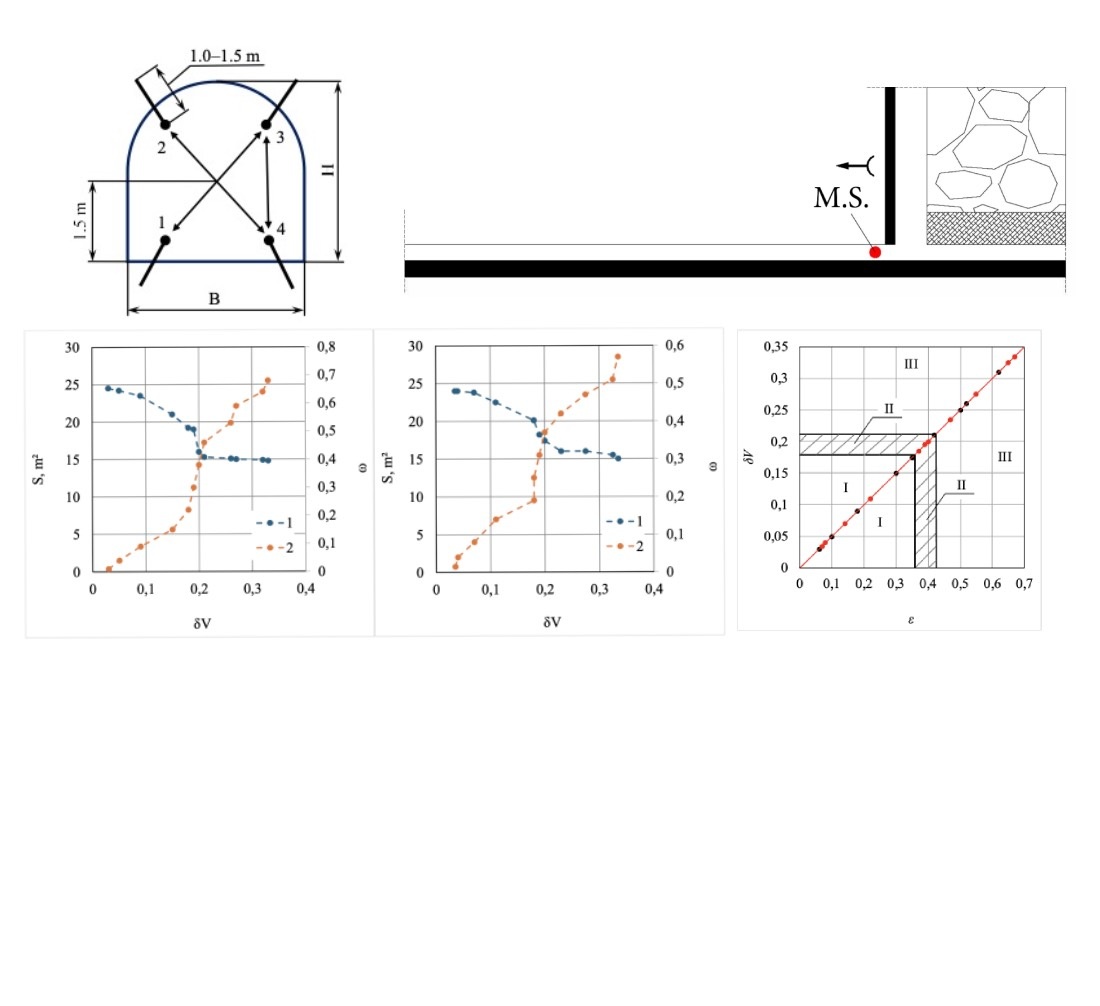
Експериментально встановлено, що у зоні активного впливу гірничого тиску на ділянці 0<l<50 м позаду очисного вибою між протяжністю виробки l (м) та відносною зміною об’єму dV охоронної споруди є експоненційна залежність. Вона характеризує безпечний деформаційний ресурс литої смуги. В його межах відбувається процес набору міцності охоронної споруди. При dV<0.18 і частоті відмов аркового піддатливого кріплення ω<0.2, втрати площі поперечного перетину виробки не перевищують 20 %. В умовах, коли dV£0.22, відбувається зростання опірності охоронної споруди, що дозволяє обмежити переміщення бічних порід на контурі виробки, забезпечити її габаритні розміри. У випадках, коли dV>0.22, а 0.22<ω<0.68, втрати площі поперечного перетину складають понад 40 %. На відстані l>80 м позаду очисного вибою рівень загрози обвалень покрівлі наближається до критичного стану, що пов’язано з неконтрольованим приростом зміщень бічних порід внаслідок втрати тримкості литої смуги.
Лита смуга виконує функції тримальної конструкції лише в певному діапазоні фізико-механічних та деформаційних властивостей.
Експлуатаційний стан підготовчої виробки забезпечується в межах деформаційного ресурсу литої смуги. Після досягнення номінальної міцності литої смуги її тримкість дозволяє обмежити переміщення бічних порід на контурі виробки та забезпечити її стійкість на відстані l£80 м по довжині виїмкової ділянки
Посилання
- Lozynskyi, V., Medianyk, V., Saik, P., Rysbekov, K., Demydov, M. (2020). Multivariance solutions for designing new levels of coal mines. Rudarsko-Geološko-Naftni Zbornik, 35 (2), 23–31. https://doi.org/10.17794/rgn.2020.2.3 3
- Salieiev, I. A., Bondarenko, V. I., Symanovych, H. A., Kovalevska, I. A. (2021). Development of a methodology for assessing the expediency of mine workings decommissioning based on the geomechanical factor. Naukovyi Visnyk Natsionalnoho Hirnychoho Universytetu, 4, 10–16. https://doi.org/10.33271/nvngu/2021-4/010
- Yalanskiy, A. O., Slashchov, І. M., Slashchova, O. A., Seleznov, A. M., Arestov, V. V. (2018). Development of new auxiliary measures for protecting preparatory roadways by the cast strips. Geo-Technical Mechanics, 141, 3–17. https://doi.org/10.15407/geotm2018.141.003
- Wang, M., Wang, W., Xu, Y., Xie, G., Qin, J., Liu, H. et al. (2024). Study on the new layout pattern about the gob‐side entry under dynamic pressure and its surrounding rock stability control. Energy Science & Engineering, 12 (4), 1389–1410. https://doi.org/10.1002/ese3.1667
- Li, J., Yin, Z. Q., Li, Y., Li, C. M. (2019). Waste rock filling in fully mechanized coal mining for goaf-side entry retaining in thin coal seam. Arabian Journal of Geosciences, 12 (16). https://doi.org/10.1007/s12517-019-4650-3
- Tripolski, V. N., Buryak, N. A., Vojtovich, Т. G. (2018). Technological schemes for supporting reused gate roads by the cast strips. Geo-Technical Mechanics, 140, 13–22. https://doi.org/10.15407/geotm2018.03.013
- Bondarenko, V. I., Buzylo, V. I., Tabachenko, M. M., Medianyk, V. Yu. (2010). Heomekhanichni osnovy pidvyshchennia stiykosti pidhotovchykh vyrobok. Dnipropetrovsk: DVNZ «Natsionalnyi hirnychyi universytet», 408.
- Baysarov, L. V., Il'yatov, M. A., Demchenko, A. I. (2005). Geomehanika i tehnologiya podderzhaniya povtorno ispol'zuemyh gornyh vyrabotok. Dnepropetrovsk: ChP «Lira», 240.
- Bondarenko, V., Symanovych, H., Kovalevska, I., Chervatiuk, V. (2018). Maintenance of reusable mine workings during the augering mining of coal seams. E3S Web of Conferences, 60, 00001. https://doi.org/10.1051/e3sconf/20186000001
- Sergienko, V. N., Kozhushok, O. D., Prohorec, L. V. (2006). Kompleksnye issledovaniya deformacionno-prochnostnyh svoystv tverdeyuschih materialov dlya lityh polos. Geo-Technical Mechanics, 66, 96–102. Available at: http://geotm.dp.ua/attachments/article/7442/97-103.pdf
- Xie, S., Wang, E., Chen, D., Li, H., Jiang, Z., Yang, H. (2022). Stability analysis and control technology of gob-side entry retaining with double roadways by filling with high-water material in gently inclined coal seam. International Journal of Coal Science & Technology, 9 (1). https://doi.org/10.1007/s40789-022-00524-x
- Chang, Q., Tang, W., Xu, Y., Zhou, H. (2018). Research on the width of filling body in gob-side entry retaining with high-water materials. International Journal of Mining Science and Technology, 28 (3), 519–524. https://doi.org/10.1016/j.ijmst.2017.12.016
- Pu, S., Wu, G., Liu, Q., Wang, Y., Li, Q., Xiong, Y. (2022). Determination of Reasonable Width of Filling Body for Gob-Side Entry Retaining in Mining Face with Large Cutting Height. Geofluids, 2022, 1–11. https://doi.org/10.1155/2022/1774110
- Li, H., Zu, H., Zhang, K., Qian, J. (2022). Study on Filling Support Design and Ground Pressure Monitoring Scheme for Gob-Side Entry Retention by Roof Cutting and Pressure Relief in High-Gas Thin Coal Seam. International Journal of Environmental Research and Public Health, 19 (7), 3913. https://doi.org/10.3390/ijerph19073913
- Krus, Yu. O. (2000). Praktychnyi metod vyznachennia malotsyklovoi vtomlenosti betonu pry stysku. Beton i zhelezobeton v Ukrayne, 4, 10–17.
- Halimendik, Yu. M., Bruy, A. V. (2013). Vliyanie otpora krepi na sostoyanie vyrabotok pri ih povtornom ispol'zovanii. Naukovi pratsi UkrNDMI NAN Ukrainy, 13 (1), 31–44.
- Volkov, S., Boichenko, H. (2023). Assessment of the stability of mine haulage drift using statistical analysis of arch yielding support failure. Journal of Donetsk Mining Institute, 1, 16–28. https://doi.org/10.31474/1999-981x-2023-1-16-28
- Galvin, J. M. (2016). Ground Engineering - Principles and Practices for Underground Coal Mining. Springer International Publishing. https://doi.org/10.1007/978-3-319-25005-2
- Chepiga, D., Podkopaiev, S., Shashenko, O., Skobenko, O., Demchenko, O., Podkopayev, Y. et al. (2024). Determining the stability of roll-back stretches in steep layers when unloading a coal rock massif. Eastern-European Journal of Enterprise Technologies, 6 (1 (132)), 41–49. https://doi.org/10.15587/1729-4061.2024.314842
- Chepiga, D., Podkopaiev, S., Gogo, V., Shashenko, O., Skobenko, O., Demchenko, O., Podkopayev, Y. (2024). Dualistic effect of the deformation of protective structures made of broken rock in mine workings under static load. Mining of Mineral Deposits, 18 (2), 122–131. https://doi.org/10.33271/mining18.02.122
- Iordanov, I., Buleha, I., Bachurina, Y., Boichenko, H., Dovgal, V., Kayun, O., Kohtieva, O., Podkopayev, Y. (2021). Experimental research on the haulage drifts stability in steeply dipping seams. Mining of Mineral Deposits, 15 (4), 56–67. https://doi.org/10.33271/mining15.04.056
- Chatfield, C., Xing, H. (2019). The Analysis of Time Series. Chapman and Hall/CRC. https://doi.org/10.1201/9781351259446
- Dekking, F. M., Kraaikamp, C., Lopuhaä, H. P., Meester, L. E. (2005). A Modern Introduction to Probability and Statistics. In Springer Texts in Statistics. Springer London. https://doi.org/10.1007/1-84628-168-7
- Yeremenko, V. S., Kuts, Yu. V., Mokiychuk, V. M., Samoilichenko, O. V. (2013). Statystychnyi analiz danykh vymiriuvan. Kyiv: NAU, 320.
- Bakhrushyn, V. Ye. (2011). Metody analizu danykh. Zaporizhzhia: KPU, 268.
##submission.downloads##
Опубліковано
Як цитувати
Номер
Розділ
Ліцензія
Авторське право (c) 2025 Daria Chepiga, Danylo Polii, Serhii Podkopaiev, Leonid Bachurin, Anatolii Bielikov, Ihor Slashchov, Yevgen Podkopayev, Olena Visyn, Valentyna Fedorchuk-Moroz

Ця робота ліцензується відповідно до Creative Commons Attribution 4.0 International License.
Закріплення та умови передачі авторських прав (ідентифікація авторства) здійснюється у Ліцензійному договорі. Зокрема, автори залишають за собою право на авторство свого рукопису та передають журналу право першої публікації цієї роботи на умовах ліцензії Creative Commons CC BY. При цьому вони мають право укладати самостійно додаткові угоди, що стосуються неексклюзивного поширення роботи у тому вигляді, в якому вона була опублікована цим журналом, але за умови збереження посилання на першу публікацію статті в цьому журналі.
Ліцензійний договір – це документ, в якому автор гарантує, що володіє усіма авторськими правами на твір (рукопис, статтю, тощо).
Автори, підписуючи Ліцензійний договір з ПП «ТЕХНОЛОГІЧНИЙ ЦЕНТР», мають усі права на подальше використання свого твору за умови посилання на наше видання, в якому твір опублікований. Відповідно до умов Ліцензійного договору, Видавець ПП «ТЕХНОЛОГІЧНИЙ ЦЕНТР» не забирає ваші авторські права та отримує від авторів дозвіл на використання та розповсюдження публікації через світові наукові ресурси (власні електронні ресурси, наукометричні бази даних, репозитарії, бібліотеки тощо).
За відсутності підписаного Ліцензійного договору або за відсутністю вказаних в цьому договорі ідентифікаторів, що дають змогу ідентифікувати особу автора, редакція не має права працювати з рукописом.
Важливо пам’ятати, що існує і інший тип угоди між авторами та видавцями – коли авторські права передаються від авторів до видавця. В такому разі автори втрачають права власності на свій твір та не можуть його використовувати в будь-який спосіб.