Визначення впливу аерації на товарні та сенсорні показники мусів при виробництві у закладах HoReCa
DOI:
https://doi.org/10.15587/1729-4061.2025.325105Ключові слова:
аеровані десерти, маркетингове дослідження, мікробіологічні, сенсорні та товарні показники, антиоксидантна активністьАнотація
Об’єктом дослідження є технологія аерованих десертів типу мус.
Існує проблема здоров’я населення та забезпечення продуктами харчування, що гарантують підвищення життєвого рівня. Аналіз ринку десертної продукції з піноподібною структурою, показав, що цей сегмент представлений досить вузьким асортиментом. Серед виробників та споживачів зацікавленість до солодких страв типу аеровані десерти зростає. Рослинна та молочна сировина, що застосовується в технології аерованих десертів, в основному спрямована на покращення їхніх якісних властивостей.
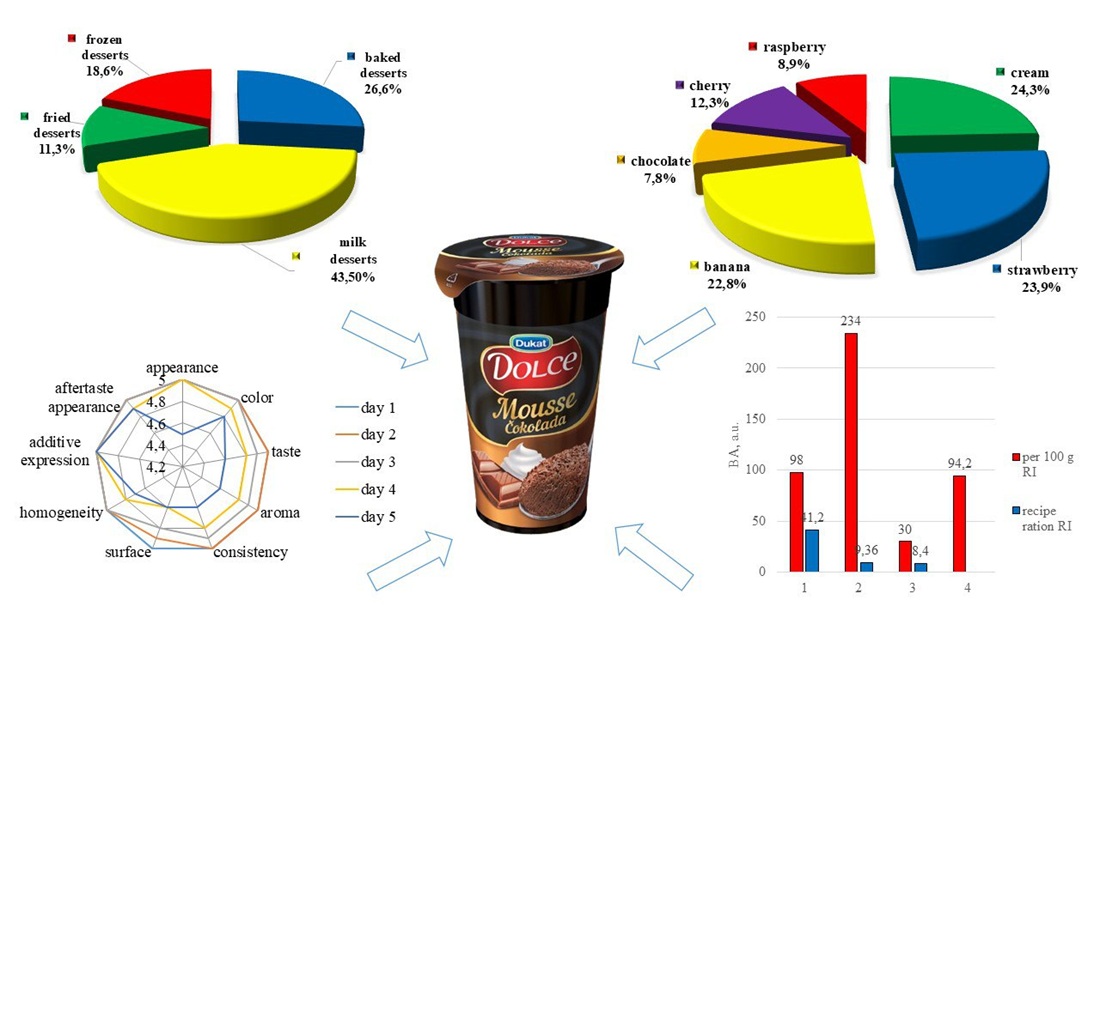
Проведено опитування серед 54 осіб щодо споживання солодкої групи страв, а саме аерованих десертів типу мус. Розроблено рецептури мусів з високим вмістом поживних речовин, що покривають добову норму споживання та які мають у своєму складі рецептурні інгредієнти, що володіють високою біологічною активністю. Проведено дослідження щодо визначення показників якості розроблених мусів, а саме сенсорних, у якому приймало участь 50 дегустаторів. Встановлено оптимальний та безпечний термін зберігання мусів, який становить для НоReCa – не більш ніж 2 доби, t=(0–4) ºС; не більш ніж 1 доба, t=(8±2) ºС; для промислових виробництв – не більш ніж 5 діб, t=(0–4) ºС; не більш ніж 3 доби, t=(8±2) ºС. Проведення сенсорного аналізу показало, що муси впродовж зберігання значно не змінились. Дані розроблені муси можуть реалізовуватись як через НоReCa, так і через промислові виробництва.
Отримані експериментальні дані можуть бути використані при оптимізації технологій виробництва аерованих десертів
Посилання
- Golubtsova, J. (2017). Development of Curd Mousse with Fruit-and-berry Builders. Journal of Pharmaceutical Sciences and Research, 9 (4), 407.
- Gomes, O. J. S., Leitão, A., Gaspar, M. C., Vitorino, C., Sousa, J. J. S., de Sousa, H. C. et al. (2024). Fortified chocolate mousse with powder and extract from Moringa oleifera leaves for nutritional value improvement. Food Chemistry, 441, 138338. https://doi.org/10.1016/j.foodchem.2023.138338
- Dzyuba, N., Oliinyk, M., Kalugina, I., Poplavska, S., Bortnykov, Y., Zakharova, S. (2023). Improving the technology of aeration of the food system of mousse at horeca enterprises. Eastern-European Journal of Enterprise Technologies, 2 (11 (122)), 74–82. https://doi.org/10.15587/1729-4061.2023.275615
- Parseh, S., Mohebbi, M., Mohammadi-Moghaddam, T., Sabbaghi, H. (2022). Optimization of Formulation for Aerated Dessert Containing Whey Protein and Xanthan Gum Concentrate using Response Surface Methodology and Investigation on Rheological and Texture Properties. Research and Innovation in Food Science and Technology, 11 (1), 1–16. http://doi.org/10.22101/JRIFST.2020.254462.1192
- Rudakova, T. V., Minorova, A. V., Narizhnyi, S. A. (2024). Sensornyi analiz strukturovanykh molochnykh desertiv z kombinovanym skladom syrovyny. Materialy VI Vseukrainskoi naukovopraktychnoi konferentsiyi. Khmelnytskyi, KhNTU, 168–171. Available at: https://rep.btsau.edu.ua/bitstream/BNAU/11693/1/sensornyy_analiz.pdf
- Analysis of the confectionery market with whipped (aerated) masses in Ukraine. 2021 year. Available at: https://pro-consulting.ua/en/issledovanie-rynka/analiz-rynka-konditerskih-izdelij-so-vzbitymi-aerirovannymi-massami-v-ukraine-2021-god
- What is aeration? Find out how to produce airy textures. Available at: https://blog.sosa.cat/en/aeration-aerated-textures/
- Desert syrkovyi Dolche yahidnyi fiuzhn 3,4%, 170h. Available at: https://shop.silpo.ua/product/desert-syrkovyi-dolche-iagidnyi-f-iuzhn-3-4-940380?gad_source=1&gclid=CjwKCAiA8sauBhB3EiwAruTRJi_eSG7KitBmGmznZvI03jDnAUJVpTR_sAgGbTSyVn55oo-n17htbhoC8SoQAvD_BwE
- Elit novynky vid «KOMO». Available at: https://www.volyn.com.ua/news/9376-elitni-novinki-vid-komo.html
- Dzyuba, N., Poplavska, S., Palvashova, A., Yemonakova, O., Ivashina, L., Kolisnichenko, T. et al. (2019). Development of a policomponent composition of smuz using biotechnological and mathematical modeling and determination of its food value. Eastern-European Journal of Enterprise Technologies, 5 (11 (101)), 56–65. https://doi.org/10.15587/1729-4061.2019.180755
- Hanieh, А., Karazhiyan, Н. (2019). The effect of substitution of egg white with licorice on some of physicochemical properties of mousse. Iranian Food Science and Technology Research Journal, 15 (1), 121–131. https://doi.org/10.22067/ifstrj.v0i0.71515
- Menéndez, M., Paredes, B., Iglesias, O., Rendueles, M., Díaz, M. (2006). Rheological Behavior and Organoleptic Effects of Ovalbumin Addition in Yogurt Mousse Production. Journal of Dairy Science, 89 (3), 951–962. https://doi.org/10.3168/jds.s0022-0302(06)72160-9
- Gomez-Betancur, A. M., Carmona-Tamayo, R., Jaimes-Jaimes, J., Casanova-Yepes, H., Torres-Oquendo, J. D. (2020). Optimisation of yogurt mousse dairy protein levels: a rheological, sensory, and microstructural study. International Food Research Journal, 27 (6), 1076–1086.
- Xavier-Santos, D., Bedani, R., Perego, P., Converti, A., Saad, S. M. I. (2019). L. acidophilus La-5, fructo-oligosaccharides and inulin may improve sensory acceptance and texture profile of a synbiotic diet mousse. LWT, 105, 329–335. https://doi.org/10.1016/j.lwt.2019.02.011
- Taghizadeh, G., Jahadi, M., Abbasi, H. (2018). Physicochemical properties of probiotic soy milk chocolate mousse during refrigerated storage. Applied Food Biotechnology, 5 (2), 79–86. https://doi.org/10.22037/afb.v5i2.19155
- Henden, Y., Gümüş, T., Kamer, D. D. A., Kaynarca, G. B., Yücel, E. (2024). Optimizing vegan frozen dessert: The impact of xanthan gum and oat-based milk substitute on rheological and sensory properties of frozen dessert. Food Chemistry, 460, 140787. https://doi.org/10.1016/j.foodchem.2024.140787
- Rudakova, T., Minorova, A., Moiseeva, L. Krushelnytska, N., Narizhnyy, S. (2023). Scientific approaches to the creation of technology structured milk desserts with a combined composition of raw materials. Animal Husbandry Products Production and Processing, 2, 128–136. https://doi.org/10.33245/2310-9289-2023-182-2-128-136
- Gomez‐Betancur, A. M., Carmona‐Tamayo, R., Martínez‐Álvarez, O. L., Casanova‐Yepes, H., Torres‐Oquendo, J. D. (2020). Effect of fat substitution using long‐chain inulin and fortification with microencapsulated calcium in the rheological and sensory properties of yogurt mousse. Journal of Food Process Engineering, 45 (7). https://doi.org/10.1111/jfpe.13433
- Donatus, F., Sintang, M. D. B., Julmohammad, N., Pindi, W., Ab Wahab, N. (2023). Physicochemical and Sensory Properties of Bahulu and Chocolate Mousse Developed from Canned Pulse and Vegetable Liquids. Applied Sciences, 13 (7), 4469. https://doi.org/10.3390/app13074469
- Kotliar, Ye., Vikul, S., Sevastyanova, E., Dets, N., Kruchek, O. (2020). Technology of a cosmetic lotion based on hydroalcoholic extract from crushed grape seeds. Scientific Works of National University of Food Technologies, 26 (5), 156–169. https://doi.org/10.24263/2225-2924-2020-26-5-20
- DSTU 4503:2005. Curd Articles. General Spesifications. Available at: https://online.budstandart.com/ua/catalog/doc-page?id_doc=84633
- DSTU 3718:2007. Food Concentrates Sweet Dishes Jellies, Mousses, Puddings, Milk Concentrates. General Specifications. Available at: https://online.budstandart.com/ua/catalog/doc-page.html?id_doc=84629
- Deputat, Y. M., Zhaldak , A. Y. (2021). Hygienic assessment of the average daily diet of the Special Operations Forces of the Armed Forces of Ukraine. Ukrainian Journal of Military Medicine, 2 (4), 60–70. https://doi.org/10.46847/ujmm.2021.4(2)-060
- Duquenne, B., Vergauwen, B., Capdepon, C., Boone, M. A., De Schryver, T., Van Hoorebeke, L. et al. (2016). Stabilising frozen dairy mousses by low molecular weight gelatin peptides. Food Hydrocolloids, 60, 317–323. https://doi.org/10.1016/j.foodhyd.2016.04.001
- Bouizar, R., Mouzai, A., Boughellout, H. (2021). Impact of milk substitution by sweet whey on chocolate mousse physicochemical, microstructural and sensory properties. Algerian Journal of Nutrition and Food Sciences, 1 (4), 17–24 Available at: https://fac.umc.edu.dz/inataa/revue/files/ajnfs0104003.pdf
- Zimbru, R.-O., Padureţ, S., Amariei, S. (2020). Physicochemical and color evaluation of confectionery mousses. Food & Environment Safety, 19 (3), 228–236. Available at: https://fens.usv.ro/index.php/FENS/article/view/732/
##submission.downloads##
Опубліковано
Як цитувати
Номер
Розділ
Ліцензія
Авторське право (c) 2025 Nadiia Dzyuba, Mariia Oliinyk, Sofiia Chernenko

Ця робота ліцензується відповідно до Creative Commons Attribution 4.0 International License.
Закріплення та умови передачі авторських прав (ідентифікація авторства) здійснюється у Ліцензійному договорі. Зокрема, автори залишають за собою право на авторство свого рукопису та передають журналу право першої публікації цієї роботи на умовах ліцензії Creative Commons CC BY. При цьому вони мають право укладати самостійно додаткові угоди, що стосуються неексклюзивного поширення роботи у тому вигляді, в якому вона була опублікована цим журналом, але за умови збереження посилання на першу публікацію статті в цьому журналі.
Ліцензійний договір – це документ, в якому автор гарантує, що володіє усіма авторськими правами на твір (рукопис, статтю, тощо).
Автори, підписуючи Ліцензійний договір з ПП «ТЕХНОЛОГІЧНИЙ ЦЕНТР», мають усі права на подальше використання свого твору за умови посилання на наше видання, в якому твір опублікований. Відповідно до умов Ліцензійного договору, Видавець ПП «ТЕХНОЛОГІЧНИЙ ЦЕНТР» не забирає ваші авторські права та отримує від авторів дозвіл на використання та розповсюдження публікації через світові наукові ресурси (власні електронні ресурси, наукометричні бази даних, репозитарії, бібліотеки тощо).
За відсутності підписаного Ліцензійного договору або за відсутністю вказаних в цьому договорі ідентифікаторів, що дають змогу ідентифікувати особу автора, редакція не має права працювати з рукописом.
Важливо пам’ятати, що існує і інший тип угоди між авторами та видавцями – коли авторські права передаються від авторів до видавця. В такому разі автори втрачають права власності на свій твір та не можуть його використовувати в будь-який спосіб.